Three weeks ago, I wrote about Kalshi's newly filed airport flight-cancellation contracts. One issue stood out.
Kalshi had designated FlightAware as the primary source for settlement. Yet FlightAware's parent company, RTX, said that FlightAware did not participate in prediction markets and did not authorize its data to be used for that purpose. I ended that article by arguing that Kalshi would need to address the FlightAware issue to avoid a potential legal dispute.
 Bennet Caldwell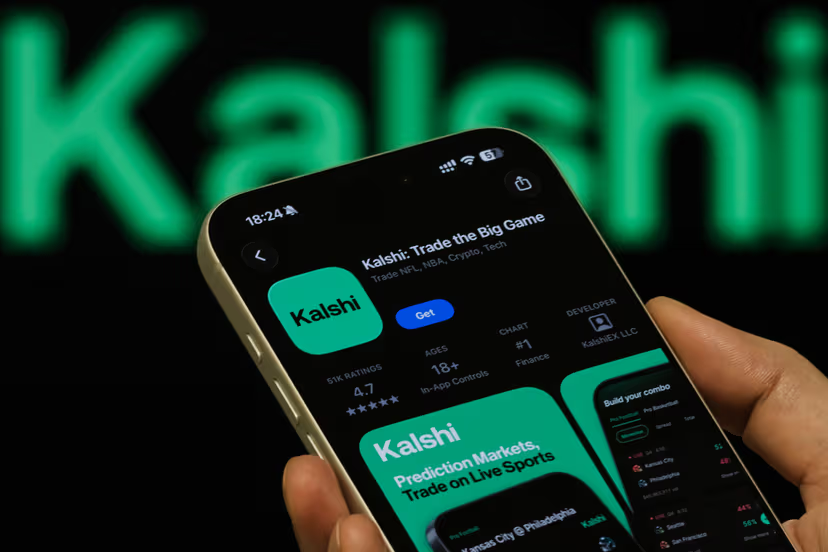
That dispute has now arrived.
On August 11, news broke that FlightAware had sued Kalshi over its use of FlightAware data and trademarks in flight-cancellation markets. The complaint was filed the previous evening, August 10, at 8:27 p.m. in the U.S. District Court for the Southern District of New York. The 45-page complaint names Kalshi Inc., KalshiEX LLC, Kalshi Klear Inc. and Kalshi Klear LLC as defendants. FlightAware also filed an emergency motion seeking court intervention.
From the complaint, FlightAware says Kalshi had opened a Personal AeroAPI account as early as July 14, 2022. It further alleges that on July 14, 2026, a Kalshi employee involved in market specifications and resolution created another FlightAware account using a Kalshi email address. FlightAware argues that these accounts were governed by its Terms of Use, Terms and Conditions and AeroAPI Personal License Agreement.
The complaint says its terms had already prohibited public or commercial use of FlightAware materials and limited free products, APIs and data to personal use. FlightAware then revised the terms on July 16 to make the point explicit, adding language prohibiting use in connection with betting, wagering, gambling, prediction markets and event contracts.
FlightAware cancelled Kalshi's Personal AeroAPI account on July 15 and sent a cease-and-desist letter. Kalshi responded on July 17 by denying that it had violated FlightAware's license or infringed its trademarks and arguing that references to FlightAware constituted nominative fair use. Kalshi subsequently added a disclaimer saying that its products had not been endorsed by FlightAware and that references to FlightAware were descriptive only.
FlightAware nevertheless proceeded to court. Its complaint contains six causes of action, including breach of contract, federal trademark infringement, injury to business reputation, federal unfair competition, unjust enrichment and New York common-law unfair competition.
It is seeking temporary, preliminary and permanent injunctive relief, damages, disgorgement of profits allegedly attributable to unauthorized use of its marks, restitution and other relief. It has also demanded a jury trial.
At this stage, none of those allegations has been proven. Kalshi will have the opportunity to answer them, and its correspondence already indicates some of the defenses it may raise.
On Tuesday, Kalshi revised how it references FlightAware, and FlightAware subsequently voluntarily dismissed the lawsuit. The dismissal could suggest that the two sides are discussing a potential resolution, although FlightAware retains the ability to bring the case again.
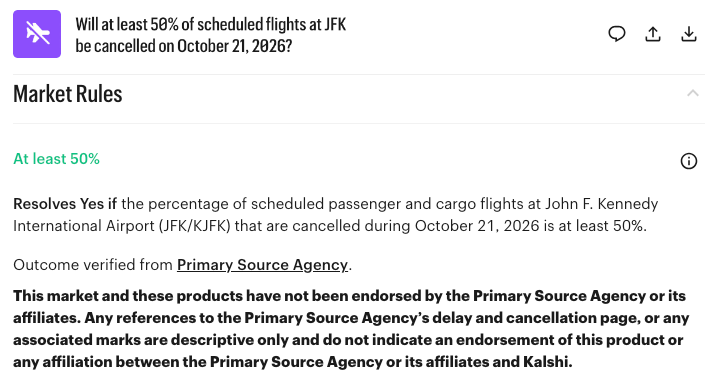
FlightAware is no longer explicitly identified in Kalshi’s flight-cancellation market rules, but the “Primary Source Agency” link still directs users to FlightAware.
This problem had already been looked at
This is not entirely new to the CFTC. In May, Cboe submitted a comment to the Commission containing an entire section titled "Source Agency Integrity and Settlement Conditions." Cboe noted that event contracts use a much wider variety of source agencies than traditional futures and argued that the Commission should provide guidance on what makes a source agency credible and reliable. It also recommended clearly specifying source agencies and what happens when settlement becomes ambiguous.
Then, on July 24, the CFTC's Division of Market Oversight issued Advisory Letter 26-22. In discussing settlement sources, the staff said DCMs should consider not only manipulation and reliability, but also the commercial acceptability, public availability and timeliness of the series used for cash settlement. "Commercial acceptability" suddenly looks much more important after FlightAware's complaint.
There is an even more interesting piece of evidence. In its own April 30 comment to the CFTC, Kalshi argued that robust event-contract resolution should include primary sources, secondary sources and fallback procedures that address source-agency failure and revisions. Kalshi further suggested the use of multiple independent Source Agencies so that no single provider becomes a point of failure, and said resolution should be structured around official, audited or widely observed data rather than proprietary or easily manipulated sources.
That principle is difficult to disagree with. FlightAware demonstrates why.
But is BTS really a fallback?
Kalshi's airport cancellation rules state that the contract switches to the U.S. Department of Transportation's Bureau of Transportation Statistics, or BTS, if FlightAware is unavailable or does not publish a usable figure.
The problem is that BTS is not a real-time flight-status service. Its Airline On-Time Performance database is a monthly dataset based on reports submitted by covered U.S. carriers. BTS says summary statistics and raw data are released with the monthly Air Travel Consumer Report, generally around 30 days after the end of the relevant month. More importantly, as of August 12, its public TranStats database contains data only through May 2026.
Kalshi's AIRPORTDELAY rules state that a contract must expire no later than one week after the end of the measurement period, with settlement normally occurring no later than the following day. The timing mismatch between contract settlement and public BTS data release creates doubts about how the contract will be settled.
How is this different from traditional futures?
Reliance on an outside source for settlement is not new to derivatives markets. Traditional commodity futures have done this for decades. A number of cash-settled contracts settle against price assessments produced by S&P Global Platts rather than against a price generated by the exchange itself. CME's FOB Santos Soybeans Financially Settled (Platts) Futures provides an example. The contract's final settlement is calculated using Platts price assessments, and the rulebook expressly states that the "Platts" trademarks have been licensed for use by CBOT.
This is an important distinction. Platts is a private, commercial data provider, just like FlightAware. Its assessments are not necessarily freely available to every market participant. But Platts is also explicitly in the business of producing benchmarks that financial and physical contracts can reference. S&P Global says Platts benchmarks underpin nearly 1,300 exchange-traded, cash-settled commodity futures contracts, and it maintains a dedicated function for licensing and exchange relationships.
The benchmark itself is also surrounded by an institutional framework designed for this purpose. Platts publishes detailed methodologies explaining how assessments are constructed, maintains procedures for identifying anomalous data and handling methodology changes, and reviews its methodologies at least annually.
In the case of event contracts, the organization in the middle may never have designed its product to serve as a financial benchmark. Its primary business may have little to do with derivatives markets, and it may never have agreed to assume the responsibilities that come with determining the payout of a financial contract. As event contracts become larger and more economically significant, merely identifying who reports the answer may no longer be enough. Exchanges may increasingly need to ask whether that organization has actually agreed to become part of the machinery that determines who gets paid.
Disclaimer: The content is for informational purposes only. You should not construe any such information or other material as legal, tax, investment, financial, or other advice. Nothing contained in this article constitutes a solicitation, recommendation, endorsement, or offer by the author(s) or any third party service provider to buy or sell any securities or other financial instruments in your or in any other jurisdiction in which such solicitation or offer would be unlawful under the securities laws of such jurisdiction. The author(s) report(s) no conflict of interest.