Housing starts just took a nose-dive, falling by 12.4% in July, while completions dropped 9.1%. Mortgage rates remain glued near 2026 highs, and Home Depot's comparable transactions are visibly soft.
It looks, at first glance, like the exact moment high borrowing costs finally crack the spine of the American real estate engine.
But my take is that high rates are still freezing the expensive end of housing, the moves, the additions, the gut remodels that need a lender's blessing. They haven't yet killed demand for the smaller stuff homeowners can't put off. The 30-year fixed averaged 6.67% on August 13, roughly where it's sat all summer.
Let's follow this split through three releases this week: what builders broke ground on, what they filed permits for, and what Home Depot and Lowe's said about what homeowners are actually buying.
While borrowing costs remain high, where do you expect homeowners to keep spending?
The construction print: Noise in the starts, intent in the paper
The initial headline print was an absolute horror show for the macro long thesis. Housing starts plunged 12.4% month-over-month to a seasonally adjusted annual rate of 1.239 million, missing consensus estimates of roughly 1.35 million by a mile.
Year-over-year, starts are down 13.5%. Single-family starts weakened, with a 9.9% slide in single-family breaking of ground to 808,000 units, although multifamily starts bore the brunt of the pullback, down 15.6%. Completions didn't fare any better, slipping 9.1% on the month and nearly 17% against last year’s pace.
If that were the whole tape, you'd take a much darker cyclical view of the space. But then building permits actually popped 5% in July to 1.443 million, with single-family permits ticking up 2.5% to 894,000.
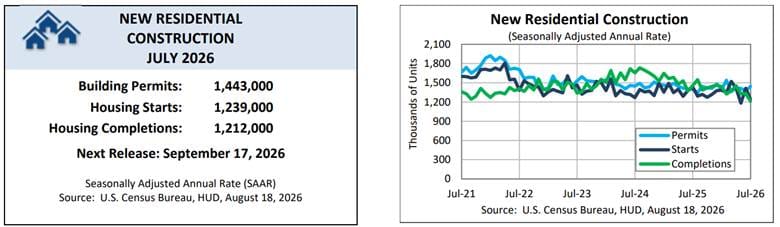
Source: Census Bureau
This looks like builders are managing risk. They are pulling back on immediate capital deployment because weak affordability and high financing costs are still choking demand. Freddie Mac's 30-year fixed mortgage was hovering around 6.4% to 6.7% through July and touched 6.67% by mid-August.
The permit rebound preserves some pipeline optionality, but one month is not enough to conclude that builders are positioning for an easing cycle.
Home Depot and Lowe's retail earnings locate the pain inside the house
If the Census Bureau's construction data tracks where new housing projects are being delayed, big-box earnings show us what homeowners are actually willing to spend out of pocket.
Home Depot delivered $47.9 billion in sales, up 5.7%, with overall comps rising 1.7%, the best print since fiscal Q3 2022, and U.S. comps up 1.3%.
However, comparable transactions slipped 1%, more than offset entirely by a 2.8% increase in average ticket size. So, traffic wasn't the hero, it was about fewer baskets, more dollars per basket. Management said customers remained engaged with smaller projects, although ticket growth alone can't tell us whether those dollars came from a busted water heater, higher prices, or product mix. Management felt confident enough in that underlying floor to maintain full-year guidance.
Lowe's offered a softer, even more revealing read-through. Comps barely scraped into positive territory at 0.2%, prompting management to cut its full-year sales outlook to $92 billion and flatten comp expectations. The culprit was persistent pressure on discretionary DIY spending. Yet, right inside this weak Lowe's report sat a massive bright spot: online sales jumped 15.7%, while management said Pro and home-services sales also grew, although it did not disclose separate growth rates for either.
Together, the results point to a split by project purpose rather than price alone. Large discretionary renovations remain pressured, while repair, maintenance and contractor demand are holding up better. Even that split is not absolute: Home Depot’s transactions above $1,000 rose 2.4%, showing that some large necessary or Pro-led purchases remain resilient.
|
Q2 FY2026
metric |
Home Depot |
Lowe’s |
|
Sales |
$47.9B |
$26.0B |
|
Comparable
sales |
+1.7% |
+0.2% |
|
Online sales |
+11.0% |
+15.7% |
|
Transactions/ticket |
Comp
transactions −1.0%; average ticket +2.8% |
Not disclosed |
|
Pro
performance |
Positive
comps; outperformed DIY |
Grew; rate
not disclosed |
|
FY2026
outlook |
Reaffirmed |
Sales cut to
$92B; comps lowered to flat |
This looks like rate drag, not a housing collapse
Pulling it all together, the thesis holds up.
A 1.7% drop in July existing-home sales and a 2.3% fall in pending sales confirm that existing-home turnover remains constrained. Limited turnover means fewer of the renovations that come attached to a move.
The permit rebound is what keeps this from a fully bearish read. Builders are filing paperwork they haven't acted on yet as starts fell, which looks like optionality more than retreat.
Yet, the aging U.S. housing stock acts as a durable maintenance floor under the sector. You can delay a move, but you can't delay entropy. The permit rebound shows builders are staging inventory for the eventual easing cycle, while non-discretionary repair demand keeps the corporate bottom line from falling off a cliff.
So, I'd treat Home Depot and Lowe's as a gauge of project mix, not a clean proxy for the homebuilding cycle. The resilience of their Pro desks and smaller-project demand means they can defend earnings even while the broader macro housing cycle sits in a rate-induced freeze.
Here’s what I would watch next
Three things to watch that will tell us whether this holds.
The cleanest test is whether August's permits and starts, due September 17, keep drifting apart or start converging. Permits ran about 16% ahead of starts in July; if this gap holds or widens, it would suggest builders are still buying optionality rather than building. Starts catching up without permits falling would say the freeze is thawing for real.
This convergence needs rates to actually move, not just hold. A soft week from Freddie Mac means little, rates touched 6% back in March and climbed back into the mid-to-high 6s by summer anyway. A sustained month below 6.5% would be different, which is why the August 26 PCE print and the Fed's September 16 decision matter more than the weekly number itself.
What’s your base case for housing through year-end?
Sources
Freddie Mac: Primary Mortgage Market Survey
Harvard Joint Center for Housing Studies: Many Owners Cannot Afford to Maintain Aging Homes
Home Depot: Second Quarter Fiscal 2026 Results
Home Depot: Q2 2026 Earnings Call Transcript
Lowe's: Second Quarter 2026 Sales and Earnings Results
National Association of REALTORS: Existing-Home Sales
Reuters: Home Depot Rides Steady Repair Demand as Housing Market Remains Subdued
Reuters: Lowe's Second-Quarter Profit Beats on Resilient Home Repair Demand
Reuters: U.S. Housing Market Remains Under Pressure in July
U.S. Census Bureau: Monthly New Residential Construction, July 2026