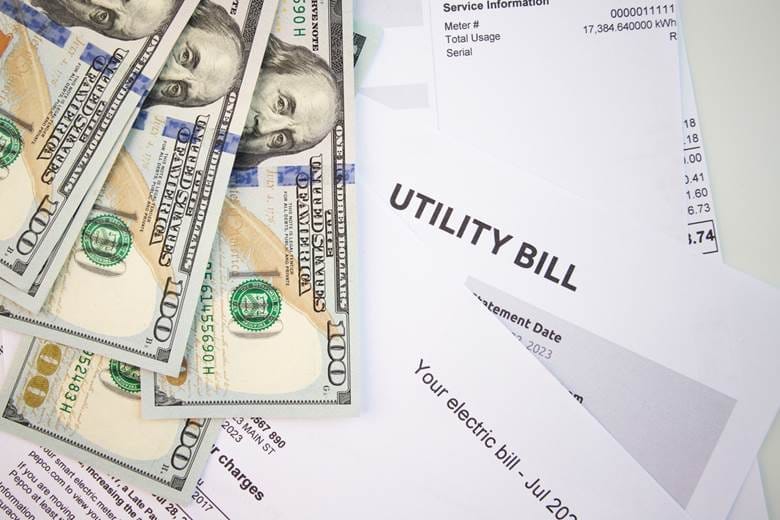
Imagine you opened your January power bill and found $281 on it. The month before, you’d paid about a hundred bucks. You’ve lived in that house nearly forty years.
This is not a made-up story, it’s what happened to John Steinbach. He lives in Virginia, where data centers took close to 40% of all the electricity the state consumed in 2024. A colder January and higher household consumption explain part of the jump.
The anecdote alone cannot isolate the effect of data centers, but it captures the question now confronting regulators across Virginia: how much of the grid expansion required by large new loads should appear on ordinary customers’ bills?
The electricity bill is the retail end of something that began in wholesale markets two years ago. Power traders and utility analysts have been repricing the AI boom since mid-2024. Equity markets caught up over the following year.
The live question now is who gets handed the invoice: the companies building the data centers, or every other customer on the grid. How that settles decides both how long the power trade runs and how much of it lands on your bill.
Has your own electricity bill jumped in the past year?
Here’s how the cost reaches you
Data centers need power, a lot of it, and they need it reliable. The kind that doesn’t blink off when the wind dies down. This has turned nuclear and gas plants from sleepy dividend stocks into AI infrastructure bets (more or less) overnight.
PJM, the grid operator covering 13 mid-Atlantic and Midwestern states, cleared capacity at $28.92 per megawatt-day for the 2024/25 delivery year, in an auction held back in December 2022. By the July 2024 auction, covering 2025/26, it had jumped nearly ninefold to $269.92. It has cleared at its administrative price cap in all three auctions since ($329.17, $333.44, $325).
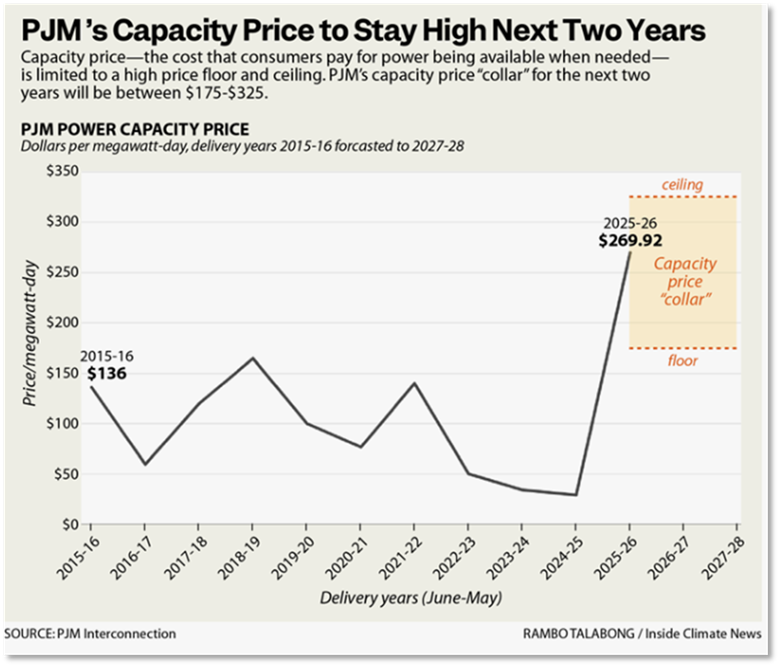
Source: PJM
PJM’s long-term load forecast projects 32 gigawatts of peak load growth between 2024 and 2030, with data centers responsible for 94% of it. In the December 2025 auction, PJM’s independent market monitor attributed $6.5 billion of the $16.4 billion cost, or 40%, to data center load, and roughly $6.2 billion of that to data centers that haven’t been built yet. This does not mean households immediately paid that entire amount, but it shows how speculative future load can affect today’s capacity procurement.
Constellation completed its approximately $21.8 billion acquisition of Calpine on January 7. Its Q1 revenue subsequently rose to $11.1 billion and GAAP net income reached $1.59 billion, although the comparison is heavily affected by the inclusion of the acquired Calpine business rather than representing purely organic growth.
Vistra reached investment grade in March, when Fitch upgraded it to BBB- citing an improved business profile and market fundamentals. The company noted the upgrade was supported by its 20-year power purchase agreements with Amazon and Meta, covering roughly 3,800 megawatts.
Much of this is already in the price. Vistra has returned roughly 670% over five years, and Constellation was trading at about 22 times forward earnings at the end of June, which is not a utility multiple.
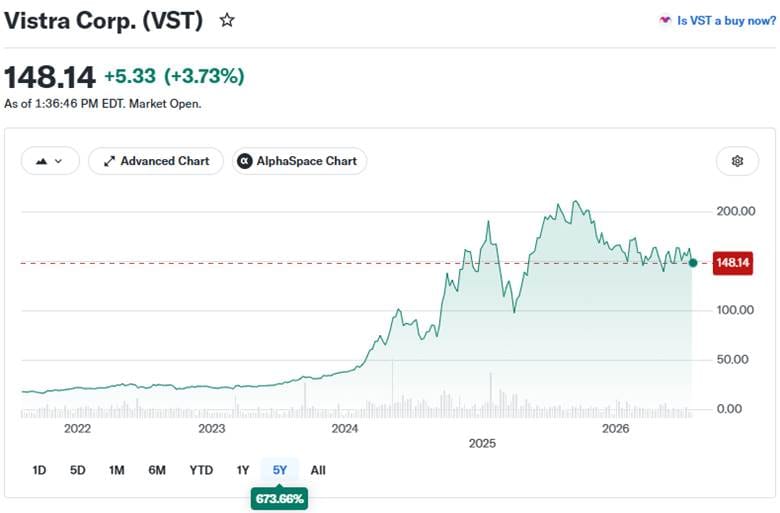
Source: Yahoo Finance - Vistra
The average bill has increased by 26% in the past five years, from $129/month in 2022 to $163/month in 2026.
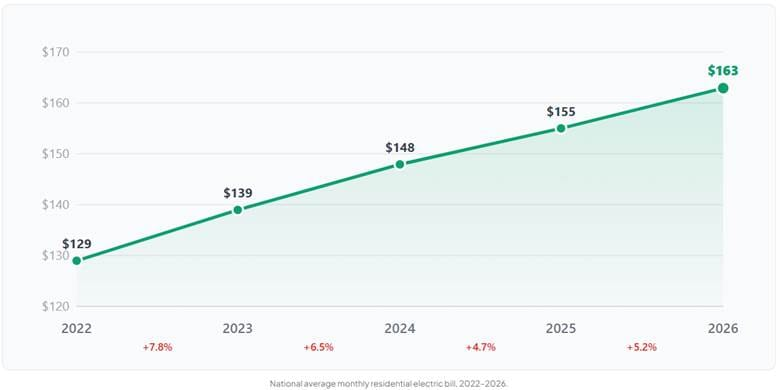
Source: Electric Choice
Nationally, residential electricity averaged 18.83 cents per kilowatt-hour in April 2026, up from 12.76 cents in 2020, a rise of nearly 50%. Goldman Sachs clocked 2025’s increase at 6.9%, more than double headline PCE inflation, and expects data centers to drive 40% of all electricity demand growth through the end of the decade.
Supply is only 30% to 50% of what a household pays, and the rest is delivery, taxes and fixed charges. Utility rates hit everyone, but at a slower and smaller price than the wholesale numbers imply.
But the data centers aren’t the only thing raising rates
Not so fast, say the skeptics, and they’ve got a few decent arguments.
First, data centers aren’t the only villain. A lot of the price pain predates the AI boom and comes from an aging grid, storm damage, and roughly $1.4 trillion in utility infrastructure spending that would be happening with or without AI.
PowerLines’ Charles Hua argues data centers have become the scapegoat because they’re the most visible new entrant, and that they aren’t the biggest reason bills have risen over five years.
Recent research gives the skepticism more weight. A June 2026 study estimated that data centers modestly lowered average U.S. retail electricity rates from 2015 through 2024 by spreading fixed grid costs over greater electricity sales. But the authors also warned that the result could reverse when supply and transmission become constrained. That distinction matters: data center demand is not automatically bad for ratepayers, but speculative growth built ahead of confirmed load can be.
Second, the fix may arrive before the bill does. States are beginning to shift more risk toward large-load customers: regulators in Virginia and Ohio have approved special tariffs requiring large data centers to make long-term payment commitments, while Oregon has used legislation and regulatory action to move in the same direction. As of May, 23 states had approved at least one large-load tariff, with another seven considering proposals.
More than 300 data center related bills were introduced across 30 states in the first six weeks of 2026, although they address a broader range of issues than ratepayer protection alone.
At the federal level, FERC has ordered all six regional grid operators under its jurisdiction to justify or reform their large-load tariffs, including mechanisms intended to prevent infrastructure costs from being shifted onto households when speculative projects fail to materialize. The direction is clear, but the final regional rules are still being developed. If these protections become standard, AI power demand could keep rising without households bearing the same share of the grid buildout.
Third, relief may come sooner than the doom headlines suggest. EIA’s July outlook has residential price growth decelerating from 5.7% in 2026 to 2.2% in 2027, and expects wholesale prices lower this summer than last on cheaper natural gas.
What breaks the trade?
PJM has proposed a one-time Reliability Backstop Procurement to address capacity that recent auctions failed to secure. An earlier design targeted approximately 14.9 GW, but the process and timetable have since been revised. Under PJM’s latest July plan, procurement would run from September 30 through October 21, with results expected in December, subject to FERC approval. The useful signals will be how much credible capacity participates, the cost of the contracts and how quickly winning projects can actually enter service.
Whether the demand is even real is a separate question. About $6.2 billion of the December auction’s cost was for data centers that don’t exist yet, and Goldman’s own forecast flags delays and cancellations as the main downside risk to how much capacity gets activated.
What finally decides your bill is the rate base. The March 4 Ratepayer Protection Pledge commits seven hyperscalers to fund their own generation and grid upgrades, but it is nonbinding, carries no audit mechanism, and an expanded version bringing in utilities and developers is reportedly coming.
There’s also a trap in the obvious reading here. If hyperscalers satisfy the pledge by building behind-the-meter generation and leaving the utility rate base, residential rates can rise more, not less: the same fixed costs get divided among fewer kilowatt-hours.
Separate rate classes can reduce cost shifting if they contain minimum-payment obligations and long-term commitments. Behind-the-meter generation is more ambiguous: it may reduce the need for shared infrastructure, but it can also leave remaining customers paying for previously approved fixed costs if large loads later bypass the grid. The outcome depends on the tariff, not simply on where the generator is located.
Who should pay for the grid capacity data centers need?
 predictionmarkets
 Antoine Tigneres
Sources
Brookings: The pledge to protect ratepayers from AI data center costs needs enforcement
CBS News Baltimore: Maryland electricity bills rise again as supply costs climb
CNBC: Electricity prices will keep rising on AI data center demand: Goldman
Consumer Reports: AI Data Centers: Big Tech’s Impact on Electric Bills, Water, and More
Fortune: Electricity prices are up 40% since 2021, but data centers shouldn’t get all the blame
Goldman Sachs: US Data Center Power Demand Projected to Double by 2027
IEEFA: Projected data center growth spurs PJM capacity prices by factor of 10
MLQ News: White House Plans Expanded Ratepayer Pledge Bringing Utilities Into Data Center Cost Framework
U.S. Energy Information Administration: Electricity Monthly Update
U.S. Energy Information Administration: Short-Term Energy Outlook
U.S. Energy Information Administration: Short-Term Energy Outlook, Current and Previous Forecast Comparisons
Vistra: Vistra and Meta Announce Agreements to Support Nuclear Plants in PJM and Add New Nuclear Generation to the Grid
White House: Ratepayer Protection Pledge
World Nuclear News: Amazon and Meta agreements boost Vistra nuclear plants