Kalshi Inc. has developed its own AI agent to help deal with a number of internal processes, including some of the thorniest issues it faces around the wording of its prediction market contracts.
The company has been using the tool — known internally as Harrison — to help avoid hiccups on the millions of wagers it handles every day on the outcomes of events like elections, sports games and award ceremonies, co-founder Luana Lopes Lara said in interview.
Multi-million dollar bets often turn on the specifics of how Kalshi’s contracts are written, such as the language being used or evidence sources. The industry has faced controversy in the past when market phrasing has not matched up with the complicated nature of real-world events.
The AI agent, which the company has not previously spoken about publicly, also performs daily tasks like aggregating top news, analyzing what competitors are offering and making recommendations on what the exchange should list next or where it should focus rewards for users adding liquidity.
“We actually have an AI engineer in the markets team, where the AI is battle-testing the entire certification — finding out if you go in this direction, maybe there’s a hole here, and all of that,” Lopes Lara said.
Lopes Lara said that outside of engineering, staff on its markets team are the biggest users of the technology among the company’s 150-person workforce. The Kalshi agent — built on top of Anthropic’s Claude model — offers a window into how fast-growing startups are building their own tools to handle tasks that used to be left to high-level employees.
When Kalshi was founded, Lopes Lara and her co-founder, Tarek Mansour, hired a roster of debate champions from Yale University to do the work of battle-testing the structure of the contracts it lists. One of those graduates still works at the company today.
Market structure has often been a thorn in the side of prediction market providers when events go in unexpected directions. Kalshi, for instance, resolved a market tracking whether a Netflix Inc. executive would say “Warner Bros.” on a January earnings call to “no” because the person pronounced the name as “Warner Brothers.”
Kalshi now has more than 500 templates for possible markets that have already been worked through by its team, Lopes Lara said, reflecting the exchange’s own predictions for what might happen in the world, with a regulated contract to match. Each template goes through the same review: how can it be generalized to fit more events? How can it be stress-tested? Does it meet user requirements?
“Nowadays it’s very easy because for every suggestion, the AI already suggests which market, which template to use, issues we should think about, maybe a new certification or amendment,” Lopes Lara added.
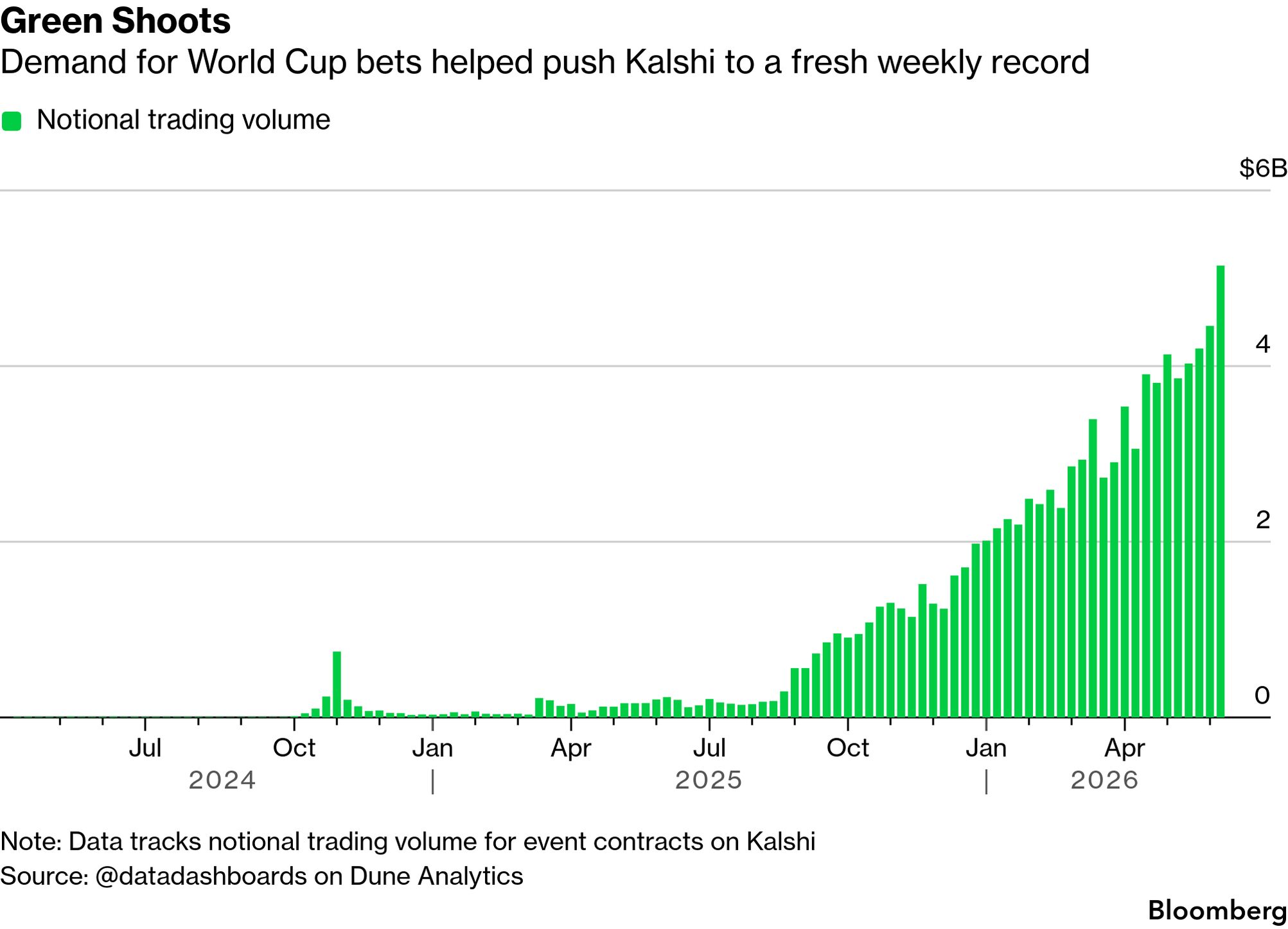
Demand for wagers on sports events like the World Cup and NBA Finals led to a record month at the exchange in May, amounting to nearly $18 billion in notional trading volume, according to user-compiled data on Dune Analytics. In the first week of the World Cup this month, Kalshi also broke a weekly record with $5.1 billion in volume.
Listing a new market on Kalshi typically requires two people, Lopes Lara said: one to work on populating the template with the right information, rules that need to be displayed or warnings to be included; and a second person to review it all. Contracts then face a one-to-two hour delay for spotting any issues before going live to all traders, with a paid bounty offered to those who identify flaws.
Resolving a market works much the same way. Some markets, like who won a sports game, can be determined automatically based on an external data provider. Elsewhere, Kalshi’s AI will send alerts to team members if it sees a lot of news articles on one topic, attaching a list of markets that might require determination.
In most cases, determining an outcome is a three-step process: someone on the markets team inputs an outcome into the system, while a second person independently adds their own decision.
Kalshi’s AI verifies whether the answers match, while also checking against its own suggested response. If a market is complicated, like a Supreme Court ruling, there’s an additional layer of checks, sometimes involving Kalshi’s chief regulatory officer.