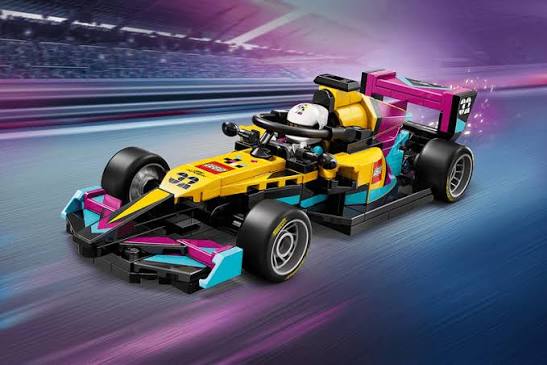
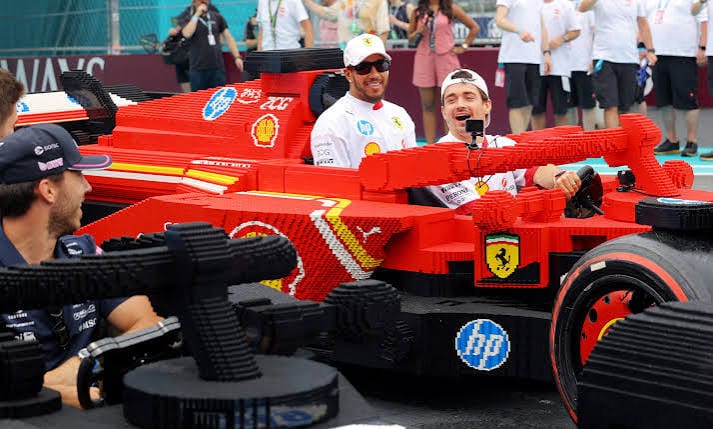
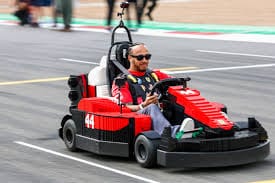
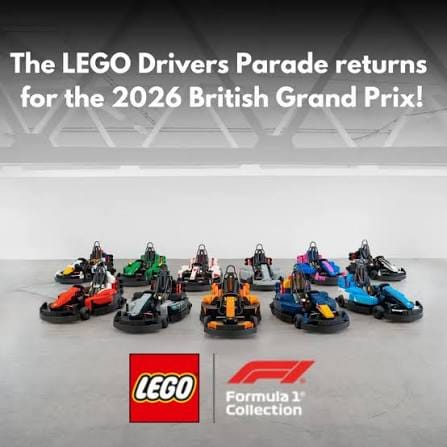
Two hours before the British Grand Prix got underway at Silverstone on July 5, twenty-two of the world's highest-paid professional racing drivers took to the track in miniature go-karts built entirely from LEGO bricks. Fernando Alonso crossed the line first, claiming victory in a race that offered no championship points and no prize money. Days earlier, Lewis Hamilton and Max Verstappen had both expressed varying degrees of skepticism about the whole affair. Hamilton's remark — that it made the drivers look "like clowns and children" — became one of the most-shared quotes of the race weekend. The parade he dismissed as undignified ended up being the most widely circulated piece of content from the entire British Grand Prix. That is not an accident. It is the latest result of a strategy LEGO has been building for two years.
Based on what 2026 has produced, will LEGO expand the scale of its F1 collaboration in 2027?
How LEGO Got Into F1, and Why
The partnership has expanded steadily since its debut. At the 2025 Miami Grand Prix, ten large driveable brick cars made their first appearance and generated a wave of viral imagery. Later that year came a LEGO trophy at the British Grand Prix and a brick-built version of the cooldown car at Las Vegas. In 2026, the collaboration moved into new territory: at Monaco, LEGO released limited-edition helmet sets celebrating McLaren's 1,000th race, with Lando Norris and Oscar Piastri appearing as LEGO minifigures for the first time. The actual race helmets both drivers wore that weekend were modeled on the brick versions — a reversal of the usual logic in which merchandise follows reality.
The commercial rationale behind all of this comes directly from LEGO's own data. Chief Marketing Officer Julia Goldin has described F1 as playing "a very important role" in LEGO's product portfolio, calling it an IP that cuts across generations and genders. The detail that surprised the industry most: F1-themed products have entered the top ten in purchasing rankings among teenage girls and female consumers. That single data point reframed what the partnership was actually for.
Three Content Lines, Three Different Audiences
The Silverstone parade illustrates the first of three distinct strategies LEGO has been running in parallel. Hamilton's reluctance and Verstappen's skepticism did not undermine the event — they powered it. The more visibly uncomfortable the drivers appeared, the more entertaining the content became. Alonso's competitive instincts, fully intact even in a go-kart race that meant nothing, produced exactly the kind of genuine, unscripted reaction that no advertising budget can manufacture. What this proves to other sports sponsors is a transferable principle: placing serious athletes in deliberately unserious situations can generate pop culture reach that traditional sponsorship formats simply cannot replicate. If NFL, NBA, or Olympic sponsors draw the same conclusion, LEGO and F1 will have created not just a memorable activation but a replicable strategic template.
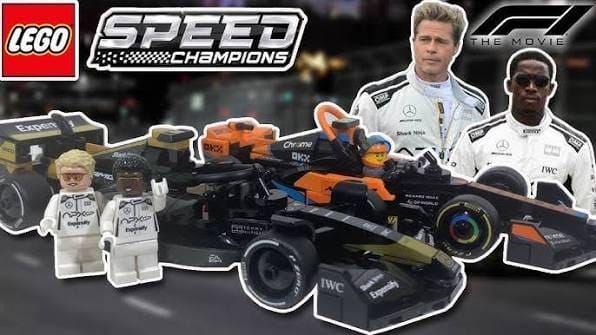
The second line runs through the Speed Champions product range. The 77252 APXGP Team Race Car — based on the fictional racing team from Brad Pitt's film F1 — is the first Speed Champions set ever built around a completely invented car from a movie. This matters beyond the product itself. It demonstrates that LEGO is now treating F1 as a platform that spans both real-world racing and cinematic storytelling simultaneously. If the sales data on that set holds up, the logic of Speed Champions changes: from a range that only documents real teams to one that can absorb fictional IP as well. The downstream possibility is that releasing a LEGO set in advance of a racing film's premiere becomes a standard part of how those films market themselves — turning LEGO from a merchandise partner into a piece of the content infrastructure.
The third line is the one with the longest potential impact. LEGO's multi-year partnership with F1 Academy has placed 20-year-old Dutch driver Esmee Kosterman on the grid under the LEGO Racing banner. The accompanying data is striking: 42% of F1 fans are women, and 87% of girls surveyed said they wanted to see more female racing drivers. F1 has spent a decade building a female audience through Drive to Survive and has never had a product dataset to quantify what that audience is actually willing to spend. If LEGO's next quarterly figures confirm that female consumers are buying F1-themed sets at scale, that number becomes the first concrete commercial evidence of female purchasing power within the F1 ecosystem — with consequences that extend well beyond LEGO's own product line into how the entire sport prices and packages its sponsorship inventory.
What the Data Shows So Far
The Silverstone parade became the most-shared content of the British Grand Prix weekend, outperforming qualifying and the race itself in social media circulation — and it did so on a budget that was a fraction of what a conventional sponsorship activation would cost. Goldin has characterized the F1 partnership as having exceeded expectations and described it as one of the brand's most important strategic bets in sports. F1-themed products entering the top ten among female consumers is a result the industry did not predict. The full sales figures that would confirm or complicate these signals are still pending from LEGO's next financial reporting period.