TL;NR
- TotalEnergies says Hormuz crude shipments remain profitable despite war-risk costs adding roughly $20mn per VLCC voyage, because Iraqi and Qatari barrels are being sold at steep discounts.
- Iran has threatened 45 tankers with fines, detention and cargo confiscation, while also warning that vessels conducting STS transfers with blacklisted ships could face penalties.
- VLCC rates have surged to record levels as crude increasingly moves through STS transfers, pipelines and longer detours, with benchmark TD3C earnings reaching about $624,000/day.
Will Iran add more tankers to its Hormuz blacklist by the end of October 2026?
TotalEnergies Is Still Making Hormuz Work
TotalEnergies Chief Executive Patrick Pouyanné said the company is continuing to move heavily discounted crude from Iraq and Qatar through the Strait of Hormuz because the trade remains profitable despite sharply higher transport costs.
| Loading window | Basrah Medium | Basrah Heavy |
|---|---|---|
| July loading | −$14/bbl | −$18.8/bbl |
| Aug 1–10 | −$27/bbl | −$29.8/bbl |
| Aug 11–20 | −$26/bbl | ~−$28–29/bbl |
| Aug 21–31 | −$25/bbl | −$27.8/bbl |
Crude oil are being offered at around $50–60 per barrel, compared with Brent above $90. Pouyanné estimated that moving a VLCC through Hormuz and back now adds roughly $20mn, about $10 per barrel for a 2mn-barrel cargo, largely reflecting war-related risks.
As long as the crude discount remains larger than the additional shipping cost, buyers still have an incentive to take the barrels.
That does not mean the current system is sustainable. TotalEnergies is also backing alternative export infrastructure, including the proposed Baghdad–Syria pipeline and an expansion of the Habshan–Fujairah pipeline, which currently has capacity of about 1.8mn bpd.
Iran Extends Pressure to Tankers and STS Transfers
At the same time, Iran is increasing the legal and operational risk around Hormuz traffic.
Authorities have threatened 45 tankers with fines, detention and potential cargo confiscation for alleged violations of transit rules. Iran has also warned that vessels conducting ship-to-ship transfers with blacklisted ships could face similar penalties.
That matters because STS has become an increasingly important part of the workaround for disrupted Gulf crude flows.
What initially functioned as an alternative logistics route is therefore becoming part of the enforcement perimeter itself. For shipowners and charterers, the issue is no longer only physical security in the strait, but also counterparty screening, insurance exposure and the risk attached to STS participation.
Read More:
 Jiayi ZHANG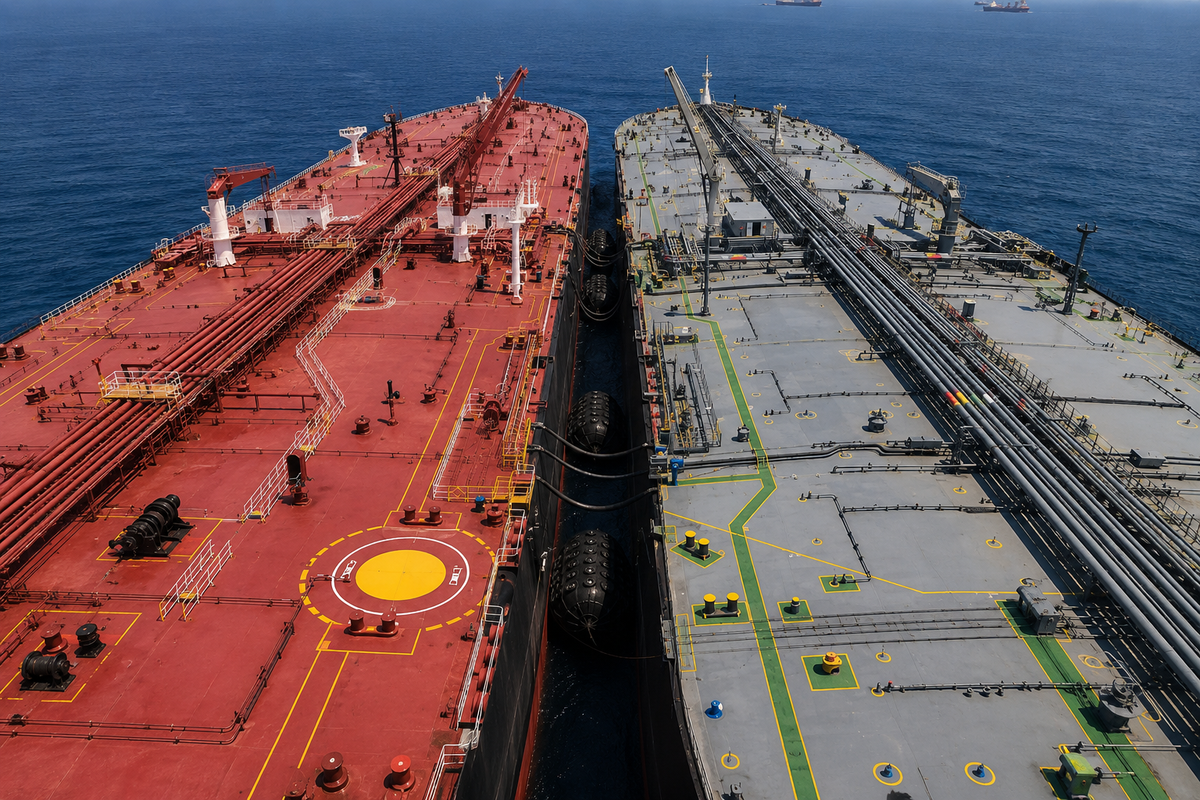
VLCC Rates Hit a Record High as Crude Routes Grow More Complex
The disruption is also showing up directly in tanker earnings.
Middle East crude is increasingly moving through combinations of STS transfers, pipeline movements, vessel repositioning and longer seaborne detours rather than straightforward Gulf-to-Asia voyages.
Those additional steps consume more vessel-days without requiring higher underlying crude volumes, tightening effective VLCC supply.
On August 24, Baltic Exchange benchmark TD3C Middle East Gulf–China VLCC earnings reached about $624,388 per day, or Worldscale 606, an all-time high.
Lloyd’s List noted that strong refining economics and heavily discounted crude are allowing charterers to tolerate freight costs that would normally look prohibitive. The result is an unusual tanker market in which disrupted trade is not necessarily reducing demand for ships; instead, each barrel is becoming more shipping-intensive.
Hormuz is still moving crude, but through a much more expensive and complicated system.
Source: