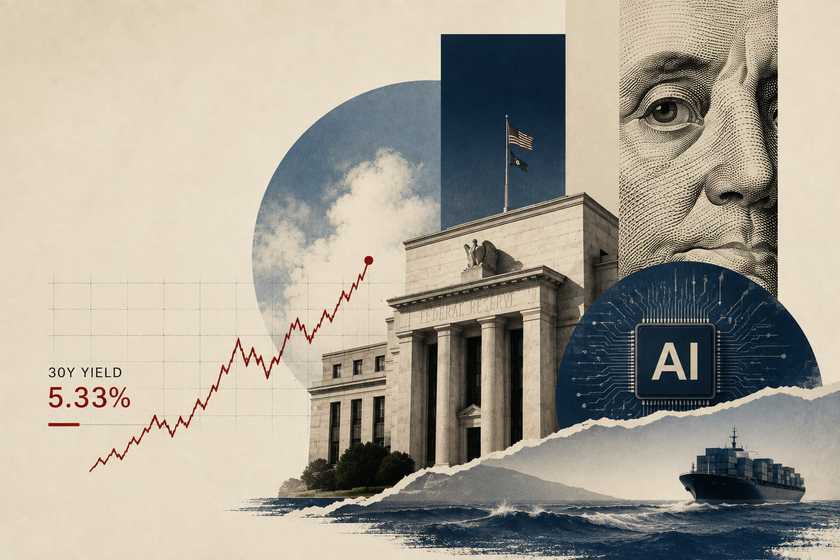
On August 19, the 30-year Treasury yield touched roughly 5.33%—its highest level since 2007—and Washington stepped in. The Treasury said it would at least double the maximum size of buybacks in the 10-to-20-year and 20-to-30-year sectors, effective September 9. The long bond rallied immediately, pulling its yield down by about 8–10 bp.
After its initial post-buyback decline, will the 30-year Treasury yield retest or exceed its August 19 high of 5.33% by the end of 2026?
The intervention came with an unusual cross-market signal. Despite the return of yields last seen nearly two decades ago, the dollar was trading close to a three-month low.
Until early 2025, the 30-year yield and the broad dollar index had generally moved in the same direction. Since then, their relationship has undergone a correlation regime shift: long-term yields have climbed while the dollar has weakened.
A rising long-term yield can tell two different stories:
- Macro strength: Stronger growth, persistent inflation or a more hawkish Fed raises expected real rates. US assets become more attractive, producing yield up, USD up.
- Risk compensation: Fiscal supply, duration risk, inflation uncertainty or policy concerns raise the term premium. Investors receive a higher yield because they perceive more risk, producing yield up, USD down.
In simplified terms:
30Y nominal yield ≈ expected real short rates + expected inflation + real term premium + inflation risk premium
The yield-dollar divergence does not prove a loss of confidence in the US, but it suggests term premium—not growth—is driving the 30-year selloff, reviving the “Sell America” narrative as higher yields fail to attract capital back to the dollar.
A global repricing of duration
The selloff is unfolding against a difficult global backdrop. War often begins as a classic risk-off event, sending investors into government bonds. But when conflict persists—or becomes a recurring feature of the geopolitical landscape—the market starts to price its longer-term consequences through several channels:
- Oil, freight, insurance and logistics costs increase inflation volatility.
- Defense, energy security and reshoring require additional public spending.
- Governments issue more debt while central banks remain cautious about easing.
- Investors demand greater compensation for uncertain inflation and fiscal outcomes.
The result is both more sovereign duration and a higher required return for holding it.
At the same time, the buyer base has become more price-sensitive:
- Central banks are no longer absorbing as much duration through QE.
- Banks face tighter balance-sheet constraints.
- More debt must be placed with asset managers, households and foreign investors.
These investors are willing to buy—but only at a sufficient concession. The selloff is the adjustment mechanism: bond prices fall and term premia rise until the marginal buyer returns.
The Treasury market is not running out of buyers. It is discovering the yield required to bring the marginal buyer back.
Japan raises the opportunity cost
Japan is central to this shift. Near-zero JGB yields once pushed Japanese institutions toward overseas bonds. That incentive is weakening.
At the August 4 auction, the weighted-average yield on the 10-year JGB reached 2.84%.
Once USD/JPY hedging costs are included, Treasuries may no longer offer Japanese investors a compelling advantage. Japanese institutions do not need to sell their existing Treasury holdings. Reducing new purchases—or demanding a wider pickup—is enough to raise the US market’s clearing yield.
The Fed cannot anchor the long end
The Fed is also contributing to uncertainty.
At its July meeting, the FOMC voted 9–3 to keep rates unchanged, with three policymakers preferring an increase. The minutes suggested that further hikes could be necessary if inflation failed to ease. Softer economic data subsequently reduced some tightening expectations. But renewed energy pressure complicated the outlook.

The 2-year Treasury yield largely tracks expectations for the policy path, while the 30-year yield also reflects long-run inflation, fiscal risk and the term premium.
Source: Federal Reserve Board via FRED .This matters differently across the curve:
- The 2-year yield mainly reflects the next several FOMC decisions.
- The 30-year yield must also price fiscal policy, long-run inflation and the real term premium.
- Unclear Fed guidance widens the distribution of future rate outcomes, increasing duration uncertainty.
The Fed can influence the expected path of short rates. It cannot determine the yield required for investors to absorb three decades of fiscal and inflation risk.
AI is an amplifier
Sovereign borrowing is the structural pressure. AI financing amplifies it.
AI CapEx requires large-scale, long-term financing. Data centers, power systems, GPUs and network infrastructure have long economic lives, encouraging hyperscalers to issue long-dated debt.
That affects long-term rates through the marginal investor:
- More AI financing produces more long-dated corporate bond supply.
- IG corporate bonds compete with Treasuries for insurers’, pensions’ and asset managers’ duration budgets.
- Treasury yields may need to rise to retain investors offered attractive corporate spreads.
Governments and AI companies are not competing for a fixed quantity of money. They are competing for the marginal balance sheet willing to hold long-duration assets.
Amazon, Alphabet, Meta and Oracle issued approximately $194bn of bonds in 2026 through July 7, compared with roughly $108bn during all of 2025. Alphabet subsequently sought another $20bn–$25bn through maturities ranging from 2 to 40 years.
AI borrowing is adding supply to an already surging corporate bond market
Reported bond issuance, USD billions
Four hyperscalers
USD bnU.S. corporate bonds
USD bnDuring H2 2026, Alphabet issued $31.8bn equivalent of fixed-rate debt in sterling, Swiss francs, euros, Canadian dollars and yen—more than the $20bn it raised in dollars. Amazon followed the same strategy.
Such foreign-currency issuance does not mean the US market has reached its financing limit. It shows that AI funding needs have become large enough for issuers to diversify currencies, investors and issuance windows.
AI is not causing the sovereign selloff. But by adding long-duration supply across currencies as governments borrow heavily, it is raising the global price of duration—not just Treasury yields. Japan illustrates the feedback loop: higher JGB yields alter relative value, weaken demand for Treasuries and transmit tighter conditions across interconnected bond markets.
What buybacks can—and cannot—do
Treasury buybacks can:
- Improve off-the-run liquidity.
- Reduce pressure on dealer balance sheets.
- Lower the liquidity premium in specific securities.
- Provide predictable liquidity events.
They cannot:
- Create reserves like Fed QE.
- Eliminate the underlying fiscal deficit.
- Materially reduce privately held net borrowing.
- Remove the need for future Treasury issuance.
The 8–10 bp rally suggests that liquidity stress and crowded positioning contributed to the selloff. But it does not prove that the structural term premium has fallen.
If auction performance and off-the-run liquidity improve while yields remain lower, the technical explanation gains credibility. If the rally quickly reverses, fiscal supply and the term premium remain the dominant forces.
Buybacks are small relative to new borrowing
USD billions. Buyback figure represents potential Q3 long-end capacity; actual purchases may be lower.
What would disprove the argument?
- Energy-driven selloff: Oil, freight rates and breakevens rise together; nominal yields rise faster than real yields; falling energy prices pull long yields lower.
- Fiscal and term-premium selloff: 30-year real yields remain high, the curve steepens from the long end and weak auctions continue even after oil falls.
- US risk-premium repricing: 30-year yields rise while USD weakens, gold strengthens and the long end underperforms the front end.
- Successful buyback intervention: Liquidity and auction demand improve, while the initial rally persists instead of reversing.
If yields and the dollar resume rising together, stronger growth, inflation or a hawkish Fed would become the more convincing explanation.
The marginal balance sheet
US fiscal supply is the structural pressure. Geopolitical and energy risks increase inflation and financing uncertainty. Japan raises the opportunity cost of holding Treasuries. Fed ambiguity adds duration uncertainty. AI financing introduces more long-dated corporate debt.
Buybacks can repair market plumbing, but they cannot change fiscal arithmetic. The Fed can influence the front end, but it cannot dictate the clearing price of long-term capital.
The final test is the dollar.
Sources:
- U.S. Department of the Treasury and Federal Reserve - https://home.treasury.gov/news/press-releases/sb0584
- Reuters - https://www.reuters.com/world/us-treasury-double-sizes-some-debt-buyback-operations-least-4-billion-2026-08-19/
- Bloomberg - https://www.bloomberg.com/news/articles/2026-07-24/global-bonds-are-reeling-as-oil-surge-renews-inflation-threat
- Reuters - https://www.reuters.com/business/hyperscaler-debt-binge-pushes-yields-up-investor-demand-cools-2026-07-29/