
Microsoft, Meta, Amazon, and AMD all reported their latest results within seven days. Three are buying the infrastructure; AMD is selling into it.
Microsoft added $450 billion in market value in one session (around 15%), the largest single-day market-cap gain ever recorded by a company, surpassing chip giant Nvidia's previous record one-day gain of $441 billion on April 9, 2025. Meta’s stock fell more than 9% intraday.
If Wall Street had simply turned against AI spending, these reactions would make no sense.
Amazon rose 15.3% the following day in its biggest single-session move since 2012, and AMD beat on revenue guidance and adjusted EPS and still dropped 6.6% in the first full session.
All three infrastructure buyers are spending more, not less.
My read is that investors have stopped asking how much is being spent and started asking whether the money already has a customer’s name on it.
Which of these four are you buying after this week?
Microsoft turned new capacity into revenue almost immediately
Azure revenue grew 43%, beating the roughly 40% analysts expected, and Microsoft guided for about 45% constant-currency growth next quarter. Management said the extra capacity brought online during the quarter was quickly sold.
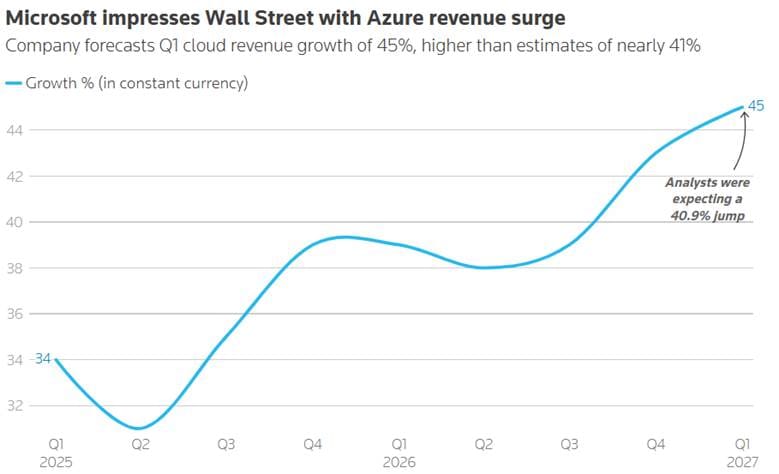
Source: Reuters
Commercial remaining performance obligation, meaning contracts signed but not yet booked as revenue, rose 84% to $678 billion, more than twice Microsoft’s full-year revenue.
However, its lower reported capex outlook partly reflects a longer assumed life for data centers, shifting more leases outside capex without reducing the commitment. Another $329.1 billion of data-center leases have not yet commenced.
Meta vs. Amazon: Both face cash-flow pressure, but on different measures
Meta generated $31.86 billion in quarterly operating cash and spent $31.08 billion on capex. This absorbed about 97.5% of the cash the business produced, leaving free cash flow of $784 million, down 91%.
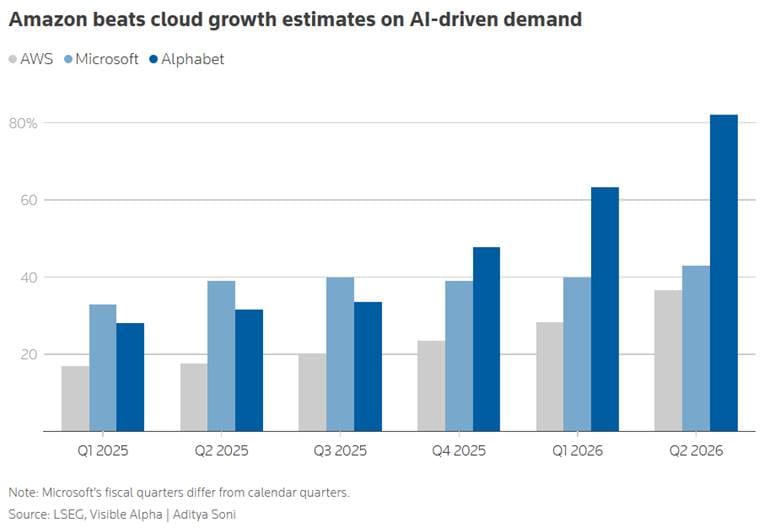
Amazon’s trailing- 12-month free cash flow swung from positive $18.2 billion to negative $7.6 billion, while its 2026 capex plan rose 10% to roughly $220 billion. Its shares rallied anyway, so why did investors give it a pass?
Source: Reuters
The reason could be that Amazon’s AWS revenue accelerated 37% to $42.2 billion, its best growth in 18 quarters, and segment operating income jumped from $10.2 billion to $16.6 billion (about 63%). Contracted backlog climbed from $364 billion to $496 billion in one quarter.
Now, Meta did provide narrower evidence that AI is improving the ad machine. Advantage+ reached a $75 billion annual revenue run rate, while newer models lifted clicks and conversions in testing. The problem is these figures show that the tools work, but not how much incremental revenue the current infrastructure build produced or whether it has earned an adequate return.
In simple terms, it is clear that Meta’s revenue grew 28% to $60.8 billion, ad impressions rose 14% and average price per ad increased 12%. And this sounds like proof that AI is already paying off, and part of it probably is, but neither figure separates model-driven improvements from the broader ad cycle.
Put simply, Amazon can point to a customer waiting for its next server. Meta can point to a much better version of Facebook and Instagram, but not how much of the improvement belongs to the latest round of infrastructure spending.
This is probably why the market gave Amazon more room than Meta. Most of its 2027 AWS compute capacity has already been reserved, with commitments stretching into 2028. The cash is leaving first, but customers are already waiting at the other end.
 Bloomberg
AMD monetizes the buildout earlier, but its stock had already priced in more
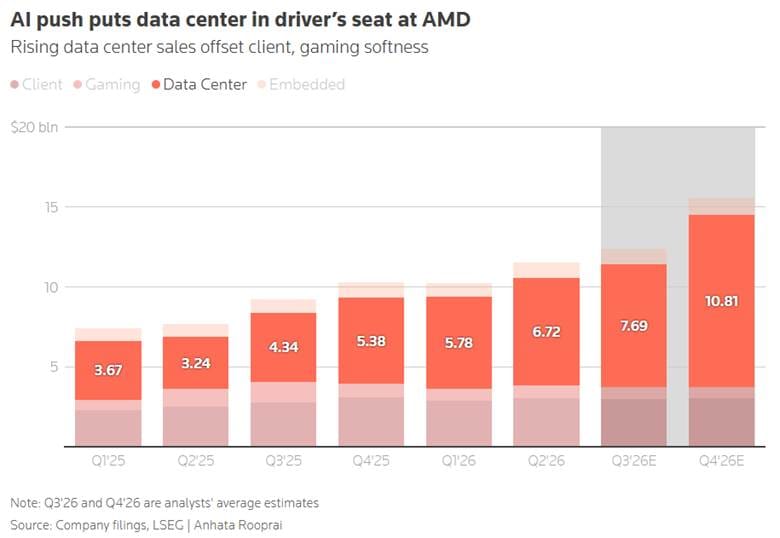
AMD turns everyone else’s capex into revenue as it sits earlier in the monetization chain. Revenue was a record $11.54 billion, up 50%. Data center revenue more than doubled to $6.72 billion, now 58% of the company, and third-quarter guidance of roughly $13 billion beat the $12.5 billion Street number.
Source: Reuters
The shares still fell before the open after more than doubling this year, even though AMD is already turning AI demand into revenue. The reaction shows that it faced an exceptionally high bar.
 Ana Frincu
The verdict? Next two quarters will test this ranking
AMD’s revenue rises the moment the other three write a cheque, which is why data center revenue more than doubled to $6.72 billion in a quarter.
And it still fell 9%. That is the most useful signal in the week: the market is not merely paying for speed of conversion, it wants confidence that the demand lasts.
Simply put, Amazon rose 15.3% and Microsoft just over 15%, so the percentage moves were roughly the same. But Microsoft’s nearly $450 billion gain was larger in dollars due to its larger starting market cap, so Amazon’s smaller base produced a smaller dollar gain. So, for now, my ranking is:
- Amazon: Strongest current evidence of contracted demand so far, with most 2027 capacity already reserved and commitments stretching into 2028.
- Microsoft: Fastest near-term conversion, with new Azure capacity sold almost as quickly as it came online. But its spending advantage is smaller than it looks, because the headline capex figure understates the commitment.
- Meta: Not necessarily the weakest monetizer, just the hardest one to measure. AI is already improving engagement, ad clicks and conversions, so the buildout is producing something. But Meta still cannot show how much incremental revenue the latest spending created or whether that return is keeping pace with the cost.
Next, keep an eye on:
Amazon: AWS growth needs to stay near the mid-30s without giving back the margin gain as Amazon works through its $496 billion backlog. If backlog keeps rising while AWS margins fall or free cash flow deteriorates further, this growth is getting more expensive.
Microsoft: Azure needs to meet the roughly 45% growth guide with stable cloud gross margin. A miss alongside more than $50 billion of Q1 capex would weaken the cleanest case.
Meta: It depends on whether operating cash flow starts pulling away from capex while ad growth holds. If capex remains close to operating cash flow, a cleaner margin alone will not prove monetization has caught up.
AMD: Q3 revenue needs to land near the $13 billion guide, with non-GAAP gross margin holding around 56% and Data Center revenue continuing to accelerate. Beyond the quarter, watch whether the Helios and MI400 ramp turns AMD's announced partnerships into actual revenue without putting pressure on margins.
 Ana Frincu
In your opinion, which company has the strongest AI monetization case right now?
Sources
Amazon: Amazon.com Announces Second Quarter Results
AMD: AMD Reports Second Quarter 2026 Financial Results
Meta: Meta Reports Second Quarter 2026 Results
Meta: Second Quarter 2026 Results Conference Call
Microsoft: Earnings Release FY26 Q4
Microsoft: Microsoft Fiscal Year 2026 Fourth Quarter Earnings Conference Call
Microsoft: Press Release & Webcast
Reuters: Amazon lifts investment plans after strong cloud sales; shares jump
Reuters: Microsoft says cash will keep flowing from AI, shares rise
Reuters: Microsoft sets record with near $450 billion single-day gain in market value
Reuters: Wall Street ends sharply higher, lifted by soaring Microsoft
Yahoo Finance: Amazon Raised Its AI Spending And Had Its Best Day In Years