Trading volume on Polymarket has declined for the first time in eight months, a setback that comes as its founder acknowledges missteps and its chief rival Kalshi Inc. continues to grow.
Monthly notional trading volume on Polymarket’s offshore exchange and US app slipped by roughly 9% to $10.3 billion in April, according to user-compiled data on Dune Analytics. Kalshi’s volume rose 13% to $14.8 billion.
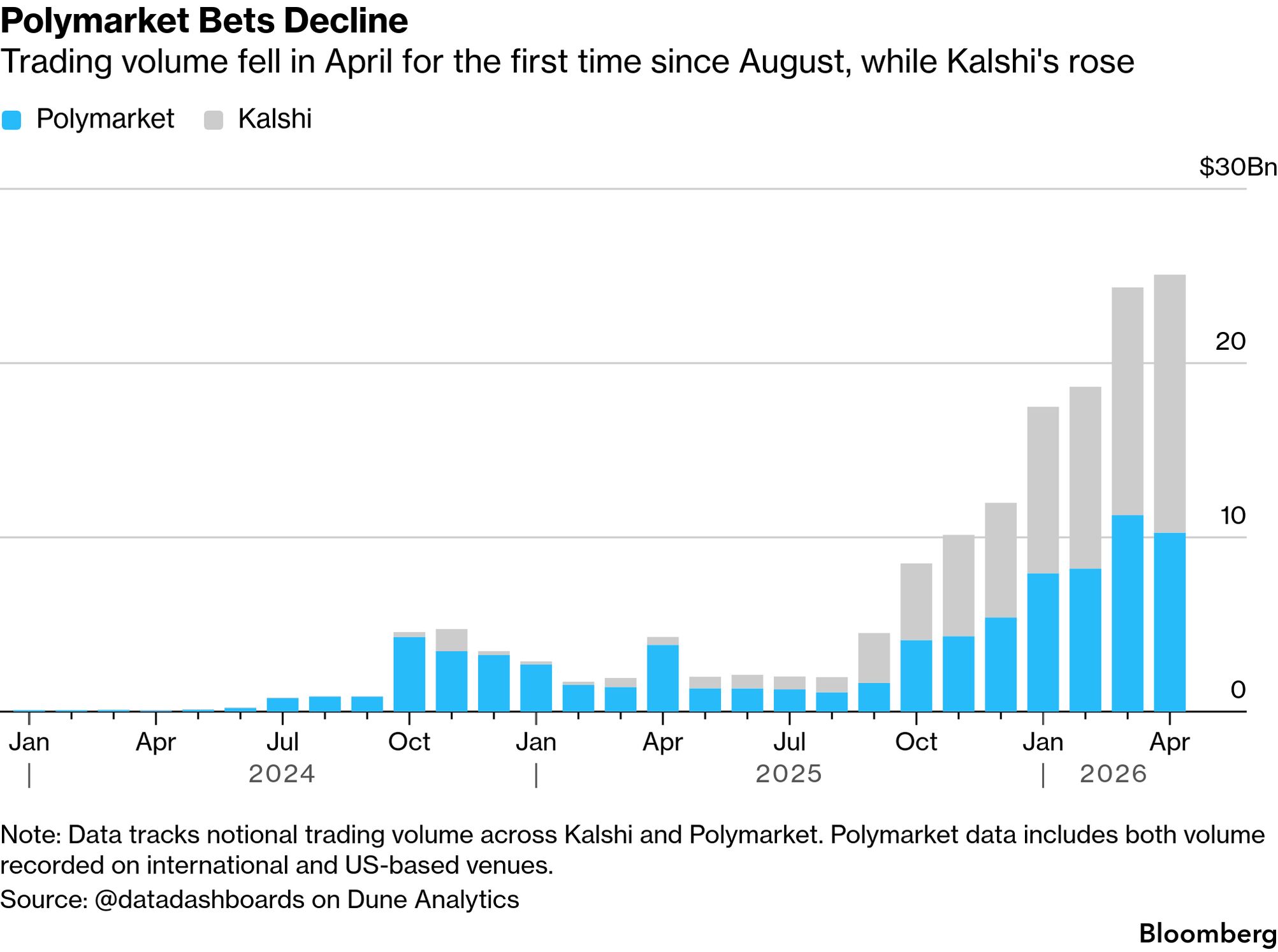
The last time volume declined on Polymarket was August 2025, the month before the National Football League regular season kicked off, attracting legions of new users. Polymarket later set its volume record in March, spurred by major sporting events including the March Madness college basketball tournament.
A Polymarket spokesperson said that volume dipped last month because of a technical overhaul designed to handle increased activity. The upgrade was rolled out on April 28 after a delay.
“Over the coming weeks, we are shipping a series of updates that will make trading faster and smoother than ever — reducing delays and delivering the biggest speed improvement in Polymarket’s history,” the spokesperson said in a statement on Wednesday.
Polymarket had more trading volume than any other prediction market exchange for most of the past few years, but it was overtaken in September by Kalshi. Polymarket has faced challenges including trading outages and delayed product launches, as well as scrutiny from lawmakers over the types of bets allowed on the platform and allegations of insider trading.
At the same time, the company’s valuation has continued to increase as the nascent industry grows. Polymarket was recently valued at $15 billion when it received a $600 million investment from Intercontinental Exchange Inc., the parent company of the New York Stock Exchange.
Founder Shayne Coplan has publicly acknowledged stumbles, saying that he sometimes found it difficult to delegate and communicate goals as the company expanded.
“There’s been a few times over the course of the business where the way the company ran was suboptimal. And I recognize that,” Coplan said at an industry event on April 28. He cited successes in other areas, including product and brand distribution.
The infrastructure upgrade late last month was aimed at resolving longstanding issues with failed transactions and frequent technical bugs. The company also added trading fees to almost all of its markets for the first time in late March.
“We’ve let people down, and I’m not going to dress that up,” Josh Stevens, Polymarket’s vice president of engineering, said in a social media post shortly before the upgrade took place. “The next few months are going to speak for themselves. Stay with us.”
The company has removed one barrier to growth. For months following a soft launch in December, users attempting to sign up for Polymarket’s US app were forced onto a waiting list. That was discontinued earlier in May, easing access for Americans.