

ECB Raises Rates Again as Middle East War Rewrites Europe’s Inflation Outlook
Brief Analysis
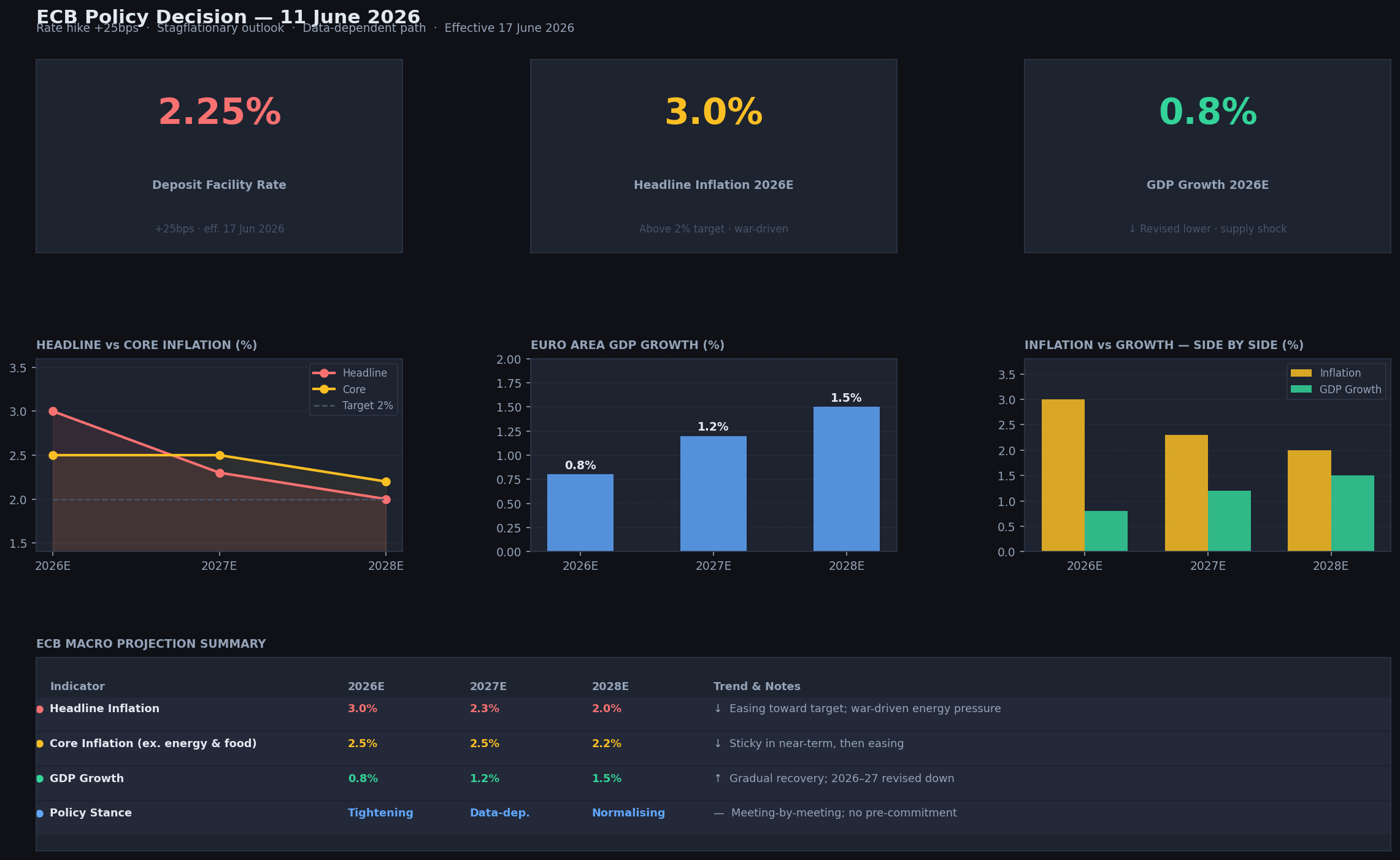
The European Central Bank raised its three key interest rates by 25 basis points on 11 June 2026, saying the war in the Middle East is generating new inflation pressure and creating uncertainty around the euro area’s medium-term outlook. The deposit facility rate will rise to 2.25%, the main refinancing operations rate to 2.40%, and the marginal lending facility rate to 2.65%, effective 17 June 2026.For markets, the most important signal is not only the rate hike itself. It is that Europe has moved back into a stagflation-style trade-off: inflation risks are rising while growth expectations are being revised lower. In the ECB’s new baseline, headline inflation is expected to average 3.0% in 2026, 2.3% in 2027, and 2.0% in 2028. Core inflation, excluding energy and food, is projected at 2.5% in both 2026 and 2027, before easing to 2.2% in 2028.
“The ECB’s latest decision turns Europe’s macro outlook into a two-sided prediction market: inflation risk is back, but growth risk is rising at the same time.”
That tension is visible in the growth forecasts. The ECB now expects euro area growth of only 0.8% in 2026, followed by 1.2% in 2027 and 1.5% in 2028. The 2026 and 2027 forecasts were revised down because the war is expected to hit commodity markets, real incomes, and confidence.
“This is not a clean tightening cycle. It is a policy response to a supply shock, where higher energy prices can lift inflation while simultaneously weakening consumers and businesses.”
The decision creates a highly tradable setup for prediction markets because the ECB is refusing to commit to a fixed policy path. It said future decisions will be data-dependent and made meeting by meeting, based on the inflation outlook, underlying inflation dynamics, incoming economic and financial data, and the strength of monetary policy transmission.
“The most important line for traders is that the ECB is not pre-committing to a particular rate path. That keeps every future meeting live.”
This makes the next phase of European monetary policy unusually measurable. Inflation prints, energy prices, growth revisions, wage data, confidence indicators, and each ECB meeting can now directly shift the odds of another hike, a pause, or even a later policy reversal.For prediction markets, the core question is simple:
Is this the beginning of a renewed tightening cycle, or the final hike before growth weakness overtakes inflation as the ECB’s bigger problem?
Original Link
Original ECB release: Monetary policy decisions, 11 June 2026.