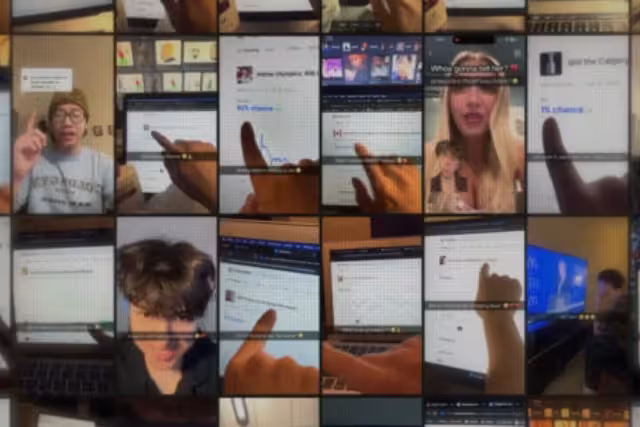
Polymarket has been banned from letting U.S. users trade on its website since 2022. But the company is waging a secret campaign for Americans’ attention on social media, paying creators to film trades on fake websites and hiring overseas workers to make the videos go viral in the U.S., a Wall Street Journal investigation found.
The campaign bolstered the perception that Polymarket lets users make fast and easy money, as the company attempts to bring its offshore website back to the U.S.
In response to our reporting, Polymarket said in a statement that it was “committed to maintaining accurate, fair, and transparent markets. We are part of a rapidly growing industry and are constantly evaluating ways to improve how we’re engaging and earning the trust of our audience.” It said it would conduct an audit of active promotional content.
Polymarket has a data partnership with Dow Jones, the publisher of The Wall Street Journal. We only used publicly available data in our analysis.
Here are three takeaways from our investigation:
Fake bets, fake wins
We reviewed more than 1,100 videos made by 10 of Polymarket’s more than 100 creators. In 70% of the videos, creators appeared to place a bet on websites that looked nearly identical to Polymarket, but were actually dummy sites the company used to film fake trades. Many of the creators didn’t disclose they were paid by Polymarket until we reached out.
Around 10% of the videos went even further, adding outdated footage or fake headlines to imply they won their bets. Those videos depicted the creators winning almost $900,000. We traced how each bet would have actually been resolved and found that in reality, the creators—and anyone who had placed identical bets—would actually have lost more than $166,000.
U.S. advertising law requires brands to be truthful about what they are promoting, although there is some gray area about what is permitted. Commodities law, which governs prediction markets, also bars deceptive and misleading practices. In response to our reporting, a spokeswoman for the Commodity Futures Trading Commission said that prediction markets should be brought onshore, where they can be more effectively policed. A spokesman for the Federal Trade Commission declined to comment.
Polymarket gave its creators bulletpointed scripts and reviewed videos before publishing, people who have worked with the company said. If a video was obviously faked, the creator would be asked to remake it.
An army of social media users
To make the videos go viral, Polymarket worked with thousands of low-wage social-media users—often teens based in Asia—to repost the videos from sockpuppet accounts that hid their Polymarket affiliation. The strategy, called “clipping,” is designed to create the appearance of a groundswell of authentic interest in a product or brand.
In a group chat, a marketing contractor for Polymarket wrote that if users reposting the clips had a social-media account with “Polymarket” or “poly” in the title, they wouldn’t be paid.
Many of the clippers’ videos specifically promote Polymarket’s website, which the company is barred from offering to U.S. traders. But clippers are only paid if at least 60% of their viewers are U.S.-based, according to instructional documents we reviewed.
Insider influencers
Polymarket’s CEO Shayne Coplan says the company is cracking down on insider trading. The company recently launched a webpage devoted to integrity that reads: “Insider trading is strictly prohibited.” Coplan himself described concerns about insider trading on Polymarket as “outlandish and baseless.”
But the company has simultaneously been paying social-media creators to disseminate short clips of online celebrities talking about how easy it would be to use inside information to trade on the platform.
One of those celebrities is Adin Ross, a 25-year-old manosphere phenomenon. Polymarket paid Ross millions of dollars for a marketing deal, according to a person familiar with the negotiations.
Polymarket’s clipping campaign paid to promote a video of Ross saying he could easily use insider information to trade on the release date of an album by Drake, a hip-hop star and Ross’s acquaintance. Representatives for Ross and Drake declined to comment.
We found at least 18 other videos Polymarket paid to promote that discussed opportunities for insider trading.