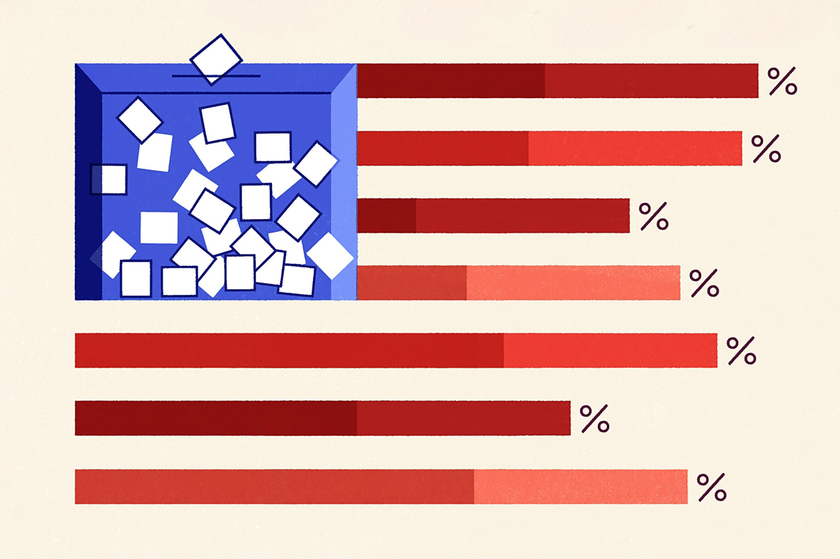
In August, a previously little-known polling firm called Median Strategies released a poll of the Los Angeles mayoral election. The result looked fairly clear: incumbent Mayor Karen Bass led challenger Nithya Raman by nearly 12 percentage points. Median claimed to have surveyed 560 voters and provided a methodology description that looked like something a legitimate polling organization would publish.
Bass's campaign quickly seized on the good news, saying on social media that it showed the campaign was "gaining momentum".

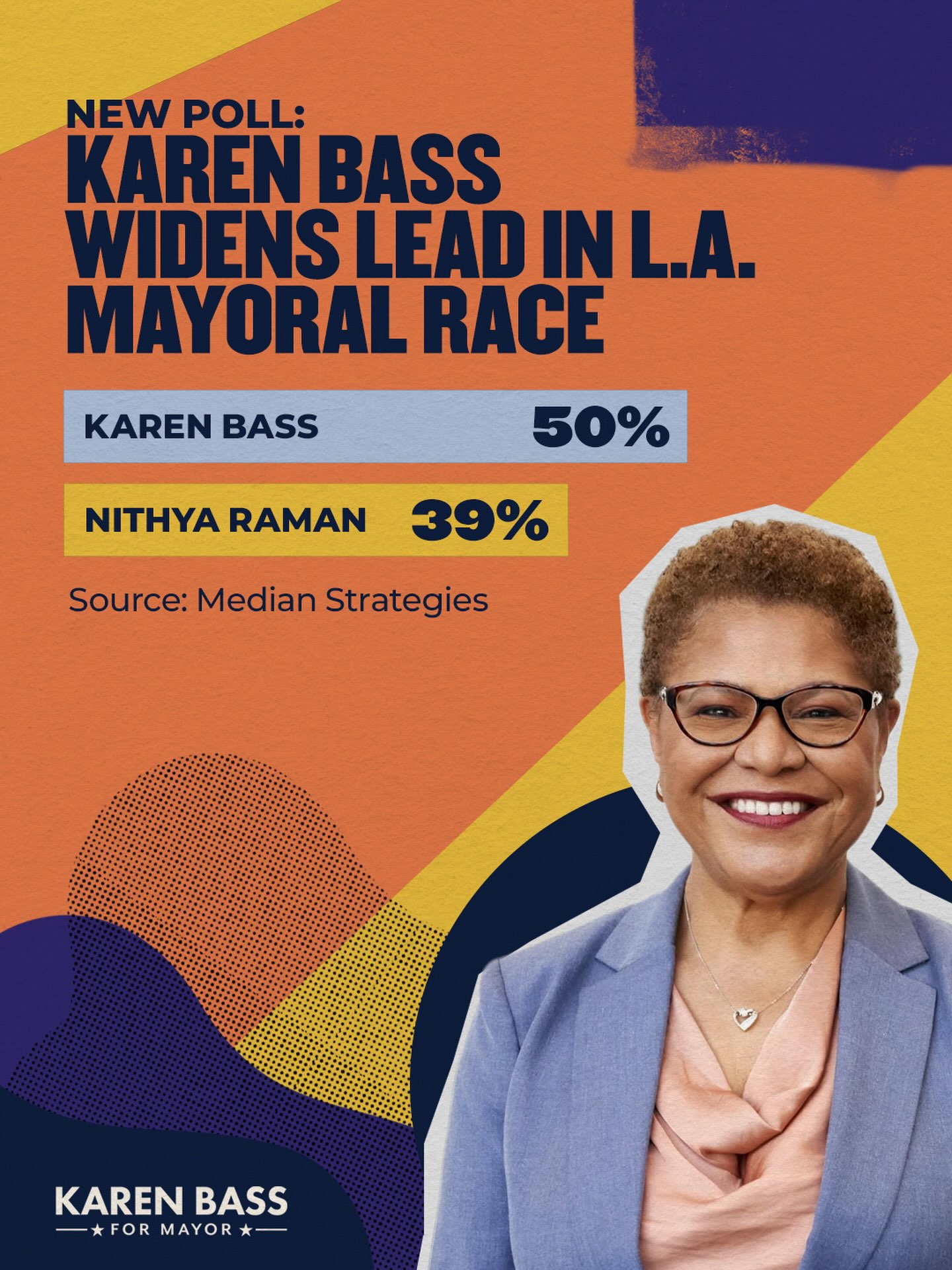
A few days later, people learned there was a problem: those 560 voters did not exist. The poll was fake.
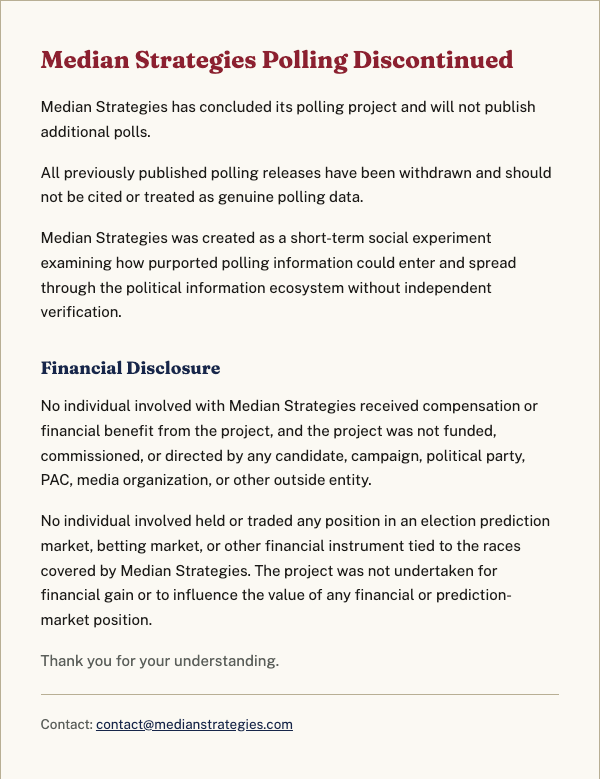
Median Strategies subsequently withdrew all of its polls, saying that it had actually been a "short-term social experiment" designed to observe how easily unverified polling information could enter the political information ecosystem. On August 20, The Guardian went further and identified the person behind the website: Rahil Prakash, a 21-year-old recent college graduate. He said he had carried out the entire project by himself and had also used AI to build the website.
Median did not just fabricate a Los Angeles poll. It also published fake polls in Wisconsin and Nevada. One of them even claimed that Francesca Hong was leading the Wisconsin Democratic gubernatorial primary by more than 20 percentage points. Prediction market prices changed dramatically at the final moment and Hong ultimately lost the race by less than 1 percentage point.
But one important detail is that these fake polls did not automatically produce noticeable moves in prediction markets. The Associated Press tracked trading on Kalshi and Polymarket. After the fake Wisconsin and Nevada data were published, neither platform showed an identifiable market reaction.
Los Angeles was different. After Bass's campaign reposted Median's result, the YES contract on Kalshi for Bass to win the mayoral election rose from about 63 cents to 65 cents, a 2-cent increase in roughly 15 minutes. The reaction on Polymarket was more concentrated. AP found that about six minutes after the relevant post went out, roughly 20 different accounts began trading thousands of contracts favorable to Bass. By contrast, during the week before Bass shared the poll, the market had been extremely quiet, with a typical individual trade worth less than $10.
A previously thinly traded market suddenly saw a cluster of orders all pointing in the same direction after information that was later proven entirely false was amplified by the candidate herself.
The Market May Not Have Believed the Poll. It Believed Bass.
Median had almost no track record of credibility at the time. Its social media accounts had only recently been created, it had just a few dozen followers, and it did not publicly identify a lead pollster whose identity could be verified. The Guardian later found that Prakash himself also had no background at a traditional polling organization.
So if Median Strategies had simply published a "Bass +12" poll on its own, traders could have ignored it entirely. In fact, the Wisconsin and Nevada results suggest that this is largely what they did.
Professional data gatekeepers spotted problems as well. AP reported that The New York Times, RealClearPolitics, and FiftyPlusOne all declined to include Median's polls in their databases. The New York Times said it had not received basic information about the survey methodology or the people running the firm, while FiftyPlusOne found that the Wisconsin poll did not disclose the source of its voter file or the vendor responsible for collecting the sample.
So this is not a story about "nobody being able to identify a fake poll". What is more interesting is that when the Karen Bass campaign later reposted it, the information acquired a second layer of credibility. Traders saw an additional signal: Bass's campaign considered the poll credible enough to promote publicly.
The Advantage of Prediction Markets Also Creates a New Attack Surface
One of the most important theoretical advantages of prediction markets is that monetary incentives can rapidly aggregate dispersed information into prices. If a trader believes the public information is wrong, that trader can bet in the opposite direction. If the trader is right, the trader can make money. This is also why prediction markets are often described as a corrective mechanism for polling, analysts, and media narratives. But there is a mirror-image problem: if the market is willing to pay for new information, then creating new information may itself have economic value.
As early as 2020, legal scholar Tyler Yeargain published a paper that reads almost like a prediction of Median Strategies. The paper examined exactly the scenario in which someone fabricates political polls, moves betting-market prices, and then profits from trading, and argued that under certain factual circumstances, such conduct could constitute commodities fraud or wire fraud.
The CFTC had also described almost exactly the same risk in advance. In its 2024 proposed rule on event contracts, the CFTC specifically noted that inaccurate polling, voter surveys, and false news reporting could distort the price formation of political event contracts. It went on to raise a problem that is distinctive to prediction markets: traditional financial derivatives usually have an underlying cash market and other economic data that can provide a pricing anchor, but political event contracts have no equivalent underlying cash market. Their price formation depends heavily on polling and other informational sources. Those sources are often unregulated, operate through opaque processes, and may not even use reliable statistical methods.
In the stock market, if someone publishes a false rumor about a company, investors can at least check earnings, SEC filings, cash flow, and other asset prices. But "Will Bass win the November mayoral election?" has no corresponding balance sheet. Polls, endorsements, campaign news, fundraising, social media narratives, and insider information are themselves the "fundamentals" of the contract.
The "Social Experiment" Is Not the Most Important Issue
Prakash told The Guardian that he did not trade on prediction markets. Median had also stated that people involved in the project did not hold prediction-market positions related to the elections in question and did not receive any financial benefit. So far, there is no public evidence that he fabricated the polls in order to profit from Kalshi or Polymarket.
But a 21-year-old acting alone, without a large team, mature polling infrastructure, or an obvious financial motive, was still able to use nothing more than a website, some professional-looking methodological descriptions, and social-media distribution to push fabricated data into real political coverage, have it amplified by a candidate, and ultimately see it coincide with real financial trading. Markets can aggregate information very efficiently, but the aggregation mechanism itself does not verify whether that information is true or false. Traditional market surveillance is best at detecting abnormal behavior that occurs inside the market. The risk demonstrated by Median Strategies, however, may originate outside the market.
Disclaimer: The content is for informational purposes only. You should not construe any such information or other material as legal, tax, investment, financial, or other advice. Nothing contained in this article constitutes a solicitation, recommendation, endorsement, or offer by the author(s) or any third party service provider to buy or sell any securities or other financial instruments in your or in any other jurisdiction in which such solicitation or offer would be unlawful under the securities laws of such jurisdiction. The author(s) report(s) no conflict of interest.