
The cleanest trade in Brazil’s 2026 presidential election may not be about who wins. It may be about whether anyone can win outright in the first round.
That contract sounds simple: will any candidate win the presidency without a runoff? But beneath the simple wording is a technical trade. This is not just a bet on Lula, Flávio Bolsonaro, or the ideological temperature of Brazil. It is a bet on the mechanics of Brazil’s valid-vote threshold, the durability of minor candidates, and whether a polarized electorate can consolidate enough to push one candidate above 50%.
On Polymarket, the "Yes" side of the first-round outright-win contract has recently traded around the low double digits, roughly 9-13%. Kalshi’s comparable market has been richer, closer to the mid-teens.
Right now, I think the market is paying too much for that tail (especially on Kalshi).
My fair value is lower at around 7-8.5%.
That does not mean a first-round win is impossible. Lula is close enough in some polling scenarios that the event belongs in the distribution. But the current price still looks too generous. The market is treating Brazil like a two-candidate referendum. However, Brazil’s first round is more like a valid-vote denominator and consolidation problem.
The contract is partly a denominator trade
Brazil’s president can win in the first round only by securing an absolute majority of valid votes. Blank and null votes are excluded from the denominator. Votes for minor candidates are not.
That distinction is the whole trade.
A candidate does not need 50% of all people surveyed. They need more than 50% of valid votes. But if minor candidates take a meaningful slice of valid votes, the leading candidate needs an unusually dominant share of the two-candidate bloc.
Let m be the valid-vote share going to all minor candidates. Let q be the frontrunner’s share of the Lula-versus-main-right-candidate bloc. The frontrunner’s valid vote share is q(1-m).
For a first-round win: q(1−m)>50%
Implying: q>50%/(1-m)
The threshold becomes demanding very quickly.
If minor candidates take 7% of valid votes, the frontrunner needs 53.8% of the two-bloc vote. If they take 10%, the frontrunner needs 55.6%. If they take 13%, the frontrunner needs 57.5%. If they take 16%, the frontrunner needs 59.5%.
This is why “polarized election” does not automatically mean “first-round winner”. Polarization can lock the electorate into two hostile blocs while still leaving enough minor-candidate leakage to force a runoff.
The polling is close to the line, but not over it
The AtlasIntel/Bloomberg poll remains the sharpest single data point because of its large sample size. In one first-round scenario, Lula is at 46.6%, Flávio Bolsonaro at 39.7%, Renan Santos at 5.3%, Ronaldo Caiado at 3.3%, Romeu Zema at 3.1%, and other candidates at 1.4%, with blank/null/undecided at just 0.6%. AtlasIntel surveyed 5,008 people between April 22 and 27, with a reported margin of error of 1 percentage point.
At first glance, Lula at 46.6% looks close to 50. But after normalizing for valid votes, he is still only around 46.6/99.4=46.9%.
He still needs roughly 3.1 valid-vote points to clear the first-round threshold. In another AtlasIntel scenario with a wider candidate field, Lula is lower, at 44.2%, while Flávio is at 39.3%.
The new polling in May weakens the "Yes" case.
Real Time Big Data, conducted from May 2 to May 4 with 2,000 respondents and a 2-point margin of error, has Lula at 40%, Flávio at 34%, Ronaldo Caiado at 5%, Romeu Zema at 4%, Renan Santos at 3%, with blank/null at 6% and don’t know/no answer at 5%. On a poll-normalized valid-vote basis, Lula is only 40/(100−6−5)=44.9%.
In its second scenario, with Ciro Gomes also included (i.e., a wider candidate field), Lula falls to 38% and Flávio to 33%. Using the same 89% effective valid-vote denominator, Lula normalizes to only 42.7%.
Meio/Ideia, conducted from May 1 to May 5 with 1,500 respondents and a 2.5-point margin of error, tells the same story. In its stimulated first-round scenario, Lula has 40%, Flávio 36%, Caiado 5.6%, Zema 3%, Ciro 2.3%, Augusto Cury 1.5%, Renan Santos 1.4%, Aldo Rebelo 0.8%, and Cabo Daciolo 0.3%, with blank/null at 3.7% and don’t know at 5.4%. Normalizing out blank/null and undecided responses gives Lula 40/(100−3.7−5.4)=44.0%.
That is not a candidate on the edge of a first-round win. It is a candidate sitting about 6 valid-vote points below the threshold in newer polls.
The crosstabs and rejection data reinforce the same structural point. AtlasIntel showed Lula strong among women, older voters, Catholics, lower-income voters, and the Northeast, while Flávio was stronger among men, evangelicals, the Center-West, and prior Bolsonaro voters. The newer rejection numbers do not show a candidate breaking through the national ceiling either: Real Time Big Data has Lula rejected by 44% and Flávio by 41%, while Meio/Ideia has Lula rejected by 44.8% and Flávio by 38%.
So the central problem with the "Yes" contract has become clearer. Current polling shows Lula leading the first round. It shows Flávio highly competitive. It even shows the runoff as nearly tied, with Real Time Big Data putting Flávio at 44% and Lula at 43%, and Meio/Ideia putting Flávio at 45.3% and Lula at 44.7%.
But it does not show either candidate near a first-round winning level. It shows a polarized, sorted, two-bloc electorate with enough minor-candidate support, blank/null responses, and mutual rejection to keep the race structurally pointed toward a runoff. And sorted electorates usually produce runoffs, not first-round landslides.
The historical base rate is hostile
Brazil has had first-round presidential wins before. Fernando Henrique Cardoso won outright in 1994 and again in 1998, helped by the extraordinary political context around the Plano Real stabilization program which ended hyperinflation.
But since then, every Brazilian presidential election has gone to a runoff: 2002, 2006, 2010, 2014, 2018, and 2022.
In other words, no one won the election outright in nearly 3 decades. Brazil’s party system is fragmented. Minor and regional parties have incentives to run candidates, preserve visibility, bargain for leverage, and maintain relevance in the broader political ecosystem. Even when voters polarize around two major poles, the first-round field does not necessarily collapse into a pure two-person race.
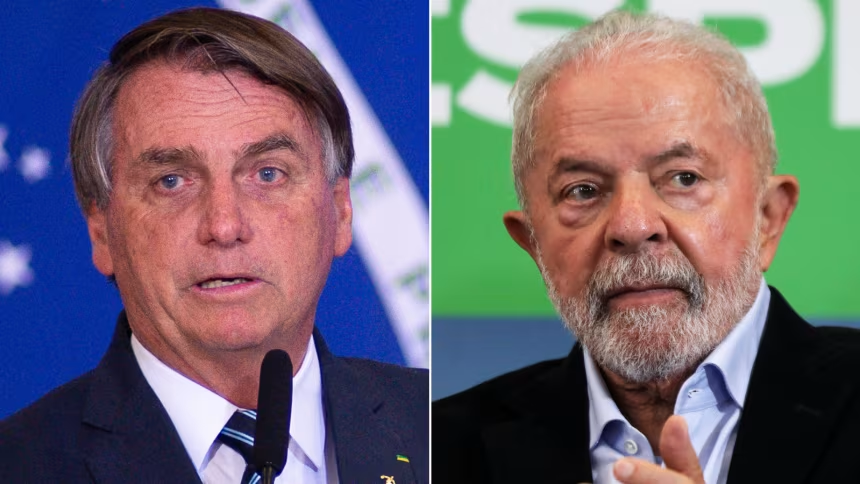
The best recent warning is 2022. That election was extremely polarized and unusually two-horse. Yet Lula still finished the first round with 48.43% of valid votes, while Jair Bolsonaro had 43.20%. Even in that environment, Lula did not clear 50%.
For the 2026 "Yes" contract to be fairly priced in the mid-teens, one has to believe the 2026 field will consolidate more than 2022, or that Lula will be stronger than in 2022, or that the right will fragment in a way that sends enough voters directly to Lula rather than to minor candidates. None of those is impossible. But current evidence does not make them the base case.
Why the market may be expensive
The mispricing may come from three places.
First, traders overreact to headline polling. A poll showing Lula at 46.6% feels close to a first-round win. But 46.6 is not 50, and the path from 46.6 to 50 is not automatic. It requires either meaningful minor-candidate collapse or a real shift from the opposing bloc. Neither is obvious from current crosstabs.
Second, traders treat polarization as consolidation. Brazil is polarized, but polarization can simply mean two large camps hate each other while a residual minor-candidate vote remains alive. That residual vote is exactly what keeps the leading candidate below 50.
Third, the market is thin and segmented. Polymarket’s contract has attracted only modest volume, while Kalshi has at times printed higher prices on very low volume. This is especially relevant because Brazil has recently taken a harder line against prediction-market platforms and political derivatives. If local participation is constrained, the market may be more influenced by global retail narratives than by domestic political microstructure.

Brazil Blocks Polymarket, Kalshi Over ‘Illegal Betting’
Things to watch out for
The first important date is June 16, when Brazil’s electoral authorities are scheduled to disclose the amount available in the Special Campaign Finance Fund. This matters because party financing helps determine whether minor candidates can remain viable enough to absorb first-round votes.
The second thing to watch out for is the July 20 to August 15 party convention and registration window. This is the field-lock period. If the ballot remains broad, the price of the first-round outright win contract should decay. If the field unexpectedly consolidates around Lula or Flávio, "Yes" deserves a repricing.
The third catalyst is the official free radio and TV campaign period from August 28 to October 1. That is when lower-information voters get pulled into the election and when minor candidates either prove durable or collapse into the two main camps.
Disclaimer: The content is for informational purposes only. You should not construe any such information or other material as legal, tax, investment, financial, or other advice. Nothing contained in this article constitutes a solicitation, recommendation, endorsement, or offer by the author(s) or any third party service provider to buy or sell any securities or other financial instruments in your or in any other jurisdiction in which such solicitation or offer would be unlawful under the securities laws of such jurisdiction. The author(s) report(s) no conflict of interest.