Polymarket has appointed a representative in Japan and is preparing to lobby for the authorization of prediction markets in the country, according to people familiar with the matter.
The global prediction market platform is aiming for government approval in Japan by 2030, the people said, asking not to be named as the plans aren’t public. Polymarket sees Japan as a large untapped business opportunity, they said.
Mike Eidlin is leading Polymarket’s Japan efforts, according to the people. Eidlin has been working as head of Japan at crypto firm Jupiter, according to his LinkedIn profile. He declined to comment on whether he is working with Polymarket.
Polymarket declined to comment on its activities in Japan. A representative for Japan’s justice ministry declined to comment on whether it has been in contact with Polymarket.
Polymarket enables users to bet on the outcomes of real-world events, such as elections, using cryptocurrencies. The company has thus far steered clear of promoting its services in Japan due to the country’s strict gambling restrictions.
The New York-headquartered firm currently blocks Japan-based users from placing bets on its website and app due to “regulatory requirements,” according to its geographic restrictions list.
Its Japan push comes as the company is under increasing pressure to expand its user base amid legal scrutiny in the US and rising competition from Kalshi Inc. and other rivals. Polymarket’s monthly notional trading volume on its offshore exchange and US app totaled $10.3 billion in April, a 9% decline from the month before.
Gambling has long occupied a legal gray area in Japan, with the nation’s Penal Code stating that habitual gambling is subject to punishment of up to three years in jail, while those running gambling businesses can be incarcerated for as long as five years. There are some regulated exceptions, including government-authorized horse racing and the public lottery.
A justice ministry representative declined to comment on the legality of prediction markets in Japan, adding that individual cases will be examined in light of the Penal Code.
Regarding its outlook for the Japanese market, a Polymarket spokesperson said it has seen “meaningful organic interest from users” in the country and across Asia. “We’re always evaluating opportunities to expand access globally in compliant and locally appropriate ways,” the spokesperson said.
Polymarket’s Japanese X account has more than 53,000 followers. The company plans to grow its presence in Japan by sharing news on social media while waiting for government approval, according to the people familiar with its plans.
While Japan heavily restricts cash gambling, it is home to the pachinko industry, in which users can win prizes from arcade-style pinball machines and other games. Pachinko operators do not offer cash payouts but players can convert prizes into real-money winnings at separate shops, thus skirting the gambling ban. Japan’s pachinko and slot machine market was worth around ¥16 trillion ($100 billion) as of 2024, according to data from the Japan Productivity Center.
Japan strengthened regulations against online gambling in 2025, prohibiting the domestic establishment and operation of online casinos. Nevertheless, the country is set to open its first casino resort, MGM Osaka, in 2030 after years of delays. The resort will operate under tight restrictions, including limits on floor space and steep entrance fees to discourage addiction.
Reports that OpenAI is set to confidentially file for an IPO as soon as Friday changed prediction market traders' outlook on which private AI giant will debut on the public markets first.
Traders on Kalshi now see OpenAI as the favorite to go public before Anthropic, giving it an 83% chance of getting the big payday first.
"Getting to public markets first is very important, given this arms race going on," said Dan Ives, Wedbush Securities' global head of technology research. "It sets a valuation, you're the first one to meet with investors on the road, and there's an advantage."
Before the initial report on the IPO timeline by the Wall Street Journal which CNBC later confirmed, traders gave OpenAI just over a 32% chance of beating its chief private rival to the public markets.
Chances Anthropic would beat OpenAI to an IPO collapsed on Polymarket to 20% from 69%.
While the birth of OpenAI's ChatGPT launched the AI bull market in November 2022, the company has lost some of its shine with investors.
Worries about the company's spending, reports on missed revenue and growth targets and leadership turnover weighed on investors' outlooks. There have even been internal disagreements on the timeline to go public, according to the Journal, with CEO Sam Altman pushing for a faster debut than CFO Sarah Friar.
At the same time, Anthropic's enterprise business has led it to experience massive growth in recent months, and reportedly is in talks with investors for a new funding round that would value the company at $900 billion, greater than that of OpenAI's latest valuation.
Investors became enchanted with Anthropic's Claude models, which have been constantly updated with new versions. Those updates were followed so closely by investors that they consistently moved the stock market in the beginning of the year, as worries about how new tools from Claude models would disrupt existing businesses mounted.
It was in late March when reports about an extremely powerful new model, Claude Mythos, circulated that Anthropic took a consistent lead over OpenAI on Kalshi of who would have a public debut first. Bloomberg reported around the same time that the company was looking to IPO as soon as October.
But with an IPO on the way — sooner than prediction market traders thought — and a court win against Elon Musk this week, it could be the moment for a turnaround, according to Ives.
"It started with the lawsuit," he said. "And now filing the IPO, that's a great one-two punch to start to put water on the negative fire that's been on them."
A huge options bet Tuesday on Brent crude prices plunging rattled oil traders already on high alert for unusual flows, as Iran war headlines continue to whipsaw prices and regulators probe suspicious trading.
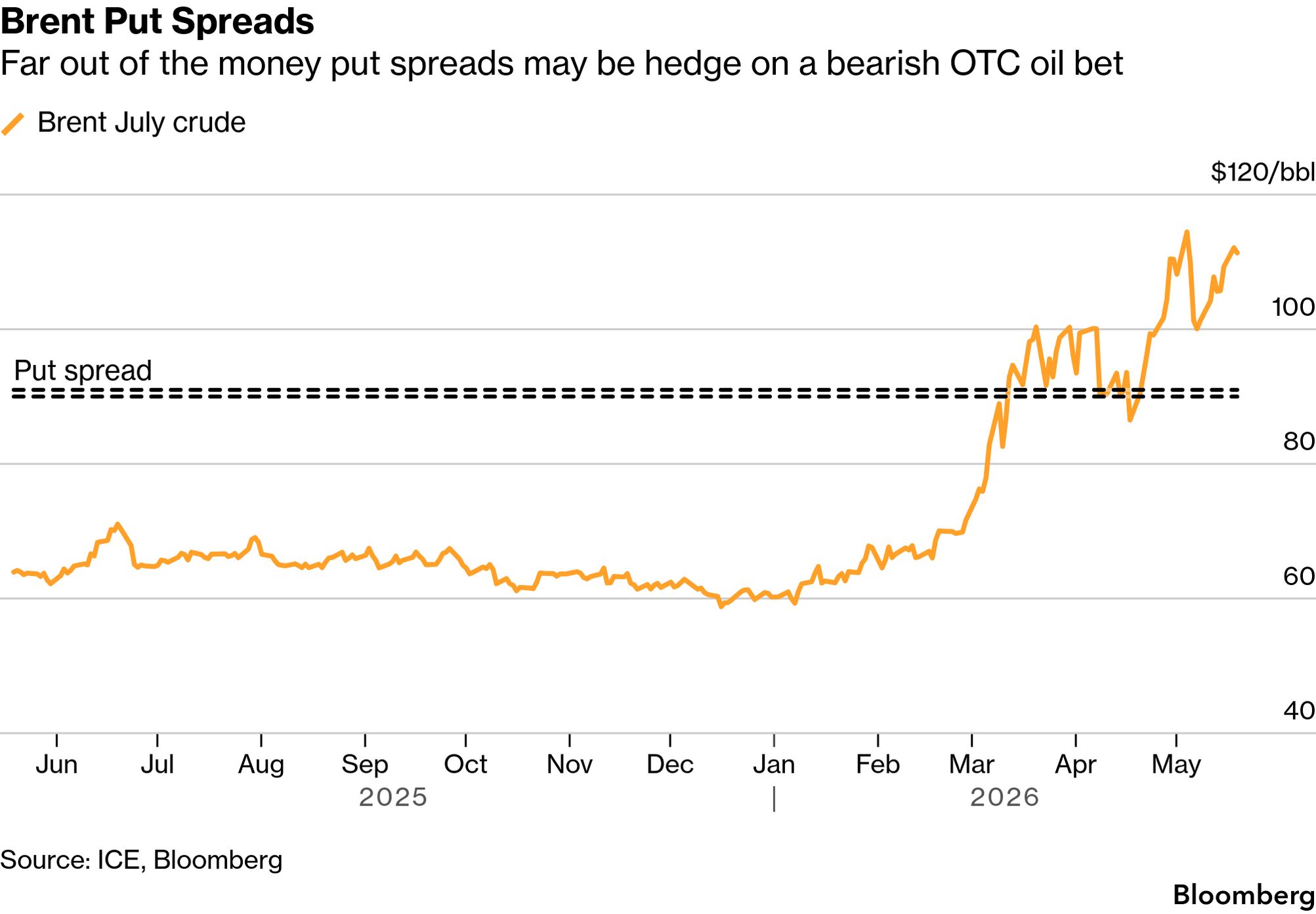
Put options equivalent to 134 million barrels of Brent crude oil traded in a single $91/$90 put spread transaction on Tuesday, according to data compiled by Bloomberg. A buyer of the spread would profit as much as $129 million if July futures tumble roughly 19% from their current level by the May 26 expiration.
Though the purpose of the trade remains unclear, call and put spreads with very narrow strike ranges are often hedges for over-the-counter binary, or digital, option trades. Another use could be hedging an event-contract trade on a prediction market such as Kalshi or Polymarket.
Even as the US-Iran conflict drags into its 12th week, traders have consistently priced in the possibility of an abrupt deescalation, including a deal under which Iran reopens the key Strait of Hormuz. The call skew, or premium traders are willing to pay for options betting on a further rally, has shrunk to the smallest level since before the conflict.
Still, the large, hard-to explain volumes raised eyebrows in a market already on edge. Multiple instances of well-timed oil trades ahead of proclamations or social media posts by President Donald Trump have sparked market-wide speculation and even prompted a Department of Justice probe. Even as firm evidence remains elusive, traders surveyed by Bloomberg report declining confidence in the oil market’s integrity, compounding risk-off sentiment in an already volatile geopolitical environment.
Later in the session, 30 million barrels of July $92/$90 put spreads also traded on ICE, along with another 26 million barrels of the same spread on a similar contract on CME Group.
Polymarket plans to use data from Nasdaq Private Market as it seeks to expand bets on unlisted companies amid a frenzy of retail investor interest.
The prediction markets platform said in a statement on Tuesday that it has signed an exclusive partnership with Nasdaq Private Market, which will provide data to resolve event contracts covering topics such as valuations, activity in secondary markets and the timing of initial public offerings.
Nasdaq Private Market was spun out from Nasdaq Inc. in 2021. According to its website, investors include the exchange operator, as well as Morgan Stanley, Citigroup Inc. and Goldman Sachs Group Inc.
Individual investors have been largely cut off from the exponential growth of private companies like OpenAI and SpaceX. By the time the companies list on the stock market, much of their value has already accrued to large venture capital firms or insiders.
That has led some retail investors to turn to largely unregulated secondary markets where employees and early investors sell shares of private firms. Last week, in a warning to traders, Anthropic PBC identified a number of secondary marketplaces as unauthorized sellers of the company’s shares.
Polymarket already offers betting on some events involving private companies. For example, a contract on what OpenAI’s closing market capitalization will be on its first day of trading has attracted roughly $1.6 million in trading volume since it was first offered in September.
Polymarket and Kalshi Inc. have been allowing customers in India to sign up and trade on their prediction markets even after the country’s technology ministry warned that the platforms are illegal.
India’s Ministry of Electronics and Information Technology said in a letter last month that users are accessing “illegal and blocked prediction market and online betting platforms,” despite “domestic prohibitions.” The advisory, posted on the ministry’s website, pointed specifically to “Polymarket and a few other similar sites,” which it said are supposed to be cut off by internet providers.
The letter, which was dated April 25, was addressed to providers of virtual private networks, which the ministry said were being used to circumvent restrictions. The agency told the providers that they would have “exposure to consequential legal action” if they allowed access to the venues. A new Indian law meant to curb online gambling countrywide went into effect on May 1.
A Kalshi spokesperson said it had no comment on the technology ministry’s advisory, or the volume of trading it receives from India.
Kalshi’s legal counsel, Valeria Vouterakou, said the company has been in communication with the Indian government and has not been told to shut down. In the meantime, it is taking new customers. Like Kalshi’s US-based customers, they are required to go through identity checks before trading on the platform.
“We will comply with the government’s requests should they make them,” Vouterakou said.
Polymarket does not include India on its list of restricted countries. A spokesperson for the company said it is “committed to complying with applicable laws and regulations across all jurisdictions in which it operates. We maintain geoblocking measures to restrict access in jurisdictions where our services are not permitted, and we continuously evaluate and update those measures.”
The technology ministry did not respond to multiple requests for comment.
Cricket Wagers
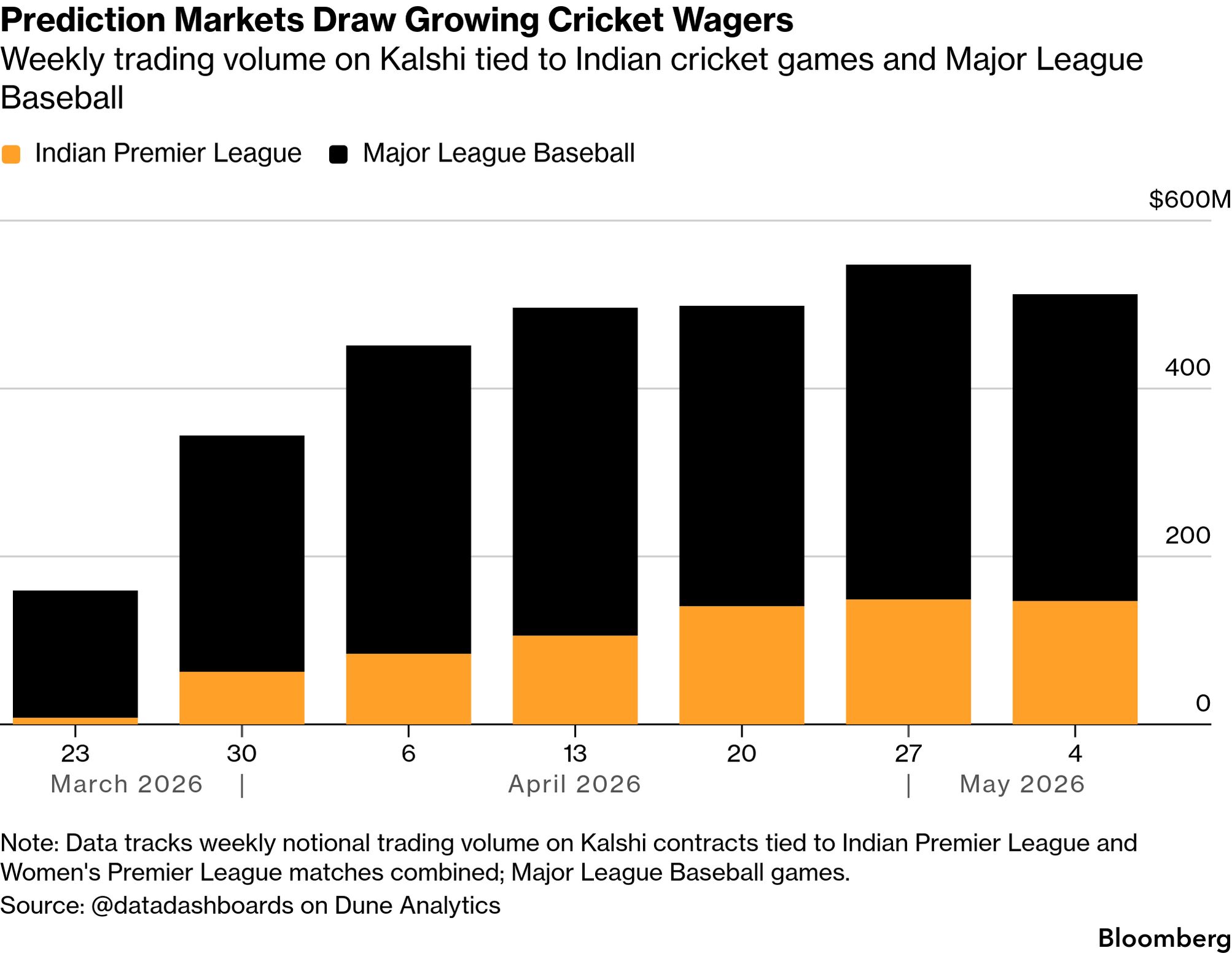
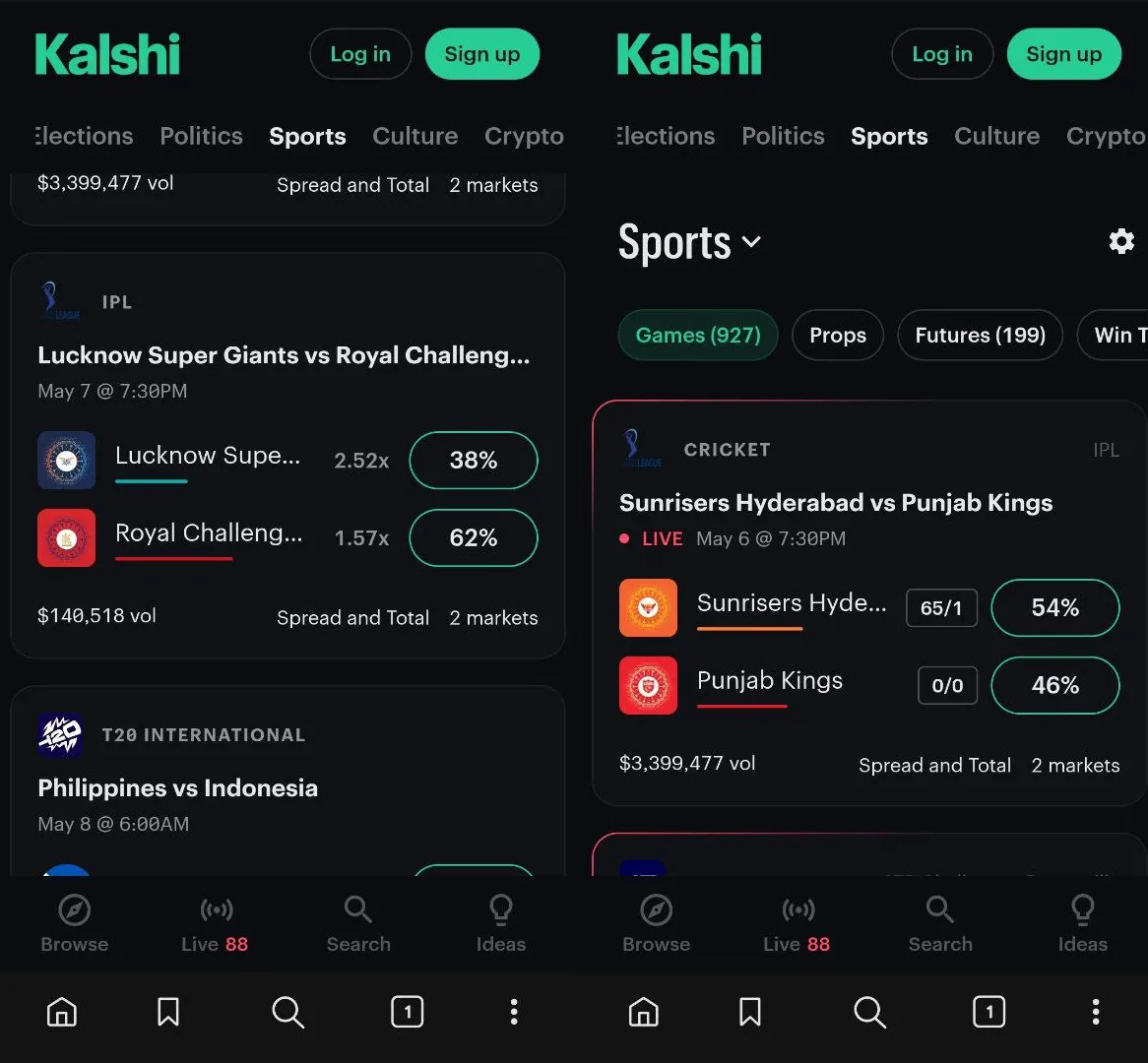
Kalshi has drawn significant wagers on Indian Premier League matches since the current season began in March, approaching half the trading volume on US baseball games on some weeks — though the data does not indicate how much of this comes from inside India. A May 7 match between Lucknow Super Giants and Royal Challengers Bengaluru attracted $27.7 million in trading on Kalshi and Polymarket.
Kalshi and Polymarket have recently emphasized their adherence with US laws as they push to go mainstream. At the same time, the ongoing business in India underscores the willingness of these startups to push the boundaries of local laws as they race to expand around the globe and draw customers to this new form of online betting.
After raising funding last year, Kalshi said it had expanded from its home base in the US to 140 countries around the world, including India. There is, though, little legal clarity in many jurisdictions on the status of event contracts — the financial instruments that allow traders to place yes-or-no bets on the outcome of various events, including sports, elections and geopolitical conflict.
Brazil Ban
Access to Kalshi in Brazil was blocked by the government last month soon after the company announced its launch in the country. In the US, Kalshi and Polymarket have offered their services nationwide, in the face of state regulators who have alleged that they are violating state gambling laws.
The Commodity Futures Trading Commission has supported the platforms in their court battles with states and said that event contracts should be regulated in the US as financial derivatives at the federal level. The CFTC declined to comment when asked about Kalshi’s overseas operations.
Some regulatory experts said that the situation in India is more black and white because of a new national law that was passed last August and went into effect on May 1 — known as the Promotion and Regulation of Online Gaming Rules — that put a broad ban on what it referred to as “online money games.”
“Polymarket, Kalshi and other prediction markets would obviously fall under online money games under PROGA, and therefore there is a blanket ban,” said Jay Sayta, a Mumbai-based technology and gaming lawyer.
Sayta said most domestic platforms stopped operating soon after parliament passed the law last year. Banks and financial institutions were uncomfortable with the financial liability of dealing with them, he said. One local platform that described itself as offering “opinion trading” now has a message on its website that says: “In light of PROGA, Probo is closed for business.”
Kalshi and Polymarket both take deposits in dollar-denominated stablecoins that move on blockchain-based financial rails. The technology ministry said it was concerned about the use of stablecoin payments to enable illegal trading.
“This raises serious concerns relating to unlawful online betting, circumvention of regulatory frameworks, potential financial risks, and threats to public order and economic integrity,” the ministry said in its advisory.
Previous Warnings
Even before the new law went into effect, Indian regulators had issued warnings about the legality of prediction market platforms. The Securities and Exchange Board of India publicly cautioned investors last year that the products on “opinion trading” platforms offered “no investor protection mechanism” and were not overseen by the agency.
“SEBI has clearly stated that it does not recognize these products and has issued warnings about them,” said Rahil Chatterjee, principal associate at Ikigai Law’s government affairs and public policy practice. “That effectively leaves platforms with limited regulatory cover. In some cases, this may simply reflect an enforcement gap rather than a clear legal gray area.”
Polymarket is in a distinct legal situation because it operates entirely on a cryptocurrency-based network and does not perform any identity checks on its customers. The company blocks customers coming from US-based internet addresses, but US customers have said they circumvent those rules by using virtual privacy networks.
At least some Indian internet providers are blocking access to Polymarket’s website. But on the company’s official Discord chat room, users have swapped tips in recent months on how to get around the country’s block on its website by changing their DNS server to a generic Cloudflare service, obfuscating their true location.
Lawmakers around the world have expressed concern about prediction markets bringing online betting to new audiences. Recent research has indicated that most traders on the platforms lose money. In announcing the implementation of the new law this month, the Indian government said that online gambling platforms “have raised serious concerns due to reports of addiction, financial losses, money laundering and even suicides.”
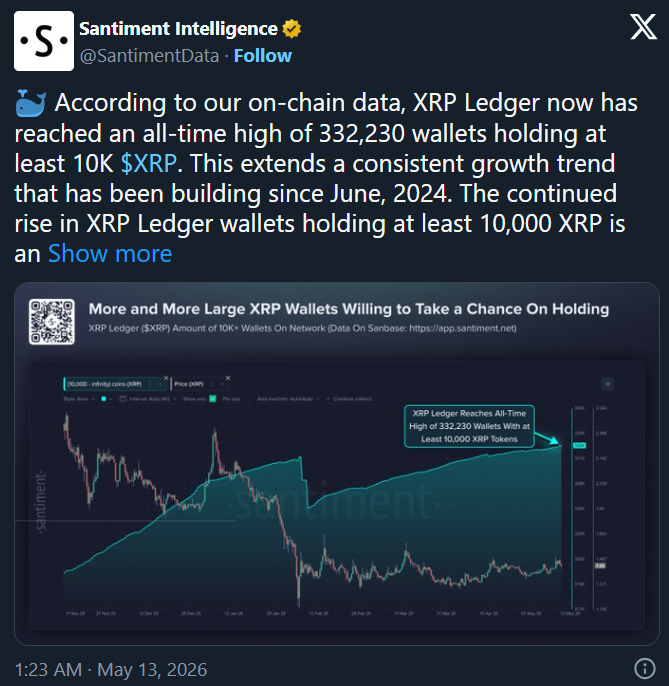
Although the price of XRP has been moving flat recently, on-chain data shows that whales have been buying this coin behind the scenes. Notably, there are now 332,230 wallets that hold over 10,000 XRP coins. This is a new ATH for XRP.
Not only that, this milestone is interesting since it shows that mid-sized and larger holders keep buying XRP even though it struggles to break out at the moment.
XRP Whale Wallets Continue Growing
According to an X post from Santiment, XRP Ledger has reached an ATH of 332,230 wallets holding at least 10,000 XRP coins. They claim this is an important long-term signal for the market.
The rise in wallets holding at least 10,000 of a coin is seen as a positive indicator because it suggests they are focused on long-term value rather than short-term speculation. This is encouraging for XRP since these mid-to-large sized holders have been accumulating this crypto even during price dips.
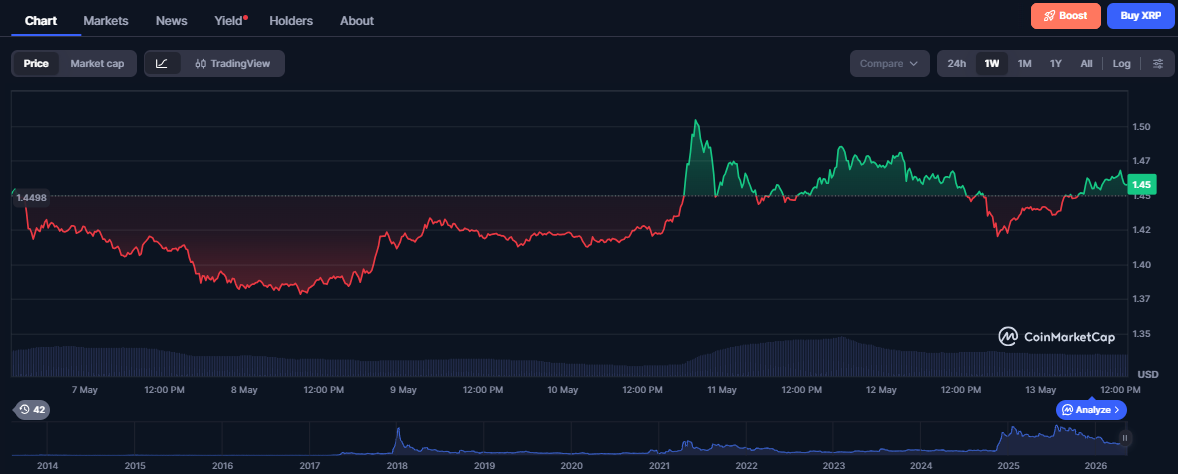
The XRP price has not been doing great despite record wallet numbers. CoinMarketCap shows that the price of XRP has been trading flat between $1.44 and $1.45 in the past seven days. This can be seen as a correction since its value has surged over 10% on the one-month chart from $1.32.
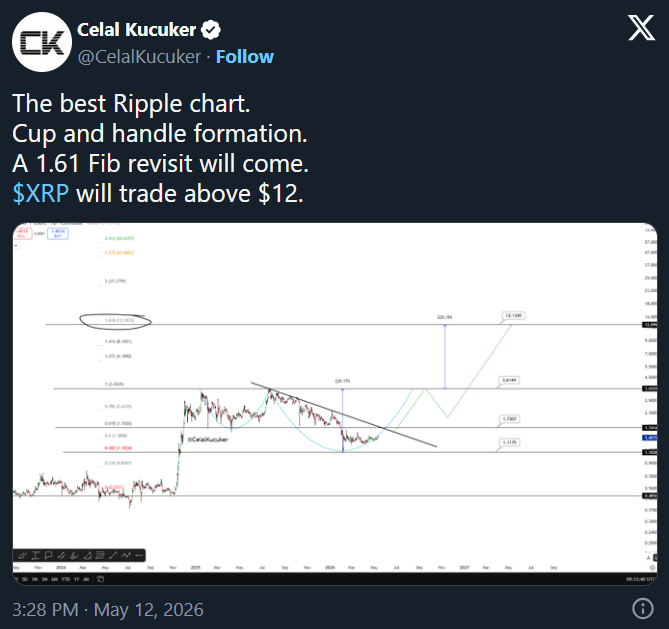
However, there is still bullish market sentiment for XRP as prominent influencers remain optimistic. For instance, Celal Kucuker made an X post saying that the XRP price has the potential to reach $12 by 2027. He projected XRP reaching $2.40 in January of 2026 and then $1.10 in February. Both predictions give credibility to his roadmap. He bases this prediction on the fact that this crypto may now be forming a cup and handle formation.
For those unfamiliar, the cup and handle is a bullish indicator where the price action carves out a U-shaped "cup" followed by a slight downward-drifting "handle". A breakout above the handle's resistance level signals an upside move. This suggests XRP may now be taking a brief pause before likely continuing its rally.
But, Celal also notes that the XRP price must go past the long-term resistance level of $3.65 for this bullish thesis to play out. Currently, the immediate resistance level that traders should watch is $1.46. If XRP manages to break past this level, it could go to $1.50. On the other hand, the immediate support sits at $1.42. If a dip happens, the price of XRP could drop as low as $1.38 which is its critical support level.
Technical Analysis Paints a Mixed Picture for XRP
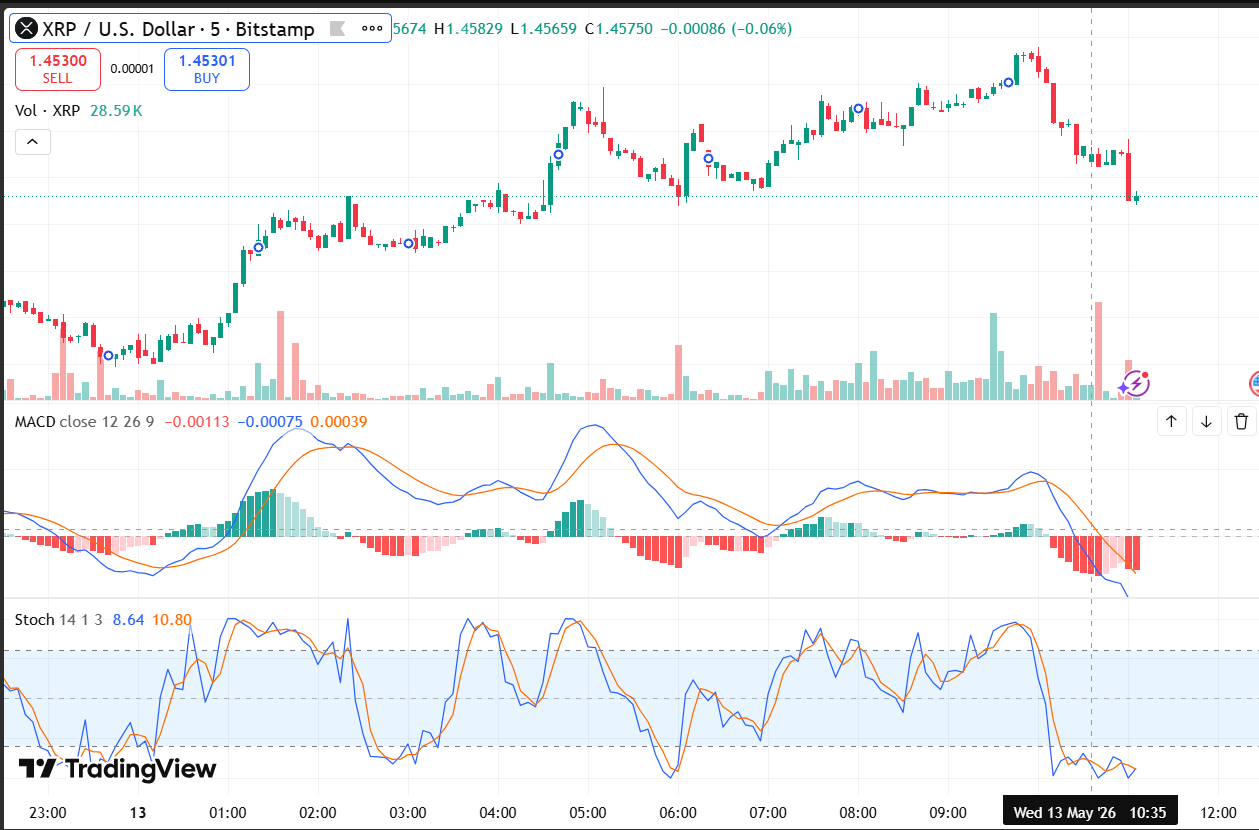
Amidst the positive wallet growth data, XRP’s technical indicators are showing mixed signs. For instance, TradingView data shows that the MACD (12,26) indicator is currently bullish with a value of 0.00039. Its 12-day EMA is now sitting above its 26-day EMA, which suggests the upward momentum is strengthening.
Nevertheless, the 14-day stochastic oscillator now shows that its main momentum line sits at 8.64 while its signal line is at 10.80. Typically, a stochastic reading of 20 or below means overselling and thus the coin is likely due for a bounce. However, because the signal line is still above the main line, it shows that downward pressure is building. These indicators combined may suggest that XRP could continue trading flat for the time being.
Bigger Holders Continue Betting on XRPc
Santiment data shows that big holders/whales continue believing in the long-term potential of XRP despite its lack of explosive price movement. Wallets with more than 10,000 XRP hitting ATH means accumulation has continued. It is a useful indicator for mid-sized XRP holders as it captures the collective behavior beyond just big whales. This shows that the middle class of investors is focusing on building positions for an expected XRP breakout.
This does not guarantee an increase in the price of XRP. Right now, the focus should be on the price point of $1.4620. If that resistance level becomes a support level, we could see a really strong upward move for XRP to the $1.50 level. Do you think the XRP price can break through the $1.50 resistance level or will we see another rejection in the future? Let us know what you think.
All eyes are on Nvidia, the world's most valuable company and artificial intelligence trade darling, as it is set to report fiscal first-quarter earnings on Wednesday after the closing bell.
On its conference call, traders on prediction markets platform Kalshi think the company might talk about President Donald Trump after CEO Jensen Huang joined him on his trip to China.
Trump has 50-50 odds of being mentioned on the call, with the chances rising recently. The president wasn't mentioned on the company's last earnings call in February. Huang joined Trump for his summit in Beijing with Chinese President Xi Jinping.
Huang's presence on the trip came as the status of Nvidia's H200 chip sales in China remains uncertain.
Trump told reporters last week that the chip model didn't come up in discussions with China, but Reuters reported that the U.S. government gave approval to several Chinese firms to purchase the model. China, though, hasn't allowed firms to purchase the chip, Trump claimed to reporters.
In January, Trump cleared the way for Chinese purchases of the chip model. That came with a 25% tariff on imports for chips that will be sent to China. There's a 57% chance the company mentions tariffs on its call on Wednesday.
But after the trip to China, traders place just an 11% chance that Nvidia mentions Taiwan. After the U.S.-China summit, neither country revealed if Trump or Xi discussed Taiwan, which is home to critical chip manufacturers. Traders now only place 15% odds that the company discusses Taiwan Semiconductor Company, down from previously a 78% chance.
And there's a 55% chance the company will discuss humanoid robots. In his keynote address at the CES Trade Show in January, Huang said he expects to see robots with some human-level capabilities this year. This would be a new feature of the Nvidia calls as that topic didn't come up in the company's February earnings call.
Cerebras Systems’ explosive Nasdaq debut has propelled the chip designer into the $100 billion club, boosting AI infrastructure landscape yet again, as it pivots from hardware sales to a direct cloud offensive against titans like Google and Microsoft. With OpenAI once eyeing the company as a "secret weapon" for AGI, this valuation milestone may only be the beginning of a massive capital markets supercycle, paving the way for highly anticipated public offerings from industry heavyweights like SpaceX, OpenAI, and Anthropic. What’s your take on the rally? Who’s going to be the next?
Welcome to the USD100B+ Club…
Listed at USD185/share, Cerebras Systems’ (CBRS) jumped 90% above its offering price in the NASDAQ debut on May 14th, 2026, giving the chip designer a valuation of USD106.75B on a fully diluted basis (Reuters).
In 2017, OpenAI looked at merging with Cerebras, viewing the chip company as potentially beneficial in the pursuit of artificial general intelligence, or AGI, according to testimony in Elon Musk’s trial against OpenAI. “Exclusive access to Cerebras hardware would give OpenAI an overwhelming hardware advantage over Google,” Greg Brockman, OpenAI’s co-founder and president, wrote in an email (CNBC).
Looking ahead, Cerebras had started shifting its focus away from selling hardware systems and more toward providing a cloud service based on its chips. That means it’s going up against cloud providers such as Google and Microsoft, which are both listed as competitors, along with Oracle and CoreWeave (CNBC).
What’s Next, for CBRS & for Capital Market as a Whole?
It seems there are more to come for CBRS - “There’s some whales out there, there’s some really big customers,” Cerebras CEO Andrew Feldman told CNBC in an interview on Thursday. “That is one of the characteristics of this market.” - So, will the stock price rally-on?
With promising tech players allegedly in the pipeline - SpaceX IPO prospectus could land as soon as next week, sources say, according to CNBC (CNBC).
Meanwhile, the market is gearing up for model developers OpenAI and Anthropic that could hit the market later this year (CNBC).
Look out for those names to pop-up on headlines! Will Cerebras double again? Who’s going to be the next star of the show?
And more... Drop us a comment on what the market should be looking at! Your choice could shape the consensus!
Will Cerebras Systems (CBRS) Stock Price Hit USD555/Share (triple of IPO listed price)?
on or before May 31th, 2026 market close (regular hours)Result
42.86%
on or before June 30th, 2026 market close (regular hours)Result
28.57%
beyond June 30th, 2026 market close (regular hours)Result
28.57%
14 Polls
EndedTBD
Will SpaceX stock price double (vs IPO) in 2026?
YesResult
69.23%
NoResult
30.77%
13 Polls
EndedTBD
What's the favorite AI models (mutiple)? (drop us a comment on your favorites)
People used to predict a great future for prediction markets. In 2008, 22 economists, including the Nobel laureates Kenneth Arrow, Paul Milgrom, Thomas Schelling, Robert Shiller and Vernon Smith, wrote a two-page manifesto in the journal Science calling them a “potent research tool” that must be freed from “unnecessary government restrictions.”
They cited “mounting evidence” that such markets could produce more accurate forecasts than conventional methods:
“Prediction market prices can be used to increase the accuracy of poll-based forecasts of election outcomes, official corporate experts’ forecasts of printer sales, and statistical weather forecasts used by the National Weather Service.”
In 2004, the University of Michigan’s Justin Wolfers, one of the signatories, co-wrote what is still the most widely cited paper in the field, showing that betting markets persistently forecast presidential elections more accurately than pre-election polls. Such markets had been around for centuries — in 16th-century Rome there was even a flourishing market to identify the winner of papal conclaves — and were consistently successful. But at the time state gambling laws formed “significant barriers” to “vibrant, liquid prediction markets” in the US.
The manifesto said:
“The first step in helping prediction markets deliver on their promise is to clear away regulatory barriers that were never intended to inhibit socially productive innovation.”
Their idea went nowhere. In 2013, US regulators even closed off Americans’ access to Ireland-based Intrade, then the biggest prediction market operating in the US. Trading on political outcomes continued for small stakes on the non-profit exchanges run by universities and licensed by the Commodity Futures Trading Commission (CFTC).
Then came an October 2024 appeals court ruling that futures tied to the outcome of the following month’s congressional election offered by Kalshi Inc., a New York-based futures exchange, were not gambling, and that the CFTC should not block them. Prediction markets have boomed ever since, led by Kalshi and its chief rival Polymarket, also based in New York, which operates a blockchain-based betting platform from Panama.
But in the last few months, academic research has suggested the great experiment is not going as the manifesto writers had hoped. The good news is that the markets generate accurate political and economic forecasts. The bad news is that the costs — particularly the harms done by gambling — are sizable.
The economists wanted markets devoted to matters of public interest, with stakes limited to $2,000 ($3,000 in today’s dollars). The markets Kalshi and Polymarket have built to date look very different. Wolfers himself laments that “the future we are in isn’t the future I imagined.”
The Prediction Market Boom
Since October 2024, Kalshi — slogan: “Trade on anything” — and Polymarket have enjoyed parabolic growth.
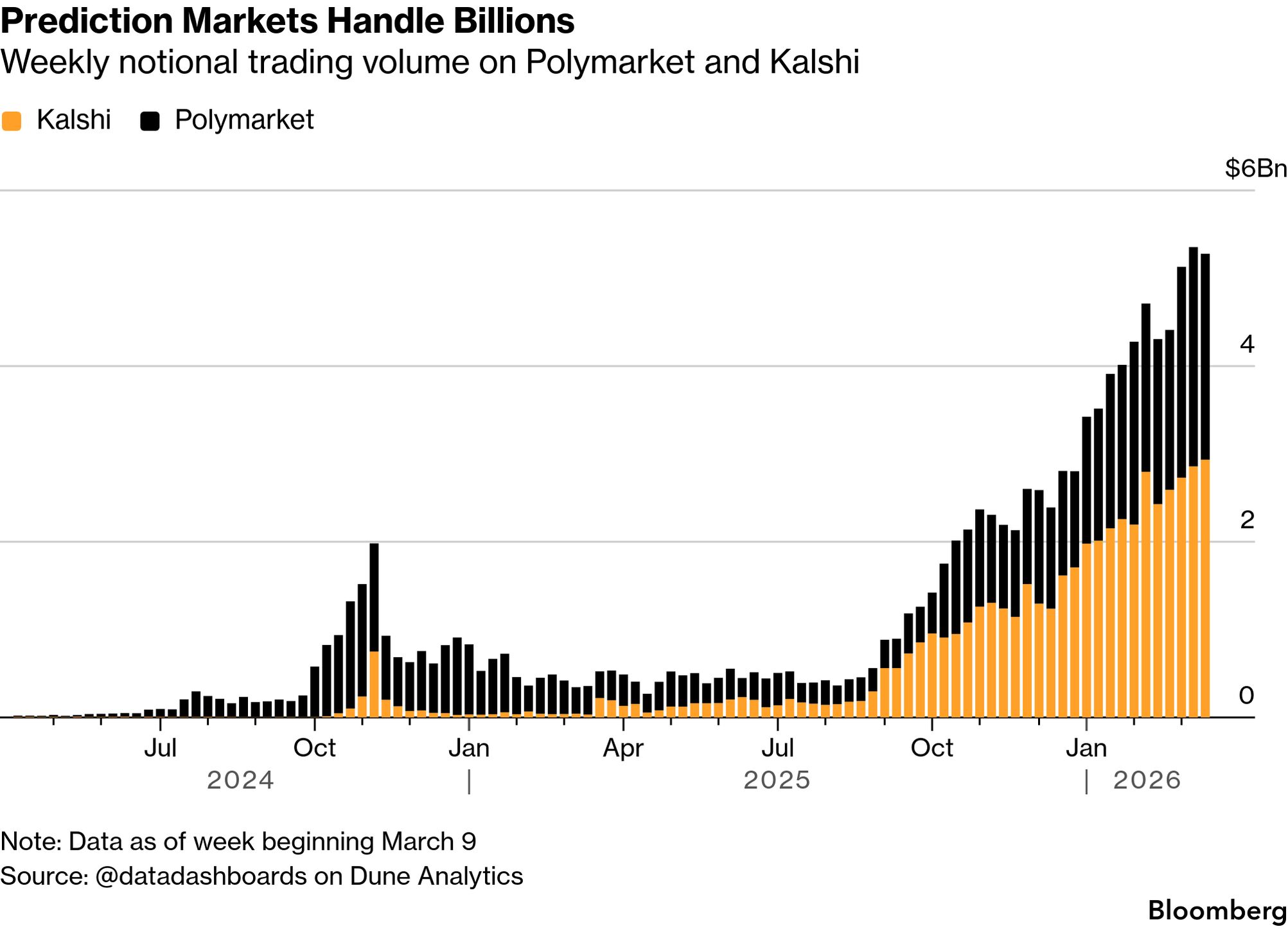
The crypto analytics group TRM Labs shows that monthly trading on these and other prediction markets rose from $1.2 billion in January 2025 to more than $20 billion a year later. The face value of bets is now close to $30 billion. According to Bank of America, Kalshi is the fastest growing non-AI company; in March 2026, it raised $1 billion at a $22 billion valuation. Polymarket is currently looking to raise funds at an implied value of $15 billion and is reportedly seeking regulatory approval to operate its main exchange in the US.
Removing regulatory barriers has sparked innovation, but not the kind the Nobelists had in mind. They proposed that CFTC-regulated markets would “presumably not include contracts on the outcomes of sports events” — but sports accounts for more than 80% of Kalshi’s trading. Dan Schwarz, who set up Google’s internal prediction market, describes Kalshi as “effectively a sports gambling website with a small prediction market attached.”
On any day, if you go to Kalshi or Polymarket’s home page, you are confronted with chances to bet (through a futures contract) on the results of sports games.
Kalshi, in an emailed statement, distinguished between games of pure chance — like roulette and blackjack — and activities where speculation has social value. Sports outcomes can have tangible effects on industries and local economies, and so sports contracts have, in the company’s estimation, “more than enough social utility.”
Kalshi also offers so-called “mention markets,” where contracts pay out if a public figure uses a particular word in a speech; this encourages young bettors to watch press conferences with the fervor of spectators at the Kentucky Derby. As the satirist John Oliver documented brilliantly, it’s hard to perceive social benefits.
To limit gambling’s social harms without obstructing political and economic predictions, the professors wanted Congress to set rules:
“Because Congress did not intend the CFTC to regulate gambling, it is important to design new regulations so that socially valuable prediction markets easily qualify for safe harbor but gambling markets do not.”
This didn’t happen. Instead, Kalshi, Polymarket and others have merged the two, and their future now rests on a turf battle between the states, who regulate gambling, and the CFTC, which oversees derivatives markets.
‘It’s Simply a Bet’
Like alcohol, tobacco or pornography, gambling is a vice that will never go away, and which consenting adults should be free to enjoy — within limits set by the public. Precedent is clear that the US Constitution gives states that right.
Prediction markets currently gain a huge advantage over sports betting groups by avoiding state regulation. They don’t pay gaming taxes, which according to Bank of America can reach 33%, and there are still 12 states — including California and Texas — that ban sports betting outright. Prediction markets also get to catch customers at 18, rather than waiting until they turn 21, as required by most states, including even Nevada, before they can legally bet.
The explosion of sports betting, since a Supreme Court ruling in 2018 gave states the right to regulate it, is already causing serious social harm. The New York Federal Reserve found that the number of people under 40 whose loans were delinquent has risen by a full percentage point more in states that legalized gambling than those that didn’t. Among bettors, the number who are more than 90 days late with loan repayments has doubled.
Now both red and blue states want to block what they see as a loophole to addict teenagers to gambling. Utah’s Republican governor says flatly that prediction markets are “illegal” in the state, and its attorney general, Derek Brown, rubbished the notion that they’re not gambling: “It’s simply a bet, dressed up in different clothing.”
However, the federal CFTC is tasked with regulating speculative futures markets, and its new chairman Michael Selig has aggressively asserted jurisdiction. Launching a consultation on new rules for prediction markets, he said:
that these markets… have the integrity and resilience and vibrancy that our derivatives markets deserve. To those who seek to challenge our authority in this space, let me be clear: We will see you in court.”
Now that Congress has missed the chance to draw the line, courts are doing so. The Third Circuit appeals court on April 6 ruled in Kalshi’s favor against a New Jersey attempt to regulate its contracts as sports betting, on the basis that the law gives the CFTC the job of regulating contracts that hedge economic outcomes. On its face, it would seem impossible for anyone to hedge a sports result without athletes betting against their own team, which has been prohibited in US life since at least the 1919 World Series. But over a strong dissent, the appeals judges argued that sports outcomes can have “financial, economic, or commercial consequences” for people such as “sponsors, advertisers, television networks, franchises, and local and national communities.” The ruling means that it will now almost certainly fall to the Supreme Court to define gambling.
Defining Gambling
The boundary where investment and speculation cease and gambling begins is notoriously difficult to define. Few can improve on Justice Potter Stewart’s infamous statement in a 1964 opinion that he could not define hard-core pornography “but I know it when I see it.” And to quote the Better Markets advocacy group, which steadfastly opposes liberalizing the sector: “Everyone should go on Kalshi and see for themselves whether it looks like sports betting or derivatives trading.” Kalshi’s advertising makes it almost impossible to distinguish its offering from sports gambling sites like DraftKings and FanDuel.
The first retort is that Kalshi, Polymarket and the others are structured as futures markets, with different traders taking either side of the trade. No house is guaranteed to win overall as in a casino.
But academics are chipping away at that claim. Kalshi and Polymarket need market makers to offer contracts and provide liquidity. In stocks, market makers protect themselves with the bid-offer spread, or gap between the prices at which they buy and sell. But in prediction markets every contract ends at either zero or 100 cents on the dollar, and the massive move when the contract settles will swamp the bid-offer spread. In particular, it should be impossible to get markets in contracts where some bettors may have inside information off the ground.
Research by Stanford University analyzing 41.6 million trades on Kalshi explained this conundrum by finding that the supply of optimists — Stanford’s Robert Bartlett, who led the research along with Maureen O’Hara of Cornell, told me that the words “mugs” or “suckers” would also be appropriate — is so great that market makers do as well as the house would in a casino.
“If you didn’t have the optimists subsidizing it, you wouldn’t have a market as market makers wouldn’t be able to make money,” Bartlett says. This is particularly true of the most contentious “single name” contracts, where some must have better information than others. These are distinct from “broad” contracts on which nobody has decisive private knowledge, such as where the S&P 500 will close or what the next CPI print will be.
On single-name contracts, makers win 63.4% of the time according to their study, more than making up for the bigger losses they suffer when they lose. Winners are confident, possibly because of inside knowledge — but so many mugs bet against them that it’s still possible to make a market. The gap is much narrower in broader contracts, which Bartlett views as “more of a fair bet.”
That looks like potent evidence that current regulation is insufficient. The political risk consultant Ian Bremmer, who founded the Eurasia Group, puts this in trenchant terms:
“Every dollar won by an insider comes directly from the pocket of a schmuck who’s under the impression they’re participating in a forecasting exercise. If a few insiders dominate a market, the suckers taking the other side of their trades will keep losing and eventually run out of money.”
What Bartlett calls the “optimism tax” allows insiders to profit. “These people derive a lot of utility from this betting, just as they do from horse-racing, but this isn’t the market that Wolfers and the others had in mind,” he says.
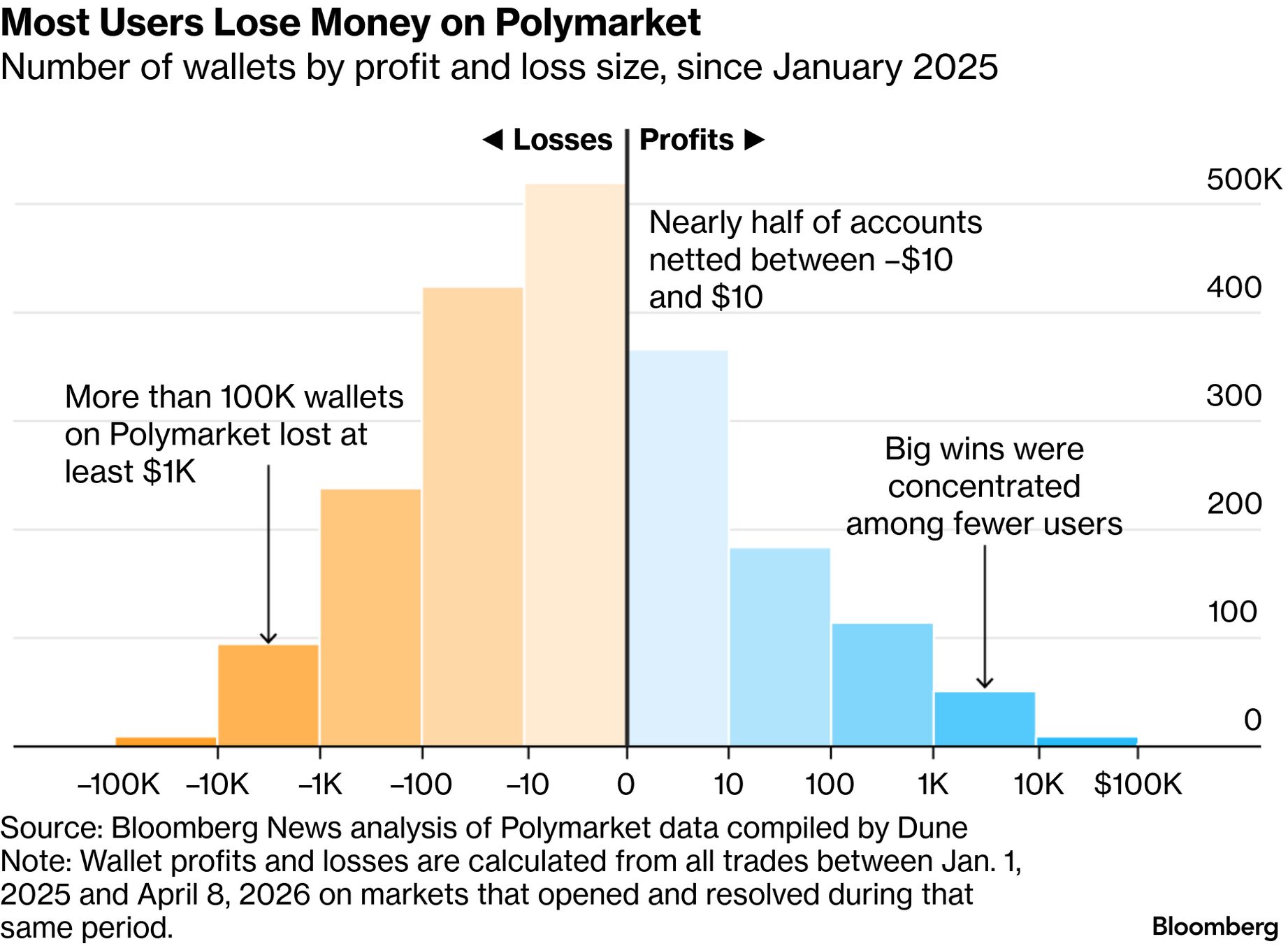
Researchers are now confirming that a great majority of accounts are losing money. Analysis of Polymarket returns by Bloomberg News found that more than 100,000 accounts lost at least $1,000 since the start of last year, almost twice the number that made that much. Most profits were made by “a small group of automated bots, with everyone else losing $131 million in aggregate,” according to Bloomberg’s analysis. Similar analysis of Kalshi by The Wall Street Journal found that “everyone loses — except a few sharks.”
Research led by the University of Toronto shows that since 2022 around 69% of traders on Polymarket lost money, with three quarters of the profits going to the top 1%. Researchers at Columbia University and the University of Haifa amplified this by crunching through 93,000 distinct markets on Polymarket looking for anomalies where insider trading appeared to be in play — and found approximately $143 million in “aggregate anomalous profit” in two years.
Polymarket disputes the idea that most of its users lose money. Eighty percent of users have a profit or loss within plus-or-minus $100, it said in an emailed statement. Those returns “split roughly evenly between gains and losses,” the company said, with “materially more large winners than large losers” and “with fewer than 2% of users recording losses greater than $1,000 compared to more than 5% posting winnings above $1,000.”
Still: If this isn’t gambling, it sounds a lot like it. The odds are stacked against the public just as much as they are in a casino. Why not, then, regulate them as casinos?
Both Kalshi and Polymarket argue that prediction markets are more accessible than traditional financial markets, allowing everyday users to participate in subjects that matter to them rather than esoteric asset classes dominated by professionals. Kalshi said that a “skill gap among participants” exists in all financial asset classes, while Polymarket said that “every competitive market rewards participants with greater experience, skill, and faster execution.”
The best defense of these markets, however, lies in the benefits the economists laid out in 2008.
Hedging
Hedging is a public good that justifies extremely speculative behavior. For example, many traders in oil futures have no direct stake in oil. They are placing bets much as Kalshi bettors bet on the World Series. But their presence allows exporters and oil producers to manage risks and lock in prices. The hope is for big, liquid prediction markets to allow a company that stands to be harmed if Candidate X wins an election to buy insurance.
This remains largely theoretical, and blatantly doesn’t apply to many, if not most Kalshi and Polymarket contracts. Nobody needs to hedge against the risk that the broadcasters say “Alley-oop” at the next Timberwolves vs. Spurs basketball game (a Kalshi market on which $25,000 is at stake at the time of writing).
But the appeals courts judges ruled that sports were economically relevant, and in its statement Kalshi says that institutions are hedging commercial risks related to sports outcomes on its platform:
“For example, via sports insurer Game Point Capital, teams are hedging against contract incentive payouts. In the contracts of many coaches, there are bonuses that trigger depending on the stage of the post-season the team is able to reach. Teams that do not want to suffer the full impact of the bonus, or simply do not want to deal with the volatility, are hedging these outcomes via Kalshi.”
Skepticism remains. “They are not taking out insurance,” Wolfers told Australia’s Financial Review, of the typical market participant. “They’re taking a bet.” He sees little sign that many people are using these markets to hedge. But there are possibilities for the future. Koleman Strumpf, an economist at Wake Forest University, laid out the potential of real estate contracts:
“A homeowner who plans to sell their home at a future date could use a prediction market contract linked to local real-estate conditions to reduce their uncertainty and lock in a price. This is distinctive from pure gambling, such as state-run lotteries, which do not provide such social benefits.”
Such contracts are already traded on both Kalshi and Polymarket but remain embryonic and lack the volume to hedge even the price of one house (the volume on Kalshi’s contract to predict April US existing home sales is $3,600). It’s hard to imagine them ever reaching the scale to allow large companies to hedge big macroeconomic risks.
Macro-Accuracy
The Nobel laureates’ other critical argument concerned accuracy, built on a rich tradition of free-market theory dating back at least to Friedrich Hayek. Markets, where people have skin in the game, concentrate minds and synthesize the existing wisdom better than anything else. Tarek Mansour, CEO of Kalshi, summons Hayek in arguing for his company’s services:
“[Hayek] argues that information is fragmented, local, dynamic, and often hidden. No government or central planner can ever fully possess it, which makes them inefficient resource allocators. He proposes markets as the solution: knowledge is decentralized and prices are how society aggregates it. This idea is the intellectual foundation of modern prediction markets.”
The accuracy of Kalshi and Polymarket forecasts has improved still further as they’ve grown. Barclays equity researchers analyzed the Polymarket contracts quoted on Bloomberg to mature so far this year, and found those with higher trading volume indeed produced more accurate final predictions. “Higher volume does not guarantee correctness,” they said, “but it increases the likelihood that a contract’s price reflects genuine collective beliefs from the broader market rather than noise.”
On big macro-forecasting issues, the Fed found that Kalshi contracts improve on consensus surveys of experts (confirming research by Wolfers and others two decades ago). Kalshi-implied probabilities on inflation and rates are “well-behaved, responsive to news, and comparable in forecasting accuracy to established benchmarks such as the Survey of Market Expectations and the Bloomberg consensus.”
No existing financial markets create forecasts on vital measures like GDP growth and unemployment, so Kalshi now offers a unique and valuable service. The Fed even intends to offer daily Kalshi data on the web, to “enable policymakers to easily monitor shifts in investors’ belief in real-time.” This is exactly what the laureates recommended.
Prediction Laundering
There are caveats. Market-based predictions look more solid and absolute than they are, and exist only within the market itself. Unlike oil futures, for example, they don’t allow you to lock in a price to buy a commodity in the real world. This leads to the fear that Kalshi and Polymarket numbers, rather than clarifying diffuse information, could distort perceptions. Academics call this “prediction laundering.”
University of Toronto computer scientist Yasaman Rohanifar coined the term to describe the process by which forecasts are “laundered” into a final prediction. She says this happens in four stages: First, complex situations become yes-or-no outcomes (determined by market administrators, who in structuring real-life complexity to make it tradable arguably behave like Hayek’s dreaded socialist planners). Second, different perspectives are flattened into a single probability. Third, the sway of large traders — “whales” — is presented as “a collective, neutral consensus.” Finally, disputes are ignored — or thrashed out in private on Discord.
A trader Rohanifar interviewed for the research explains the effects:
“It’s funny because once I see a number attached to a possible outcome, it stops feeling like an opinion and more like... real truth. It doesn’t matter who is betting or why. You just see 72% and it feels like that is the truth, even though I know it is coming from... just a mess of guesses and incentives!”
Markets can only be as accurate as the data fed into them. Psychologists have found that when people can measure something and give it a value, this often becomes a belief that they can control it. This was a critique of the widely used Value at Risk models that appeared to reduce traders’ risks to one fixed number, bred overconfidence, and failed spectacularly in the Global Financial Crisis.
Treating prediction market outcomes as revealed truth might similarly lure people into bad decisions. Rohanifar’s remedies include “whale alerts” or “concentration metrics” to flag when a probability is being driven by only two or three traders; displaying a “sentiment map” or confidence intervals rather than a single percentage (Kalshi said in its statement that it is indeed considering rolling out sentiment maps and similar visual displays); and leaving a permanent record of all disputes that happened before a market was resolved.
Drawing the Line
The challenge is to draw a line that allows markets to gauge probabilities on important issues not otherwise traded directly (like the widely cited contracts on when the Strait of Hormuz will reopen) without distorting perceptions or luring the unwary into gambling.
Sports betting might yet provide the funding and scale to allow more worthwhile prediction markets to flourish, much as porn fueled the early internet. Kalshi says there is cross-pollination “from sports markets to other categories like politics,” which it is intentionally fostering. Wolfers, who now argues for ringfencing contracts where there is value in price discovery or fundamental hedging discovery and regulating the rest as gambling (or banning it), concedes that corporate internal prediction markets needed sports to get people interested. “You need that honey to get the bees to come,” he says. “Then the question is how much honey and how many bees do we really need?”
Robin Hanson of George Mason University, another manifesto signatory and a committed libertarian, isn’t bothered by sports bets but fears “a new prudish temperance movement may shut them down, and as a side effect shut down the more promising markets that I’ve envisioned.”
That looks unlikely. With a Supreme Court ruling likely a year or two away, Wall Street is betting the incumbents have enough time to dig themselves in, thanks to the popularity of the sports platform they have already built. “Sports were the catalyst for Kalshi to get to this point, but now it may increasingly have the active users, brand recognition, relationships and financial wherewithal to diversify its growth from here,” says BofA. Bloomberg Intelligence sees prediction-market volume “potentially exceeding $1 trillion annually by 2030,” and reaching $300 billion this year — compared to just $51 billion in 2025.
David Hoppe, founder of San Francisco media law group GammaLaw, draws an analogy with Uber and ride-hailing services. By the time regulation catches up, the services have had “enough time to develop and grow a constituency of people that really liked their service.”
Wolfers agrees that this may already have happened for prediction markets, even though most of their trading “has no redeeming social value beyond entertainment.” He’s left to regret that his research “turned out to be the cover that Kalshi and Polymarket are using in order to buy respectability from the regulators.”
Chances the economy getting hit by stagflation, the bitter mix of high inflation and unemployment, have increased to nearly 40% from 11% in almost three months, according to Kalshi traders.
The pessimistic forecast for the end of this year comes after the Bureau of Labor Statistics said Tuesday the consumer price index reached 3.8% in April on a year-on-year basis — the most since May 2023. Wholesale prices also had their biggest annual increase since 2022 last month.
In a separate contract, Kalshi traders predicted a more than 65% chance inflation will be at least 4.5% this year, much higher than FactSet's consensus of 2.8%.
Oil supply shocks that led to distressing stagflation in the 1970s has been compared to the surging oil prices and inflation that the economy is seeing today.
"If there's a recession and inflation goes up, then there's a potential for a short period of stagflation — which means low, below potential growth rate and higher inflation — but not something close to what happened in the '70s and early '80s," said Eugenio Aleman, chief economist at financial firm Raymond James back in March.
The unemployment rate held at 4.3% in April, the BLS' latest jobs report showed. It's been above 4% since May 2024.
A so-called soft landing, which gradually slows the economy without confronting high inflation and tumbling into a recession, has the lowest chances of happening, per Kalshi traders.
Chances for the ideal economic turnout was at a high of 55% in early March, but that quickly tumbled a few weeks later and again in early May. They currently stand at only 21%.
Traders on Polymarket predict a different reality, placing stagflation at 22% and soft landing at 32% as of Thursday.
Virtu Financial is joining a small but growing list of institutional market-making firms trading on prediction markets, according to people familiar with the matter.
The New York-based firm has started pricing and trading event contracts offered by exchanges including Kalshi Inc. and CME Group Inc., said the people, who asked not to be identified because the information is confidential.
Until last year, prediction markets had been too small to draw interest from Wall Street players like Virtu. One of the biggest players, Citadel Securities, said last month that it is monitoring the fast-moving space, but hasn’t begun trading and isn’t considering trading on sports, the most popular category in the nascent industry.
Virtu has been trading on some sports games alongside other topics, the people said. The firm, one of the largest institutional market-makers in the US, put a quantitative trader based in New York in charge of prediction markets, the people said. It has also enlisted a handful of other traders around the globe to allow for around-the-clock coverage, including on the weekends, one of the people said.
The firm is approaching prediction markets in the same way it handles other assets including equities and exchange-traded funds, the person said. That generally involves moving quickly between positions rather than making longer-term directional bets.
“We’re kind of ready to trade in any market, any exchange, and it’s really about where the volume goes,” Virtu Chief Executive Officer Aaron Simons said in the firm’s first quarter earnings call when asked about event-contracts.
A representative for Virtu declined to comment beyond the details shared on the company’s calls with analysts.
Prediction markets have boomed in popularity over the last year by bringing financial contracts into areas that used to be the domain of gambling companies.
Unlike sportsbooks, the platforms don’t take the other side of customer wagers. That role is now frequently being played by market makers, some of whom have enjoyed significant profits, while smaller traders have lost money, recent analysis has indicated.
Interactive Brokers Group Inc. announced on Thursday that it was expanding access to prediction markets for its customers by creating a single platform that offers contracts from its own event betting venue, ForecastEx, alongside products from Kalshi and CME Group.
Virtu has built its business by processing orders from retail traders, especially in the equity markets, since it was founded in 2008 by Vincent Viola and Douglas Cifu.
Firms like Virtu and Citadel Securities pay to handle trades with customers from brokerage firms such as Robinhood Markets Inc.
Susquehanna International Group, the trading business run by former professional gambler Jeff Yass, has been essentially the only financial trading firm to publicly discuss its role as a market maker on Kalshi. Jump Trading also became an early adopter, making markets on Kalshi and other prediction market platforms, Bloomberg reported.
Virtu’s entry into the space signals a broader adoption of prediction markets as a serious new asset class within the broader financial industry, despite the many legal uncertainties around the business and numerous allegations of insider trading.
Several states have argued in court that prediction markets should come under their gambling regulations. But the CFTC has taken the side of the platforms and said they should be regulated like financial derivatives.
In its early stages, Virtu is being selective about which types of event-contracts it trades as it builds its own market-making capabilities.
“In prediction markets, we don’t have any expertise predicting geopolitical events, but it really depends on volume, to be honest,” Simons said on the earnings call.
Prediction market traders think President Donald Trump will make some major announcements in his trip to meet with Chinese President Xi Jinping in Beijing.
Traders on Kalshi give an 86% chance that he will announce China will buy aircraft from domestic manufacturer Boeing.
That belief is shared with Wall Street, as Boeing's stock advanced nearly 2% on Wednesday ahead of the meeting.
"The speculation is that Trump wants this to be the largest order ever announced, which could mean a Boeing purchase commitment in the triple-digit billions," wrote Tobin Marcus, head of U.S. politics and policy at Wolfe Research, in a note. "Investors will need to await clarification from the company about how 'real' those numbers are and what specific airframes are included."
Traders are also placing more than 81% odds that Trump will announce an extension of the U.S.-China tariff truce. In their October deal, China agreed to pause export controls on rare earths while the U.S. cut tariffs on the country related to fentanyl to 10% from 20%.
Barclays predicted that tariff might move a few percentage points lower if China purchases aircraft, as well as American oil and soybeans. While Kalshi traders see a 79% chance a soybean purchase is announced, oil purchases have a much lower probability at just 24%.
Traders also think there's a 69% chance a U.S.-China Board of Trade is announced. This is a key goal of U.S. Trade Representative Jamieson Greer, Wolfe's Marcus noted. "We suspect that this will be done primarily through ongoing purchase commitments, with the Board of Trade eliciting a centralized answer from the CCP about what China will buy from the US to mitigate their bilateral trade surplus," he wrote.
Trump told reporters on Tuesday as he departed for the trip that while he expected to chat about the Iran war with Xi, he also said, "I don't think we need any help with Iran." Despite that, traders see a likelihood of 61% that he talks about Tehran during the bilateral meeting. They also give a 59% chance he talks about oil or gasoline.
However, traders think there's just a 54% chance he'll talk about artificial intelligence. Jefferies analyst Edison Lee in a Tuesday note predicted the topic will likely be of great interest, considering the background of executives expected to join Trump on his trip.
"In addition to discussions on US AI chip/WFE [wafer-fabrication-equipment] export restrictions, the presence of Micron's CEO and Meta's president could offer scope for the issues of China's ban on Micron's products in key Chinese infra and restrictions against Facebook to be part of the discussions," he wrote. "We also see these issues as part of the bargaining process in relation to US tech restrictions against China."
And while China-U.S. tensions are high these days, traders don't think that will stop a firm handshake. Traders think the most likely scenario is Trump and Xi will shake hands for about 8.5 seconds.