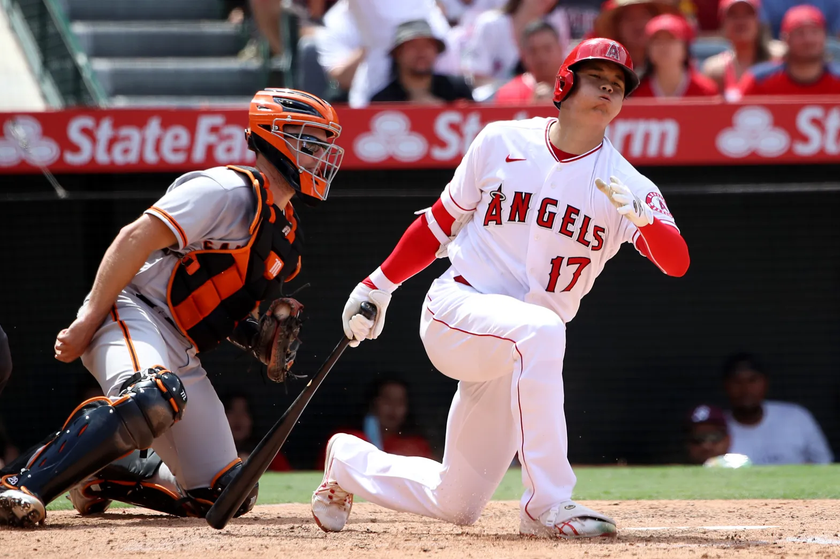
During the San Francisco Giants vs. Los Angeles Angels baseball game on July 24, the score was 6-6 entering the bottom of the 10th. With the bases loaded, Giants player Rafael Devers hit a ball that went over, or bounced over, the left-field wall. The play was initially treated as an extra-base hit that drove in two runs. The stadium scoreboard and some data sources initially displayed 8-6, but the score was later corrected to 7-6 (Giants 7, Angels 6) under MLB's special scoring rules for game-ending hits. MLB's official record and report, as well as Reuters, all confirm a 7-6 final, with Rafael Devers' game-winning hit scored as a single.
During the brief window in which 8-6 was treated as the final score, bonding bots bought contracts on Kalshi and Polymarket at prices close to 99 cents, including Game Total Over 13.5, Giants Team Total Over 7.5, and Giants Winning Margin Over 1.5. Informed traders who understand the baseball rules rapidly reversed positions and pushed binary-market prices toward their extremes.
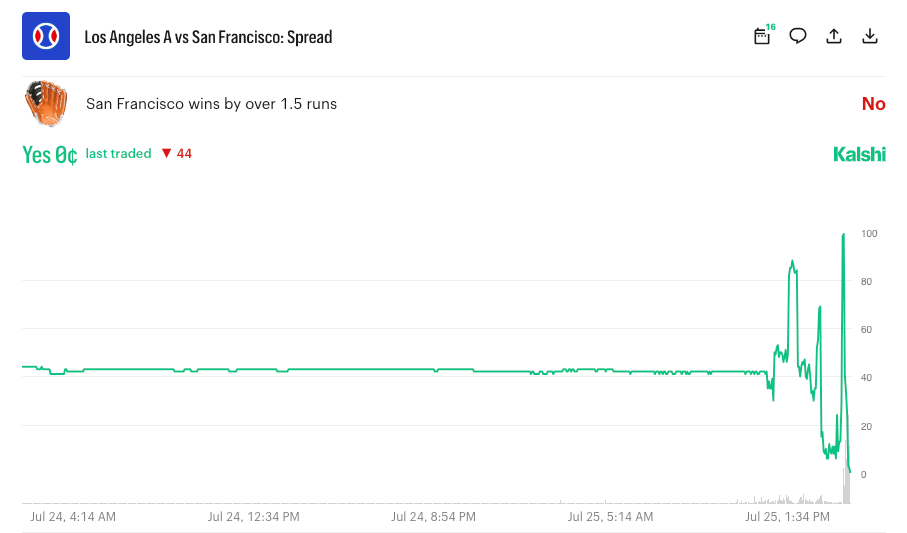
Volume wise, Kalshi spread-market volume increased from about 11,000 contracts before the bottom of the 10th to roughly 5 million. Game Total Over 13.5 contract volume exceeded 1.1 million contracts. The Giants team-total market traded about 60,000 contracts.
Market participants estimated that losses across platforms may have reached seven figures. However, that estimate has not been confirmed by either the exchange or by an independent trade-level analysis.
MULTI-MILLION DOLLAR RINSE: Full single-post summary for people with normal sleep schedules of the most insane rinsing of bond bots I've seen firsthand, in which PM bonders appear to have lost 7 figures🤯
— DataBasedBets (@DataBasedBets) July 25, 2026
Scene: Last MLB game of the night (Giants vs Angels) bottom of the 10th… https://t.co/uRtWlLr9D0 pic.twitter.com/PHf246KERy
The three directly relevant Kalshi markets currently display the following outcomes:
| Contract | Result Under Official 7-6 | Current Kalshi Result |
|---|---|---|
| Game Total Over 13.5 [Kalshi] | No | Yes |
| Giants Team Total Over 7.5 [Kalshi] | No | Yes |
| Giants Win by More Than 1.5 [Kalshi] | No | No |
This means that Kalshi's total and team-total markets follow the earlier 8-6 display, while the spread market follows the official 7-6 final. Three markets tied to the same game therefore display an internally inconsistent final-score state.
Polymarket US used 8-6 to settle the spread, while Polymarket International used 7-6.
On compensation, one Reddit user said that a parlay containing Under 13.5 was initially graded at $0 and that the user later received a cash refund. Another user said support had promised a payment of about $1,500, but the money had not arrived as of the user's last update. There is no official Kalshi compensation announcement, so the evidence supports only the possibility of account-level compensation, not a platform-wide resettlement.
Will Kalshi make a public refund accouncement for affected users?
Why Kalshi May Have Allowed This Outcome
Kalshi's baseball game-total rules state that the designated source is the governing league, that the official statistics at the end of the game are used, that later revisions after Expiration are not included, and that Expiration may be moved earlier once the outcome appears to be determined.
Kalshi's spread rules use a similar structure: the underlying is the final run differential; the source is the governing league; post-Expiration revisions are excluded; and early Expiration may be allowed.
For team-level baseball statistics, the source terms published by Kalshi use a hierarchy that includes the governing league, the official scorer, MLB.com, ESPN, Fox, and the official broadcaster. Those terms likewise exclude revisions made after expiration.
Therefore, each contract may be asking "What did the designated source or source hierarchy record at this market's expiration and determination time?"
If the total and team-total markets expired while the source showed 8-6, but the spread expired only after the source changed to 7-6, then:
- Game Total Over 13.5 = Yes
- Giants Team Total Over 7.5 = Yes
- Giants -1.5 = No
would be possible simultaneously under the literal text of the contracts.
However, the event is a timing-consistency failure in which different contract groups may have frozen different versions of the same event. Even if each contract can be justified under its own rules, the cross-market system still has a consistency problem.
A Bonding Strategy Disclosed by a User
I would like to share an interesting strategy here. A trader using the name predict_anon on X said that s/he had operated a sports strategy on Polymarket that placed orders at 99.9 cents and that this event caused a large loss and prompted the strategy's shutdown.
According to that disclosure, the strategy worked as follows:
- Monitor changes in Polymarket's tick size via the tick_size_change WebSocket notification. Before that, you can only place orders at 99c. After that, you can place orders at 99.9c.
- After a result appeared certain, place an early order in the 99.9c queue.
- Because earlier orders in the queue get filled first, posting orders at (not below) the API rate limit without waiting for the WS notification on tick_size_change is the best way.
- Wait and obtain fills through earlier queue priority.
- Wait for the contract to settle at $1.
Shit😅
— anon (@predict_anon) July 26, 2026
Poly上因为这个亏得最多得冤大头就是我
我最早玩Poly写了一个体育99.9c策略, 其实没啥利润, 风险又大, 但是因为能赚几个小钱就懒得关掉; 这波一下亏大发了, 不过正好让我下决心停掉
我公布出来玩法吧, 你们想搞还是可以赚小钱的(我不想让做这么蠢策略的人因为我的停机赚钱,哈哈😁)… https://t.co/MYVkYliO1z
This strategy is not essentially risk-free. Rather, it continuously insures against extremely low-frequency but near-total-loss settlement risks at a rate of 99.9 cents. Under normal circumstances, each contract can only earn 0.1 cents, but a single error can result in a loss of 99.9 cents, equivalent to wiping out the profits of approximately 999 successful trades. Even more dangerous is that while being at the front of the order queue can increase the execution rate during normal periods, it also means being the first to accept toxic orders from informed traders when anomalies occur.
 Bennet Caldwell
Market Structure and Governance
The deeper problem was not simply that a few bots misunderstood an unusual baseball rule. The total, team-total, and spread contracts were all derived from the same final score, yet they appear to have settled using different versions of that score. Even if each result can be defended under its individual expiration rules, the market as a whole became internally inconsistent.
Linked contracts should therefore share one verified data snapshot and one event-level settlement process, with an automated check confirming that every outcome can be generated from the same underlying result.
The response also raises a governance issue. Account-level refunds may reduce individual losses, but discretionary compensation is not a substitute for a transparent policy. Exchanges should disclose the exact data source, snapshot time, correction procedure, and compensation criteria used in disputed settlements. Otherwise, traders are to bear the uncertain chance that the platform will intervene after an error. In that sense, the final fraction of a cent earned by bonding bots is compensation not just for waiting, but for bearing the governance risk embedded in the exchange’s settlement architecture.
 Bennet Caldwell
Disclaimer: The content is for informational purposes only. You should not construe any such information or other material as legal, tax, investment, financial, or other advice. Nothing contained in this article constitutes a solicitation, recommendation, endorsement, or offer by the author(s) or any third party service provider to buy or sell any securities or other financial instruments in your or in any other jurisdiction in which such solicitation or offer would be unlawful under the securities laws of such jurisdiction. The author(s) report(s) no conflict of interest.