
The freshly dropped Consumer Price Index print delivered a collective sigh of relief across trading desks, with an inflation reading that was both fairly benign and free of a nasty surprise.
Headline CPI rose 0.1% in July, after falling 0.4% in June. Core CPI, which strips out food and energy, rose 0.2%, after sitting flat the month before. Both numbers landed exactly on the consensus forecast, the kind of nothing-happened print traders haven't gotten much of this year.
Year over year, headline inflation eased from 3.5% to 3.4%. Core slowed from 2.6% to 2.5%.
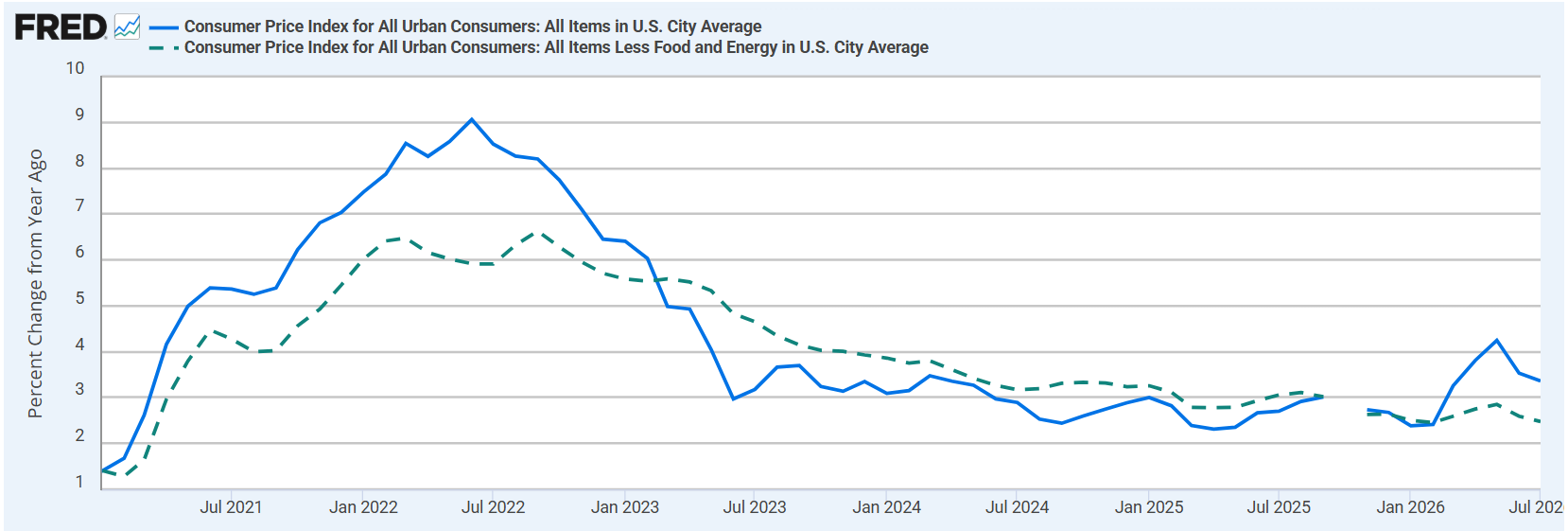
Source: FRED
This makes it a mildly dovish report. For anyone trading a few weeks out, the data made it more difficult to justify an immediate September rate increase.
Where do you think September lands?
The details were soft, but not uniformly so
Shelter made the largest positive contribution to the monthly increase, even though the shelter index rose only 0.1%. And accounted for roughly two-thirds of the increase in the overall index. Within shelter, rent and owners’ equivalent rent each rose 0.3%, while lodging away from home fell sharply.
|
Category |
July move |
Context |
|
Shelter |
+0.1% |
~2/3 of the
headline gain |
|
Rent / OER |
+0.3% each |
still the
stickiest line |
|
Lodging away
from home |
-2.8% |
sharp decline |
|
Energy |
-1.5% |
gasoline
-2.9% |
|
Food |
+0.1% |
groceries
down slightly |
|
Medical care |
+0.4% |
one of the
hot spots |
|
Airfares |
+2.2% |
one of the
hot spots |
|
Used cars |
+0.4% |
one of the
hot spots |
Source: BLS Consumer Price Index
Energy prices declined 1.5%, led by a 2.9% fall in gasoline. Food rose a modest 0.1%, with grocery prices falling slightly even as food away from home continued to rise.
The report was not uniformly soft. Medical care rose 0.4%, airline fares jumped 2.2%, and used-car prices increased 0.4%. Core goods also showed some renewed upward pressure. Still, these pockets were not broad or powerful enough to flip the overall report hawkish.
The most important message from the Bureau of Labor Statistics release is that underlying inflation continued to cool on a year-over-year basis, although monthly core inflation increased from zero in June to 0.2% in July. And energy prices remained 14.7% higher than a year earlier.
Does a soft jobs report cancel out three hawkish votes?
Not entirely. This is the short answer, and it's why September is no longer a foregone conclusion although a hold remains the more likely outcome.
The Federal Reserve’s target range is currently 3.50%-3.75%. At its July meeting, the FOMC voted 9-3 to hold rates steady, and all three dissents wanted a hike.
This is a genuine hawkish bloc, not merely tough rhetoric, and it explains why a September hike still carries meaningful probability even after a friendly CPI report.
But the economic evidence since that meeting has weakened the case for tightening. Payrolls fell by an estimated 23,000 in July, and the two months before that turned out weaker than first reported, by a combined 103,000. Wages are still climbing at a 3.2% annual pace, and fewer people are participating in the labor force than were in January.
None of this proves the three dissenters were wrong in July, but it does mean that raising rates again in September would mean tightening into a labor market that's visibly losing altitude, a much harder case to make than it was a month ago.
Put together, inflation still runs hot enough to keep three voting FOMC members uncomfortable, and the labor market's soft enough to make expanding a three-member dissent into a majority for a hike a much tougher sell. Both things are true at once.
Fed funds futures implied roughly a 38%–40% probability of a September hike after the CPI release. My own working distribution is similar: about 65% for no change, 35% for a 25-basis-point hike, and only a negligible probability of a cut.
Where the 65/35 split might be leaning on the wrong question
Does a hold in September mean the meeting would be dovish? Not necessarily.
September comes with fresh economic projections. The Fed could leave rates unchanged while delivering a hawkish message through the statement, the dot plot and the press conference. Financial conditions could therefore tighten even if the target range does not change.
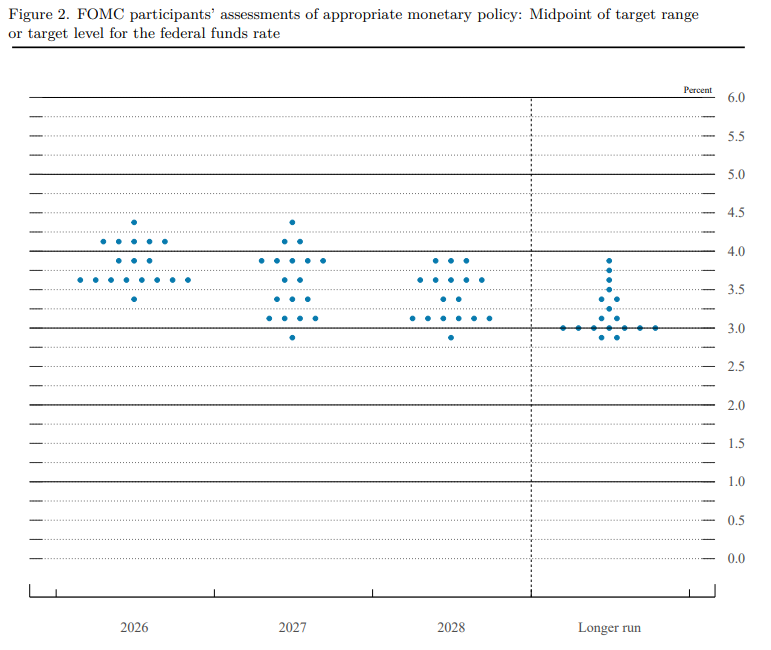
Source: Federal Reserve
This creates a useful distinction between the settlement outcome and the macro outcome. A hold can win the bet and lose the trade.
Second, the benign July headline depended partly on falling gasoline prices. Energy is still up sharply over the past year, and renewed geopolitical pressure on oil could reverse this contribution in August. The Fed is more likely to look through a temporary energy shock than a broad demand-driven acceleration, but it will care if energy begins feeding into transportation, goods, services or inflation expectations.
The largest repricing may therefore come after one of the intermediate releases produces an outsized change in September expectations, rather than from the immediate CPI reaction.
The bottom line
July CPI was helpful to the doves but it was not an all-clear. The Fed’s preferred PCE index remained well above its 2% objective in June, three voting FOMC members supported a July hike, and another employment and inflation cycle will arrive before the September decision.
For the next few weeks, the better posture is to treat September as a live two-way market and update probabilities as the evidence arrives.
|
Incoming evidence |
Likely September repricing |
|
Core PCE at or below 0.2%,
weak payrolls, and August core CPI at or below 0.2% |
The probability of a hold
could rise toward 75%-85%. |
|
Mixed data, with core
inflation around 0.2%-0.3% |
A hold likely remains
favored in roughly the 55%-70% range. |
|
Core PCE or CPI at or
above 0.3%, stronger employment, or a renewed energy shock |
A 25-basis-point hike
could become the favorite. |
|
Very weak employment
combined with soft inflation |
A hold remains the base
case; a cut becomes a non-zero tail risk, but probably not the central
outcome. |
The principal dates are July PCE on August 26, the August employment report on September 4, August PPI on September 10, August CPI on September 11, and the FOMC decision on September 16.
Which release is most likely to move this before September 16?
Sources
BEA, news release schedule: July PCE release date
BLS, July 2026 Consumer Price Index: Official July CPI data
CBS News, July CPI report: July CPI and Fed-policy implications
Cleveland Fed, Inflation Nowcasting: Real-time core PCE model estimate
CNBC, July CPI report: Coverage of the July 2026 CPI release
Federal Reserve, FOMC meeting calendar: September 16 decision date
Forbes, on the July FOMC dissents: Breakdown of the 9-3 FOMC vote
Reuters, July CPI report: Consensus forecasts and market reaction
Wichita Liberty, July 2026 jobs report: Payrolls and revision detail