Premier info portal for prediction markets. The start point of information market.
Market Rumor - Apple is not get a favor on pricing with CXMT?
News Flash
HyperscalersConsumer SpendingSemiconductorMust ReadMag 7 Semi News

Market Rumor - Apple is not get a favor on pricing with CXMT?

According to Korea's Digital Daily source, CXMT is not lowering prices for Apple...

Economics & FinanceTech

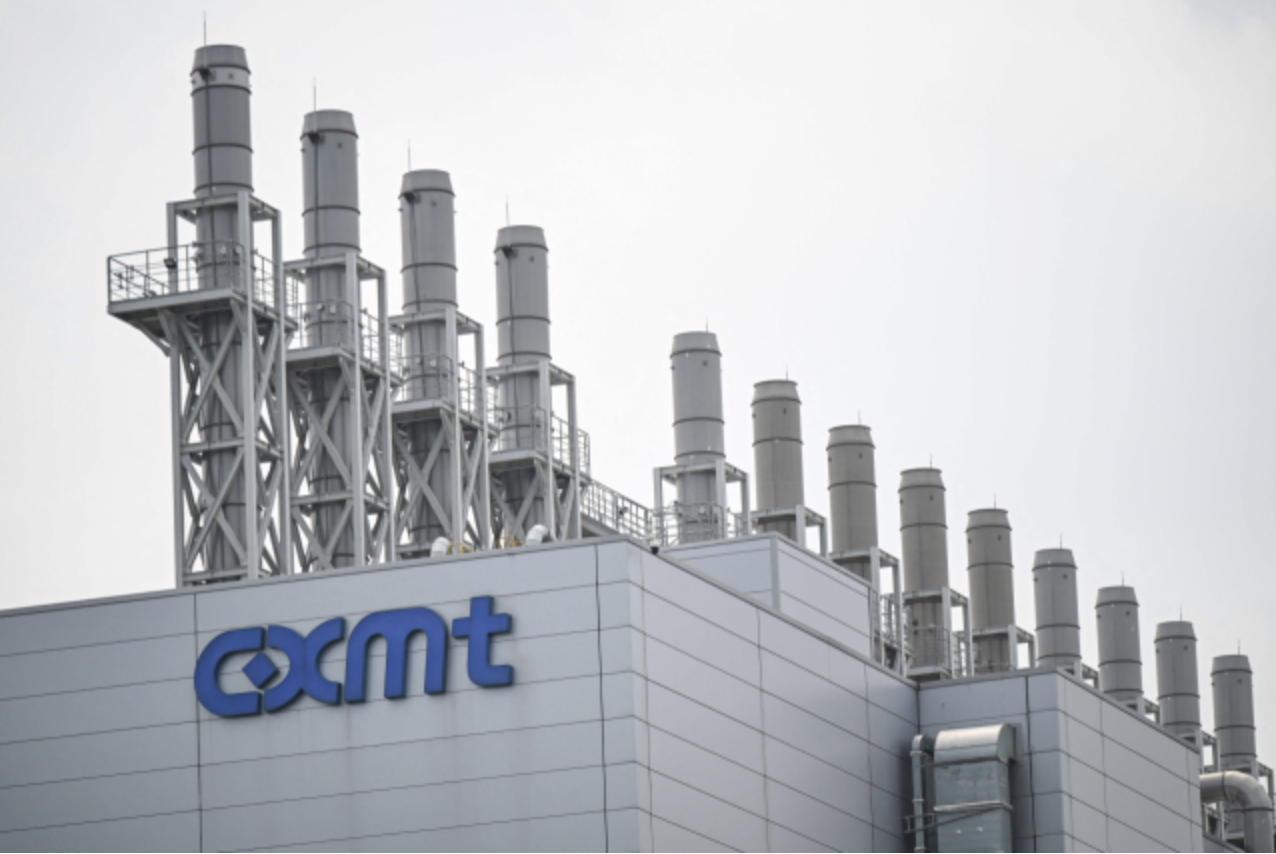
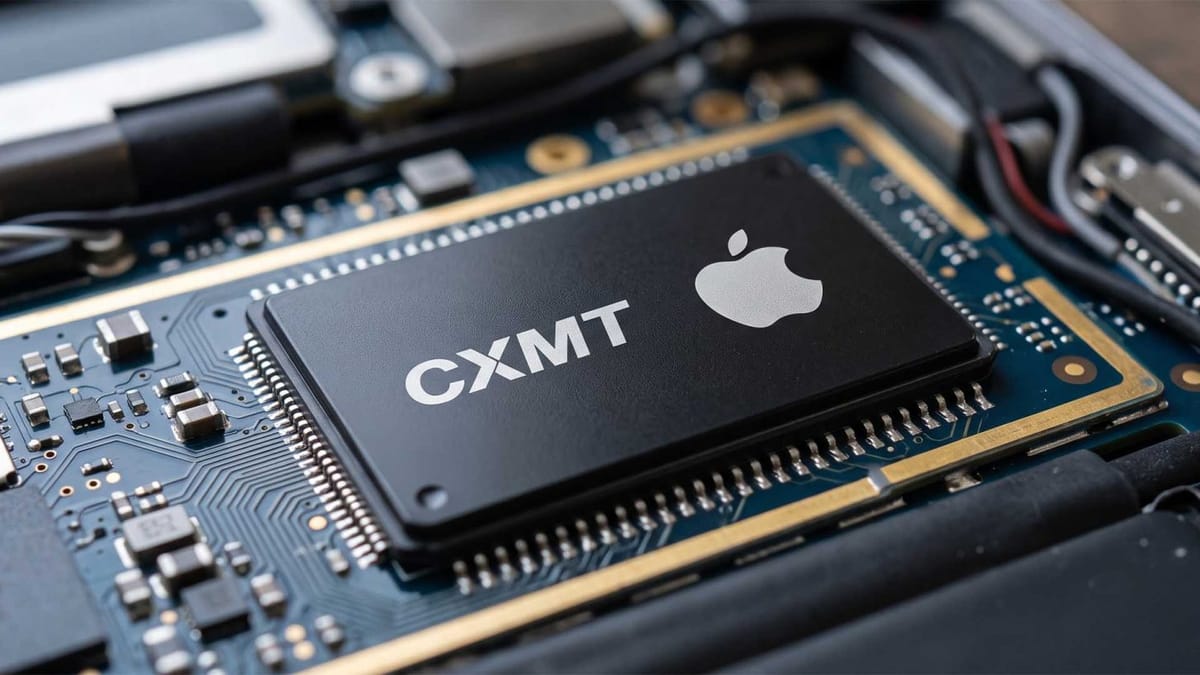
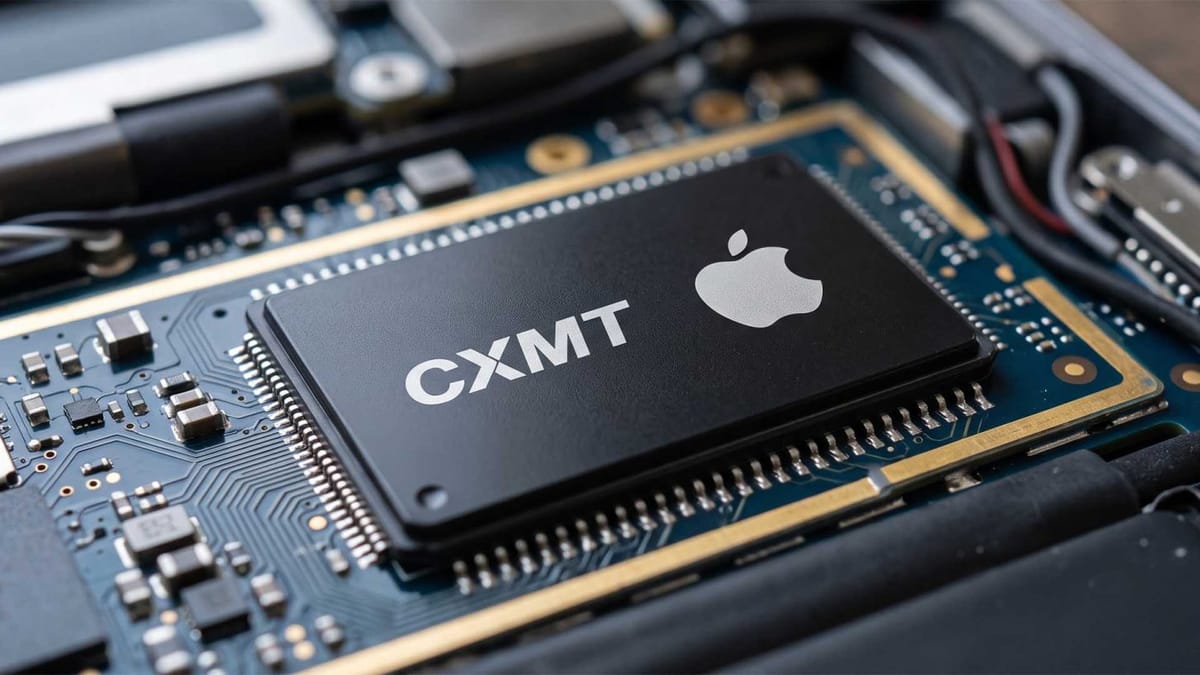
According to Korea's Digital Daily source: it is understood that Apple, which had recently been considering China's Changxin Memory Technology (CXMT) as a new supply chain to reduce costs, is facing difficulties in negotiations regarding further price reductions.

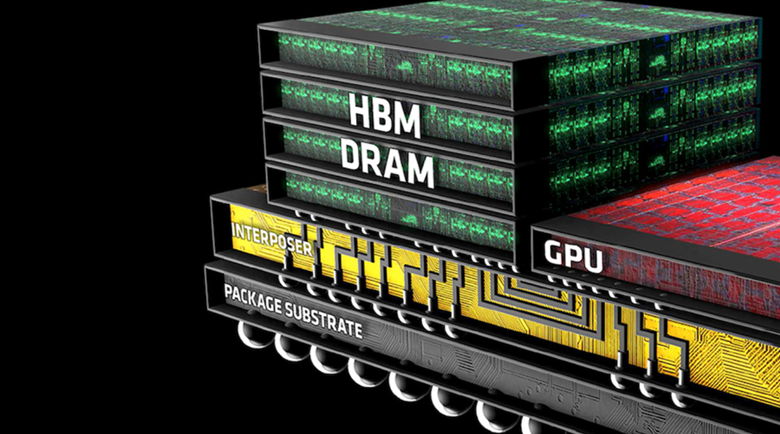
Paradoxically, as the workaround for low-cost Chinese components is blocked, Samsung Electronics and SK Hynix have relieved the burden of shipping general-purpose DRAM. This appears to be creating market dynamics where they are concentrating production lines on high-value AI memory, such as High Bandwidth Memory (HBM), thereby gaining complete control over global memory pricing power.

Check out our prior posts on this matter:

Apple interest thrusts China’s CXMT into memory chip spotlight
CXMT has been thrust into the global spotlight by the race for memory chips. Apple has begun testing the company’s DRam chips for devices sold in China, according to two people familiar with the matter
Apple Raises Price While Micron Calls out Apple for Memory Shortage
Apple is raising prices of multiple key products as a pass-through of skyrocketed memorgy costs; While Microns seems to hold a different view. Apple vs Micron - Who Stands for the Truth? AppleResult33.33%MicronResult66.67%3 PollsEnded Apple raises prices of MacBooks, iPads as memory costs skyrocket SAN FRANCISCO,
Market Rumor - Apple seeks to buy memory chips from blacklisted Chinese company
iPhone maker wants Trump administration to sign off on purchases to ease pressure from rising semiconductor prices.

Source:

  1. Digital Daily; https://www.ddaily.co.kr/page/view/2026080513445474844
Breaking News - Korean Investors accusing Samsung & SK Hynix CEOs Breach Over Performance Bonuses?
News
LegalHyperscalersSemiconductorBreaking NewsAI Infrastructure Semi News

Breaking News - Korean Investors accusing Samsung & SK Hynix CEOs Breach Over Performance Bonuses?

SEOUL, Aug. 5 -- A minority shareholder rights group said Wednesday its complaints against the chief executive officers (CEOs) of Samsung Electronics Co. and SK hynix Inc. over the companies' recently signed wage deals have been assigned to a regional police agency south of Seoul.

Economics & FinancePolitics

SEOUL, Aug. 5 – A minority shareholder rights group said Wednesday its complaints against the chief executive officers (CEOs) of Samsung Electronics Co. and SK hynix Inc. over the companies' recently signed wage deals have been assigned to a regional police agency south of Seoul, according to Korean news sources quoted.

Will Korean investors' accusation on Samsung & SK Hynix CEOs moves into next material stage by the end of August 2026?

Yes
27.76%
No
72.24%
796 Polls

According to the Korean Shareholders’ Movement Headquarters on August 5, the Gyeonggi Nambu Provincial Police Agency assigned the case involving Samsung Electronics CEO Jun Young-hyun and Vice Chairman Roh Tae-moon, accused of breach of trust under the Specific Economic Crimes Aggravated Punishment Act, and the case involving SK Hynix CEO Kwak Noh-jung to its 1st and 2nd investigation divisions, respectively.

The Korean Shareholders’ Movement Headquarters maintains that performance bonuses should not be subject to labor-management collective bargaining but require shareholder meeting approval. They also claim that linking a fixed percentage of operating profits to performance bonuses has potential legal violations.

Separately, the group filed another complaint with the Corruption Investigation Office for High-ranking Officials, accusing Minister of Employment and Labor Kim Young-hoon of abuse of authority, obstruction of exercise of rights, and coercion. Their argument is that the government unduly intervened in the provisional agreement on performance bonuses between Samsung Electronics and its labor union in May.

Source:

  1. The Chosun Daily; https://www.chosun.com/english/national-en/2026/08/05/BIDJRBSNDFFATAA6T6V4QSRW5Q/
  2. Yonhap News Agency; https://en.yna.co.kr/view/AEN20260805003200315
Breaking News - Is Sandisk And SK Hynix making a new era with its HBF structure? (August 4, 2026)
News Flash
HyperscalersSemiconductorBreaking NewsAI Infrastructure Semi News

Breaking News - Is Sandisk And SK Hynix making a new era with its HBF structure? (August 4, 2026)

Sandisk and SK hynix Inc. tannounced the release of the HBF (High Bandwidth Flash) technical specification through the Open Compute Project (OCP), advancing the workstream to drive HBF standardization for the AI inference era, just six months after the consortium began work in February 2027.

Economics & FinanceTech

Sandisk Corporation (Nasdaq: SNDK) and SK hynix Inc. today announced the release of the HBF™ (High Bandwidth Flash) technical specification through the Open Compute Project (OCP), advancing the workstream to drive HBF standardization for the AI inference era, just six months after the consortium began work in February 2027.

Will NAND memory chip price raise (Q/Q) again in 1Q2027?

Will be based on industry consultant's sources such as TrendForce

Yes
86.60%
No
13.40%
418 Polls

Key remarks by the companies are as below:

First HBF standard showcased within six months of consortium launch, expanding the ecosystem with participation from Google, Tenstorrent
Keynote by SK hynix Executive Vice President Kim Chun-sung and Vice President Kang Uk-song on opening day, offering solutions for next-generation AI infrastructure based on ‘Tiered Memory’
“Expanding the boundaries of memory and storage through HBF technology… contributing to new architectures that boost system efficiency”

Source:

  1. Sandisk press release; https://www.businesswire.com/news/home/20260803297696/en/Sandisk-and-SK-hynix-Advance-Global-Standardization-of-High-Bandwidth-Flash-with-Release-of-First-OCP-Technical-Specification
  2. SK Hynix press release; https://news.skhynix.com/en/hbf-at-fms-2026/
  3. Yahoo Finance; https://finance.yahoo.com/technology/ai/articles/sandisk-sndk-sk-hynix-release-011325591.html
Breaking News - Alibaba Adds to China AI Breakthroughs With New Qwen Model
News
LLMsBreaking NewsHyperscalersAI Infrastructure

Breaking News - Alibaba Adds to China AI Breakthroughs With New Qwen Model

Alibaba Group Holding Ltd. released its biggest ever AI model, claiming performance on par with global leader Anthropic PBC in the latest Chinese breakthrough to challenge US rivals.

Economics & FinanceTech

Alibaba Group Holding Ltd. released its biggest ever AI model, claiming performance on par with global leader Anthropic PBC in the latest Chinese breakthrough to challenge US rivals.

The new Qwen3.8-Max is built on 2.4 trillion parameters, a measure of a model’s sophistication, and ranks higher on several benchmarks than the headline-grabbing Kimi K3 from Moonshot that was recently unveiled. Alibaba shared results showing it delivering comparable or sometimes better scores than Anthropic’s Fable 5, a cutting-edge artificial intelligence model that was temporarily put under export controls by the US due to its advanced capabilities.

The debut comes days after Moonshot’s Kimi sent ripples through stock markets and Silicon Valley as it showed Chinese developers quickly catching up with the top models crafted by Anthropic and OpenAI despite relatively constrained computing resources. DeepSeek also just expanded access to its latest model, V4 Flash, while ByteDance Ltd. and MiniMax Group Inc. unveiled new video generators on Friday.

“Many investors continue to underestimate Chinese AI models because of US chip restrictions or general skepticism,” said Vey-Sern Ling, managing director at Union Bancaire Privée. “In reality, the gap is probably much closer, and narrowing fast. Alibaba’s Qwen 3.8 is another proof point, following Kimi K3.”

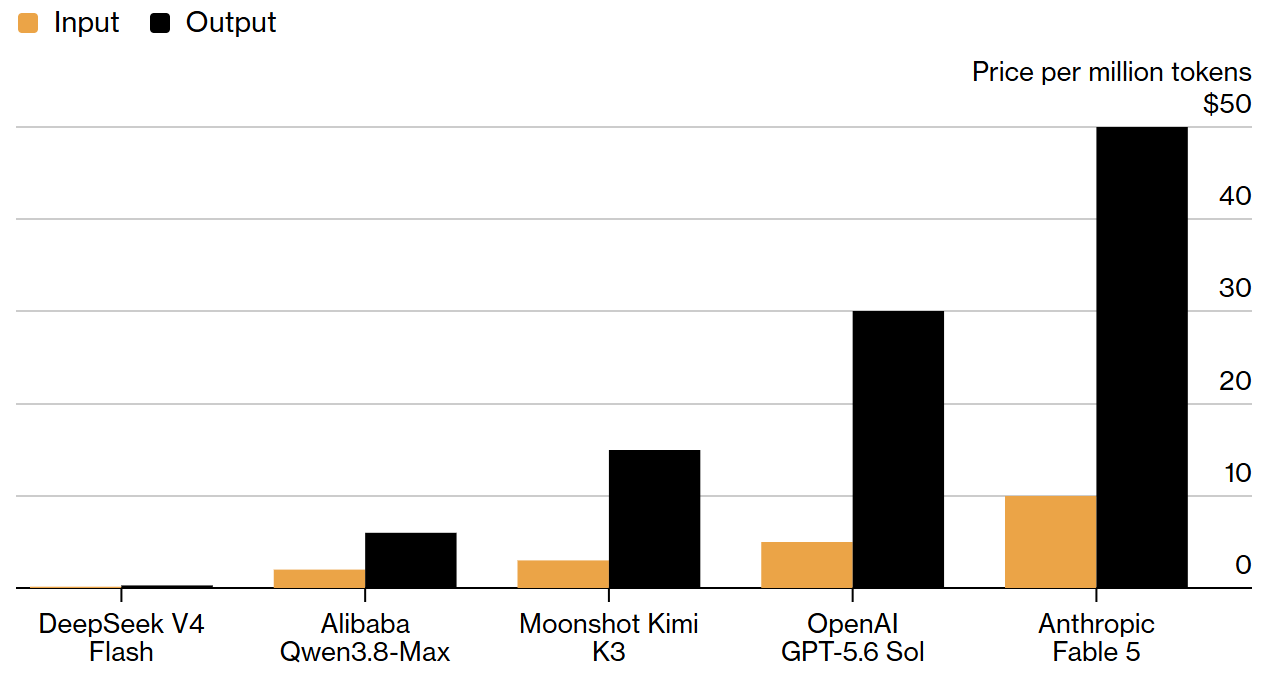
Alibaba's New Flagship AI Model Comes With Attractive Pricing. Source: Bloomberg

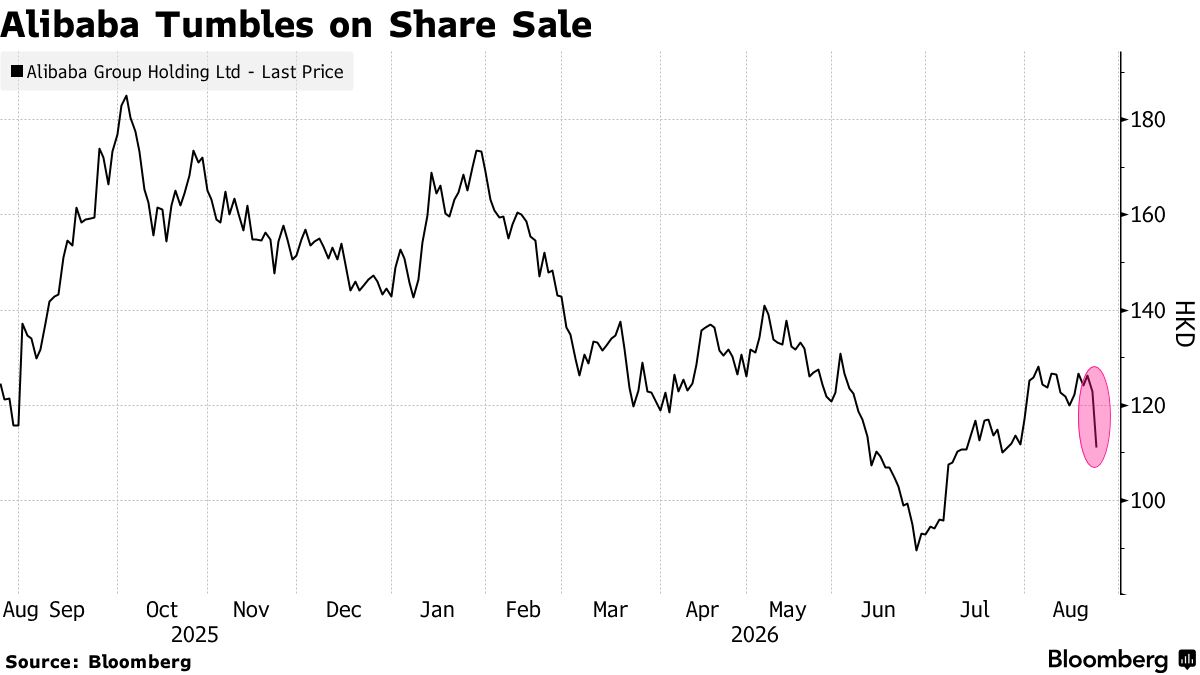
Alibaba’s shares surged by 7% in Hong Kong on Monday, the most in nearly a month.

The Hangzhou-headquartered internet pioneer will release the Qwen3.8-Max weights for public download next week, which will allow users to customize the technology, marking the next major move in the intensifying race among China’s AI contenders that include DeepSeek, Z.ai and ByteDance.

Alongside Kimi K3 at 2.8 trillion parameters — akin to brain synapses that help an AI system store, process and respond with the help of more information — Alibaba is delivering one of the biggest models to date. Also like Moonshot, however, Alibaba uses an approach that only activates a small proportion of the full parameter set per task, to maintain efficiency.

While DeepSeek’s latest is by far the most affordable among new marquee releases, Alibaba’s Qwen offering is also priced aggressively at $2 per one million input tokens and $6 per million outputs. Each AI system will use a different number of tokens to handle tasks, but that still makes Alibaba’s model look attractive compared to the best from the US leaders.

The new Qwen3.8-Max performs well in autonomous coding and long-horizon execution, and was able to independently perform a software engineering project over 16 days in internal testing, Alibaba said. Reducing performance degradation over long tasks or conversation is an ongoing challenge for AI developers as their models grow in complexity.

“Alibaba’s full stack of capabilities stands out,” Jefferies analysts Thomas Chong and Zoey Zong wrote after the release. With AI making an increasing contribution to revenue, “margin profile is expected to improve.”

Will lower-priced Chinese AI models led by Alibaba’s Qwen3.8-Max rank into top 3 global model in August 2026?

Yes
54.81%
No
45.19%
416 Polls

Source: https://www.bloomberg.com/news/articles/2026-08-03/alibaba-drops-another-china-ai-model-with-breakthrough-performance

Market Rumor - Apple Plans Broad iPhone Price Hikes as Foldable Model Tops $2,000
News
SemiconductorSupply ChainMarket RumorConsumer DiscretionaryHyperscalersMag 7 Semi News

Market Rumor - Apple Plans Broad iPhone Price Hikes as Foldable Model Tops $2,000

Apple is expected to raise prices on its next generation of premium iPhones this autumn as higher memory and processor costs squeeze margins across its hardware business.

Economics & Finance

Apple is expected to raise prices on its next generation of premium iPhones this autumn as higher memory and processor costs squeeze margins across its hardware business.

The iPhone 18 Pro and Pro Max may cost $100 to $200 more than comparable current models, according to Bloomberg’s Mark Gurman. GF Securities analyst Jeff Pu has estimated a steeper increase of $250 to $300, citing higher prices for advanced processors, DRAM and NAND memory.

Will Apple raise the US starting price of the iPhone 18 Pro by at least $200 compared with the iPhone 17 Pro?

Yes
73.71%
No
26.29%
1,320 Polls

Apple’s first foldable iPhone is expected to start at at least $2,000. More expensive camera systems, a complex foldable display and tighter manufacturing yields are likely to push its production cost well above that of a conventional iPhone.

The expected increases follow mid-cycle price rises across parts of Apple’s Mac and iPad portfolios. Chief Executive Officer Tim Cook has described the surge in memory prices as a “100-year flood,” while warning that silicon costs will also remain elevated.

Apple is responding by reshaping its semiconductor supply chain.

The company agreed in July to spend more than $30 billion with Broadcom Inc. under a multiyear agreement covering custom silicon and wireless-connectivity components. The partnership is expected to produce more than 15 billion chips in the US, strengthening Apple’s domestic supply base even as component costs rise.

Apple Expands Broadcom Partnership with $30 Billion U.S. Supply Chain Commitment
Apple announced it will expand its partnership with Broadcom through a more than US$30 billion commitment focused on strengthening its U.S. supply chain. As part of the initiative, Apple will also invest US$1.5 billion in Broadcom’s manufacturing facility in Fort Collins, Colorado.

At the same time, Apple has begun testing DRAM chips from China’s ChangXin Memory Technologies (CXMT), for devices sold in China. The move would give Apple another potential source of memory as supplies tighten and prices rise, though the company would face US political and regulatory scrutiny over its use of a Pentagon-blacklisted supplier.

Apple interest thrusts China’s CXMT into memory chip spotlight
CXMT has been thrust into the global spotlight by the race for memory chips. Apple has begun testing the company’s DRam chips for devices sold in China, according to two people familiar with the matter

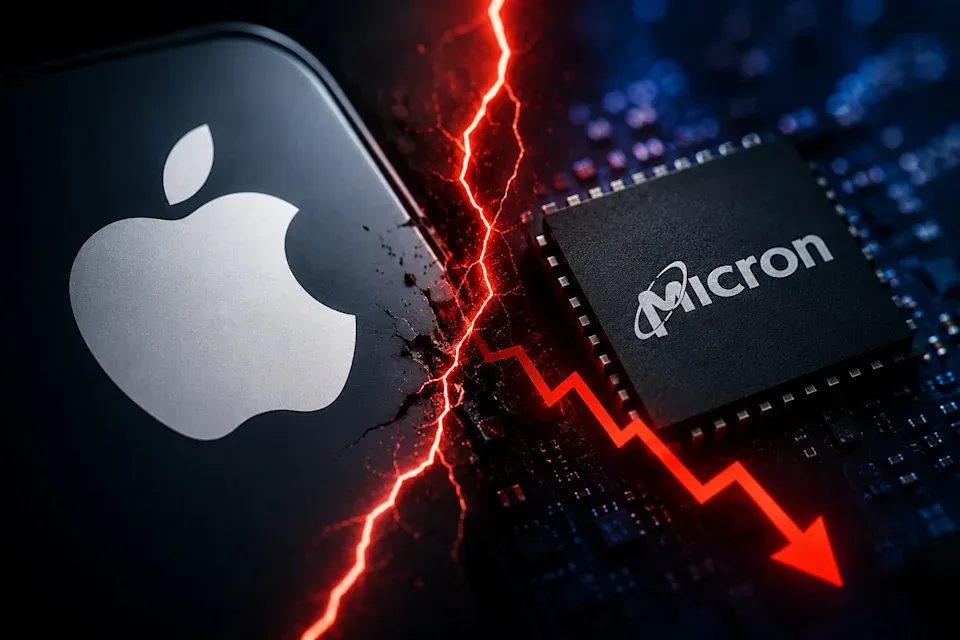
Apple’s interest has also drawn opposition from Micron Technology Inc. The US memory producer has argued against allowing Apple to purchase CXMT chips, while Apple has pushed for greater competition among suppliers to reduce its exposure to the shortage.

The dispute highlights the conflicting interests created by the memory crunch. Apple wants more supply and lower prices, while Micron and other established producers are benefiting from tight capacity and stronger pricing.

Apple Raises Price While Micron Calls out Apple for Memory Shortage
Apple is raising prices of multiple key products as a pass-through of skyrocketed memorgy costs; While Microns seems to hold a different view. Apple vs Micron - Who Stands for the Truth? AppleResult33.33%MicronResult66.67%3 PollsEnded Apple raises prices of MacBooks, iPads as memory costs skyrocket SAN FRANCISCO,

Apple may ultimately pass more of those costs on to buyers. A $100-to-$200 increase would broadly match its recent Mac and iPad adjustments, while a larger rise would suggest that the company is no longer willing to absorb semiconductor inflation through lower margins.

The iPhone launch will therefore be more than a test of Apple’s pricing power. It will show how the global shift toward AI infrastructure is reshaping the economics of consumer electronics, as chipmakers prioritize higher-margin data-center demand and device makers compete for tighter supplies. Apple’s response — diversifying suppliers, deepening domestic partnerships and passing more costs to consumers — could become a model for how the broader hardware industry adapts to a structurally more expensive semiconductor market.

Source: https://www.bloomberg.com/news/newsletters/2026-08-02/apple-subscriptions-macbook-air-shortages-apple-to-make-glasses-health-device-ms

AI Speedrun - Chip Stocks Hit a Bear Market as Big Tech Raised AI Spending. Which Signal Breaks First?
Analysis
SemiconductorIndustry PulseHyperscalersAI InfrastructureAI Speed Run Semi Analysis

AI Speedrun - Chip Stocks Hit a Bear Market as Big Tech Raised AI Spending. Which Signal Breaks First?

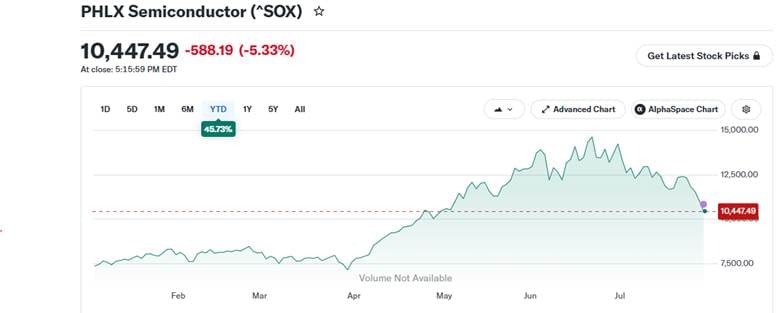
Semiconductors have given back a fifth of their value since June, and nothing in the spending plans of the companies buying them has changed to explain why.

Economics & FinanceTech

Two signals have been moving in opposite directions. On July 17, the Philadelphia Semiconductor Index closed 20.2% below its June 22 record, entering a technical bear market after its worst week in more than a year. The selloff deepened later in July, although chip stocks staged an 8.2% rebound on July 30 after strong Microsoft and Amazon results.

At the same time, Alphabet, Amazon, Meta and Microsoft are still on course to spend roughly $720 billion to $745 billion on capital investment this year. Three have raised or tightened their spending outlooks, while Microsoft says its underlying expansion plans remain intact despite an accounting change that reduced reported capex.

The apparent contradiction is therefore still real, but more precise: chip stocks are questioning the returns and valuations attached to the AI buildout, while the companies placing the orders continue to report strong demand.

So is AI spending in trouble, or is it fine and chip stocks just had a rough month? Which is it?

What's your read on the chip drawdown?

Demand is starting to crack
12.57%
Funding is getting tight
35.29%
Just a hot sector cooling off
52.14%
1,074 Polls

The bear case: The buildout is eating the cash that funds it

The number to watch is free cash flow, but not because it represents a dedicated budget for the next round of chips. Free cash flow measures what remains after operating cash has covered capital expenditure (capex). When it turns negative, the buildout is no longer being financed entirely from internally generated cash.

That does not force chip orders to fall immediately.

Cash reserves, debt, leases and outside financing can keep spending going. But it introduces a second constraint: the buildout must satisfy not only management’s conviction, but also lenders’ required returns and credit-market appetite.

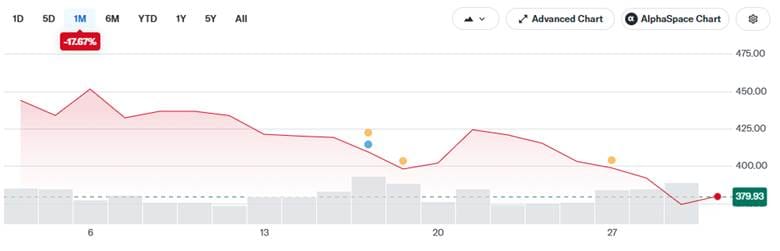
Alphabet’s free cash flow went negative for the first time since it went public in 2004.

Source: Alphabet

Meta reported on July 29 that it made $31.9 billion in cash from operations and spent $31.1 billion on capex, leaving $784 million. That left Meta with free cash flow equal to roughly 2.5% of its operating cash flow. Its stock fell about 10%, even though revenue grew 28%.

Source: Yahoo Finance - GOOGL

Alphabet posted negative quarterly free cash flow, while Meta retained only $784 million. Microsoft remained strongly positive at $19.6 billion, although that was down 23% year over year. Amazon’s trailing-12-month free cash flow, which is not directly comparable with the quarterly figures, turned negative by $7.6 billion.

For two years, this buildout was paid for out of pocket, and money spent out of pocket needs no one's approval. From here, a growing share of it gets borrowed, and borrowed money comes with terms, whether it is a coupon, a maturity, and a lender's view of how long AI demand lasts.

Chipmakers sit at the end of that chain and don't get a vote in it. They find out when the order arrives. Or doesn't.

The bull case: Two years of being wrong about this exact call

The bear case has a weakness: betting against hyperscaler capex has lost money for two straight years.

Goldman Sachs found that at the start of both 2024 and 2025, most analysts expected spending to grow about 20%. It actually grew more than 50% both years. As of June, Goldman still thinks analysts are underestimating and expects roughly $1.1 trillion in 2027.

The demand-side numbers haven’t cracked, either. Google Cloud’s backlog sits near $514 billion, roughly 5x where it was a year ago. TSMC, the world’s biggest chipmaker, beat expectations and raised its own spending plans during the same week the chip index crashed, and its stock fell anyway.

When good news doesn’t help a stock, the problem is usually investor mood rather When strong results fail to lift a stock, the gap often lies in valuation and prior expectations rather than current operating performance. Investors may believe the good news was already priced in, or that future returns will not justify the capital required to deliver it.

Source: Yahoo Finance - TSM

My read: this is no longer about whether AI demand is strong enough (backlog numbers & capex increases already answered this). The actual question is, can spending approaching $1 trillion a year be sustained long enough to keep clearing a bar the market has priced for flawless execution?

Put simply, this looks more like the SOX’s 105% run from its March low to the June peak finally meeting a bar it couldn’t keep clearing. A 45%-plus year-to-date gain surviving a 20% drawdown is a market that priced in flawless execution and is now pricing in merely very good execution.

Source: Yahoo Finance - SOX

Anthropic vs Meta: Two Compute Signals, One Confusing Week
Two headlines landed within days of each other and appear to point in opposite directions: Anthropic locking up two decades of dedicated data-center capacity, while Meta suggesting it has AI compute to spare -- analysts, investors, and the companies themselves haven’t settled on one story.

What actually resolves this

Now, it’s a matter of whether capex nearing $1 trillion a year can keep being funded, and chip stocks, not hyperscaler stocks, are where this question gets tested first.

This is not a question a single earnings report answers. It gets resolved, one way or the other, over the next two quarters.

  1. Free cash flow, not capex headlines.

Spending covered by operations answers to a CEO's conviction, but spending covered by bond issuance answers to credit markets, which can change their mind in a quarter for reasons that have nothing to do with AI. If FCF keeps compressing through Q3 and Q4, they’ll likely need to issue more debt, sooner, and possibly a larger amount at once.

Once a larger share of the buildout requires external financing, chip orders become more sensitive to interest rates, credit spreads, lease terms and lender appetite—in addition to underlying AI demand.

  1. Whether Korea is a fundamentals signal or a leverage unwind.

SK Hynix is one of the clearest upstream indicators of AI accelerator demand because it is a leading supplier of high-bandwidth memory. But its share price is not a pure demand signal: it also reflects memory-cycle expectations, valuation, Chinese competition and unusually heavy leverage in the Korean market.

Reuters reported signs of forced unwinding and found that leveraged products had amplified market volatility. The cleaner comparison is therefore between HBM contract pricing, shipment guidance and the share price. If operating indicators remain firm while the stock continues falling, that would strengthen—but not prove—the case that positioning and leverage are driving much of the decline.

  1. Whether Kimi K3 changes workload economics.

Moonshot AI says Kimi K3 approaches leading U.S. models at substantially lower cost, although its own technical report still places it behind the strongest proprietary systems overall. Benchmark performance alone does not establish that enterprises will move production workloads. Reliability, security, integration, latency and migration costs matter as much as token pricing.

The effect on chip demand is also ambiguous. A more efficient model may require less compute for each task, but lower costs can expand the number of tasks companies are willing to run. Watch for named enterprise migrations, declining contracts at incumbent AI providers and sustained changes in accelerator utilization—not benchmark scores alone.

Which happens first?

A hyperscaler raises debt to fund capex
75.36%
SK Hynix stabilizes as the leverage clears
14.18%
A named enterprise moves workloads to Kimi K3
4.61%
None of the above by year-end
5.85%
564 Polls
AI Propped Up the Global Economy. Can It Keep Doing So?
AI investment helped cushion global growth, but with hyperscaler capex nearing $725 billion, can demand and productivity justify the cost?

Sources

Business Insider: Goldman Sachs says the AI boom is bigger than investors think

CNBC: Philadelphia SE Semiconductor Index

Reuters: Meta cash flow craters as Zuckerberg doubles down on AI spending

Yahoo Finance: Meta, Microsoft, Amazon, and Alphabet are about to spend a shocking amount of money to dominate the AI era

Reuters: China's Moonshot unveils world's largest open AI model, closing in on US rivals

Breaking News - OpenAI cuts GPT-5.6 prices as cost sensitivity grows; will others follow?
News Flash
LLMsHyperscalersAI InfrastructureTechnology

Breaking News - OpenAI cuts GPT-5.6 prices as cost sensitivity grows; will others follow?

OpenAI on Thursday announced it is slashing the price of two of its latest artificial intelligence models, GPT-5.6 Terra and GPT-5.6 Luna, roughly three weeks after their public release, according to the company and a CNBC report (July 30, 2026).

TechEconomics & Finance
  • OpenAI announced it is slashing the price of two of its latest artificial intelligence models, GPT-5.6 Terra and GPT-5.6 Luna.
  • The company said it is reducing the price of Terra by 20% and the cost of Luna by 80%.
  • The company is facing pressure to cater to a more cost-sensitive customer base and fend off competition from Chinese startups and other tech giants.

Do you think, will other AI model makers cut prices, by the end of August 2026?

Yes
85.03%
No
14.97%
1,309 Polls

OpenAI on Thursday announced it is slashing the price of two of its latest artificial intelligence models, GPT-5.6 Terra and GPT-5.6 Luna, roughly three weeks after their public release. 

The company is facing pressure to cater to a more cost-sensitive customer base, where enterprises have been less inclined to deploy expensive models without a clear picture of the return on their investments. It’s also working to fend off competition from Chinese startups and tech giants Google and Microsoft, which have been touting cost-effective models.

OpenAI launched three models as part of its GPT-5.6 series, including Sol, the most powerful offering, Terra, the mid-tier model, and Luna, its fastest offering. 

The company said Thursday that it’s reducing the price of Terra by 20% to $2 per million input tokens and $12 per million output tokens. It’s cutting the cost of Luna by 80% to 20 cents per million input tokens and $1.20 per million output tokens. Sol’s pricing remains the same. 

“Our strategy remains focused on advancing both capability and efficiency so each generation of intelligence can accomplish more work at a lower cost,” OpenAI said in a release.

OpenAI kickstarted the AI boom with the launch of ChatGPT in 2022, prompting companies across the U.S. to rush to deploy the technology and incentivize adoption within their workforces. The era of so-called tokenmaxxing was born, where employers encouraged staffers to use as much AI as possible without worrying about costs.

Source: CNBC; https://www.cnbc.com/2026/07/30/open-ai-price-cut-gpt.html

Results Deep Dive - The P&L Inversion: What Big Tech Earnings Reveal About the "Inference Tax" and the "CapEx Wall"
Analysis
HyperscalersLLMsAI InfrastructureSilicon BakeryEarnings & OperationsIndustry Pulse Semi Analysis

Results Deep Dive - The P&L Inversion: What Big Tech Earnings Reveal About the "Inference Tax" and the "CapEx Wall"

Economics & FinanceTech

As the dust settles on this week’s major Big Tech earnings releases, the financial media remains predictably fixated on top-line revenue beats and cloud growth percentages. However, for institutional investors and universal asset owners, the most critical data points are no longer found in the revenue headlines, but buried deep within the cash flow statements. Silicon Valley is definitively exiting the high-margin, zero-marginal-cost era of traditional software. Driven by the relentless computational demands of artificial intelligence, Big Tech has rapidly mutated into a capital-intensive heavy industry.

The sheer scale of this transition is historically unprecedented. Over the past 36 months, the global financial system has funneled an estimated $1 trillion into physical AI infrastructure. Yet, as leadership at Norges Bank Investment Management (NBIM) recently highlighted, a profound structural asymmetry persists: while an estimated $1.4 trillion is required for global hardware buildouts, direct and verifiable AI revenues struggle to cross a mere $13 billion threshold. With macroeconomic projections from Morgan Stanley anticipating the combined capital expenditures (CapEx) for the five largest US tech giants to hit $1.16 trillion by 2027, the thematic hype cycle is officially over.

We have entered the era of the "CapEx Wall," where the fundamental measure of corporate survival is no longer algorithmic promise, but strict balance sheet resilience and the ability to defend Free Cash Flow.

The Microsoft & Alphabet Proxies: Quantifying the Capital Burden

The sheer magnitude of this infrastructure burden is already visible in the latest SEC filings. Alphabet’s trajectory—with its CapEx surging 74% (from $52.5 billion to $91.4 billion between 2024 and 2025)—was an early warning. Microsoft’s recent Q4 2026 results confirm this permanent escalation in capital intensity, with quarterly capital expenditures reaching an unprecedented $35.80 billion.

AI, a Capital-Intensive Industry Hit by the Inference Tax

The historical paradigm of the tech industry—distributing software at zero marginal cost—is obsolete. Generative AI now resembles a heavy industry, structurally penalized by an “inference tax.” While Microsoft CFO Amy Hood highlighted “a strong quarter to close out the fiscal year, underscored by $59.3 billion in Microsoft Cloud revenue,” the reality of the balance sheet shows profitability under pressure. The Intelligent Cloud division’s operating margin peaked at 40.6% (Q4), and the company’s regulatory filings confirm a squeeze on gross margin directly attributable to AI infrastructure costs.

This massive cash burn is exacerbated by a trap of accelerated depreciation. State-of-the-art GPUs (Nvidia H100 or Blackwell architectures) become obsolete within 3 to 4 years. This ultra-short life cycle forces perpetual reinvestment in hardware, which mechanically crushes free cash flow generation, transforming a competitive advantage into a permanent exercise in capital destruction.

The FinOps Pivot and Margin Cannibalization

To finance this unyielding infrastructure burden without defaulting on profitability, tech companies are aggressively cannibalizing their internal operating models. Historical Sales & Marketing (S&M) budgets are being drastically cut from 47% to 41% of revenue (KeyBanc), freeing up capital to prioritize R&D, which now exceeds 22% of revenue. This reallocation automatically extends the CAC payback period to 18 months, while 55% of IT decision-makers admit that their current infrastructure cannot support AI without significantly eroding their margins (Forrester).

Meta Platforms illustrates this dynamic with unprecedented accounting severity. Lacking a B2B cloud division to offset the hardware burden, the company relies exclusively on advertising, leaving it fully exposed to infrastructure risk. The second-quarter 2026 results confirm this “CapEx Wall”: capital expenditures (CapEx) reached $31.08 billion, forcing management to tighten its colossal annual guidance range to between $130 billion and $145 billion. This need to absorb the surge in computing costs led to a 55% year-over-year spike in operating expenses (OpEx), sharply reducing the operating margin from 43% to 31%. The sacrifice of short-term profitability is reflected in a crushing decline in free cash flow, which has been squeezed down to just $784 million. Although Mark Zuckerberg maintains that AI “is accelerating our core business today,” the financial statements reveal a more stark reality: the race toward hyper-infrastructure requires the temporary depletion of available cash.

As the "CapEx Wall" forces a FinOps pivot, what is the most severe P&L risk for enterprise software over the next 18 months?

Aggressive OpEx cannibalization (slashing S&M and headcount to fund compute)
10.58%
Further upward revisions of annual CapEx guidance despite market backlash
40.13%
Passing the "inference tax" directly to enterprise customers via price hikes
19.03%
Scaling back non-core R&D to protect short-term Free Cash Flow
30.26%
2,118 Polls

Macro-Financial Displacement and the Stock Market Divide

The price action observed during after-hours trading on July 29, 2026, confirms a clinical reassessment of the risk associated with artificial intelligence infrastructure. The markets are no longer penalizing revenue stagnation, but rather the destruction of free cash flow (FCF) attributable to the “CapEx Wall.” The -6.41% correction inflicted on Meta Platforms—which fell to $548.09 despite solid revenue—illustrates this perfectly: investors are penalizing the accumulation of capital expenditures that lack immediate profitability.

Conversely, the 8.97% jump in Microsoft’s stock (to $425.56) demonstrates a strict market requirement: depreciation costs must be offset by tangible monetization. Microsoft was rewarded for proving its Operating Alpha—the ability to generate cash despite the hardware drag. As highlighted by the financial press’s narrative illustrating this “great AI divide,” balance sheet resilience now takes precedence over the promise of expansion.

Beyond equity markets, this asymmetry is triggering a severe macro-financial “crowding-out” phenomenon in global credit. According to BIS data, nearly 60% of global FX derivatives are now concentrated among the ten largest banks to finance Big Tech’s data centers, automatically drying up credit conditions for traditional SMEs.

Conclusion: The Valuation Doghouse and the New Institutional Mandate

The cycle of abundant liquidity fueling innovation has come to an end. The markets are conducting a ruthless binary culling: 73% of publicly traded traditional SaaS companies are now relegated to a "Valuation Doghouse," trading at a median multiple of just 3.3x their future revenue (Meritech). Only the elite—those demonstrating true Operating Alpha by mastering the “Rule of 40”—are capturing liquidity.

Ultimately, this week’s Big Tech earnings confirm a definitive regime change: AI is no longer a speculative vector for exponential hyper-growth, but a highly capital-intensive, defensive infrastructure. For institutional allocators, the mandate is clear. Capital allocation must be rigidly anchored to organizations capable of navigating the CapEx wall, enforcing FinOps discipline, and protecting Free Cash Flow generation against the crushing weight of accelerated hardware depreciation.

As the market enforces a ruthless binary culling across the tech sector, what is the ultimate survival criterion for institutional portfolios?

Uncompromised Free Cash Flow (FCF) resilience against the hardware drag
37.22%
Accelerated B2B AI monetization to outrun capital intensity
62.78%
540 Polls
Results Review - SK Hynix, 2Q2026 a miss?
Quick Take
HyperscalersSemiconductorEarnings & OperationsAI Infrastructure Semi Analysis

Results Review - SK Hynix, 2Q2026 a miss?

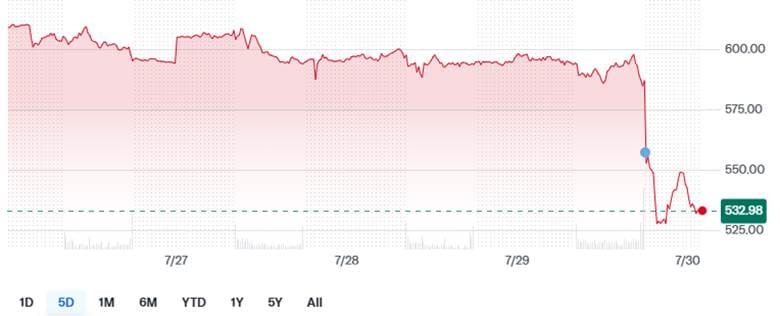
SK hynix reported record-breaking 2Q26 financial results on July 29, 2026, driven by intense AI memory demand and higher chip prices. Yet, stock price took a huge dip...

Economics & FinanceTech

SK hynix reported record-breaking 2Q26 financial results on July 29, 2026, driven by intense AI memory demand and higher chip prices. Yet, stock price took a huge dip...

What will SK Hynix operating profit margin be for 3Q2026 (vs 2Q2026)?

Higher
63.86%
Lower
36.14%
1,162 Polls

TL;DR:

What's Good: Absolute profit and revenue growth were extraordinary by any historical standard. Operating profit of ₩60.54 trillion was up more than 550% year over year, and revenue and operating profit increased 257% and 557% year-over-year, respectively.

What's Good: Long-term contract book was locked in with key customers. SK hynix has finalized Long-Term Agreements with around 10 customers, including key strategic partners, aiming to secure mid-to-long-term supply stability, improve operational efficiency, and support sustainable growth.

What's Good: HBM4 hit technical milestones and began shipping. SK hynix began mass shipments of HBM4 in Q2 2026 and plans to ramp production in the second half, and HBM4 achieves customer-required operating speeds, industry-leading power efficiency, and cost competitiveness, demonstrating differentiated technological edge.

What's Good: Structural position within the AI memory shortage remains dominant. Goldman Sachs has estimated a 2026 DRAM supply-demand gap of 4.9%, described as the most severe shortage in 15 years, with DRAM spot prices up approximately 52% since January 2026, and industry analysts estimate SK Hynix holds approximately 60 to 70% of Nvidia's HBM4 allocation for the Vera Rubin AI platform, with Samsung capturing roughly 25-30% and Micron supplying the remainder — an allocation confirmed publicly by Nvidia CEO Jensen Huang during a Seoul visit in June.

What's Missed: Operating profit missed consensus by a meaningful margin, despite the YoY headline.

What's Missed: Multi-year HBM supply contracts are structurally capping upside capture. Korea Investment & Securities projected Q2 operating profit roughly 8% below consensus, revealing how the company's multi-year high-bandwidth memory supply contracts prevent it from capturing the full spot-price upside investors were modeling — the company is essentially leaving spot-market pricing gains on the table in exchange for locked-in volume certainty.

What's Missed: HBM4 ramp timing came in later than some analysts had priced. Investors had anticipated that shipments of SK Hynix's next-generation HBM4 [would scale in Q2], [but] that increase had not materialized at scale. Full-scale HBM4 mass production is now expected to begin in the third quarter of 2026 — a shift that also removed a source of upside analysts had priced into Q2 estimates.

Key Debates:

Is the "miss" actually a demand problem, or purely a contract-structure artifact?

How much of the sell-off is stock-specific versus sector-wide noise?

Does the HBM4 delay to Q3 change the growth trajectory, or just shift timing?

Source:

  1. SK Hynix press release; https://news.skhynix.com/en/q2-2026-business-results/
Market Rumor - Amazon overhauls its AI strategy, winding down most flagship models, Business Insiders - July 28, 2026
News Flash
HyperscalersLLMsMarket RumorAI InfrastructureMag 7

Market Rumor - Amazon overhauls its AI strategy, winding down most flagship models, Business Insiders - July 28, 2026

Business Insider reports that Amazon is overhauling its AI strategy by winding down much of its flagship Nova lineup and concentrating engineers and computing resources on a smaller number of frontier-model efforts (July 28, 2026).

Economics & FinanceTech

Business Insider reports that Amazon is overhauling its AI strategy by winding down much of its flagship Nova lineup and concentrating engineers and computing resources on a smaller number of frontier-model efforts.

Will Amazon raises, or holds, or cut CAPEX in 2Q2026 briefing?

Raise
66.67%
Hold
33.33%
Cut
0.00%
3 Polls
Ended

Amazon has reportedly begun deprecating Nova Premier, Omni, Reel, and Canvas. Employees described some models as being in “keep the lights on” mode, meaning they will remain supported for existing customers but are no longer major development priorities.

Resources are increasingly moving toward Frontier Model Research, led by Pieter Abbeel. He joined Amazon through its acquisition of AI robotics startup Covariant. FMR has become a top priority and is developing a new flagship foundation model expected to debut at this year’s re conference.

The shift follows layoffs in Amazon’s AGI organization and the shutdown of AGI Lab, the long-term research group created after Amazon hired key leaders from Adept. The broader AGI organization now sits under SVP Peter DeSantis, who also oversees Amazon’s custom-silicon and quantum-computing teams.

Amazon is not abandoning Nova entirely. Nova 2 Sonic, Nova 2 Lite, Nova Forge, and Nova Act remain active, while the new FMR model could also launch under the Nova brand.

An Amazon spokesperson told Business Insider that AI models remain among the company’s most important priorities. The spokesperson added that Amazon will continue supporting models customers rely on while providing guidance and migration paths as its lineup evolves.

Source:

Business Insider; https://www.businessinsider.com/amazon-overhauls-ai-strategy-phasing-out-most-nova-models-2026-7

Breaking News - Nvidia behind $50bn lease on Texas data center that will use its chips, media reports
News Flash
HyperscalersTechnologyBreaking NewsAI InfrastructureMag 7 Semi News

Breaking News - Nvidia behind $50bn lease on Texas data center that will use its chips, media reports

Nvidia is reported to be behind another Ai infrastructure move, leasing $50 billion Texas data center that will uses Nvidia's chips.

Economics & FinanceTech

Nvidia is reported to be behind another Ai infrastructure move, leasing $50 billion Texas data center that will uses Nvidia's chips, (The Financial Times, Channel News Asia).

What's your take on Nvidia?

Concerns on circular financing
51.69%
AI infra is just at the beginning
48.31%
1,033 Polls


The nearly $5tn company is leasing the entire 1 gigawatt facility that developer Hut 8 is building, which will house hundreds of thousands of Nvidia’s graphics processing units, said five people familiar with the deal.

The move is the latest example of Nvidia’s chief executive Jensen Huang aggressively using the company’s financial strength to keep it at the centre of the fast-growing market for AI computing power.

These efforts have included spending billions of dollars to foster a new generation of AI infrastructure providers, such as CoreWeave, to buy and run its GPUs. The Texas lease goes further, putting Nvidia behind the facilities that will house its chips.


The Texas site has secured access to electricity, something that is increasingly rare as developers compete for grid power. Nvidia wielded its financial muscle to lock in the site for its own chips, said an executive familiar with the deal.

“They have the balance sheet to acquire power, and in doing so, ensure their product is deployed,” the person said, asking not to be named. Once completed, Nvidia could sublease capacity to its “neocloud” partners that buy its GPUs and sell AI cloud computing, the person said.

The arrangement will intensify concerns about circular financing, as the chip group underwrites more of the market for its chips.

Source:

  1. The Financial Times; https://www.ft.com/content/685014e7-47dd-471b-a585-1b9b73ce5d6f?syn-25a6b1a6=1
  2. Channel News Asia; https://www.channelnewsasia.com/business/nvidia-behind-50-billion-lease-texas-data-center-ft-reports-6282306
Nvidia Credit Risk Surges as $750 Billion AI Push Raises Financing Fears
News
SemiconductorHyperscalersAI InfrastructureMag 7 Semi News

Nvidia Credit Risk Surges as $750 Billion AI Push Raises Financing Fears

The cost of protecting Nvidia Corp.’s debt against default surged by the most on record Monday, after reports of the chipmaker being in conversations on more than $750 billion of artificial intelligence infrastructure deals stoked fears about the company’s obligations.

Economics & Finance

The cost of protecting Nvidia Corp.’s debt against default surged by the most on record Monday, after reports of the chipmaker being in conversations on more than $750 billion of artificial intelligence infrastructure deals stoked fears about the company’s obligations.

A partnership with SK Group unveiled late Friday means the companies will be doing more than $500 billion in business with each other, Nvidia said. Nvidia is also in talks to backstop as much as $250 billion to help OpenAI lease computing power from a US data center project in what would be among the chipmaker’s biggest financing deals with a customer.

Nvidia is also having discussions to finance $350 billion of OpenAI’s purchases of its chips for the US project, according to a person familiar with the matter.

Such borrowing would likely require investment-grade ratings, which are difficult for the likes of OpenAI and Anthropic PBC to currently support given they are rapidly burning cash to grow their businesses. Backing from big firms can help debt that funds AI infrastructure spending win high-grade ratings.

Meanwhile, the price of protecting Nvidia's debt against default for five years rose as much as 0.14 percentage point to 0.82 percentage point a year, according to ICE Data Services. That’s the biggest intraday rise since the swaps started to actively trade in November.

Nvidia's credit default swaps jumped on $750 Billion AI Push. Source: Bloomberg, ICE

“The amount of capex needed to build out the AI infrastructure is massive, and debt markets are being inundated with supply,” said Sal Naro, chief investment officer of Coherence Credit Strategies. “There’s a fear of financial alchemy driven by opaqueness, off-balance-sheet transactions and intercompany relationships, which could result in credit rating downgrades.

The move echoes Oracle’s downgrade to BBB- earlier in July, underscoring how the enormous financing demands of the AI buildout are beginning to strain even the industry’s largest companies’ credit profiles.

S&P Downgrades Oracle to BBB-
S&P Global downgraded Oracle’s long-term credit rating from BBB (Negative) to BBB- (Stable), citing elevated business risk and weaker near-term cash flows.

Will more AI infrastructure companies face rating downgrades after Oracle?

Yes
52.10%
No
47.90%
1,837 Polls

Source: https://www.bloomberg.com/news/articles/2026-07-27/nvidia-credit-risk-jumps-in-swaps-market-on-ai-deal-talk-reports