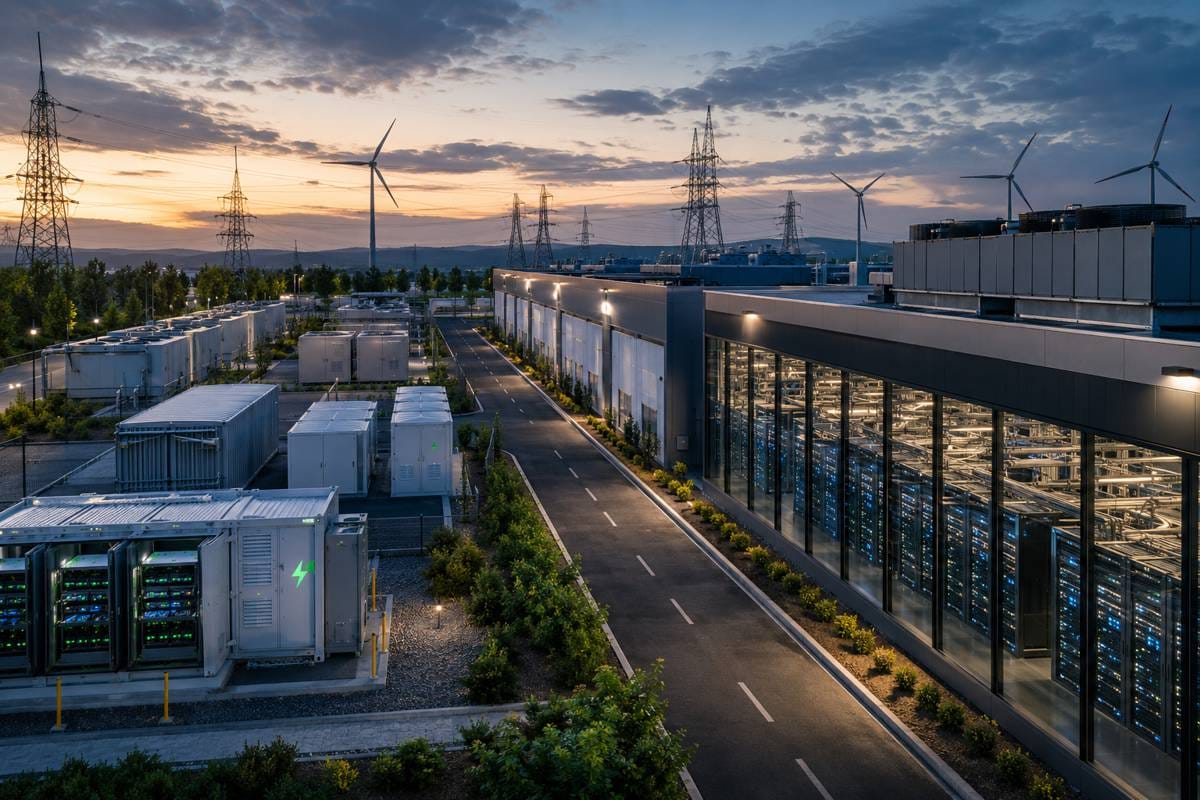
A report from IEA shows that data center electricity use surged in 2025, turning power access into one of the most important constraints on the AI boom.
The AI trade has usually been framed around chips, models and capital. But the International Energy Agency’s latest report points to a less glamorous bottleneck: electricity.
Will electricity access become a bigger bottleneck for AI growth than chip supply by 2028?
YesResult
33.34%
NoResult
33.33%
About equalResult
33.33%
3 Polls
EndedTBD
According to the IEA, the capital expenditure of five major technology companies exceeded $400 billion in 2025 and is expected to rise by another 75% in 2026. Data center electricity demand grew 17% in 2025, while AI-focused data centers grew even faster, surging 50%, comparing with only 3% growth in global electricity demand overall.
It is important because AI is moving from a software story into a physical infrastructure story. The market can keep pricing model improvements, GPU supply and user growth. But how about a basic question: can AI companies get enough power, quickly enough, in the right locations, at prices that still support attractive returns?
The IEA expects global data center electricity consumption will roughly double by 2030, reaching about 945 TWh. China and the United States are predicted to account for nearly 80% of global data center electricity growth through 2030.
Due to AI tasks are becoming more complex, especially as video generation, reasoning models and agentic workflows grow. Even if each unit of compute becomes cheaper, total electricity demand can still rise if users do far more with AI.
That is why electricity is becoming a form of competitive advantage. The best AI company may not simply be the one who owns the smartest models. It may be the one with the best power contracts, fastest grid connections, most flexible data center designs and strongest infrastructure financing.
PJM as the largest grid operator in U.S. can be seem as a foreshow. It has warned of possible electricity shortfalls as early as 2027 because data centre demand rises faster than supply. Reuters (May 2026) reported that PJM capacity prices have jumped by about 1,000% over recent auctions, increasing pressure on utility bills and forcing debate over market reforms.
This is a key market signal. When AI demand starts affecting capacity prices and grid reliability rules, electricity is no longer just an operating cost. It may becomes a pricing variable.
For investors, this means the AI trade is expanding into new markets: utilities, grid equipment, natural gas, renewable power purchase, regional electricity prices etc.
As the IEA's data already suggest the AI demand will rise, the better question is where will the bottleneck bites first?
Will electricity constraints slow down new AI data centre construction? Will PJM-style price spikes spread to other regions? Will hyperscalers move more aggressively into onsite power or even nuclear offtake? Will electricity access become material enough to affect AI company valuations?
The AI boom is still an energy consumer. But it is also becoming an energy market maker.
People express their opinions about all kinds of events on prediction markets, from elections, crypto, sports, to the second coming of Jesus and if the earth is flat.
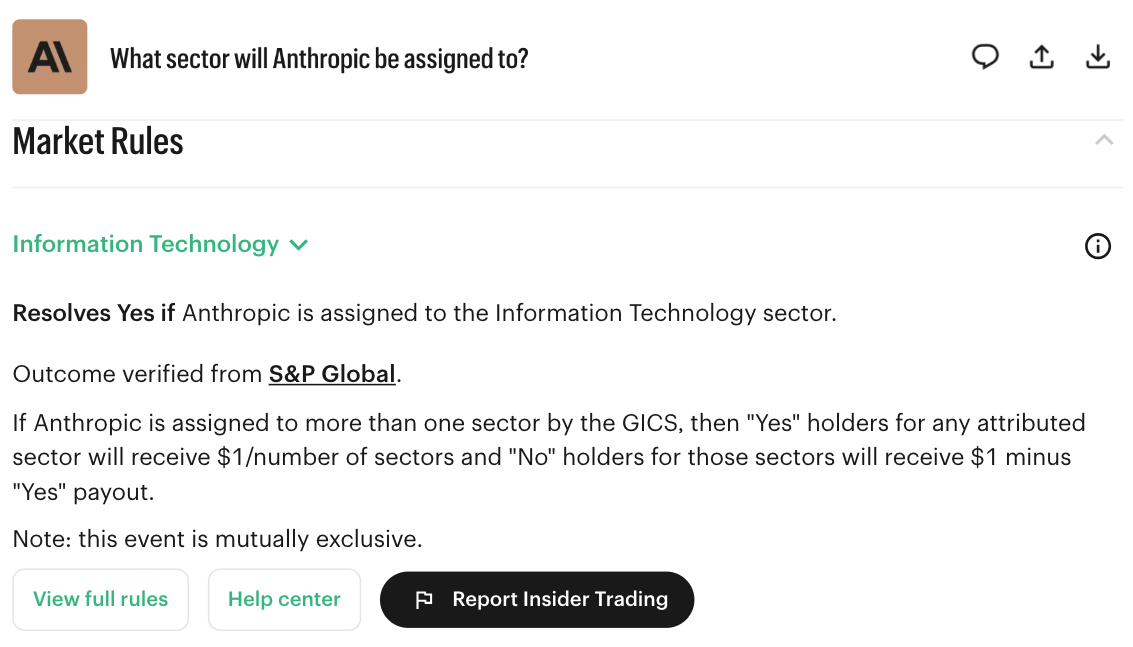
And now, apparently, people are trading on whether Anthropic is "Information Technology" on the market titled "What sector will Anthropic be assigned to?"
As of this writing, the "Information Technology" outcome is shown at 76% chance, together with "Unassigned" at 10% and "Communication Services" at 2%.
At first glance, this Anthropic sector market on Kalshi looks funny. Because the answer seems obvious to most people. Anthropic makes Claude. Claude is AI. AI is tech. So why is this even a market?
The answer is that prediction markets are not about what sounds obvious in normal language. They are about what the contract actually says. The real question is, "what GICS sector will S&P Global assign to Anthropic before the market deadline?"
Read the rules before having an opinion
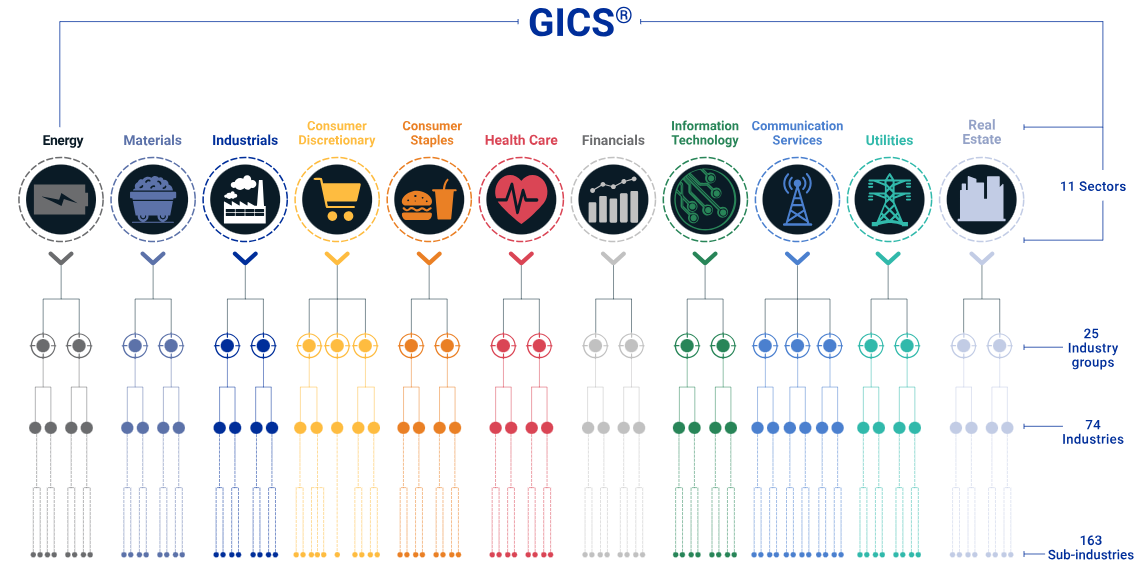
A GICS sector classification is basically Wall Street’s standardized way of putting a company into an industry bucket. GICS stands for Global Industry Classification Standard, a framework developed by S&P Dow Jones Indices and MSCI to help investors compare companies consistently across markets.
It has a hierarchy: a company is assigned to a sub-industry, then an industry, then an industry group, and finally one of the broad 11 sectors, such as Information Technology, Communication Services, Financials, Health Care, or Industrials.
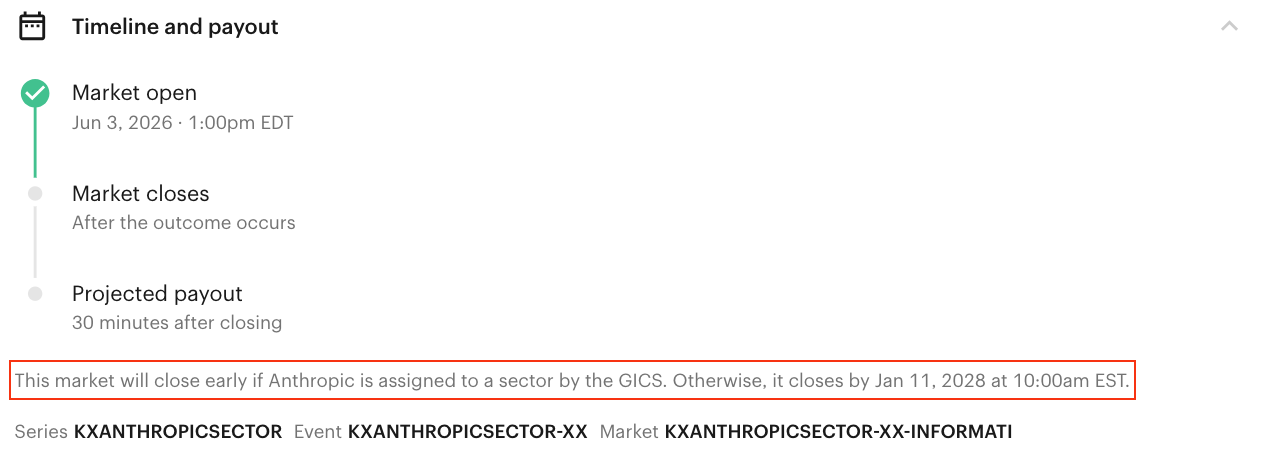
The actual question of the contract is narrower and cleaner: Will Anthropic receive a GICS sector assignment by the deadline Jan. 11, 2028 at 10:00am EST, and if so, which sector will it be?
If Anthropic is assigned to more than one GICS sector, the payout is split across the sectors that receive an assignment. For example, if Anthropic were assigned to two sectors, YES holders in each assigned sector would receive $0.50 instead of the full $1. NO holders in those same sectors would receive the remaining amount, meaning $0.50. Therefore, the contract price should be read as the expected payout of that outcome after accounting for the possibility of split payouts, not simply as the probability that Anthropic receives only that sector label.
In practice, this rule reduces the value of a YES contract if multiple sectors are recognized, even if your chosen sector is technically correct.
However, GICS is designed as a single-classification system. Each company is assigned one GICS classification at each of the four levels: sub-industry, industry, industry group, and sector. The classification is based on the company’s principal business activity, with revenue usually being the most important factor, while earnings and market perception can also matter.
So even highly diversified companies usually still get only one sector. For example, Amazon has cloud computing, advertising, logistics, streaming, and retail, but GICS still classifies it as Consumer Discretionary, NOT both Consumer Discretionary and Information Technology.
Since the probability of multiple GICS sector assignments appears close to zero, I treat each contract price as approximately equal to the probability that Anthropic receives that sector as its sole GICS sector label.
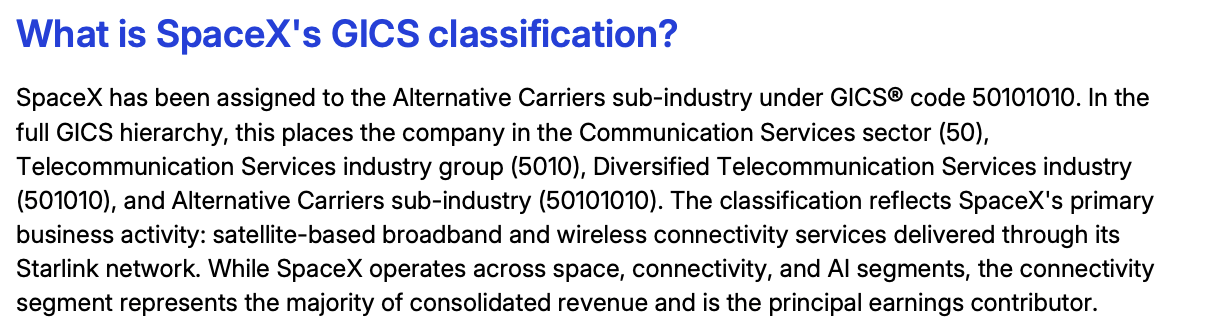
Recently IPO-ed SpaceX is placed in the Communication Services sector because of its major source of revenue. (From MSCI)
Does Anthropic need to IPO before getting a sector assignment?
A quick but important answer: strictly, no. Practically, probably yes.
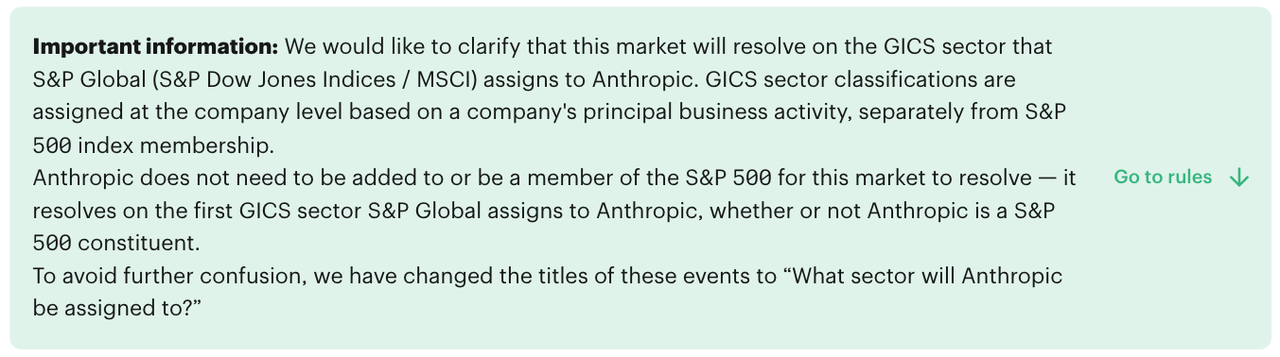
The Kalshi contract does not require Anthropic to IPO. The rules explicitly separates sector assignment from S&P 500 membership.
But in practice, the most likely path to sector assignment is an IPO or another public-market event. For a private company, there is much less public financial information. For a company going public, the prospectus gives the classification providers a clean description of the business, revenue model, risk factors, and financial profile. So IPO is not a legal condition of the Kalshi contract, but it is probably the most important practical trigger.
Thereofre, related IPO markets prices are useful inputs.
The probability tree hiding inside the market
The clean way to price the Information Technology contract is: P(Anthropic Under IT) = P(Anthropic Assigned) × P(Under IT | Assigned).
That looks simple, but it changes the whole analysis.
Kalshi shows: P(Anthropic Under IT) = 76% and P(Anthropic Unassigned) = 10%.
So the market is implying: P(Anthropic Assigned) = 1 - 10% = 90%.
Then the conditional probability is: P(Under IT | Assigned) = 76%/90% = 84.4%.
Then the real market-implied statement is: If Anthropic receives any GICS sector assignment, the market is still giving about a 15.6% chance that the sector is NOT Information Technology.
That is the interesting part. The market is not just pricing IPO timing. It is also pricing a meaningful non-tech classification tail.
Now the job is to ask whether that 15.6% non-IT conditional probability makes sense.
Use related markets instead of vibes
Kalshi has a separate market on when Anthropic will officially announce an IPO, which defines IPO confirmation as one of three things: the SEC declares the S-1 effective, the IPO is priced, or a securities exchange assigns a ticker.
As of this writing, the odds were:
Before Oct. 1, 2026: 47%
Before Nov. 1, 2026: 60%
Before Jan. 1, 2027: 72%
Before Mar. 1, 2027: 84%
Polymarket has a company IPO market as well. The odds retrieved were:
Before Sep. 30, 2026: 9%
Before Oct. 31, 2026: 37%
Before Dec. 31, 2026: 76%
This gives us a useful timing curve. The market is putting meaningful probability on confirmation or IPO completion within the next few months.
In other words, the market is already treating an Anthropic public listing path as highly plausible before the sector market’s Jan. 2028 deadline on Kalshi.
That view also has a fundamental catalyst. Reuters reported on June 1, 2026 that Anthropic had confidentially filed for a U.S. IPO, calling it a move that put Anthropic ahead of OpenAI in the race to public markets. Reuters describes the typical timeline from initial filing to market debut as roughly 3 to 6 months, depending on SEC review and market conditions.
What sector should Anthropic actually get?
GICS has 11 sectors. The top 2 most likely outcomes here are Information Technology and Communication Services.
S&P describes Information Technology as companies offering software and IT services, plus technology hardware, communications equipment, computers, semiconductors, and related equipment.
S&P describes Communication Services as companies that facilitate communication and offer related content and information through various mediums. That sector includes telecom, media and entertainment, interactive gaming, and companies engaged in content and information creation or distribution through proprietary platforms.
The strongest case for Information Technology is the business model. Anthropic sells Claude access, API usage, enterprise plans, developer tools, and workplace AI products. Claude’s Enterprise plan is designed for organizations that need security, compliance controls, and scalable AI across teams. It includes usage-based pricing, with usage billed separately at API rates, and it supports workplace-tool connectors such as Google Drive, Gmail, Google Calendar, GitHub, Microsoft 365, and Slack.
Anthropic’s product list also includes Claude, Claude Code, Claude Code Enterprise, Claude Cowork, Claude for Microsoft 365, Skills, and other software products.
That sounds much more like AI software + API access + developer tools + enterprise workflow infrastructure than media + advertising + telecom + entertainment.
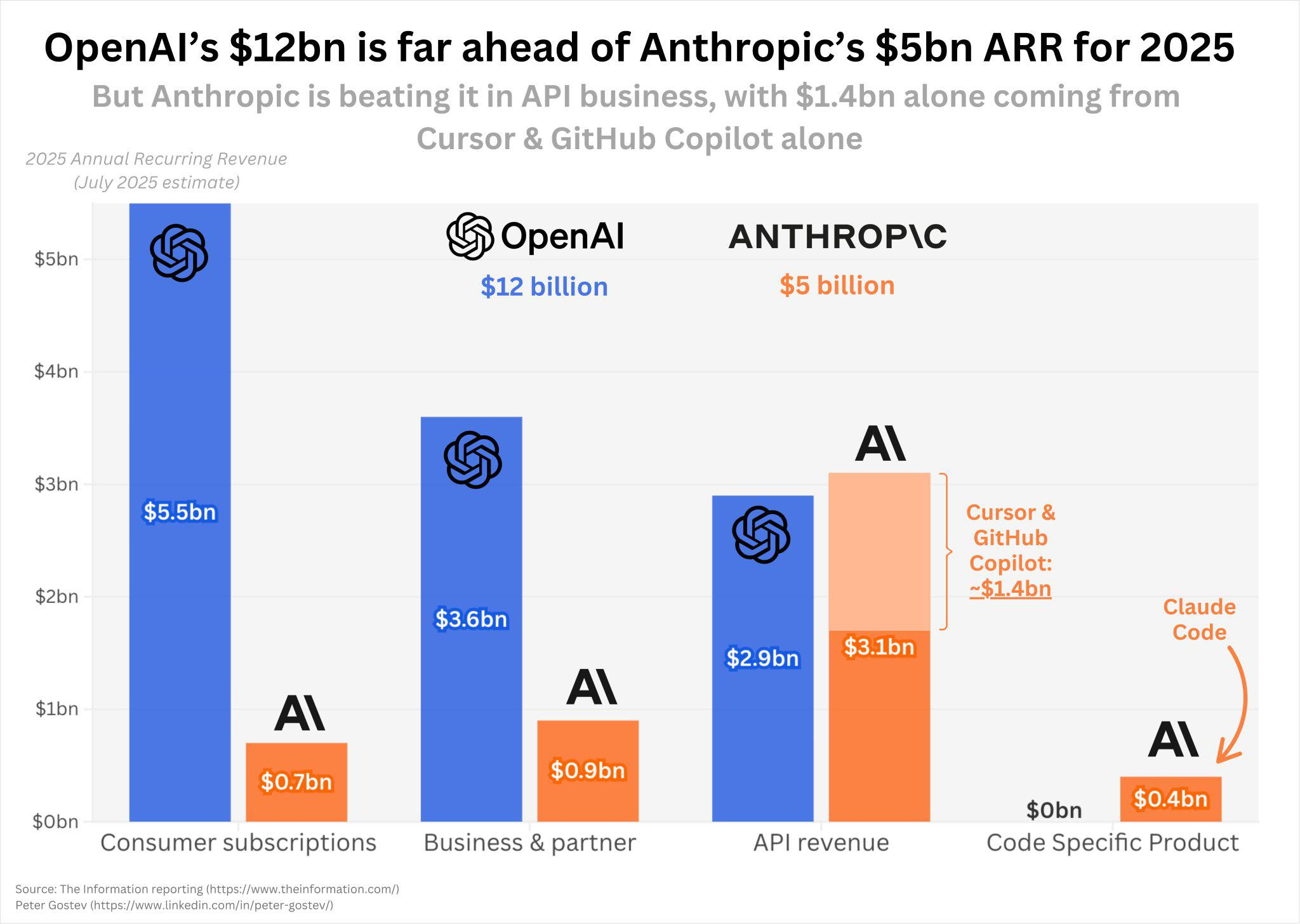
Revenue breakdown for OpenAI and Anthropic
There is a Communication Services tail, but it is not the base case. The tail argument is that Claude is an interactive information platform. Users ask questions, receive information, generate text, and interact with a proprietary platform. That could make someone squint and compare it to internet platforms inside Communication Services.
But that argument seems weaker than the software argument. Anthropic’s monetization is not primarily advertising. It is not a social network or media distributor or telecom provider. It is selling model access and software-like productivity tools.
This is why the 15.6% conditional non-IT probability looks potentially too high.
Anthropic co-founder and CEO Dario Amodei speaks on an AI panel at HubSpot’s Inbound 2025 event, held at the Moscone Center in San Francisco on September 4, 2025. (Image Credit: Chance Yeh | Getty Images Entertainment | Getty Images)
In comparison with the OpenAI market
A good way to test a market is to compare it with a similar market.
Kalshi has the same sector market for OpenAI. As of this writing, OpenAI’s Information Technology outcome is shown at 84%. OpenAI’s Unassigned outcome is shown at 13%, and Industrials is shown at 1%.
Now apply the same conditional math.
For OpenAI, P(OpenAI Unassigned) = 13%;
So, P(OpenAI Assigned) = 1-P(OpenAI Unassigned) = 87%;
And, P(OpenAI Under IT) = 84%;
Therefore, P(OpenAI Under IT | Assigned) = 84%/87% = 96.6%.
Compare that with Anthropic: P(Anthropic Under IT | Assigned) = 76%/90% = 84.4%
So the market is implying that, conditional on assignment, OpenAI is almost automatically Information Technology, while Anthropic has a much larger chance of being put somewhere else.
Indian Prime Minister Narendra Modi stands with OpenAI CEO Sam Altman and Anthropic CEO Dario Amodei at the AI Impact Summit in New Delhi on February 19, 2026. (Image Credit: Ludovic Marin | Afp | Getty Images)
The lesson is simple: read the rules, separate the probability paths, use related markets, and compare similar contracts. The real trade is whether the market is overpricing the chance that S&P calls Anthropic something else from a tech company.
The main thing to watch next is Anthropic’s IPO process. A public S-1, ticker assignment, IPO pricing, or SEC effectiveness would reduce the “Unassigned” risk. After that, the most important evidence will be how Anthropic describes itself in its prospectus: enterprise software, API access, coding tools, and productivity infrastructure would support the IT case.
Disclaimer: The content is for informational purposes only. You should not construe any such information or other material as legal, tax, investment, financial, or other advice. Nothing contained in this article constitutes a solicitation, recommendation, endorsement, or offer by the author(s) or any third party service provider to buy or sell any securities or other financial instruments in your or in any other jurisdiction in which such solicitation or offer would be unlawful under the securities laws of such jurisdiction. The author(s) report(s) no conflict of interest.
June 29 (Reuters) - Uber and Alphabet's Waymo have ended their self-driving partnership in Phoenix, Arizona, as the ride-hailing giant prepares to launch a new autonomous vehicle collaboration in the city.Under the partnership struck in 2023, Uber had integrated Waymo's autonomous vehicles into its ride-hailing and food delivery platforms.
How many cities will Uber's autonomous-vehicle network be live in by end of 2026?
Fewer or Equal to 12Result
50.00%
13 to 14Result
25.00%
Exactly 15Result
25.00%
16 or MoreResult
0.00%
4 Polls
EndedTBD
A Waymo spokesperson said that vehicles used for the pilot program have already been integrated back into its own Phoenix fleet, where they remain available through its app.
Waymo's vehicles are still available on Uber in Austin and Atlanta."Phoenix was our first pilot market with Waymo and was an intentionally limited deployment, reaching just over a dozen vehicles dedicated to the program," an Uber spokesperson said.Uber said it is readying the launch of a separate autonomous vehicle partnership in Phoenix, but did not name the new partner.The end of the partnership follows Waymo's recall of nearly 3,900 robotaxis in the U.S. because a software issue could cause the vehicles to enter a closed freeway construction zone and continue driving.
The design-enabler layer of the chip economy — the software and reusable IP that make every chip possible. A companion to Semiconductor Equipment & Materials primer.
Will Cadence Design Systems' IP segment revenue growth outpace its EDA segment growth by more than 500 basis points (5%) in FY2026?
YesResult
0.00%
NoResult
0.00%
0 Polls
Ended
Executive summary
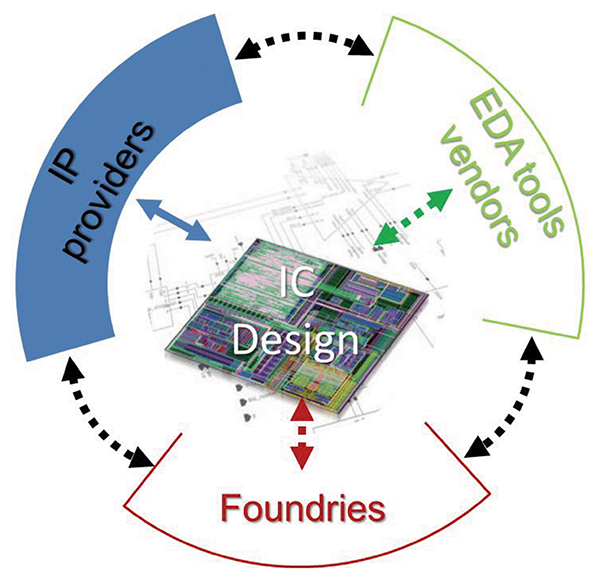
Electronic design automation (EDA) and semiconductor intellectual property (IP) form the design-enabler layer of the chip industry. EDA is the software — and specialized hardware — used to design, simulate, verify, and sign off integrated circuits before they are manufactured. Semiconductor IP is pre-designed, pre-verified circuit blocks (processors, interfaces, memory controllers, analog functions) that chip designers license and reuse rather than build from scratch. Together they are the indispensable toolkit of every fabless company, IDM, and increasingly every hyperscaler designing its own silicon.
The sector is small in revenue but immense in leverage. The combined EDA-and-IP market is on the order of $20 billion a year — a fraction of the equipment market and roughly 2% of global semiconductor revenue — yet no chip reaches a fab without passing through it. That asymmetry, plus software economics, produces a remarkable financial profile: gross margins above 80%, recurring revenue of 70–80%+, customer retention above 95%, multi-year backlogs, and contractual price escalators that lift revenue from existing customers every year.
Structurally the sector is even more concentrated than equipment. EDA is a “Big Three” oligopoly — Synopsys, Cadence, and Siemens EDA — holding roughly three-quarters of the market between them. Processor IP is dominated by Arm, whose designs sit in the overwhelming majority of the world’s smartphones and a fast-growing share of data-center and automotive chips. Two forces now define the outlook: artificial intelligence (which both multiplies chip-design demand and is being embedded inside the design tools themselves), and geopolitics (the May–July 2025 episode in which the United States briefly cut China off from EDA tools demonstrated that design software is a chokepoint as potent as lithography).
1. Defining the sector and its strategic importance
EDA and IP answer a single problem: a modern system-on-chip can contain tens of billions of transistors, far beyond what any team could lay out by hand. EDA software automates the design, while IP supplies ready-made building blocks. A leading-edge processor might combine licensed CPU cores, a GPU, memory controllers, and high-speed interfaces — much of it third-party IP — stitched together and verified using tools from two or three EDA vendors.
The strategic point is leverage. The sector is often described as “small but mighty”: although EDA spending is only around 2% of the semiconductor industry’s revenue, it gates the other 98%. A fab can cost tens of billions of dollars, but it has nothing to build without a finished, verified design — and that design cannot exist without these tools. This is why EDA and IP command software-like margins and why they have become instruments of national technology policy.
Financially, the sector is also notably less cyclical than equipment and materials. Equipment demand tracks fab capital expenditure, which swings with the chip cycle; EDA and IP track customers’ R&D budgets and design activity, which are far steadier — companies keep designing through downturns. Combined with recurring-revenue contracts, this gives the sector unusually high earnings visibility.
2. Position in the value chain
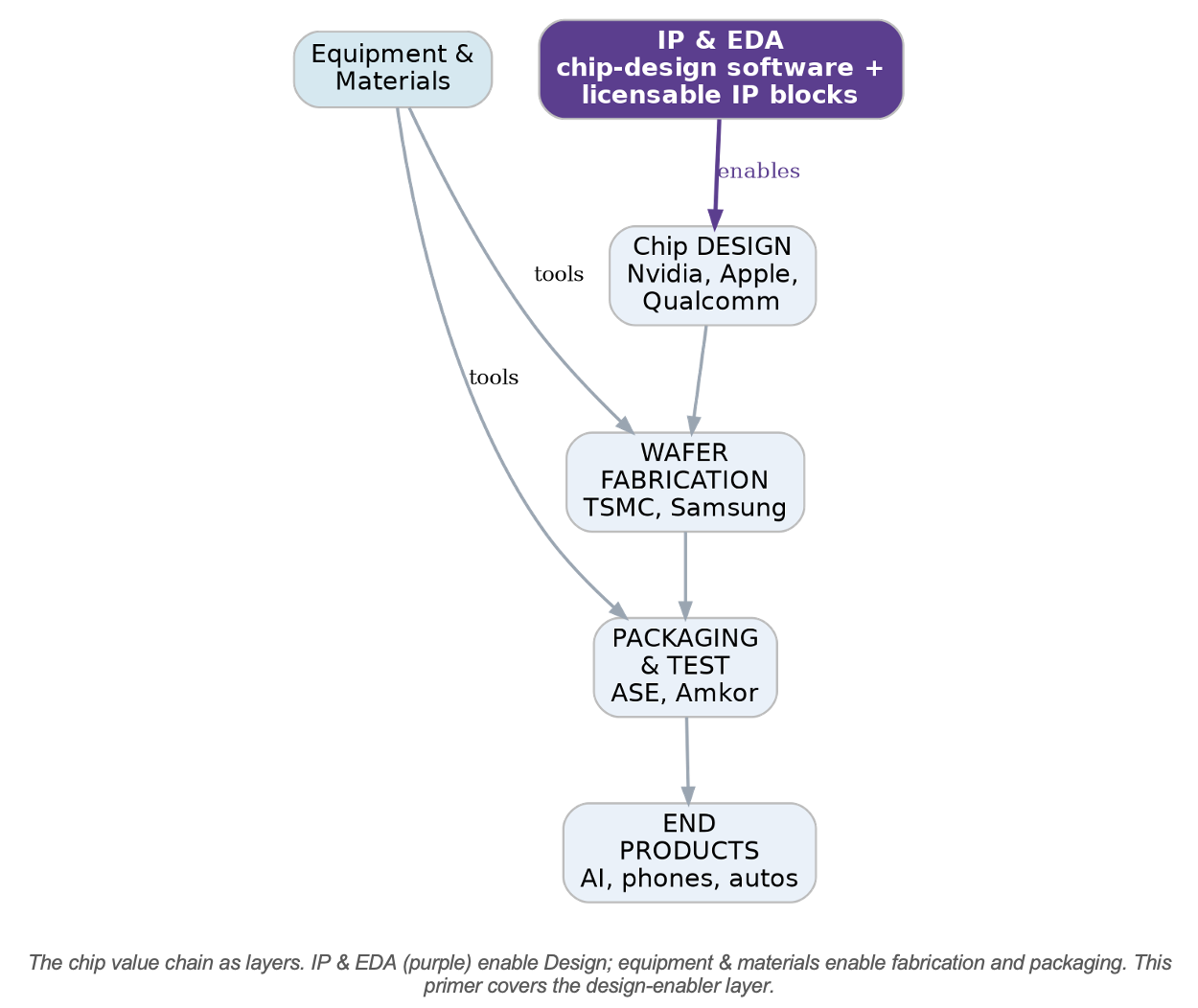
In the layered view of the industry, two enabling layers sit beneath the core chip-making flow. Equipment and materials enable fabrication and packaging;IP and EDA enable design. This primer covers the latter — the layer feeding the very first stage of the chip’s life.
A useful contrast with the equipment sector: both are upstream enablers, but they attach to different stages and have different economics. Equipment is capital-intensive hardware sold into a cyclical capex budget; EDA and IP are capital-light software and licensing sold into steadier R&D budgets. The two also differ in customer breadth — EDA and IP serve every company that designs a chip, including fabless firms and hyperscalers that own no fabs at all.
3. The chip design flow — and where tools and IP fit
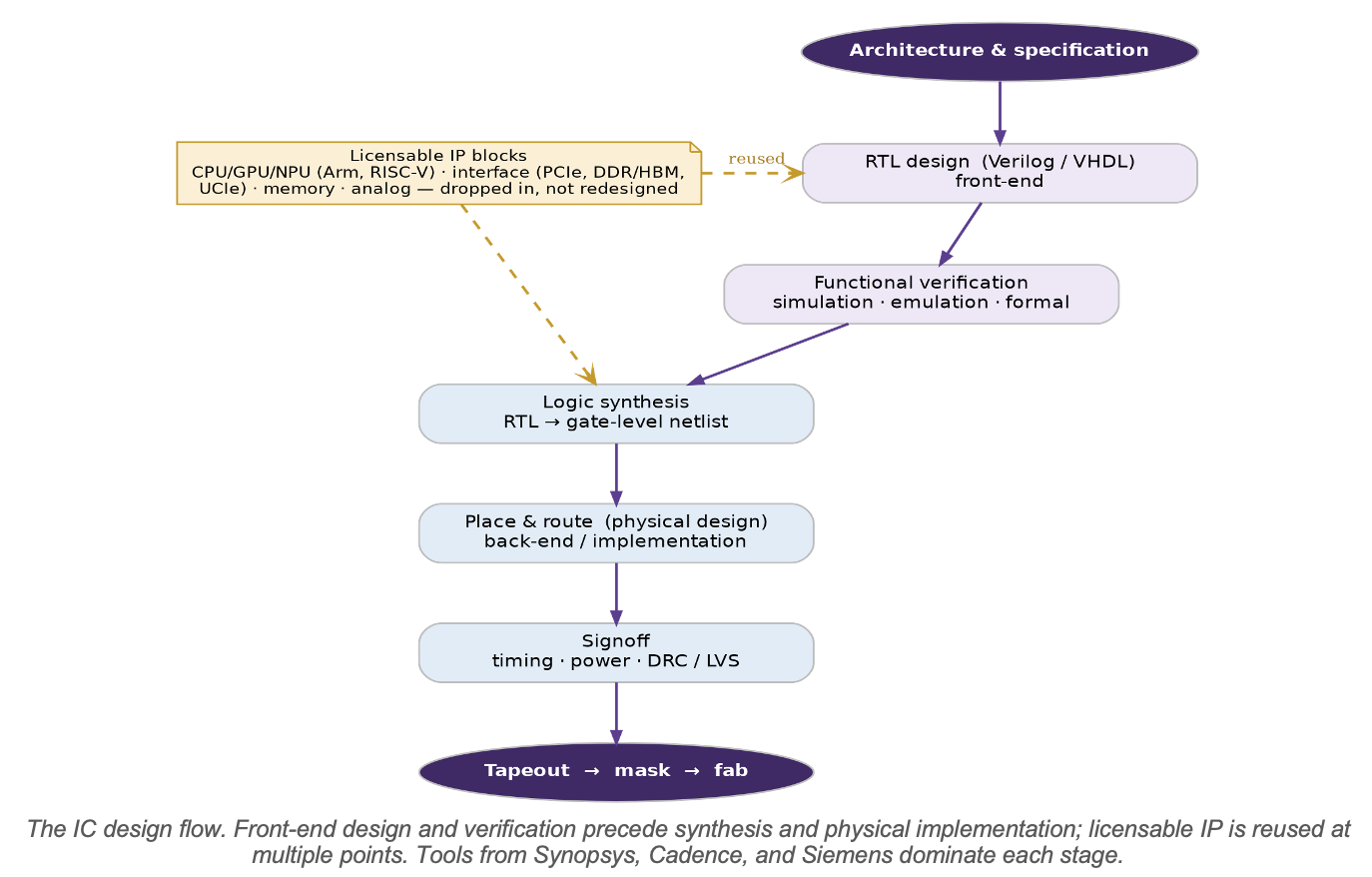
Each EDA tool category maps to a stage of the design flow, which runs from an architectural specification to “tapeout” (the point at which the finished design is sent to the foundry to make photomasks). IP blocks are inserted along the way rather than designed from scratch.
Two features of this flow drive the sector’s economics. First, verification is the single largest consumer of effort — frequently cited as 60–70% of design time — which is why simulation, emulation, and formal-verification tools (and the expensive hardware emulators that accelerate them) are such a large and profitable part of EDA. Second, the flow is sticky end-to-end: once a team builds a chip on a given vendor’s tools and qualified IP, switching mid-project risks schedule and yield, so customers rarely leave. Artificial intelligence is now compressing this flow — machine-learning optimizers can explore design options and close timing far faster than manual iteration, a capability the vendors are monetizing as a premium tier.
4. Market size and segmentation
As with equipment and materials, the two halves of this sector are best presented separately. Market-sizing also varies widely by methodology, so the figures below are indicative ranges anchored to the most authoritative tracker — SEMI’s Electronic Design Market Data (EDM) report, compiled from member-company filings.
4.1 Electronic design automation (EDA)
Core EDA — design, verification, and signoff software plus emulation/prototyping hardware — is roughly a $14–17 billion market growing at a high-single-digit to low-double-digit rate. SEMI’s EDM report, which combines EDA and IP, recorded $5.47 billion in the fourth quarter of 2025 alone (+10.3% year-on-year), implying a combined annual run-rate around $20–21 billion; computer-aided engineering (simulation/verification) was the largest single category at about $2.08 billion that quarter. Demand is broadly split across IC physical design and verification, verification/CAE, and PCB/system design.
4.2 Semiconductor IP
Licensable semiconductor IP is a smaller market — commonly estimated at $4–7 billion depending on whether processor royalties are fully counted — but it is strategically pivotal because it includes the processor architectures at the heart of most chips. The category divides into processor IP (CPU, GPU, NPU), interface IP (PCIe, USB, DDR/HBM memory, Ethernet, and the emerging UCIe chiplet interconnect), foundation IP (standard-cell libraries and memory compilers), and analog and security IP. Processor IP is the largest and most concentrated slice, dominated by Arm.
A structural quirk worth noting for analysts: in SEMI’s data the IP line is heavily influenced by a single dominant player, so reported IP “market” growth can swing with one company’s licensing timing rather than broad demand.
5. EDA tool segments and their leaders
EDA divides into several tool families, each with a clear duopoly or near-duopoly:
• Logic synthesis & digital implementation (turning RTL code into a physical layout) — Synopsys (Fusion Compiler, Design Compiler) and Cadence (Genus, Innovus).
• Verification (simulation, formal, and hardware emulation/prototyping) — the largest spend pool. Synopsys (VCS, Verdi, ZeBu) and Cadence (Xcelium, Palladium, Protium); emulation hardware is a high-value, fast-growing sub-segment driven by complex AI chips.
• Custom / analog & mixed-signal design — Cadence (Virtuoso) is the long-standing leader, with Synopsys (Custom Compiler) competing.
• Signoff (timing, power, and physical verification) — Synopsys (PrimeTime, IC Validator) and Cadence (Tempus, Voltus); Siemens EDA’s Calibre is the de facto standard in physical verification (DRC/LVS).
• PCB & system design — Cadence (Allegro), Siemens (Xpedition), with Altium and Zuken also present.
• Manufacturing / TCAD / DFM — Synopsys and Siemens; increasingly important as design and manufacturing co-optimize at advanced nodes.
6. IP segments and their leaders
• Processor IP (CPU/GPU/NPU) — dominated by Arm, whose architecture underpins essentially all smartphones and a rising share of data-center and automotive silicon. The open-standard RISC-V instruction set (commercialized by SiFive and others) is the principal long-term challenger. Synopsys (ARC) and Cadence (Tensilica) supply specialized processor and DSP cores; Imagination supplies GPU IP; Ceva supplies DSP/AI IP.
• Interface IP — high-speed connectivity (PCIe, DDR/HBM, USB, Ethernet, UCIe). Synopsys is the clear leader and this is its largest IP category; Cadence and Alphawave are significant competitors. Interface IP is booming with AI chips, which need enormous memory and chiplet bandwidth.
• Foundation, memory, analog, and security IP — standard-cell libraries and memory compilers (Arm, Synopsys), plus analog and security blocks. These are lower-profile but high-volume, deeply embedded in the foundry ecosystem.
7. Competitive structure and company financials
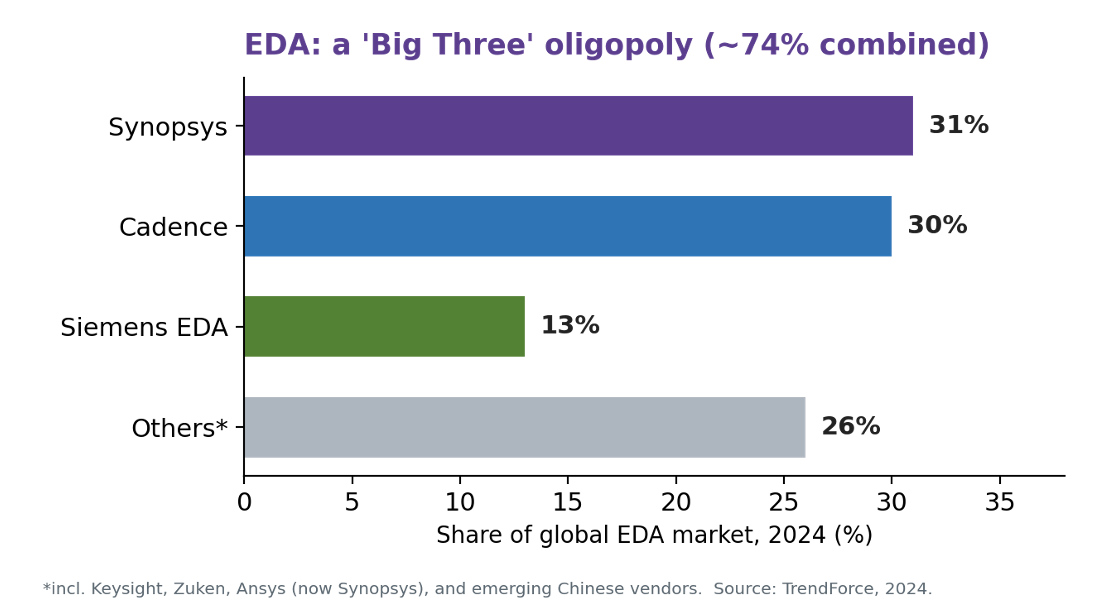
EDA is among the most concentrated software markets in existence. Per TrendForce, the three leaders held roughly Synopsys 31%, Cadence 30%, and Siemens EDA 13% in 2024 — about three-quarters of the market combined. The remainder is split among Keysight, Zuken, Ansys (now part of Synopsys), and a cohort of emerging Chinese vendors.
The financial profile across the leaders is exceptional — high growth, software margins, and large backlogs. The latest full-year results:
The defining corporate event was Synopsys’ $35 billion acquisition of Ansys, completed in July 2025, which extends the company from chip design into system-level simulation (thermal, electromagnetic, structural, and fluid dynamics). The logic is that modern chips cannot be designed in isolation from the systems they sit in — a 700-watt data-center GPU must be co-designed with its cooling. The deal expands Synopsys’ addressable market to roughly $31 billion and, to satisfy regulators, required divestitures (the Optical Solutions Group and PowerArtist). By mid-2025 Cadence and Synopsys each carried equity-market values around $75–80 billion — multiples that reflect their recurring revenue and moats more than their current sales.
8. Business model and economics
Two distinct monetization models operate in the sector. EDA is sold primarily through multi-year, time-based licenses — often large enterprise license agreements (ELAs) — supplemented by upfront emulation-hardware sales. IP is sold through a combination of upfront license fees and per-unit royalties collected for the life of the chip.
The EDA model is, in effect, a renewal engine. Time-based arrangements are 70–83% of Synopsys’ and Cadence’s revenue; customer retention exceeds 95% (and approaches 99% for signoff and analog tools); and contracts carry annual escalators, so a customer that signed a $10 million ELA in 2020 may renew at $12–14 million in 2025 without adding a single engineer. The result is large committed backlogs — Synopsys reported $11.4 billion (about 1.6 years of revenue) and Cadence roughly $7.8 billion — giving rare forward visibility for a technology business.
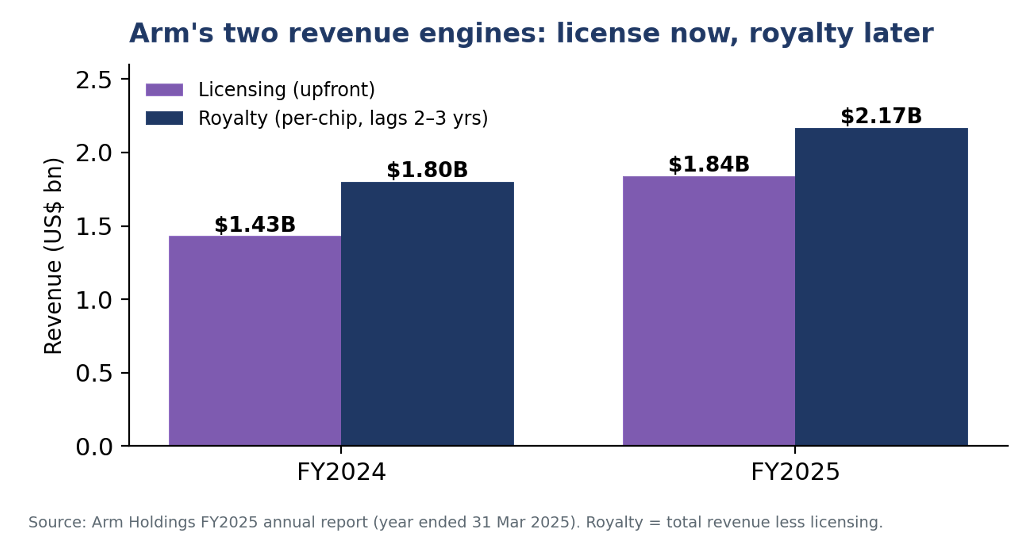
Arm’s IP model has a characteristic time lag that rewards patient analysis:
Because royalties lag licenses by two to three years, a surge in licensing today is an advance signal of royalty growth in 2027–28. Arm is also raising revenue per chip: its newer Armv9 architecture and pre-integrated Compute Subsystems (CSS) carry higher royalty rates than prior generations, and v9 already accounts for roughly a third of royalties. Annualized contract value (ACV) — a normalized measure of the licensing base — was growing around 28% year-on-year as of late 2025.
9. Demand drivers
Artificial intelligence — a double tailwind. AI raises demand in two ways. It multiplies the number and complexity of chips being designed (accelerators, networking, custom silicon), and it is being embedded inside the EDA tools themselves: ML-driven optimizers such as Synopsys’ DSO.ai and Cadence’s Cerebrus can close designs faster and better than manual methods, which the vendors sell as a high-margin premium.
Rising design complexity. Each new node (3nm, 2nm, gate-all-around) and each additional billion transistors increases verification and implementation effort, lifting tool consumption per design.
Chiplets, 3D-IC, and advanced packaging. Multi-die designs require new tools for partitioning, 3D floor-planning, thermal analysis, and die-to-die interconnect — a direct beneficiary of the same advanced-packaging wave reshaping the back-end, and a key motivation for the Synopsys-Ansys combination.
The custom-silicon boom. Hyperscalers designing their own chips (Google’s TPU, AWS’s Graviton and Trainium, Microsoft’s Maia, Meta’s MTIA) have multiplied the number of sophisticated design starts — each one a new consumer of EDA seats and licensed IP, often from customers who never previously designed silicon.
10. Geopolitics: design software as a chokepoint
EDA is a control point comparable to EUV lithography: the leading tools are supplied by two US companies and one US-based unit of a German firm, and they cannot be readily substituted. This was demonstrated vividly in 2025. On 23–29 May 2025, the US Bureau of Industry and Security imposed license requirements on EDA exports to China, abruptly cutting Chinese chip designers off from new tools, updates, and support. Barely six weeks later, on 2–3 July 2025, the restrictions were rescinded as part of a broader US-China framework that also eased China’s rare-earth export curbs.
The episode underscored several realities. China was a meaningful revenue source — roughly 16% of Synopsys and ~12% of Cadence revenue — so the controls hurt the vendors as well as their customers, and Siemens EDA reported a significant China revenue decline that quarter. It also accelerated China’s push for domestic EDA (Empyrean, Primarius, X-EPIC, and newer entrants such as Univista), though Chinese tools remain far behind on full-flow, leading-edge design. RISC-V adds a parallel dimension: as an open, license-free instruction set not owned by any single country’s company, it is attractive to Chinese designers seeking to reduce dependence on Arm.
Will US-headquartered EDA vendors see their total revenue share from the Asia-Pacific region (excluding Japan) drop below 20% in audited fiscal year 2026?
YesResult
0.00%
NoResult
0.00%
0 Polls
Ended
11. A framework for financial analysis
• Value the recurring base and backlog. Time-based revenue mix, retention rates, and committed backlog (e.g., Synopsys’ $11.4 bn) are the core quality signals; they make revenue unusually predictable.
• For Arm, watch licensing as a leading indicator. Licensing and ACV today foreshadow royalties two to three years out; royalty-per-chip (the v9 and CSS mix) is the key margin lever.
• Track the AI attach rate. Adoption of AI-driven tools (DSO.ai, Cerebrus) is both a growth driver and a test of pricing power.
• Remember the sector is R&D-cycle, not capex-cycle. EDA/IP revenue is tied to customers’ design budgets, which are steadier than fab capital spending — a defensive quality versus the equipment names.
• Mind valuation. These are high-multiple equities; much of the value rests on durable growth and moats, so they are sensitive to any deceleration or to regulatory and geopolitical shocks.
PredictionMarkets Org disclaimer: This article is an educational overview, not investment advice, and does not constitute a recommendation to buy or sell any security.
12. Key debates to watch
• RISC-V versus Arm. Whether the open instruction set erodes Arm’s royalty economics in volume markets, or remains complementary at the edges.
• Arm moving up the stack. Arm’s shift toward pre-integrated subsystems (CSS) — and reports of its own chips — raises potential channel conflict with the customers it licenses to.
• AI in EDA: boon or pricing pressure? Whether AI tools mainly expand the premium tier, or eventually let customers do more with fewer seats.
• China’s domestic EDA. How quickly local vendors can close the gap on full-flow, leading-edge design — the sector’s equivalent of the EUV question.
• Concentration and antitrust. The Synopsys-Ansys deal required divestitures; further consolidation will draw scrutiny.
13. Risk summary
• Geopolitical/regulatory — export controls can cut off a ~10–16% revenue market overnight, as 2025 showed.
• Disruption risk — RISC-V (to Arm) and open-source EDA efforts (to the Big Three), though both remain early.
• Customer concentration and consolidation — a handful of large designers and foundries drive much of demand.
• Valuation/multiple risk — rich multiples leave little room for growth disappointment.
• Integration risk — absorbing Ansys is a large undertaking for Synopsys.
The capital-equipment and materials layer that enables all semiconductor's manufacturing — its structure, economics, leaders, and strategic risks.
Executive summary
The semiconductor equipment and semiconductor materials industry supplies the capital tools and consumable inputs required to manufacture every integrated circuit produced worldwide. It sits at the apex of the chip supply chain: its customers are the chip designers/fablesses, foundries, integrated device manufacturers (IDMs), and outsourced assembly-and-test houses (OSAT) that together constitute the rest of the industry. Because no advanced chip can be fabricated without these tools and materials, the sector functions as the binding constraint on global computing capacity — a position that confers both unusual pricing power and acute strategic sensitivity.
Three characteristics define the sector’s investment profile. First, structural concentration: a handful of firms control the majority of each process step, and several occupy de facto monopolies. 2) Second, deep and durable barriers to entry: leading-edge tools embody decades of accumulated process physics and are co-developed with customers years ahead of production, making displacement rare. Third, geopolitical centrality: because controlling the means of production is the most effective lever for controlling who can manufacture advanced chips, the sector has become the principal instrument of export-control policy between the United States, its allies, and China.
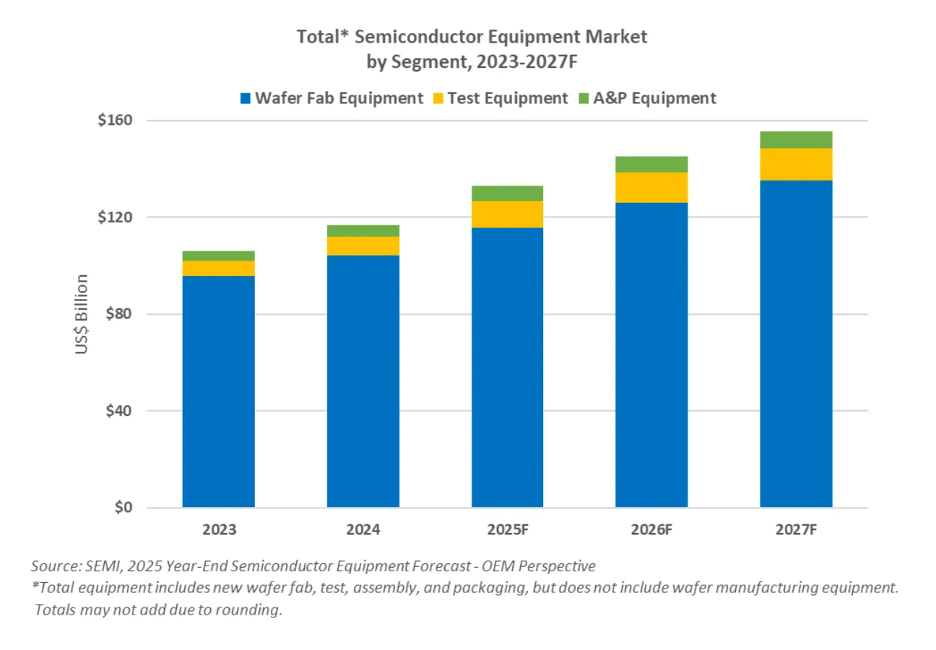
On the latest data, total semiconductor equipment sales reached a record $135 billion in 2025 and are forecast by SEMI to surpass $150 billion for the first time in 2027 (~$156 billion) (SEMI), while the separately-reported materials market set a record of $73.2 billion in 2025 (SEMI). The current cycle is distinguished less by unit volume than by complexity: artificial intelligence, high-bandwidth memory, and advanced packaging are reshaping where capital is deployed across the manufacturing flow.
1. Defining the sector and its strategic importance
For semiconductor equipments, a useful starting point is the economics of a modern fabrication plant (“fab”). A single leading-edge logic fab now requires a capital outlay on the order of $20–30 billion or more, of which the great majority — commonly 70–80% — is spent on process equipment rather than the building itself, based on our channel check and industry analysis. The equipment industry therefore captures the largest share of every wave of fab investment, and its revenues are a direct function of the capital-expenditure decisions of a small number of very large manufacturers (for example, TSMC, Samsung, Intel, and the memory producers).
The materials industry operates on a different rhythm. Where equipment is a periodic capital purchase, materials — silicon wafers, photoresist, process gases, substrates — are consumed continuously as long as a fab is running. This gives the materials business steadier, utilization-linked revenue that is far less volatile than equipment demand, an important distinction for portfolio construction.
Taken together, the sector is best understood not as a supplier of components but as the owner of the enabling technology for the entire digital economy. Its products are the precondition for every downstream activity, which is why a relatively modest revenue base (roughly $200 billion across equipment and materials combined in 2025, according to SEMI) commands disproportionate strategic and financial attention.
2. Position in the value chain
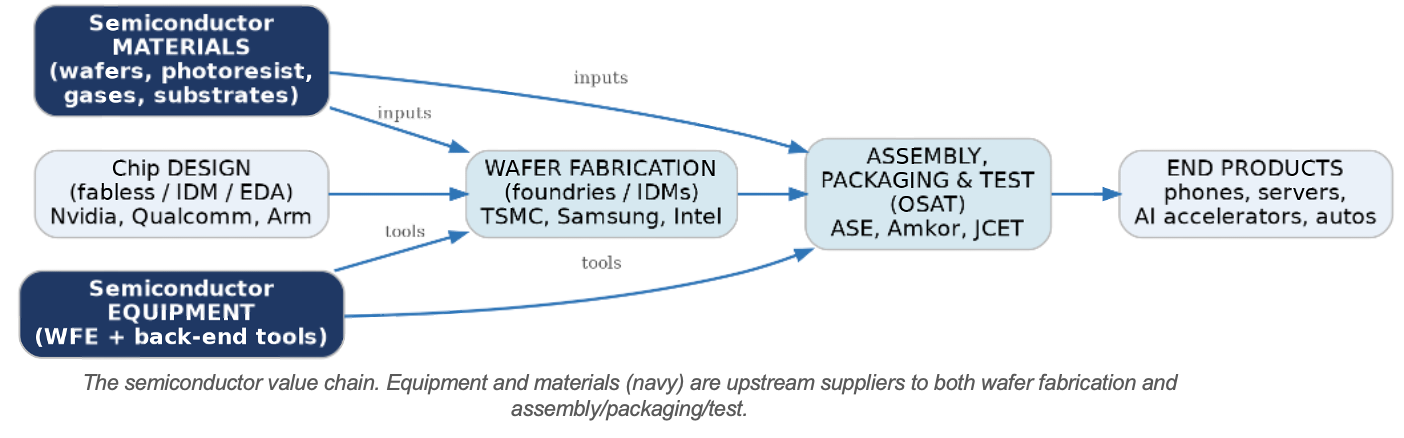
The chip moves through a sequential value chain, with equipment and materials feeding in from upstream. Crucially, equipments & materials supply both ends of manufacturing — the front-end fabs that build circuits on the wafer, and the back-end houses that package and test finished devices. The equipment vendor is always upstream of whoever operates the tool.
This distinction resolves a common point of confusion. “Assembly, packaging, and test” denotes both a service (performed downstream by OSAT firms such as ASE and Amkor) and the equipment used to perform it (supplied upstream by tool vendors). The back-end equipment is upstream of back-end manufacturing; the naming overlaps, but the economic roles do not.
3. How chips are made — and where each tool fits
Understanding the sector requires understanding the manufacturing flow, because each major equipment category maps to a specific process step. Fabrication divides into a front-end phase (building the transistors and interconnect on the wafer) and a back-end phase (singulating, packaging, and testing the finished chips).
Front-end: a repeated build-up of layers
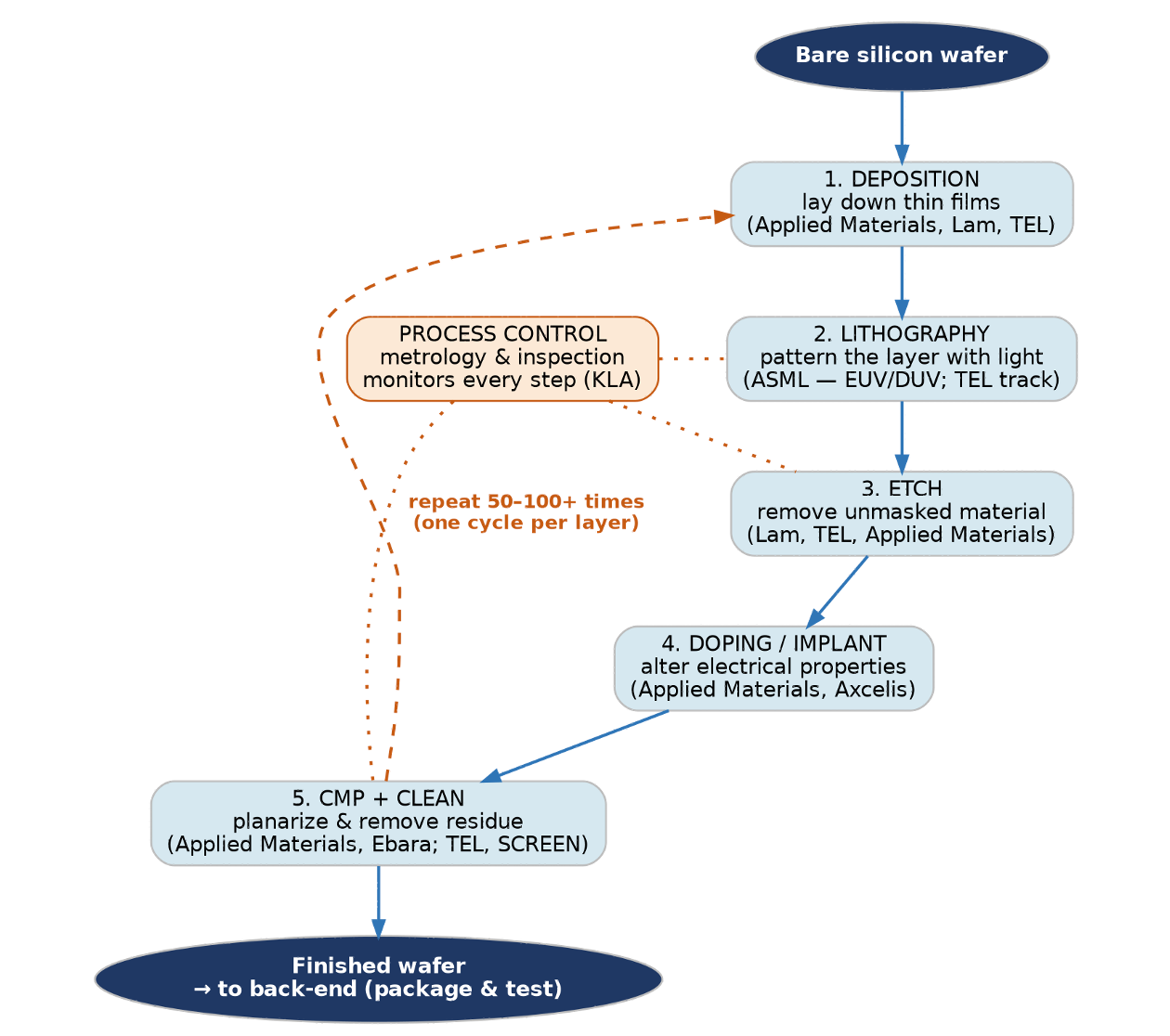
The front-end does not run once; it is a cyclical process repeated 50 to more than 100 times, once for each layer of the device. A simplified cycle proceeds as follows:
Each pass deposits material, patterns it with light, and etches away what is not needed, with doping, planarization, and cleaning interspersed. Because the cycle repeats so many times, even small per-step improvements in yield or throughput compound enormously — which is why customers are reluctant to switch qualified tools and why incumbents enjoy such durable positions. As devices migrate to advanced architectures (FinFET and now gate-all-around transistors, plus 3D memory stacking), the number of deposition and etch steps has risen sharply, increasing the equipment intensity of each wafer and benefiting the deposition/etch leaders in particular.
Back-end: from wafer to packaged, tested chip
Once the wafer is complete, the back-end dices it into individual dies, attaches and connects them within a package, and tests the result. Historically a lower-value, slower-growing segment, the back-end has been transformed by advanced packaging, which increasingly uses wafer-level, fab-style processes and so blurs the traditional front-end/back-end boundary.
4. Market size and segmentation
We summarize semiconductor equipment and materials in two separate SEMI data sets. The equipment figures come from SEMI’s Year-End Total Semiconductor Equipment Forecast; the materials figures come from SEMI’s annual Materials Market report. The two markets differ in size, segmentation, and cyclicality, so combining them obscures more than it reveals.
4.1 The equipment market
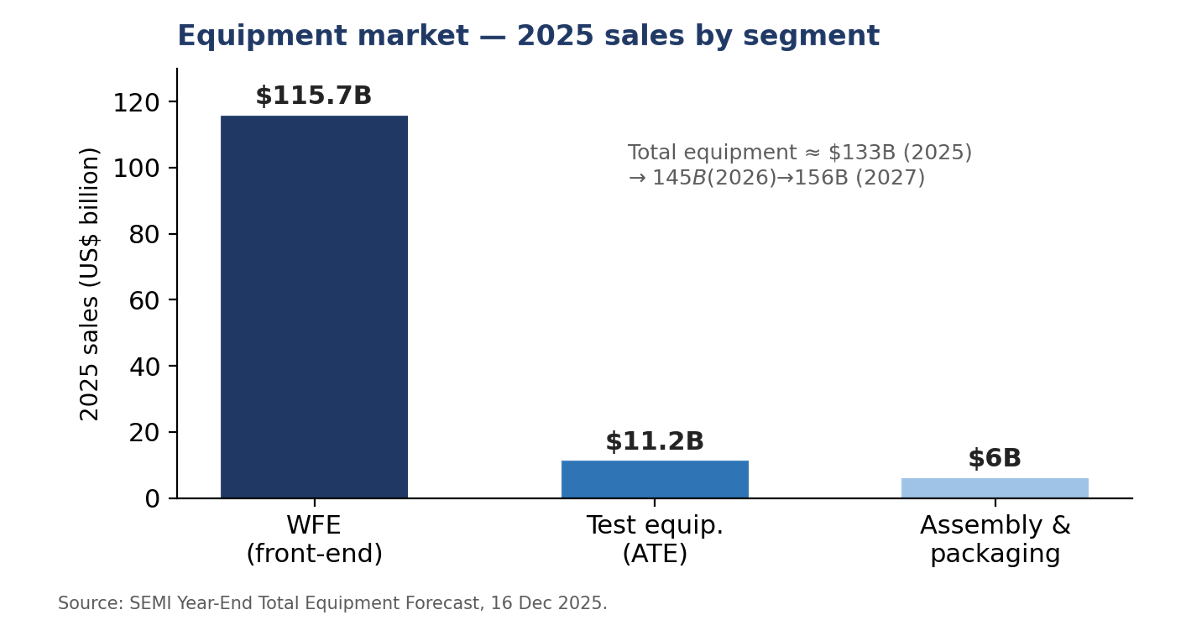
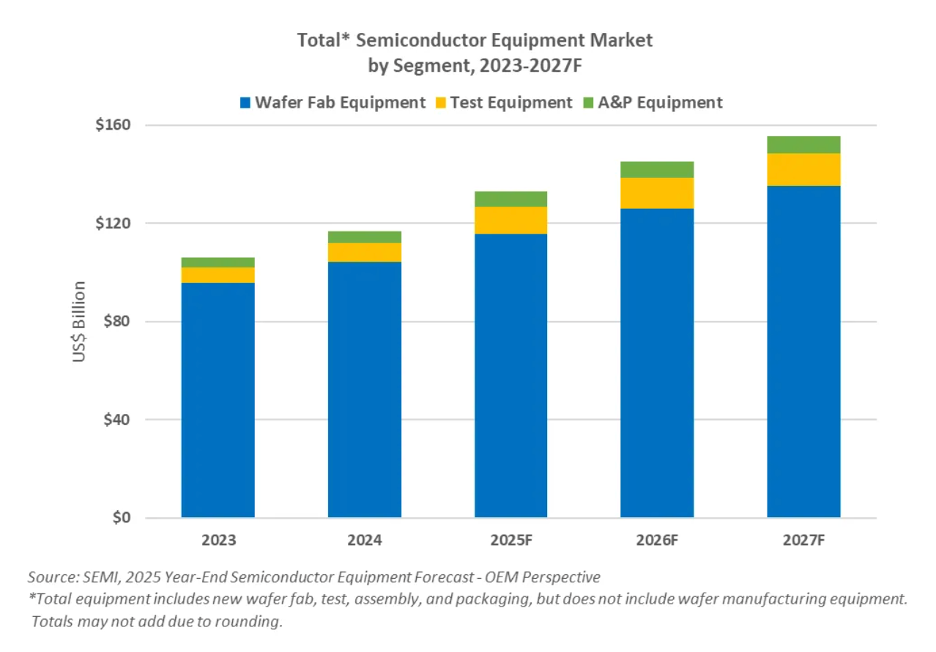
Per SEMI’s Year-End Total Equipment Forecast (16 December 2025), total semiconductor manufacturing equipment sales reached a record $133 billion in 2025 (+13.7% year-on-year), and are projected to grow to $145 billion in 2026 and $156 billion in 2027 — surpassing $150 billion for the first time. Wafer fab equipment (WFE) dominates, while the back-end (test and packaging) has rebounded sharply off a smaller base.
Equipment
segment
2025 sales
2025 growth
Trajectory
to 2027
WFE (front-end)
$115.7 bn
+11.0% (from $104 bn in
2024)
→ $135.2 bn by 2027
(advanced logic, DRAM/HBM)
Test equipment (ATE)
$11.2 bn
+48.1%
+12.0% 2026, +7.1% 2027 (AI/HBM test complexity)
Assembly & packaging
$6.0 bn
+19.6%
+9.2% 2026, +6.9% 2027
(advanced packaging)
Total equipment
$133 bn
+13.7%
→ $145 bn 2026 → $156 bn 2027
Within WFE, foundry-and-logic applications alone accounted for roughly $66.6 billion in 2025 (+9.8%), reflecting resilient leading-edge spending. China, Taiwan, and Korea are expected to remain the top three equipment-buying regions through 2027.
4.2 The materials market
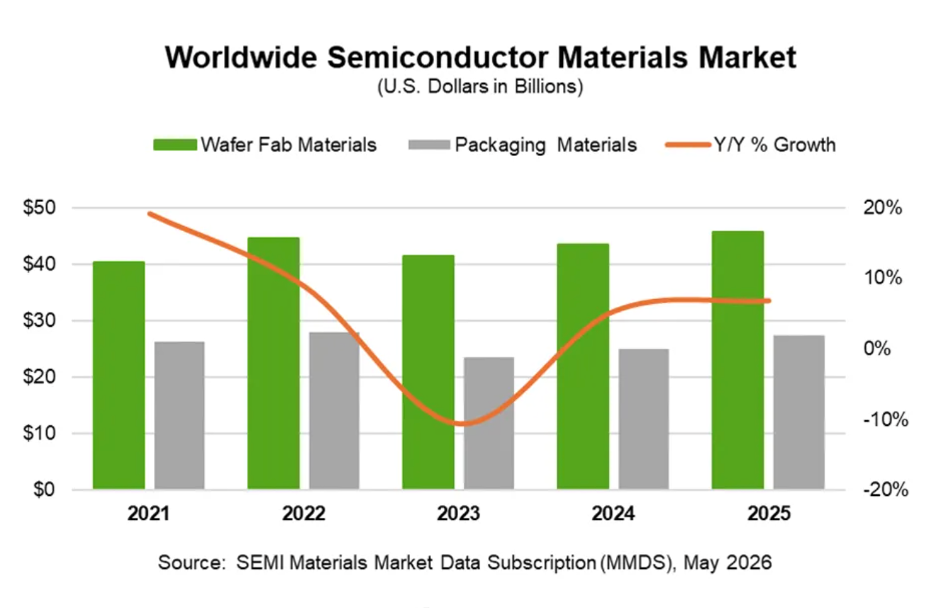
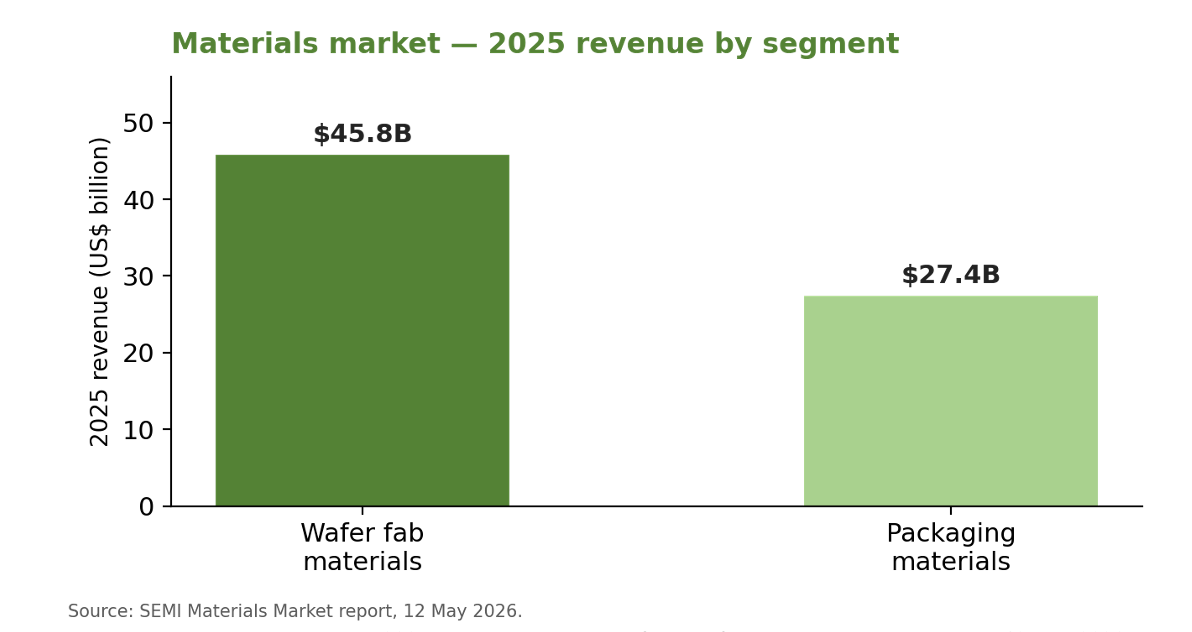
Per SEMI’s Materials Market report (12 May 2026) — a wholly separate release — global semiconductor materials revenue reached a record $73.2 billion in 2025 (+6.8% year-on-year). Materials are consumables purchased continuously as fabs run, so this market is steadier and less cyclical than equipment. It divides into wafer fab materials (used in front-end fabrication) and packaging materials (used in back-end assembly).
Substrates, bonding wire, lead frames, encapsulants
Total materials
$73.2 bn
+6.8%
—
Geographically, the materials data show where chips are actually built. Taiwan was the largest consumer for the 16th consecutive year (~$21.7 billion in 2025), followed by China (~$15.6 billion) and South Korea (~$11.2 billion). A related SEMI release (Feb 2026) noted that silicon wafer shipments rose 5.8% in 2025 to a record area, even as wafer revenue dipped slightly — a sign that AI-driven demand is concentrated in higher-value advanced wafers.
Top
materials consumers (2025)
Revenue
Taiwan (16th consecutive
year as #1)
~$21.7 bn
China
~$15.6 bn
South Korea
~$11.2 bn
5. Equipment segments and their leaders
The front-end equipment market is segmented by process step, with a clear leader (often a near-monopolist) in each:
· Lithography — the highest-value and most concentrated step, patterning circuits onto the wafer with light. ASML is the sole producer of extreme-ultraviolet (EUV) systems, which use 13.5-nanometer light to print the smallest features; its next-generation High-NA EUV tools cost in excess of $350 million each. ASML also leads advanced deep-ultraviolet (DUV) immersion lithography, with Canon and Nikon present at older nodes.
· Deposition — building up thin films via CVD, PVD, ALD, and epitaxy. Led by Applied Materials, Lam Research, and Tokyo Electron (TEL). Atomic-layer deposition in particular has grown with gate-all-around transistors and 3D memory.
· Etch — selectively removing material. Lam Research and Tokyo Electron lead, with Applied Materials present; high-aspect-ratio etch for 3D NAND and advanced logic is a key battleground.
· Process control (metrology & inspection) — measuring dimensions and detecting defects to protect yield. KLA holds a commanding position, and its importance rises as devices grow more complex; this segment also carries the highest margins in the industry.
· Other front-end steps — cleaning and surface preparation (TEL, SCREEN), ion implantation (Applied Materials, Axcelis), chemical-mechanical planarization (Applied Materials, Ebara), and thermal processing. Notably, TEL holds an estimated 88–90% share of the coater/developer (“track”) tools that pair with lithography.
Back-end equipment is more fragmented but faster-growing:
· Assembly & packaging tools — wire, die, flip-chip, and hybrid bonders; leaders include ASMPT, Kulicke & Soffa, and Besi. Hybrid bonding is the critical enabler of 3D stacking.
· Test equipment (ATE) — a duopoly of Teradyne and Advantest; Advantest in particular has benefited from the surge in testing intensity for AI accelerators and HBM.
6. Materials segments and their leaders
Materials feature their own deep moats: a contaminant measured in parts-per-billion can destroy a wafer, qualification cycles run for years, and switching costs are high.
• Silicon wafers — the substrate, led by Shin-Etsu and SUMCO of Japan, with GlobalWafers and Siltronic also major. Worldwide wafer shipments rebounded in 2025–26 on AI demand (SEMI).
• Photoresist and ancillaries — light-sensitive chemicals central to lithography. Japanese suppliers — Tokyo Ohka Kogyo (TOK), JSR, and Shin-Etsu — together hold more than half the global market, with leadership in EUV and ArF-immersion resists. This is among the most R&D-intensive material categories.
• Specialty gases and wet chemicals — Air Liquide, Linde, Merck, and others; consumption rises with process-step count.
• Photomasks, CMP slurries/pads, and sputtering targets — specialized consumables across the front-end flow.
• Packaging materials — substrates (notably ABF substrate), bonding wire (cost tied to gold prices), lead frames, and encapsulants. The fastest-growing materials sub-segment, driven by advanced packaging and the higher material intensity of multi-die AI chips; packaging materials grew 9.3% to $27.4 billion in 2025 (SEMI).
7. Competitive structure and company financials
The sector’s defining commercial feature is oligopoly with monopoly pockets. The five largest equipment suppliers — Applied Materials, ASML, Tokyo Electron, Lam Research, and KLA — together command an estimated 56–66% of the equipment market, and the leader in each individual step typically holds a far higher share still.
The financial signature of this structure is high and persistent margins, substantial recurring service revenue, strong returns on equity, and large capital returns. The latest full-year results illustrate the point:
Company
Core
franchise
FY2025
revenue
Gross margin
Net income
ASML
Lithography (sole EUV maker)
€32.7 bn (~$35 bn)
52.8%
€9.6 bn
Applied Materials
Broadest front-end + services
$28.4 bn
48.7%
~$7.0 bn
Lam Research
Etch & deposition +
services
$18.4 bn
48.7%
$5.36 bn
KLA
Process control / inspection
$12.2 bn
~60.9%
$4.06 bn
Several financial themes emerge from these disclosures:
• Margin hierarchy reflects competitive intensity. KLA’s ~61% gross margin — well above the ~49–53% of the others — reflects its dominant, lightly-contested position in process control. ASML’s margins are buoyed by the EUV monopoly.
• Recurring service revenue is a stabilizer. Service (spares, upgrades, field options on the installed base) is roughly 23% of revenue at ASML, Applied Materials, and KLA, and a notably higher ~43% at Lam Research — a meaningful cushion against the equipment cycle.
• Returns and capital allocation are aggressive. All five majors generate returns on equity above 30%. ASML authorized a new buyback of up to €12 billion (through 2028); Applied Materials repurchased ~$4.9 billion of stock in fiscal 2025. These are cash-generative, capital-light franchises.
• Customer and geographic concentration is high. Applied Materials’ two largest customers represented roughly 19% and 15% of revenue in FY2025; Lam Research derived 34% of fiscal-2025 revenue from China. Concentration is both a source of scale economics and a risk.
Tokyo Electron, the largest Japanese supplier and the third/fourth-largest globally, rounds out the front-end “big five” with its track dominance and strong etch/deposition franchises; precise figures follow its own (April-ending) fiscal calendar.
8. Demand drivers: an AI- and complexity-led cycle
The present up-cycle is driven by architecture and complexity rather than unit volume. The principal drivers:
Artificial intelligence and high-performance computing. Training and serving large models requires vast quantities of leading-edge logic and high-bandwidth memory (HBM), pulling WFE for advanced nodes and for DRAM/HBM capacity. KLA’s management has explicitly tied its return to leading-edge growth to “expanding AI and high-performance computing investments.”
The end of easy transistor scaling and the rise of advanced packaging. As shrinking transistors becomes harder and costlier, performance increasingly comes from packaging — stacking and interconnecting multiple dies and memory. The advanced-packaging market was roughly $33–38 billion in 2024–25, growing at a double-digit CAGR, and by some estimates surpassed traditional packaging as a majority of total packaging value in 2025 (Yole). TSMC’s CoWoS platform is the marquee example: CoWoS wafer demand is forecast to rise roughly 40% year-over-year into 2026, driven overwhelmingly by Nvidia.
Memory as a strategic asset. HBM has converted DRAM from a boom-bust commodity into a constrained, high-value product, prompting elevated memory-equipment spending. This is the proximate cause of the upward revisions to WFE forecasts through 2027.
Because advanced packaging increasingly relies on wafer-level processes, front-end-style tools (deposition, etch, lithography) are migrating into the back-end, expanding the addressable market for the large front-end vendors and partly explaining their strategic push into packaging.
9. The dominant risk: geopolitics and export controls
Export controls now move the sector’s share prices. The governing logic is that controlling the tools is more effective than controlling the chips: a lithography system is a ~$200 million asset requiring years of vendor servicing, whereas a finished chip is a commodity that can be rerouted. The United States and its allies (the Netherlands and Japan, home to ASML, TEL, Nikon, Canon, SCREEN, and Advantest) have progressively restricted exports of advanced equipment to China.
The state of play as of mid-2026:
• EUV is fully denied to China. ASML’s EUV tools have never been sold there; no domestic alternative exists, and China’s SMEE remains far behind on indigenous lithography.
• DUV and servicing are the live battleground. SMIC and Hua Hong still use ASML’s DUV immersion tools, applying multipatterning to reach 7nm-class chips. Proposed US legislation (the MATCH Act) would tighten DUV and etch controls and press allies to align.
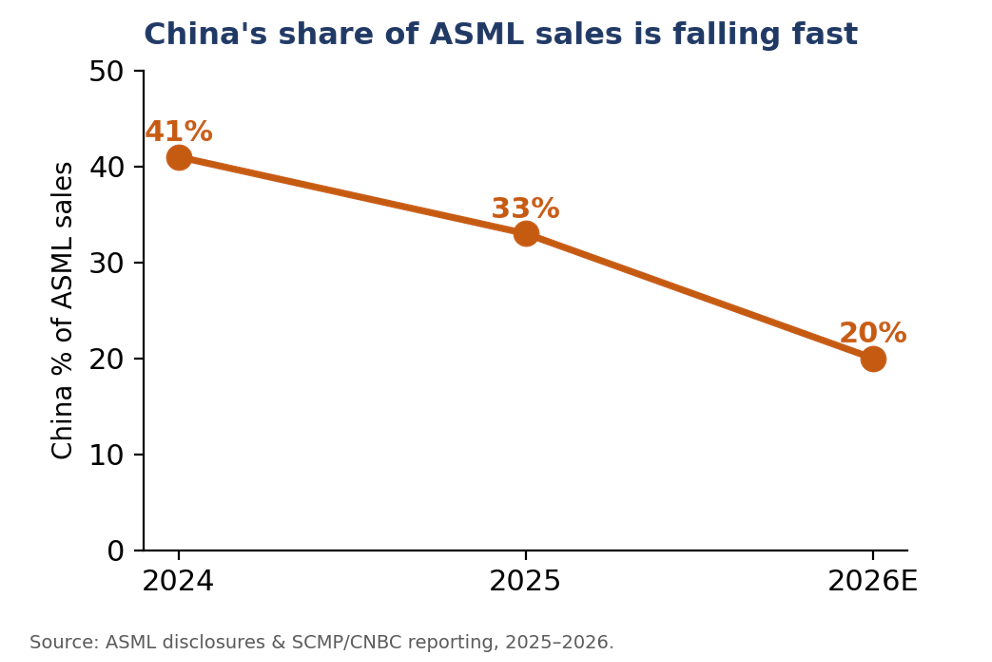
• Western vendors’ China exposure is falling sharply. China’s share of ASML sales declined from roughly 41% (2024) to 33% (2025), with guidance toward ~20% in 2026.
• China is accelerating self-sufficiency. Beijing has reportedly mandated at least 50% domestic equipment sourcing, with a 15th Five-Year-Plan target of ~80% self-sufficiency by 2030, a fully domestic 7nm equipment line, and stable 14nm production. Domestic suppliers (NAURA, AMEC, and SiCarrier-linked entities) are gaining share in mature-node and packaging tools.
The widely noted irony is that aggressive controls are accelerating China’s domestic investment, pushing the world toward two parallel supply chains. For investors this is double-edged: a near-term loss of a large market for Western vendors, and the longer-term emergence of subsidized domestic competitors at the low-to-mid end.
10. A framework for financial analysis
Several principles help in evaluating companies in the sector:
• Track the capex cycle through leading indicators. Equipment demand follows customer capital budgets; monitor the capex guidance of TSMC, Samsung, Intel, and the memory makers, plus fab-utilization rates and company backlog and bookings (ASML’s quarterly net bookings, which reached €13.2 billion in Q4 2025, are a closely watched signal).
• Use “WFE intensity” as a structural lens. Because each node transition adds deposition, etch, and patterning steps, WFE spending per wafer tends to rise structurally even when wafer volumes are flat — a secular tailwind beneath the cycle.
• Value the recurring base. Service and installed-base revenue is higher-margin and far steadier than tool sales; a larger service mix (e.g., Lam’s ~43%) warrants a more defensive valuation.
• Watch margin persistence and R&D intensity. Sustained high gross margins signal pricing power; sustained heavy R&D (ASML alone spent €4.7 billion in 2025) is the price of staying ahead — falling R&D is a warning, not a saving.
• Pair equipment with materials. Equipment offers torque to the capex cycle and the highest margins; materials offer steadier, utilization-linked revenue. Holding both balances cyclicality.
This document is an educational overview, not investment advice, and does not constitute a recommendation to buy or sell any security.
11. Key debates to watch
• Durability of the AI capex cycle — multi-year structural build-out versus eventual digestion and over-build.
• Who captures advanced packaging — foundries (TSMC), OSATs (ASE, Amkor), and equipment makers are all advancing; the economics of process and tool ownership are still being decided.
• Pace of China’s indigenization — mature nodes and packaging appear achievable; EUV and the most advanced steps remain a steep, multi-year climb.
• HBM/memory cyclicality — whether HBM stays supply-constrained or swings back to a glut is a key swing factor for memory-exposed equipment demand.
12. Risk summary
• Cyclicality in fab capital expenditure, amplified for the most equipment-levered names.
• Customer concentration — a few foundries and memory makers drive a large share of demand.
• Geopolitical and regulatory risk — export controls can remove a large market quickly and are subject to political change.
• Technology-transition risk — a missed node or packaging transition can permanently shift share.
• Long qualification cycles in materials can delay new-product revenue.
Will ASML's full-year 2026 net sales beat €40 billion (guided in April 2026?
YesResult
75.00%
NoResult
25.00%
4 Polls
Ended
Which company will see the biggest gross margin increase for its fiscal year vs prior fiscal year?
June 26 (Reuters) - OpenAI said on Friday it was delaying a full public launch of GPT‑5.6 at the U.S. government's request, limiting the AI model's initial access to a small group of vetted partners whose details were shared with the authorities.
Will GPT-5.6 Released on or before July 15, 2026?
YesResult
92.31%
NoResult
7.69%
26 Polls
EndedTBD
Will GPT-5.6 Post Restrictions on Citizenships or Other form of ID/Trust-Groups?
YesResult
88.89%
NoResult
11.11%
9 Polls
EndedTBD
The decision underscores growing concern in Washington over the national security risks posed by powerful AI systems, with policymakers pressing companies to put guardrails around them.
By securing early access to frontier models, U.S. officials are aiming to identify threats ranging from cyberattacks to military misuse before the tools are widely deployed.
OpenAI said in a blog post that the limited release was a temporary step as it works with Washington on a broader framework for future launches. The ChatGPT maker presented its plans and the models' capabilities to the government prior to the launch, it added.
CEO Sam Altman said on X that extensive safety testing "is not a bad idea. I just don't like the idea of the government picking the customers."
President Donald Trump signed an executive order earlier this month establishing a voluntary framework for AI developers to offer "covered frontier models" to the U.S. government for up to 30 days before releasing them to trusted partners.
"We are taking this short-term step because we believe it is the strongest path to broader availability in the coming weeks, while we work with the Administration to develop the cyber Executive Order framework and a repeatable process for future model releases," OpenAI said.
The company said it would continue rigorous testing and close coordination with its partners as it prepares for a wider release, but cautioned that this level of government access and oversight should not become a permanent standard. It did not disclose the names of its partners.
OpenAI, however, expressed concern that such a process would restrict access to advanced AI tools for users including developers, businesses, cybersecurity professionals and international partners who could benefit from them.
At the center of the new lineup is GPT‑5.6 Sol, OpenAI's most advanced model yet, alongside mid-tier Terra and lower-cost Luna.
Earlier this month, the U.S. government ordered Anthropic to suspend access to its frontier AI models for foreign nationals, citing national security concerns. The Claude maker remains embroiled in a legal and regulatory battle with the government.
Both OpenAI and Anthropic have confidentially filed for U.S. initial public offerings. The New York Times reported on Thursday that OpenAI is considering holding off on its public debut until next year.
Will Overcapacity Problem Hit Memory Market with Samsung & Hynix expansion?
YesResult
30.30%
NoResult
69.70%
934 Polls
EndedTBD
SEOUL, June 29 (Reuters) - Samsung Electronics and SK Hynix plan to each build two new massive chip fabrication sites in South Korea's southwest region as part of a national project to build chip production "ecosystem" valued at 800 trillion won ($517.87 billion), the government said on Monday.
The plan was unveiled at the announcement of three new "mega-projects" by the country and the global chip giants to spur growth and dominate the AI sector.
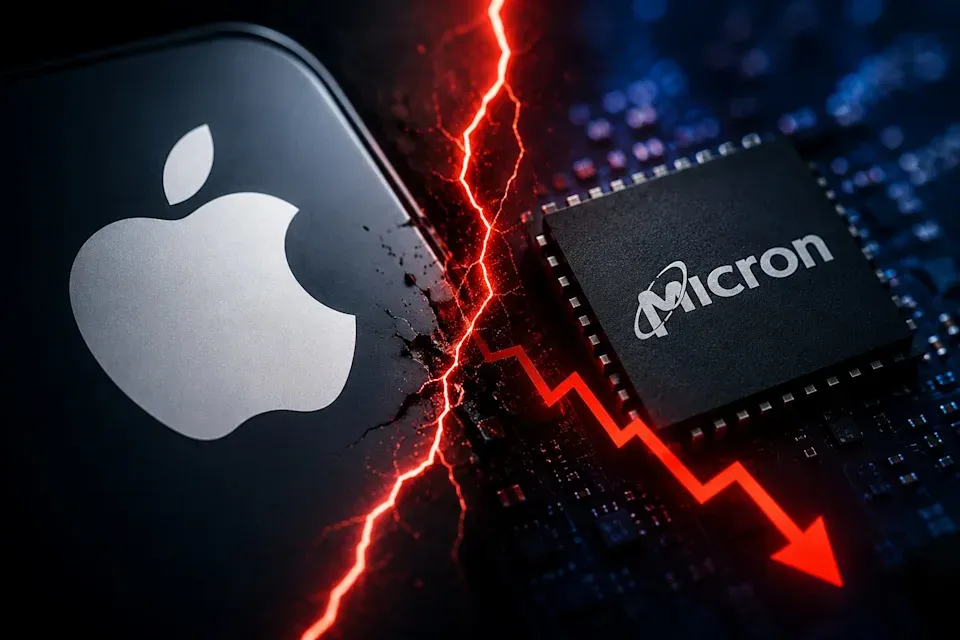
Apple is raising prices of multiple key products as a pass-through of skyrocketed memorgy costs; While Microns seems to hold a different view.
Apple vs Micron - Who Do You Believe Stands for the Truth?
AppleResult
28.57%
MicronResult
71.43%
56 Polls
EndedTBD
Apple raises prices of MacBooks, iPads as memory costs skyrocket
SAN FRANCISCO, June 25 (Reuters) - Apple raised iPad and MacBook prices on Thursday, saying it could no longer shield customers from soaring memory and storage chip costs driven by the AI industry's datacenter buildout.The move does not affect Apple's main cash cow, the iPhone. But it would take starting price of the Neo - its lowest priced laptop aimed at winning marketshare from affordable Windows and Chromebook laptops - from $599 to $699 months after launch.
The increase shows even the world's most valuable consumer electronics company with supply chain relationships that are the envy of the industry is not immune to a memory price surge that has dulled the outlook for smartphone and PC sales.Memory makers such as Micron have in recent months prioritized orders from AI chipmakers like Nvidia, helping them earn record profit but leaving little supply for electronics makers that have been forced to increase prices."We have never seen a component price increase this much, this quickly," Apple said in a statement. "We have shielded our customers from these increases so far, but we have now reached a point where we need to begin raising prices on a number of products, including today's increases for iPad and Mac."
Micron Suggests Apple Helped Cause Memory Price Crisis
As one of Apple’s suppliers, however, Micron sees the situation differently. Speaking to the Wall Street Journal and without naming names, Micron CBO Sumit Sadana implied that Apple is partly to blame for the current situation.
In an interview Wednesday night, Micron Chief Business Officer Sumit Sadana said the company couldn’t make investments during the memory market’s last downturn, when Micron’s gross profits went negative, in part because certain customers took advantage to pay rock-bottom prices.
“We told a couple of the customers who were being very aggressive with pricing at that time that this is not constructive,” he said, without naming Apple, adding that low prices discouraged capital investments. “A lot of the industry investments got shut down in 2023 because of really poor pricing and really poor margins.”
iPhone maker wants Trump administration to sign off on purchases to ease pressure from rising semiconductor prices.
Will Apple Buy From CXMT?
YesResult
35.59%
NoResult
64.41%
767 Polls
EndedTBD
June 26 (Reuters) - Apple is lobbying the Trump administration for clearance to buy memory chips from ChangXin Memory Technologies, a Chinese company the Pentagon has put on a blacklist, the Financial Times reported on Friday.The iPhone maker has lobbied the White House for approval aimed at easing financial pressure on the company from rising memory chip prices, the newspaper said, citing unnamed sources.
The White House, Apple and CXMT did not respond to requests for comment from Reuters outside business hours.The lobbying push underscores the bind facing major U.S. technology companies as soaring memory chip costs collide with Washington's national security restrictions on Chinese chipmakers.
Apple approached the Commerce Department more than a month ago and also engaged other administration officials and allies in Washington, one person told the FT.
CXMT, China's top memory chipmaker, was designated as a Chinese military company by the Defense Department under the Biden administration. The company, among others, was approved by an interagency committee last year for addition to the Commerce Department's Entity List.
U.S. companies cannot ship goods, software and technology to companies on the list without a license, which is likely to be denied.
Apple raised Pad and MacBook prices on Thursday, saying it could no longer shield customers from soaring memory and storage chip costs driven by the AI industry's data center buildout.
The experimental app, internally called “Arena,” would be independent of Facebook and Instagram. It could compete for attention with Polymarket and Kalshi, the biggest prediction markets.
Will Meta launch Prediction Markets App by end of 2026?
Yes - it shipsResult
57.14%
No - quietly killedResult
42.86%
7 Polls
EndedTBD
What would actually get you to use a Prediction Product? (select all that apply)
Polymarket and Kalshi, prediction markets where users can bet on outcomes as varied as the Super Bowl and the length of the State of the Union address, have been some of the fastest-growing destinations on the internet.
Mark Zuckerberg has noticed — and he wants in on the action.
Mr. Zuckerberg, the chief executive of Meta, recently dispatched a small team at his company to create a smartphone app similar to Polymarket and Kalshi, two employees with knowledge of the matter said. Users would not wager money, and the app would probably rely on a video-game-like points system instead, one person said, though the company had not ruled out the eventual use of real money betting.
The app is internally referred to as “Arena” and would function independently from Meta’s social networking apps, which include Facebook, Instagram, WhatsApp and Messenger, said the employees, who spoke on the condition of anonymity to discuss confidential plans. Meta aims to grow the app by leveraging its large social networking audiences and directing them toward using it, they said.
The effort, which insiders characterized as experimental but a top priority, is part of a broader push by Mr. Zuckerberg to create new types of apps based on emerging social behavior online. More than 3.56 billion people visit one or more of Meta’s apps every day, an amount that has raised questions about whether those platforms have reached a saturation point.
Arena is one of a handful of apps that Meta is trying out. Others include one called Meta Photos, another stand-alone app, which would create new types of media using artificial intelligence, the employees said.
Meta declined to comment.
For years, Mr. Zuckerberg has chased growth by looking for how user behavior on the internet is changing and then quickly following fast-growing competitors such as Snap and others by cloning their apps and features.
Those efforts have had mixed success. Meta has struggled with new stand-alone apps before, largely because it has been difficult to get people to find and download them. In 2019, under a team called “New Product Experimentation,” employees tried creating various social apps, including those focused on podcasts and travel, as well as music and matchmaking. Few gained traction, three people familiar with the projects said.
But as Facebook and Instagram increasingly serve video-focused content, Meta executives believe there are fewer areas inside the apps to test new product ideas, the people said. That has pushed the company to set its sights on separate apps.
This is not the first time Meta has experimented with prediction markets. In 2020, it released Forecast, a crowdsourced prediction market app that prompted people to make guesses about the world in the early days of the Covid-19 pandemic. The app was positioned as a way to share crowdsourced knowledge. It used a points system to make predictions about the future. Meta shuttered the app in 2022.
Since then, prediction markets have exploded into a cultural phenomenon, featured during major sports events and in the Golden Globes telecast. In 2025, Kalshi and Polymarket drew a combined $50 billion in online trades. This year, the total has already surpassed $130 billion.
That success has drawn attention from other companies. A prediction market operator can make money by collecting fees on every bet, a potentially enormous source of revenue. Traditional gambling firms like FanDuel and DraftKings have started offering them, as has Gemini, a cryptocurrency exchange. Trump Media & Technology Group, President Trump’s social media business, has also rolled out prediction market plans.
A subway advertisement for Kalshi, a prediction market that, along with its rival Polymarket, has become increasingly popular. Karsten Moran for The New York Times
Kalshi declined to comment. Polymarket did not respond to a request for comment.
The surge of betting on prediction markets has brought intense legal scrutiny. Because these markets offer odds on virtually everything, they create new opportunities for people to use inside information to make money.
A pattern of suspicious trading on Polymarket in particular has generated concerns in Washington. In April, federal prosecutors in New York City charged a member of U.S. Special Forces with using confidential information to place bets about the top-secret plan to capture Nicolás Maduro, the president of Venezuela. The soldier made more than $400,000 betting on the operation, according to prosecutors.
Concerns about insider trading and other possible abuses have put a spotlight on the Commodity Futures Trading Commission, the obscure federal agency that oversees prediction markets. The agency, never particularly large, has shrunk under the Trump administration, leaving it with its smallest staff in years, just as its responsibilities have rapidly expanded.
Senator Richard Blumenthal, Democrat of Connecticut, criticized Meta’s plans on Tuesday in a social media post: “Meta copied slot machines to addict kids to Instagram. Now Zuckerberg is turning his company into a prediction market.”
He added that Meta’s business model was “profiting from addiction” and directed people to support two bills he was cosponsoring in Congress, the Kids Online Safety Act and the Prediction Markets Security and Integrity Act.
Meta insiders have cautioned that Arena remains in development and may not be released.
But as executives search for ways to keep the world’s largest social media sites thriving, Mr. Zuckerberg appears to be relying on his well-worn product development strategy: Follow the users.
Mike Isaac is The Times’s Silicon Valley correspondent, based in San Francisco. He covers the world’s most consequential tech companies, and how they shape culture both online and offline.
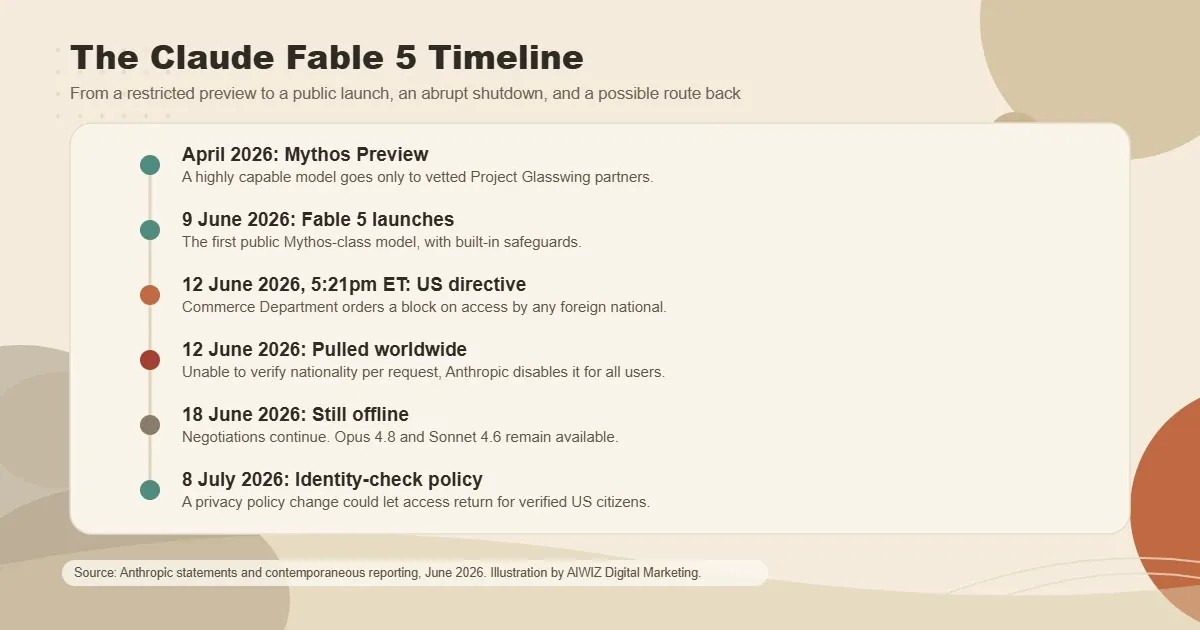
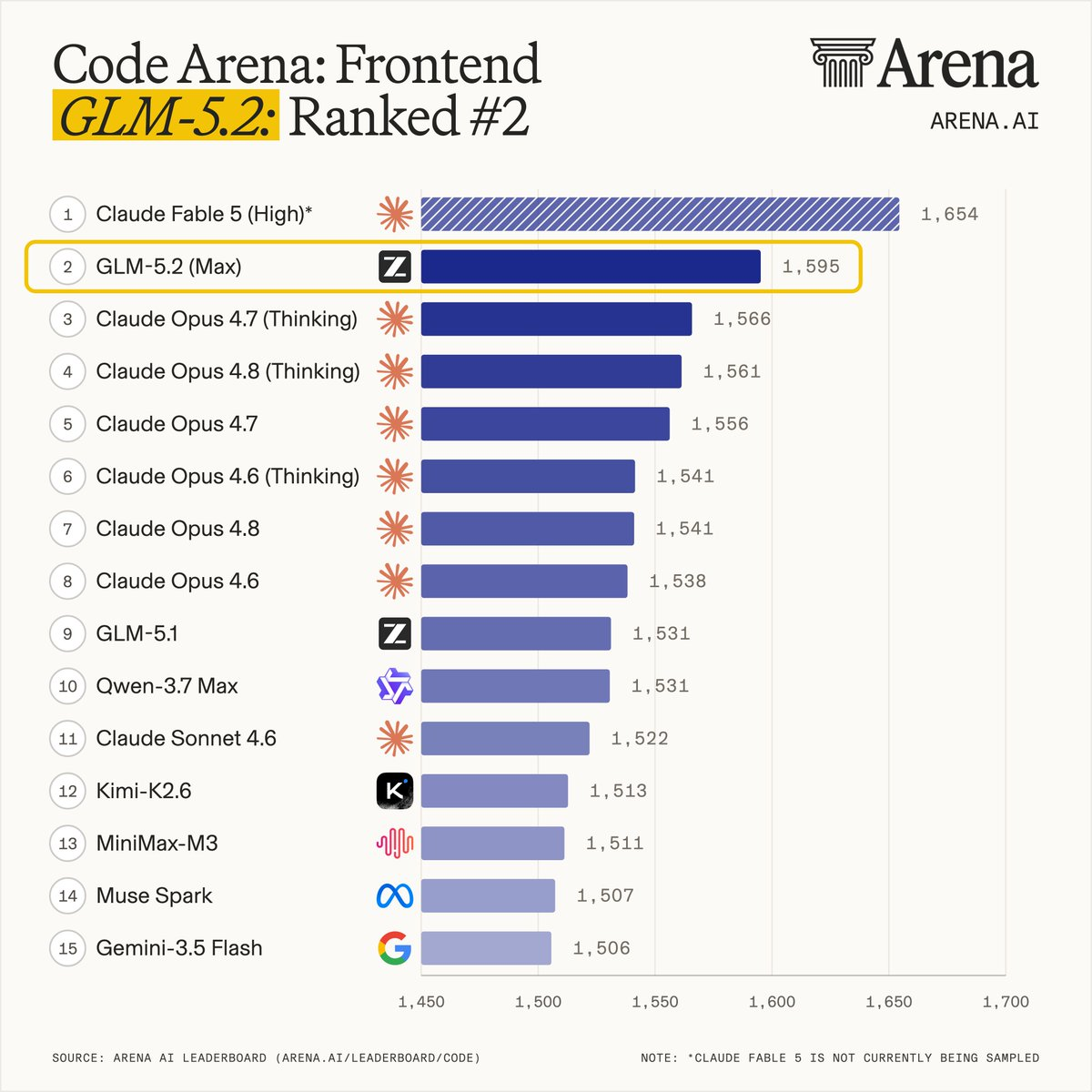
On June 9, Anthropic released Claude Fable 5, an AI model that comfortably beat OpenAI’s GPT 5.5 on agentic-coding benchmarks by more than twenty points.
However, the revolutionary model’s shelf life was only fleeting!
At around 5:21 p.m, eastern time, Friday, June 12, the US Commerce Department sent a letter.
By the evening of the same day, Fable 5 and Mythos 5, its unrestricted sibling, went dark for every customer on the planet.
An Old Law to Implement a Kill Switch
What is also equally interesting is the instrument through which the shutdown directive was carried out. It was the Export Control Reform Act of 2018 and the “deemed export” rule under 15 CFR 734.13 which treats granting a foreign national access to controlled technology, even if its inside the US, as an export.
The order, which essentially made Fable 5 a deemed export, also covered the company’s own foreign-national employees. With no way to verify citizenship in real time at API scale, Anthropic only had one compliant move in its pocket: shut the model down for everyone, on a global scale.
Calling the Fable 5 decision a restriction barely captures the entire essence of the event. When a foreign-national restriction is being implemented on a live service with millions of subscribers, it isn’t exactly a restriction, it is a kill switch. And the kill switch was the only way to enforce it on a same-day notice.
This was done without an independent technical review, court approval, prior notice or any exemption for allied nations.
The government letter arrived on a Friday evening, by nightfall, all the “problematic” models had gone dark.
Ignoring Government Access Order Framework
A more plausible reading that holds the argument beyond the jailbreak rhetoric could be the June 2 White House executive order which directed the NSA, Treasury and CISA to work on a “covered frontier model” framework. Under the framework, the government will have a 30-day access to models such as Fable 5 before they’re released to other partners or general audiences. Fable 5 launched five days after that order and never made it to government offices for testing or due diligence.
This is why, the export directive is less of an emergency response to a security finding and more of an enforcement of a voluntary framework that a leading AI lab bypassed. The jailbreak served as a legal hook, while the executive order powered the motive.
Meanwhile, the alleged letter that Commerce Secretary Howard Lutnick had sent to Anthropic’s CEO, did not spell out any specific concern. However, it does appear that the real motive behind the letter was not just about resolving a patch, but a negotiation tactic over who gets to see such frontier models before they become open for public.
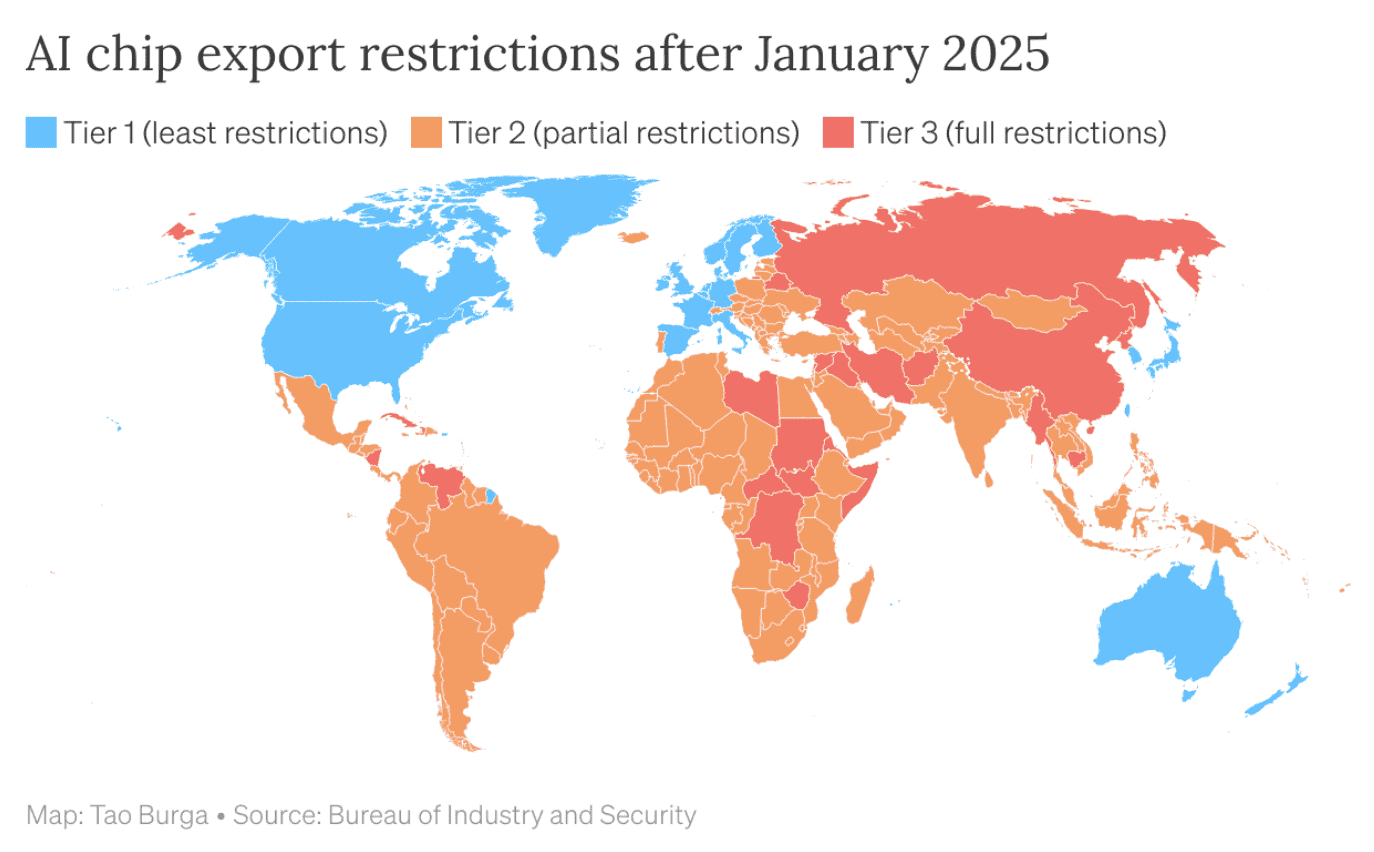
The move to completely shut down Fable 5 is an unprecedented one. Never before has a deployed commercial AI product gone through something like this. Earlier, the biggest regulatory barriers for AI were export controls targeting hardware or advanced chips to China under the January 2025 diffusion framework.
The move also sets a precedent or a blueprint for any frontier model which serves to a global user base, vulnerable to the whims of a government agency which can revoke its presence, leveraged by national security, without any verbal evidence or a committee, while also rendering it powerless to lodge an appeal against the decision.
Since the shutdown, most of the commentary has been focused on the trigger point. Was it a really dangerous jailbreak? Was the US government right about the severity of the jailbreak?
While the debate is quite an interesting one, it is essentially beside the point.
The key event isn’t really an alleged flaw. The key instrument here are the tools that were used to make a groundbreaking model go dark at its infancy.
The unprecedented shutdown was same-day, global and court-free of a deployed commercial product. It would naturally make people wonder how dangerous Fable 5’s capabilities were that the US government decided to bypass all conventional legal channels to pull the plug.
Is the Jailbreak a Distraction?
The merits of this move naturally require specific reasoning. Based on Anthropic’s own communications, government concerns are mostly around the ability of the model to read a codebase and identify software flaws. But there isn’t really anything unique about it since the same job is done by developers, cybersecurity specialists and pretty much every security engineer who runs a software before it goes live.
Based on the points made by Andrew Morris of GreyNoise Intelligence and Katie Moussouris, the capabilities in question aren't unique to Fable 5 so a simple patch doesn't necessarily fix everything.
Anthropic can patch the vulnerability and the control is lifted. However, Anthropic and other testers argue that the same capability is available from other models such as GPT 5.5 and even its own Opus 4.8. In short, there is no quick fix that would solve the problem without crippling a flagship model for a capability that its rivals retain without government oversight.
Perhaps it is safe to say that the government is asking a company to patch a property of capable models in general, not a defect unique to this one. To put simply, the entire Fable 5 is more than just a bug report – it is a critical debate about whether frontier coding ability is safe in public hands.
A Warning Cloaked as Patch Fixing?
While supporters of the act will call this event a major national security win, the action hasn’t really had the desired outcome. It hasn’t eliminated a purported dangerous capability from existence. All it has done is simmer downed Anthropic’s version of the capability that the likes of GPT 5.5, Opus 4.8 and a host of other open-weight models already provide.
What it has done so far, is that it has set a precedent for future frontier models to showcase compliance in face of a national security-linked directive.
The most logical response to this precedent is perhaps migration towards models that cannot be switched off, are self-hosted, open-weight or foreign. In light of what has happened earlier this month, the Cloud Security Alliance has suggested companies to relocate critical workloads across multiple vendors, thus containing a capability rather than allowing it to fizzle out.
Another pertinent point here is that the bypass did not come from a foreign adversary, it came from Amazon, Anthropic’s largest investor and primary cloud provider, along with its direct competitor.
Such a move can also pave way for other models to offer something similar to Fable 5 and emerge as direct competitors. For instance, the Beijing-based Zhipu AI's GLM-5.2 model is already filling the gap Fable 5's vanishing act has created.
Will Fable 5 Return?
Presently, Anthropic is working to restore access and officially considers the executive order a misunderstanding. The model is likely to return, with no timeline in sight at the moment. However, in this case, timeline isn’t important – the terms of return are what matter more.
If access returns bundled with regulatory concessions based around the pre-briefing framework, the model will be working with a hanging noose of another shutdown if it deviates from the terms. However, if the government quietly backs down once Anthropic provides technical detail, it becomes a one-off event, thus allowing a frontier model to branch out unchecked.
The timing of this is also critical and could impact Anthropic's initial public offering plans.
Will Fable 5 return at the end of July?
Yes, by end of JulyResult
100.00%
No, but before end of AugustResult
0.00%
1 Polls
EndedTBD
Conclusion
For years, AI industry has been arguing about guardrails and what a model should and should not do. Fable 5 revealed that the real discussion was never really about safety training. It was more about an out-of-the-blue executive order that is currently a lever sitting over an entire industry, waiting to take action based on national security interests.
The model that went offline doesn’t seem to be the biggest story here. What it doesn’t come back with once the switch is turned on again, is the real discussion.
Meta Platforms Inc. Chief Executive Officer Mark Zuckerberg has directed a small team to create a prediction market application similar to Kalshi Inc. and Polymarket, but with lower stakes as users won’t likely wager real money.
The standalone product, which is still in development and known internally as Arena, would complement Meta’s other social media offerings by giving people a place to interact around live events like sports games or politics, according to a person familiar with the matter, who asked not to be identified as the details aren’t public. The Times Exclusive: Mark Zuckerberg Directed Meta to Create a Prediction Markets App first reported on the internal effort. A Meta spokesperson declined to comment.
The prediction market industry, which lets people wager on the outcome of various real-world events, has exploded in the face of a newly friendly regulatory environment in Washington. Upstarts like Kalshi and Polymarket have benefitted from that, garnering multibillion dollar valuations. While Arena intends to capitalize on that user interest, the app isn’t currently expected to require real funds. Instead, it would likely engage users through a points system, the person said.