Premier info portal for prediction markets. The start point of information market.
Embodied AI - What Tesla's Optimus Timeline Really Tells Investors
Analysis
TeslaEmbodied AIMust ReadIndustry PulseMag 7

Embodied AI - What Tesla's Optimus Timeline Really Tells Investors

Economics & FinanceTech

While Polymarket’s Optimus contracts may be priced accurately, the underlying reasons for these valuations are widely misunderstood. Ahead of the June 30 deadline, Polymarket’s contract on the likelihood of Tesla releasing Optimus sits at just 1%, while the consensus for the December 31 deadline is tilted slightly higher at 16%. The prices and the bets aren’t necessarily wrong, but their standard interpretation misses the mark.

Currently, Polymarket is running two Optimus release markets (June 30 and Dec. 31), while Kalshi is running a contract based on the robot's availability for sale in 2026.
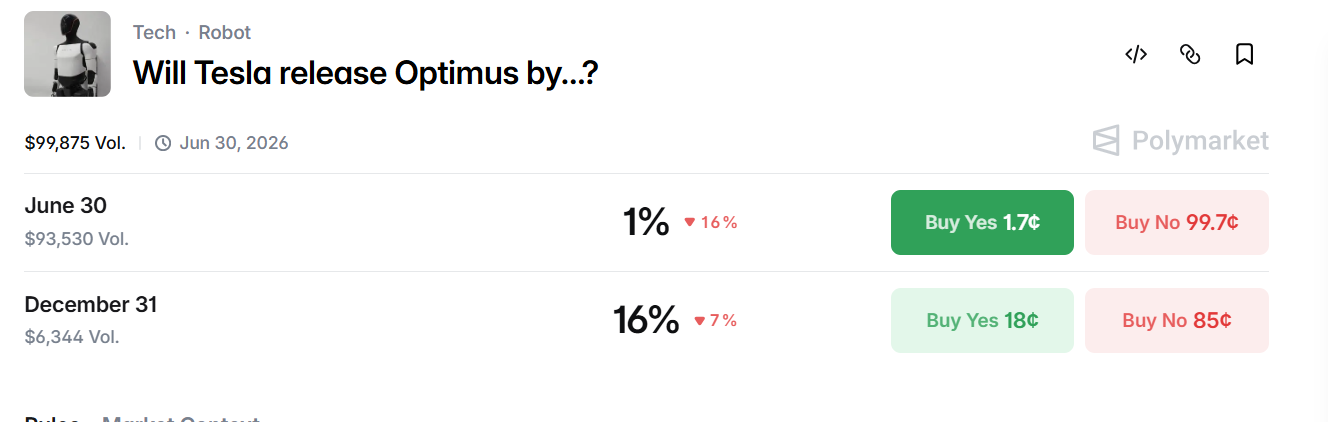
Source: PolyMarket

All year long, we’ve seen the prices for these contracts drift downward. The June 30 market currently has an order book of around $93,530 against a lifetime volume of $99,873. It is safe to say the market isn’t expecting Tesla to make a massive Optimus announcement anytime soon, especially with public attention largely divided among Elon Musk's other ventures.
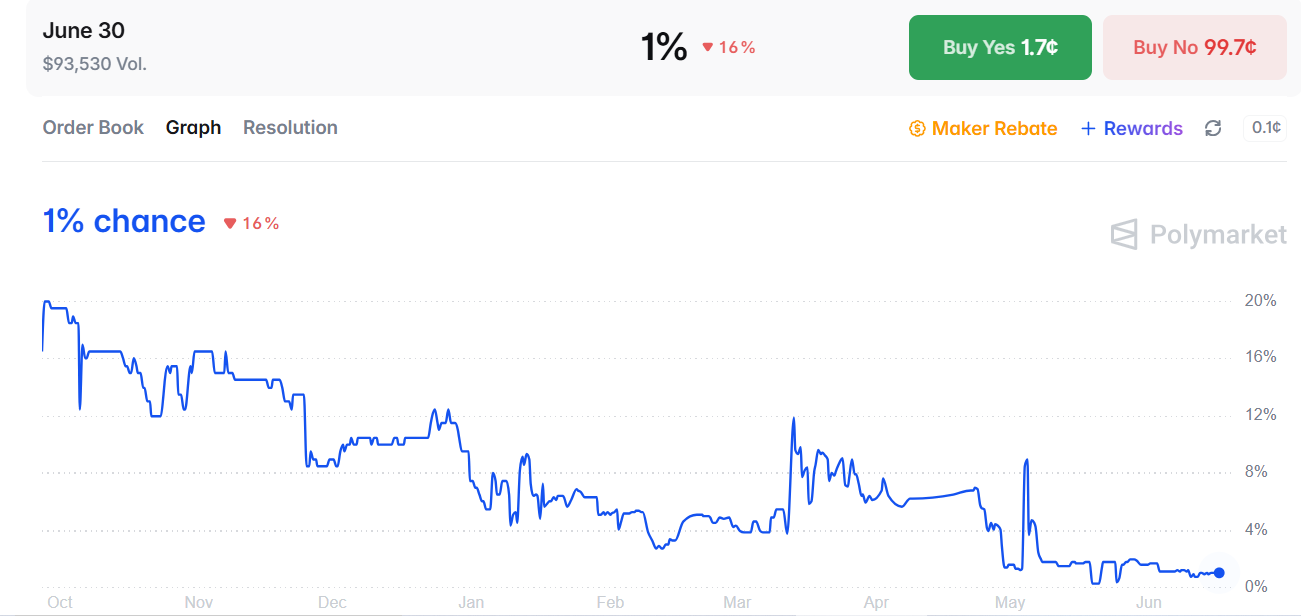
Source: Polymarket

More importantly, resolving these contracts positively requires a very specific event: the availability of the Optimus robot for general purchase via an official Tesla press release, accompanied by a standard consumer checkout feature. Anything less than that—such as product demos, pilot launches, or asking visitors to register their interest without an exact launch date—will not trigger a payout.

Therefore, we can safely assume that these Polymarket contracts have nothing to do with the actual progression of AI or whether Tesla has the wherewithal to build a multi-use robot. They are exclusively pricing the odds of seeing a consumer checkout button.

The True Metric: Industrial Deployment

Currently, the market is pricing these contracts fairly accurately because Elon Musk has already informed investors that the earliest consumers could purchase Optimus would be in the latter half of 2027. Furthermore, the 2026 Optimus program is entirely focused on internal usage and a gradual transition toward industrial applications. The first units are slated to be deployed on Tesla’s own production lines later this year before moving to other industries.
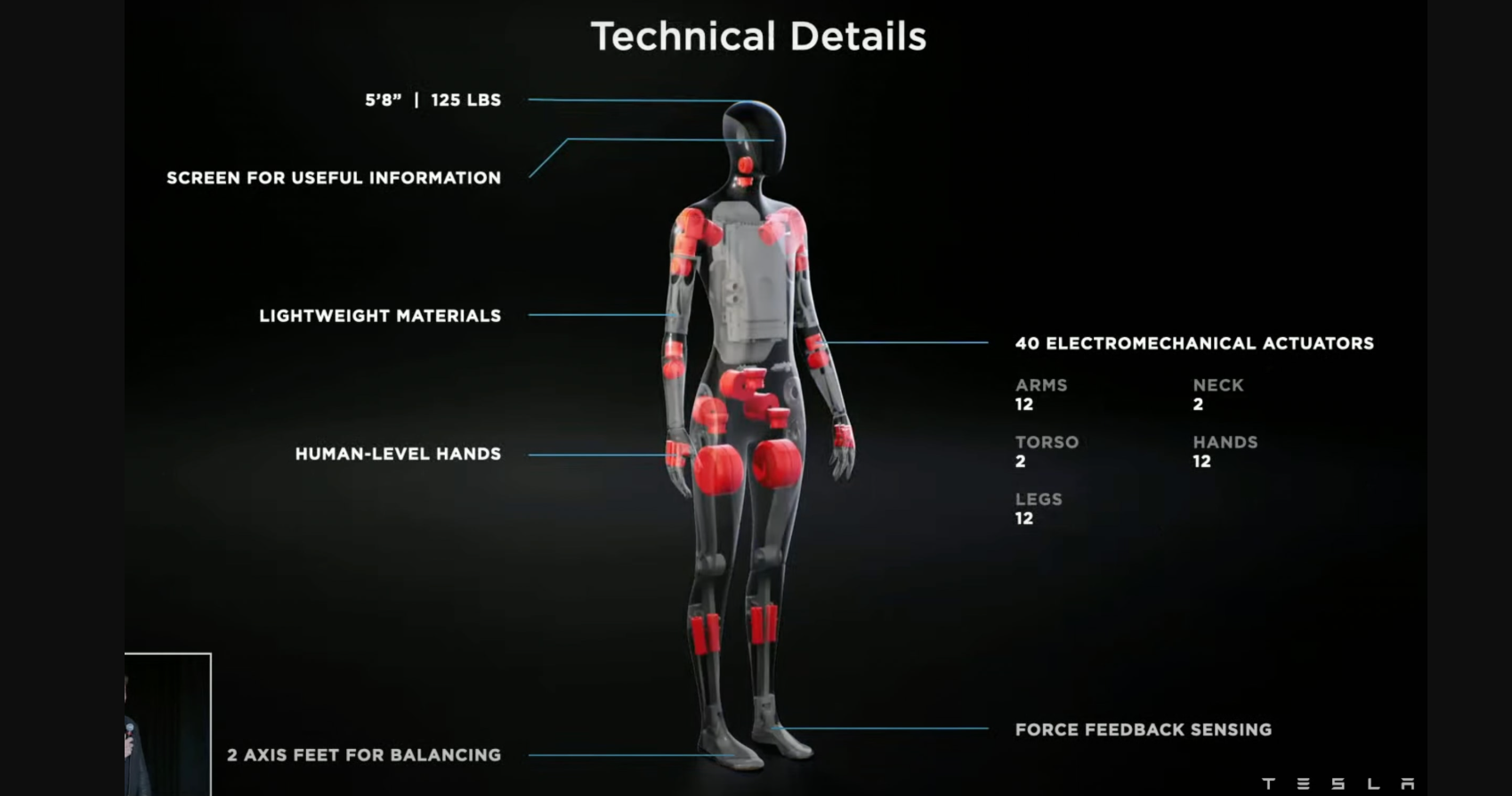
Source: Tesla Media Release

This is exactly why citing these prediction contracts as a verdict on the viability of "embodied AI" is erroneous. While a contract might accurately answer its own narrow criteria, it is the wrong medium for the questions most investors are actually asking, such as "Does embodied intelligence actually work?"

The reality is that while Optimus has no presence on the retail floor, the actual leading indicators of embodied AI are purely industrial. This sector is moving incredibly fast, with several companies already running parallel to—or even ahead of—Tesla.

For now, anything linked with Optimus capabilities, pricing and demand would be confined to speculations and forecasts, with contracts serving as the closest source to gauge its prospects in the near term.

It can also be said that the existing contracts are handicapped and limited because of a lack of clear catalysts visible through the company's investor relations department. For Tesla, the key value this year could be assessing total robot hours clocked and rigorous testing before the product is ready for general consumer use.

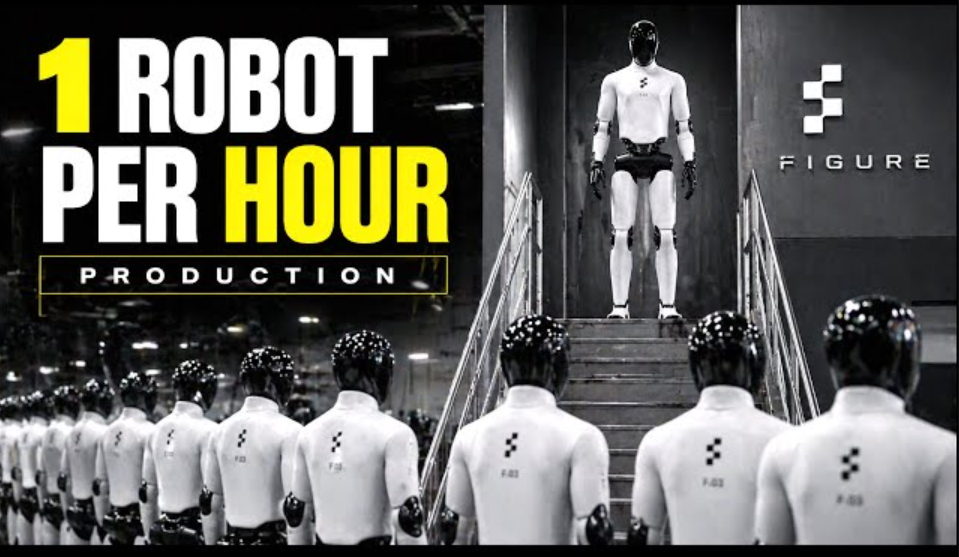
Figure, for instance, tested its Figure 02 robot at BMW’s Spartanburg Plant in an 11-month deployment. The robot clocked more than 1,200 hours, handled over 90,000 parts, and contributed to the manufacture of 30,000 vehicles. Since then, the company has deployed next-generation units in the same facility, and UPS is slated to become its second paying customer. Furthermore, Figure recently revealed how its Helix control model replaced human-built C++ balance code, reducing new development turnaround time from 12 months to roughly 30 days.
Source: Figure 01

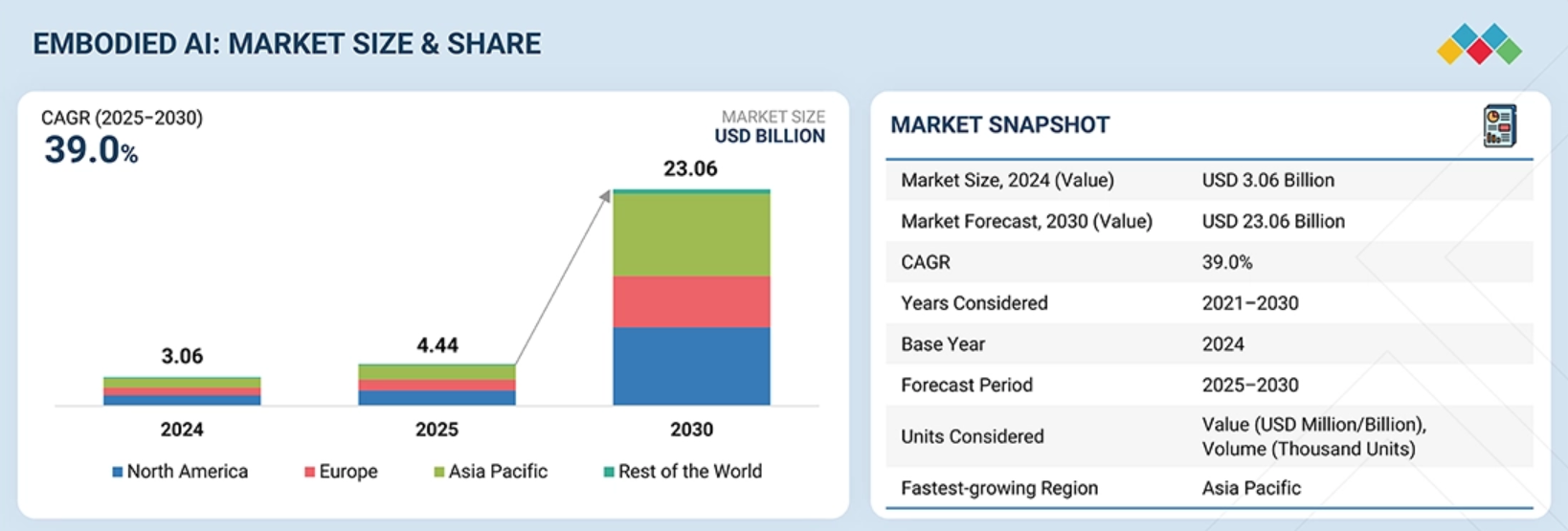
Meanwhile, Chinese manufacturers are already shipping hundreds of humanoid models, and industrial units are actively being deployed on automotive assembly lines. The key variable the broader market is currently blind to is the transition of embodied AI into tangible industrial robot-hours, which is already creating revenue streams and reducing deployment timelines.
Embodied AI Market Research by Markets & Markets

Two Fundamental Flaws in the Optimus Contracts

Treating the Optimus retail contract as a bellwether for the robotics industry is a decoy. In fact, relying on it commits a double category error by getting two fundamental things wrong:

The Event Type: The contract is pricing a retail consumer launch, not a commercial deployment. Tesla has already hinted at having zero fully useful internal units currently and hasn’t even committed to a concrete production number for 2026.

The Industry Benchmark: The market assumes Tesla is the sole vanguard of humanoid robotics. While Tesla’s massive valuation points to its potential, it isn’t actually at the forefront of industrial humanoid deployment. Figure raised over $1 billion at a $39 billion post-raise valuation last year, is already generating revenue via BMW, and is targeting production of 100,000 robots within four years.

Source: Teahose Figure AI Seed Funding Rounds

It wouldn’t be a stretch to say that the existing Optimus prediction contracts are marketing artifacts rather than technical barometers. In time, we will likely see a "Reserve your Optimus" page with a refundable deposit—a standard launch playbook Tesla has previously used for the Cybertruck and Roadster. However, even if Tesla, Figure, and Chinese manufacturers deploy thousands of units in factories globally, these Polymarket contracts could remain unresolved because industrial reality rarely converges with an immediate consumer checkout option.

Looking Beyond the Headlines

Despite their flaws, the year-end contracts still offer valuable insights. Because they rely on a more distinct possibility, they gauge Tesla’s potential capability to expose Optimus to consumer purchase this year, offering a glimpse into the market's read on development timelines.

More importantly, the pricing reflects market bearishness regarding Musk’s notoriously optimistic timelines. While dedicated Optimus factory construction officially began at Giga Texas in May, actual production isn’t likely to begin before July or August. Even when it does, initial units will only support internal factory tasks. Earlier this year, Tesla archived its Model S and Model X lines, with the last units rolling out of Fremont in May, recalibrating the factory space to accommodate Optimus. The company is heavily betting on embodied AI to beef up its revenue, but it is entering a market where competitors are already scaling and serving paying customers.

It is also crucial to look at where the embodied AI industry is heading. The near-term consensus seems modest with Goldman Sachs projecting roughly 502,000 humanoid shipments by the end of 2032 and a total addressable market of $38 billion by the same period, attributing this to AI breakthroughs and a potential 40% drop in manufacturing costs.

Additionally, Morgan Stanley has forecasted a $5 trillion total market by 2050 with around 13 million humanoids in service by 2035, before pushing to 1 billion by 2050.

Ultimately, if you are looking for a better instrument than a headline poll to track embodied AI, look off-market. Watch the metrics that matter: industrial deployment numbers and total robot-hours.

The Optimus contracts follow a prediction pattern similar to Tesla’s Robotaxi markets. While a driverless service is a technological certainty, the prediction contracts for Robotaxis in California are trading at around 11% because they bank on consumer regulatory approval and purchase optionality, not purely on the underlying technology.

Existing prediction markets don’t tell the whole story. As the industry matures, we should expect the narrative to deepen, eventually addressing the frontier-capability questions that investors actually want priced into future contracts.

Will Tesla's Optimus Production Facility Become Operational by July 31?

Yes
34.59%
No
65.41%
1,570 Polls
Ended
Kalshi Builds AI Agent to Stress-Test Prediction Market Bets
News
TechnologySignalsPrediction Market

Kalshi Builds AI Agent to Stress-Test Prediction Market Bets

Kalshi uses an internal AI agent to manage complex prediction market contract wording, reflecting a trend of startups automating high-stakes tasks.

Economics & FinanceTech

Kalshi Inc. has developed its own AI agent to help deal with a number of internal processes, including some of the thorniest issues it faces around the wording of its prediction market contracts.

The company has been using the tool — known internally as Harrison — to help avoid hiccups on the millions of wagers it handles every day on the outcomes of events like elections, sports games and award ceremonies, co-founder Luana Lopes Lara said in interview.

Multi-million dollar bets often turn on the specifics of how Kalshi’s contracts are written, such as the language being used or evidence sources. The industry has faced controversy in the past when market phrasing has not matched up with the complicated nature of real-world events.

The AI agent, which the company has not previously spoken about publicly, also performs daily tasks like aggregating top news, analyzing what competitors are offering and making recommendations on what the exchange should list next or where it should focus rewards for users adding liquidity.

“We actually have an AI engineer in the markets team, where the AI is battle-testing the entire certification — finding out if you go in this direction, maybe there’s a hole here, and all of that,” Lopes Lara said.

Lopes Lara said that outside of engineering, staff on its markets team are the biggest users of the technology among the company’s 150-person workforce. The Kalshi agent — built on top of Anthropic’s Claude model — offers a window into how fast-growing startups are building their own tools to handle tasks that used to be left to high-level employees.

When Kalshi was founded, Lopes Lara and her co-founder, Tarek Mansour, hired a roster of debate champions from Yale University to do the work of battle-testing the structure of the contracts it lists. One of those graduates still works at the company today.

Market structure has often been a thorn in the side of prediction market providers when events go in unexpected directions. Kalshi, for instance, resolved a market tracking whether a Netflix Inc. executive would say “Warner Bros.” on a January earnings call to “no” because the person pronounced the name as “Warner Brothers.”

Kalshi now has more than 500 templates for possible markets that have already been worked through by its team, Lopes Lara said, reflecting the exchange’s own predictions for what might happen in the world, with a regulated contract to match. Each template goes through the same review: how can it be generalized to fit more events? How can it be stress-tested? Does it meet user requirements?

“Nowadays it’s very easy because for every suggestion, the AI already suggests which market, which template to use, issues we should think about, maybe a new certification or amendment,” Lopes Lara added.

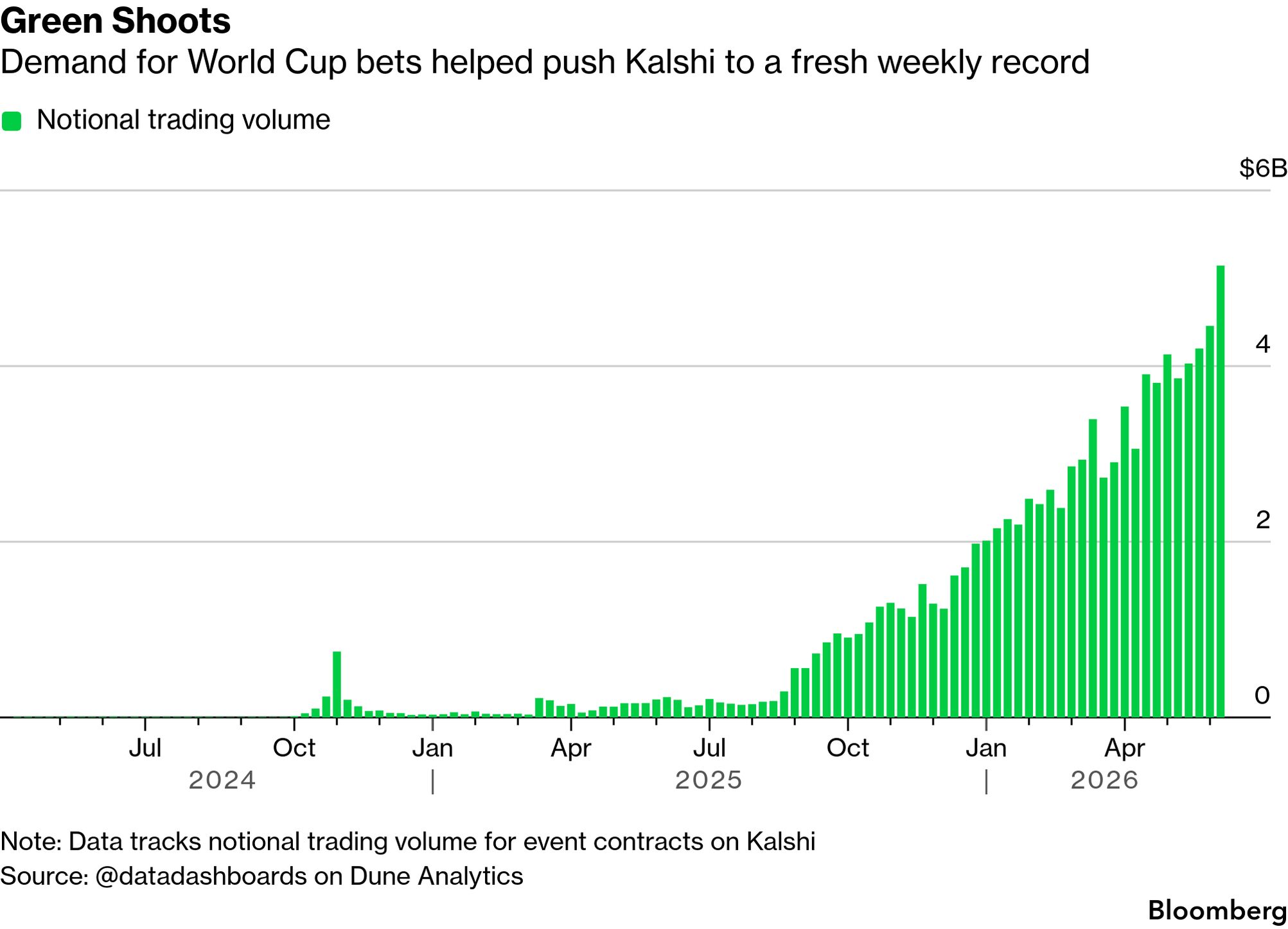
Demand for wagers on sports events like the World Cup and NBA Finals led to a record month at the exchange in May, amounting to nearly $18 billion in notional trading volume, according to user-compiled data on Dune Analytics. In the first week of the World Cup this month, Kalshi also broke a weekly record with $5.1 billion in volume.

Listing a new market on Kalshi typically requires two people, Lopes Lara said: one to work on populating the template with the right information, rules that need to be displayed or warnings to be included; and a second person to review it all. Contracts then face a one-to-two hour delay for spotting any issues before going live to all traders, with a paid bounty offered to those who identify flaws.

Resolving a market works much the same way. Some markets, like who won a sports game, can be determined automatically based on an external data provider. Elsewhere, Kalshi’s AI will send alerts to team members if it sees a lot of news articles on one topic, attaching a list of markets that might require determination.

In most cases, determining an outcome is a three-step process: someone on the markets team inputs an outcome into the system, while a second person independently adds their own decision.

Kalshi’s AI verifies whether the answers match, while also checking against its own suggested response. If a market is complicated, like a Supreme Court ruling, there’s an additional layer of checks, sometimes involving Kalshi’s chief regulatory officer.

Source: https://www.bloomberg.com/news/articles/2026-06-15/kalshi-builds-ai-agent-to-stress-test-prediction-market-bets

Fly Me to The Moon - Analyzing What Exactly the SpaceX IPO Catalyzes
Analysis
Capital MarketsIPOsIndustry PulseSpaceFly Me to The Moon

Fly Me to The Moon - Analyzing What Exactly the SpaceX IPO Catalyzes

Economics & FinanceTech

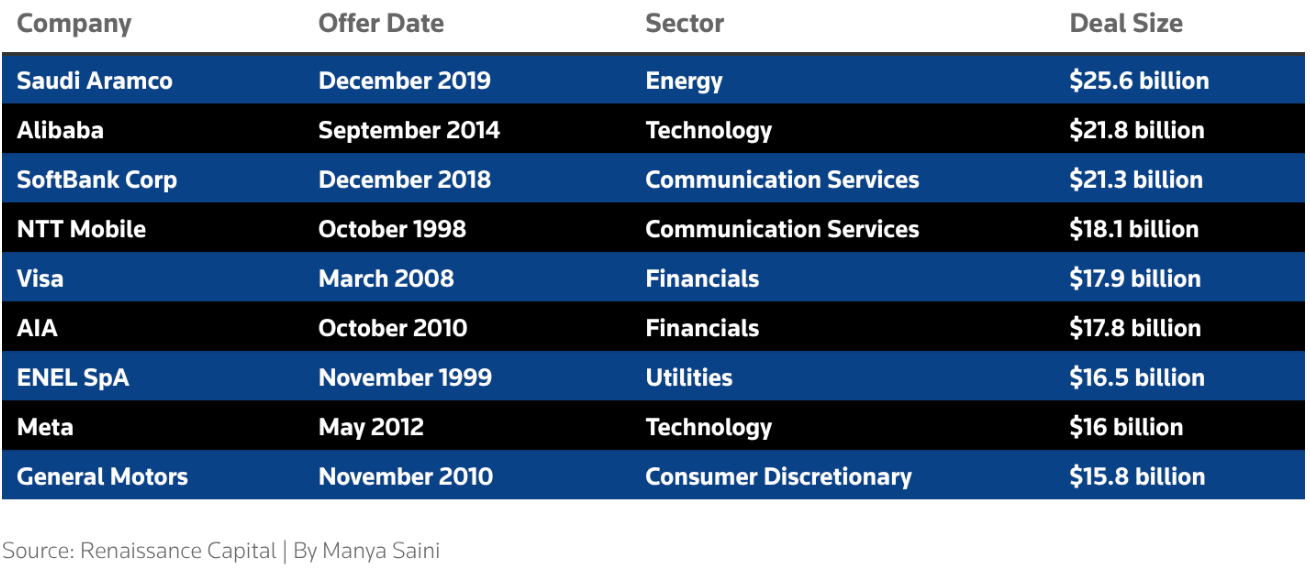
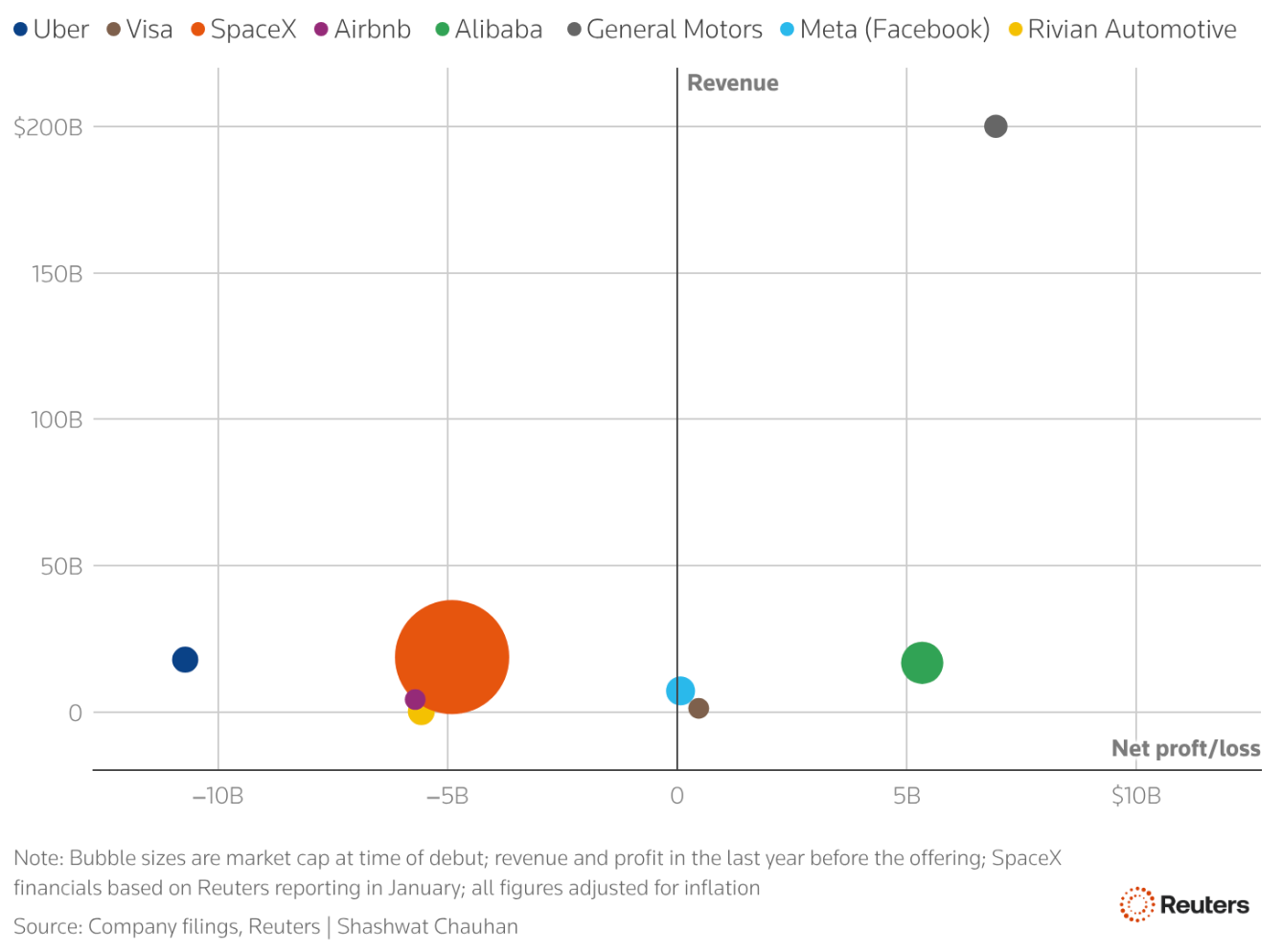
SpaceX is slated for its initial public offering in June, with the IPO expected to be the largest ever in history, crossing the Aramco IPO which was priced at $1.7 trillion.

SpaceX is now targeting a valuation of at least $1.7 trillion with the latest Polymarket predictions pricing the IPO to be closer to the $2.5 trillion mark.

The IPO numbers are a sight to behold – a fixed price of $135 per share for 555.6 million shares and a target to raise around $75 billion, according to Reuters reports.

Table 1: Largest U.S. IPO deals in history (Renaissance Capital sorted)

Figure 1: Largest U.S. IPO deals in history

Meanwhile, 30% of the float has been reserved for retail investors, with Elon Musk expecting to walk away with around 82% of the voting power.

On the surface, the SpaceX IPO promises to be a crucial catalyst for the entire space industry, with its listing validating the varying paths other listed companies in the sector have taken.

And you can’t really argue against that as we approach June 12, the date when the stock begins trading.

Since SpaceX IPO reports surfaced back in March, space stocks have experienced an unprecedented rally. Rocket Lab’s stock has surged nearly 72% year-to-date, AST SpaceMobile is up over 47%, while carrying a market cap of $41 billion, while booking under $15 million in quarterly revenue, missing estimates by 60%.

Similarly, Stellogic is up over 335% YTD. It is a similar story across other stocks such as Intuitive Machines, Firefly Aerospace, York Space Systems and Planet Labs.

However, if we look at this closely, none of these stocks’ surge is driven by strong earnings.

These stocks appear to be flying high because investors who craved exposure to the SpaceX IPO story had no way to own the stock and decided to put their money in the closest alternatives.

That logic however, expires on June 12.

This is when as an investor, you would no longer need a SpaceX alternative when you can buy the stock.

A $75 Billion Raise

SpaceX is targeting to raise $75 billion upon IPO and has option for another $11 billion – making it the largest equity drain in the sector’s history.

SpaceX is likely to be the key stock that every institutional fund would want to get their hands on for space exposure.

This could have an impact on stocks such as Rocket Lab and AST SpaceMobile whose slice of the money is likely to be chased by SpaceX.

On top of that, Nasdaq’s expedited entry rules will make the company of SpaceX’s size eligible for the Nasdaq-100 after a 15-day period.

It is safe to say that SpaceX is not just a company that is competing for capital – it is a company that competes through its product line. The company’s S-1 already named Rocket Lab as a competitor and will be looking to diversify into medium-lift payload.

Until the IPO, AST SpaceMobile could trade at around 100 times estimated forward sales only because of the absence of a publicly-listed pure-play stock to keep a leash on it. Following SpaceX’s IPO, we can expect this metric to be contained.

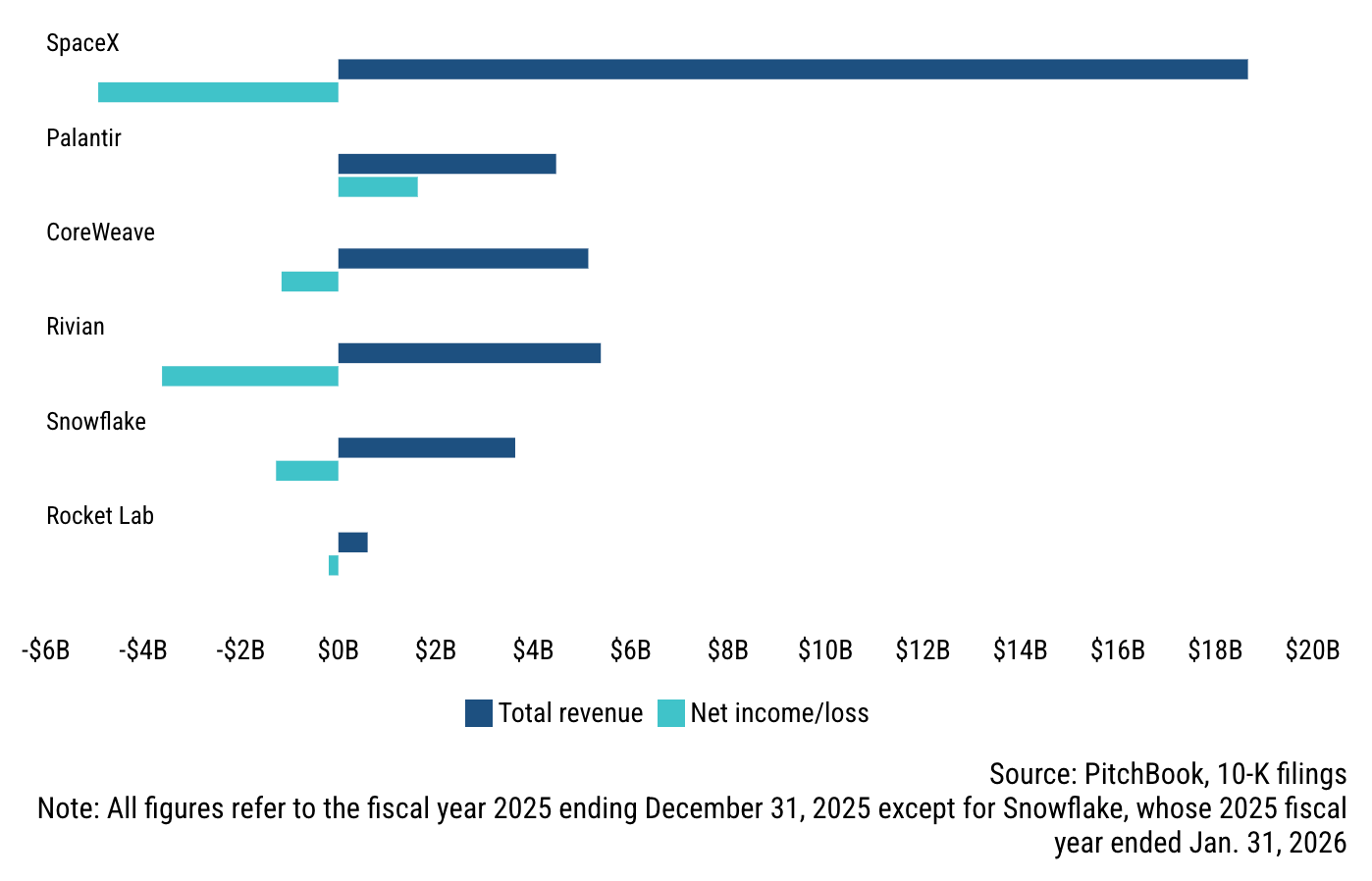
Figure 1: Financial Performance of Peers (Morningstar sorted)

How are Prediction Markets Seeing the IPO Event?

One of the best ways to assess the SpaceX IPO event and its fallout is by gauging Polymarket traders sentiment.

Over 99% traders expect the IPO to close above $1.2 trillion, while 70% expect it to close over $2 trillion.

Meanwhile, a wide majority of traders expect the company’s market cap to cross $1.6 trillion by the end of June.

Embedded JavaScriptEmbedded iFrameWill SpaceX's market cap be less than $1.0T at market close on IPO day?
Yes 0% · No 100%
View full market & trade on Polymarket

The numbers are telling and validate the IPO mechanics. Rather than going for a conventional price range, SpaceX has gone for a fixed share price. Musk will be selling zero shares, thus constricting supply with expected frenzied demand of the stock.

To date, investor focus on prediction markets is on SpaceX, which means that a lot of industry peers are quietly going through a de-rating event after initially benefitting from the IPO announcement.

Will SpaceX Cross $2 Trillion In Market Cap in 2026?

Yes
29.98%
No
70.02%
1,938 Polls

All Eyes to Remain on SpaceX

One cannot deny that SpaceX IPO is going to be a key driver for the space economy. The World Economic Forum has already forecasted the sector to reach $1.8 trillion by 2035. SpaceX becoming a publicly-listed company further legitimizes the projections.

However, the WEF report, when studied in detail, focuses on growth areas that a lot of SpaceX peers aren’t venturing into yet.

Around 60% of space industry expansion will come from segments such as logistics, agriculture, insurance and defense data and not launchers and satellite – two segments that a lot of listed space stocks call their bread and butter.

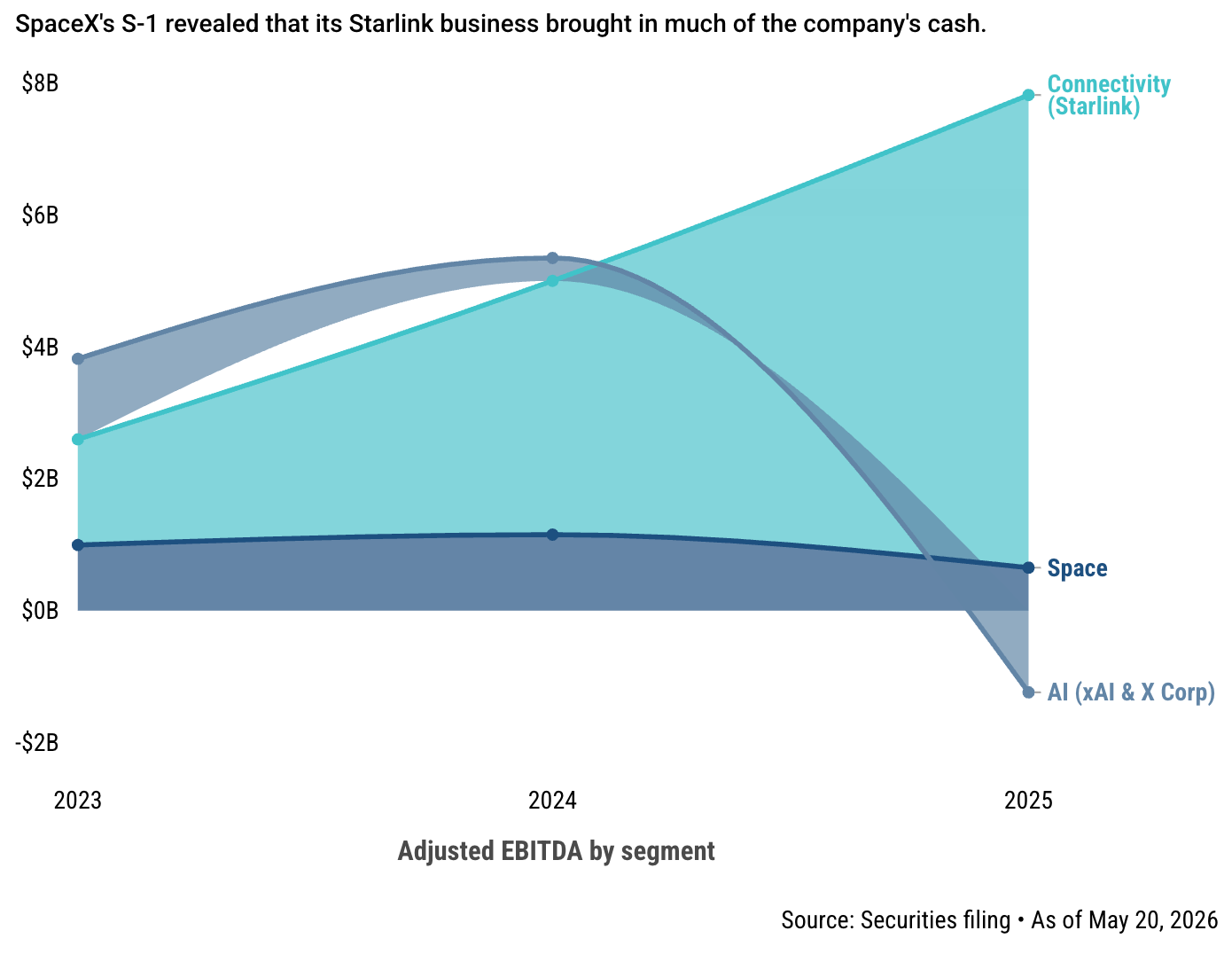
The same can be said about SpaceX whose only profitable segment is Connectivity through Starlink, which posted a quarterly profit of $1.19 billion.

Space launch segment on the other hand, booked a loss of $619 million.

SpaceX has been tagged as a satellite-broadband-and-AI company which also owns the best rocket technology in the world. And this is the dangling carrot that investors are chasing.

What also needs to be analyzed is that the company booked $4.94 billion GAAP net loss in 2025, capital expenditure of $10.1 billion in a single quarter and a $41.3 billion accumulated deficit.

A company with a potential market cap of $1.77 trillion cannot afford execution shortcomings on projects such as Starship, Starlink or burning cash on AI.

Figure 2: SpaceX Adjusted EBITDA by Segment (Morningstar sorted)

A Sum-of-Its-Parts Valuation

Taking away the glamor and spectacle that we’ve come to see from anything carried out by Musk, SpaceX is promoting itself as a potential $1.77 trillion company which relies on three distinctly different businesses, thus making the valuation a sum of its parts.

Connectivity is expected to remain the best performing segment and helps justify the current valuation, especially if Starship continues to refine its tech stack.

The launch business on the other hand, appears to be more of a strategic presence rather than a profit making tool.

Meanwhile, the company is burning cash on its AI unit, which means that in the long run, SpaceX will either “normalize” as either a highly niche space innovation company or an AI company with several space-related clusters with long-term strategic goals.

Figure 3: Valuation of Major Offering on Record (Reuters sorted)

The Liquidity Siphon Effect

Naturally, the $75 billion fund raising target seems like an apocalyptic scenario for its peers. However, this amount represents only a fraction of the total US money-market funds which is about $7.89 trillion.

And while it may appear that the IPO could potentially impact other space stocks, we need to understand SpaceX as a business.

The company is very unusual if we look at it purely from a space industry point of view. It is a space stock, a satellite-broadband and telecommunications stock and it is also an AI-infrastructure stock following the xAI merger.

In the US, IPO funds are mostly raised from institutional investors and large brokerages through the recalibration of existing equity and portfolio positions.

Therefore, upon its IPO, SpaceX will be siphoning the $75 billion from multiple sources – from space allocations to the telecom sector to the AI-infrastructure bucket, meaning that no single source is going to be drained.

However, one siphoning scenario that could unfold in the coming days could be the stock’s entry in the Nasdaq-100, which could result in several funds selling a slice of every niche stock they hold to acquire the SPCX stock.

This could expose several space stocks but the event would not be confined to them, with the likes of Nvidia, Microsoft, Alphabet and even Nebius, likely to be exposed.

SpaceX IPO – A Catalyst of Differentiation

June 12, the day when SpaceX IPO takes place, should be seen as a sorting mechanism, not just a cataclysmic event for the space industry.

While the IPO is definitely a catalyst, what it actually catalyzes is market differentiation.

In the first couple of weeks of the IPO, we could see SpaceX experiencing a rally, while other space stocks lose a chunk of their respective market caps.

By the end of the 15th day, the time when the company could be eligible for the Nasdaq-100 entry, we could see a weight dilution event with constituents shrinking their weight proportionally to make room for funds to add SPCX into their portfolios.

The largest constituents such as Nvidia, Apple, Microsoft, Alphabet and Amazon could be the key stocks in what is likely to be a modest dilution event, simply because they have the biggest positions.

A very crucial point to be mentioned here is that an index fund doesn’t buy a stock based on the company’s full size, it makes a buy based on float. SpaceX is only selling around $75 billion worth of stock, while the rest will be locked up by Musk and insiders.

Now Nasdaq’s rule explicitly cap the index weight at around 3x the float, not the market cap.

Since there will be very few shares trading at the start, index fund could struggle to find enough which could lead to a short-term increase in the stock price. Under Nasdaq-100 IPO lockup regulations, insiders are restricted from selling their shares for 180 days. Once the lockup period ends, insiders could start selling their shares, thus creating a secondary market distribution.

Therefore, it is safe to assume that the share buying will be spread out and not aggressive on day 15.

Will SpaceX Gain Entry into the Nasdaq-100 After Day 15 of its IPO?

Yes
96.06%
No
3.94%
1,650 Polls

On top of that, Nasdaq-100 will remain the only major index buying the SpaceX stock. The S&P 500 is closed for now because the company lost around $4.9 billion last year, making it unqualified.

The overall effect of the SpaceX IPO on the big stocks, based on our research, is likely to be small and mechanical. However, what should be looked at in the long run would be the company’s own share dynamics and how the smaller space stocks behave immediately and a while after the IPO.

This startup wants to reduce payment friction on prediction markets
News
CompetitionPrediction MarketTechnology

This startup wants to reduce payment friction on prediction markets

Prediction markets' growth exposes banking system lag, driving EDGE Markets to debut real-time payment solutions for traders and institutions.

Economics & FinanceTech

As prediction market volumes continue to march higher and platforms increasingly look to institutional players to engage, a startup is seeking to make it easier to move money around on event contract exchanges.

EDGE Markets — which runs a banking platform designed for gambling and prediction market spending — is set to debut two products, the company shared exclusively with CNBC ahead of a Monday announcement. It will also reveal a $29.2 million Series A funding round, led by venture capital firm CoinFund.

The company will announce EDGE Connect, a real-time payments system to reduce the time it takes for individual traders to transfer funds from their bank accounts into wallets on prediction market exchanges.

Users get access to EDGE Connect if they use EDGE Boost, a financial platform that only allows deposits to be used for spending on gambling and prediction markets. CEO Seni Thomas told CNBC in an interview that EDGE Connect is currently available on Kalshi, and that the company is actively working to implement the technology on five other platforms in the coming months.

Kalshi confirmed to CNBC the partnership with EDGE.

"We have 24-hour markets… and you can't get money in at the same velocity," Thomas said. "Any one of our users can sign into our consumer bank accounts and actually push out up to $10 million per day, and it hits your Kalshi account within two minutes."

The company is also announcing EDGE Pro, a platform that will serve as a hub for institutional market makers to easily move money between various prediction markets regulated by the Commodity Futures Trading Commission. Pro will launch to a waitlist as EDGE awaits regulatory approvals from the National Futures Association.

Thomas said that Pro solves a unique issue that institutional traders face in the prediction market space.

"You're going to now have 10 different liquidity pools, actually offering very similar contracts," he said. "You need to have a very, very fast infrastructure to be able to kind of move all that in real time."

EDGE Markets was founded in 2020 by Thomas and then launched EDGE Boost in March 2025. Boost has processed over $2 billion in transactions since then.

"The biggest moments in gaming and prediction markets happen on nights and weekends, exactly when the banking system slows to a crawl. EDGE built the rails to match that reality," Alex Felix, a managing partner at CoinFund, said in a statement. "We think EDGE becomes the default settlement layer for an entirely new category of financial markets."

Source: https://www.cnbc.com/2026/06/08/this-startup-wants-to-reduce-payment-friction-on-prediction-markets.html

AI Speedrun - OpenAI takes the lead in AI IPO horse race: 'Getting to public markets first is very important'
News
LLMsIPOsAI InfrastructureCapital MarketsAI Speed RunIndustry Pulse Semi News

AI Speedrun - OpenAI takes the lead in AI IPO horse race: 'Getting to public markets first is very important'

OpenAI's reported imminent IPO filing has sharply reversed prediction market odds, positioning it to beat Anthropic in the race to become the first major AI company to go public.

TechEconomics & Finance

Reports that OpenAI is set to confidentially file for an IPO as soon as Friday changed prediction market traders' outlook on which private AI giant will debut on the public markets first.

Traders on Kalshi now see OpenAI as the favorite to go public before Anthropic, giving it an 83% chance of getting the big payday first.

"Getting to public markets first is very important, given this arms race going on," said Dan Ives, Wedbush Securities' global head of technology research. "It sets a valuation, you're the first one to meet with investors on the road, and there's an advantage."

Before the initial report on the IPO timeline by the Wall Street Journal which CNBC later confirmed, traders gave OpenAI just over a 32% chance of beating its chief private rival to the public markets.

Chances Anthropic would beat OpenAI to an IPO collapsed on Polymarket to 20% from 69%.

While the birth of OpenAI's ChatGPT launched the AI bull market in November 2022, the company has lost some of its shine with investors.

Worries about the company's spending, reports on missed revenue and growth targets and leadership turnover weighed on investors' outlooks. There have even been internal disagreements on the timeline to go public, according to the Journal, with CEO Sam Altman pushing for a faster debut than CFO Sarah Friar.

At the same time, Anthropic's enterprise business has led it to experience massive growth in recent months, and reportedly is in talks with investors for a new funding round that would value the company at $900 billion, greater than that of OpenAI's latest valuation.

Investors became enchanted with Anthropic's Claude models, which have been constantly updated with new versions. Those updates were followed so closely by investors that they consistently moved the stock market in the beginning of the year, as worries about how new tools from Claude models would disrupt existing businesses mounted.

It was in late March when reports about an extremely powerful new model, Claude Mythos, circulated that Anthropic took a consistent lead over OpenAI on Kalshi of who would have a public debut first. Bloomberg reported around the same time that the company was looking to IPO as soon as October.

But with an IPO on the way — sooner than prediction market traders thought — and a court win against Elon Musk this week, it could be the moment for a turnaround, according to Ives.

"It started with the lawsuit," he said. "And now filing the IPO, that's a great one-two punch to start to put water on the negative fire that's been on them."

Source: https://www.cnbc.com/2026/05/20/openai-takes-the-lead-in-ai-ipo-horse-race-getting-to-public-markets-first-is-very-important.html

Weekly Casserole - After the Hottest IPO Debut (Cerebras) of the Year, Will SpaceX Top Over It, and What Next?
Analysis
Capital MarketsTechnologySemiconductorAI InfrastructureIPOsWeekly Casserole Semi Analysis

Weekly Casserole - After the Hottest IPO Debut (Cerebras) of the Year, Will SpaceX Top Over It, and What Next?

Economics & FinanceTech

Cerebras Systems’ explosive Nasdaq debut has propelled the chip designer into the $100 billion club, boosting AI infrastructure landscape yet again, as it pivots from hardware sales to a direct cloud offensive against titans like Google and Microsoft. With OpenAI once eyeing the company as a "secret weapon" for AGI, this valuation milestone may only be the beginning of a massive capital markets supercycle, paving the way for highly anticipated public offerings from industry heavyweights like SpaceX, OpenAI, and Anthropic. What’s your take on the rally? Who’s going to be the next?

Welcome to the USD100B+ Club…

  • Listed at USD185/share, Cerebras Systems’ (CBRS) jumped 90% above its offering price in the NASDAQ debut on May 14th, 2026, giving the chip ‌designer a valuation of USD106.75B ​​on a fully ​diluted ​basis (Reuters).
  • In 2017, OpenAI looked at merging with Cerebras, viewing the chip company as potentially beneficial in the pursuit of artificial general intelligence, or AGI, according to testimony in Elon Musk’s trial against OpenAI. “Exclusive access to Cerebras hardware would give OpenAI an overwhelming hardware advantage over Google,” Greg Brockman, OpenAI’s co-founder and president, wrote in an email (CNBC).
  • Looking ahead, Cerebras had started shifting its focus away from selling hardware systems and more toward providing a cloud service based on its chips. That means it’s going up against cloud providers such as Google and Microsoft, which are both listed as competitors, along with Oracle and CoreWeave (CNBC).

What’s Next, for CBRS & for Capital Market as a Whole?

  • It seems there are more to come for CBRS - “There’s some whales out there, there’s some really big customers,” Cerebras CEO Andrew Feldman told CNBC in an interview on Thursday. “That is one of the characteristics of this market.” - So, will the stock price rally-on?
  • With promising tech players allegedly in the pipeline - SpaceX IPO prospectus could land as soon as next week, sources say, according to CNBC (CNBC). 
  • Meanwhile, the market is gearing up for model developers OpenAI and Anthropic that could hit the market later this year (CNBC). 

Look out for those names to pop-up on headlines! Will Cerebras double again? Who’s going to be the next star of the show? 

And more... Drop us a comment on what the market should be looking at! Your choice could shape the consensus!

Will Cerebras Systems (CBRS) Stock Price Hit USD555/Share (triple of IPO listed price)?

on or before May 31th, 2026 market close (regular hours)
42.86%
on or before June 30th, 2026 market close (regular hours)
28.57%
beyond June 30th, 2026 market close (regular hours)
28.57%
14 Polls

Will SpaceX stock price double (vs IPO) in 2026?

Yes
69.23%
No
30.77%
13 Polls

What's the favorite AI models (mutiple)? (drop us a comment on your favorites)

OpenAI GPT-5.5
22.22%
Anthropic Claude Opus 4.7
50.00%
Google Gemini 3.1
16.67%
DeepSeek V4
5.56%
Alibaba Qwen 3.6
0.00%
Others (drop us a comment!)
5.55%
12 Polls
Weekly Casserole - Cerebras IPO, US-China Talk Kick-Off in Seoul, Jensen Huang’s Last-Minute Invite, Alibaba/Tencent Results and more — Fueling another Rally or Forging a Rivalry?
Analysis
Capital MarketsIPOsSemiconductorGeopoliticsLLMsTechnologyWeekly Casserole Semi Analysis

Weekly Casserole - Cerebras IPO, US-China Talk Kick-Off in Seoul, Jensen Huang’s Last-Minute Invite, Alibaba/Tencent Results and more — Fueling another Rally or Forging a Rivalry?

Economics & FinancePoliticsTech

AI is pivoting toward a "transactional infrastructure" phase, where the focus has shifted from general AI hype to the specific mechanics of deployment and trade. In the semiconductor space, capital is aggressively chasing inference-specialized hardware to solve the high-latency bottlenecks currently stalling real-time AI applications. Meanwhile, the upcoming talks between the two superpowers are under the spotlight - What will be talked? What deals could be reached? What problems remain in limbo? All eyes on the development this week...

Another Hot Semiconductor Name to Be Listed…

  • As the second attempt to list, Cerebras Systems is focused ​on inference, the process by which AI systems respond to user queries, and has tied much of its growth to OpenAI, including a $20 billion multi-year deal under which the ChatGPT creator ​will deploy 750 megawatts of Cerebras chips (Reuters).
  • The company is considering a new IPO price range of $150-$160 a share, up from $115-$125 ​a share, and raising the number of shares marketed to 30 million from 28 million, said the ​sources, who asked not to be identified because the information isn't public yet. The increase follows a broader surge in AI adoption ​that has driven sharp demand for high-performance chips and turned semiconductors into a key bottleneck in the technology supply chain. Cerebras' IPO has drawn orders for more than 20 times the number of shares available, the people said, as the chipmaker looks ​to manage surging interest ahead of its May 13 pricing.

Two Superpowers Meet Again After Almost a Decade…

  • President Lee Jae Myung held rare back-to-back meetings with top US and Chinese economic officials in Seoul, as preparatory talks were being held ahead of a high-stakes US-China summit (Korea Herald).
  • Trump is expected to focus heavily on trade with the aim of securing what he can present as economic wins ahead of November’s midterm elections. Washington has pushed for China to increase purchases of American goods, including Boeing aircraft, beef and soya beans, while also seeking closer investment and trade cooperation (Al Jazeera).
  • Beijing, meanwhile, is expected to press the US to ease restrictions on advanced semiconductor exports and roll back measures limiting China’s access to critical chip-making technology. Taiwan is also likely to remain one of the most sensitive and contested issues in the summit.

What’s the Market Looking At?

  • On the IPO front, the market consensus is that Cerebras isn't an "Nvidia Killer" for training, but it is the first real threat in Fast Inference. The sentiment is that while Nvidia will continue to dominate 90%+ of the general market, Cerebras is "skimming the cream" by taking the highest-value, low-latency workloads (like real-time AI agents) from OpenAI.
  • On trade & technology, Jensen Huang’s surprise China trip could signal AI shift in US-China talks (New Fortune Times). The last-minute decision for Huang to join the trip has drawn global attention because his company, Nvidia, sits at the center of the global AI race. Market analysts said investors interpreted Huang’s attendance as a positive sign for future AI cooperation between the two countries.
  • Meanwhile, China tech giants Alibaba and Tencent both will disclose quarterly performance on May 13th. Will they beat or miss? What catalyst to look out for? How is AI integrated into their blueprint, and how’s the execution?
  • The “deals” over “diplomacy” - as a group of key figures across technology, industrials, basic materials, and finance joining the trip, the market could be eyeing a series of deals to be reached - but not to forget the prolonged trade tensions since 2025 Liberation Day.

Mark your calendars: Cerebras will go public on May 13, at what price will it close after debut? How will it influence semi-conductor landscape? What’s the keys to be discussed in the US-China meet-up and what will they come out with? 

Traders will soon be able to bet on computer chip prices as AI drives costs skyward
News
InsightAI Infrastructure

Traders will soon be able to bet on computer chip prices as AI drives costs skyward

Compute futures let traders hedge AI investments against volatile GPU prices in the booming artificial intelligence buildout.

Economics & FinanceTech

A new futures market for semiconductors will let traders hedge their artificial intelligence investments with bets on the increasingly expensive price of computing power.

Contracts on the new "compute futures market" from CME Group will be based on graphics processing units (GPU) price indexes from Silicon Data, the companies said in a statement released Tuesday announcing the joint venture, which still is pending regulatory review.

The new market will let investors lock in a price for computing capacity based on a GPU benchmark, which can be used to hedge against rising GPU rental rates and other operational costs in the enormous and multifaceted AI buildout.

"GPU markets ... have historically lacked standardized reference pricing," Carmen Li, chief executive of Silicon Data, said in the release. "The launch of compute futures is an important step toward giving AI builders, cloud providers and investors more reliable tools for valuation, hedging and long-term planning."

Futures markets are traditionally associated with basic commodities like foodstuffs, metals, and petroleum products, but they've also popped up for assembled components in rapidly developing segments of advanced industrial sectors.

During the broadband explosion in the late 1990s, the broadband services division of Enron aimed to sell unused capacity on its network of fiber optic cables prior to the company's spectacular failure.

Silicon Data sells access to specialized price indexes to clients, similar to the consumer price index or personal consumption expenditures price index, except for semiconductors. Its products include a standardized GPU price index, a RAM index and projections for GPU rental prices.

Wall Street doesn't see demand for GPUs, or more traditional central processing units (CPUs), slowing down any time soon.

"Agentic AI requires entirely new racks of CPU servers that sit alongside GPU infrastructure and run to power the work of all these agents," analyst Shawn Kim at Morgan Stanley wrote in a report Monday.

"The AI system in the future will look like a distributed system consisting of GPU racks for dense model compute … [and] agentic CPU racks for orchestration, processing data and tool execution," Kim said.

Memory chip prices soared in the first quarter as AI drove increased demand for CPUs. Hyperscalers increased capital spending across the board while executives expressed concerns about a bottleneck in memory that's driving input costs higher.

Memory chip makers are projecting huge profit margins through this year and next as valuations have skyrocketed.

Source: https://www.cnbc.com/2026/05/12/new-futures-market-for-semiconductors-comes-as-ai-drives-costs-skyward.html

Silicon Bakery - It’s Getting Hotter and Hotter, What’s the Next Wave in Semiconductors?
Editorial
Capital MarketsSemiconductorHyperscalersAI InfrastructureIndustry PulseSilicon Bakery Semi Analysis

Silicon Bakery - It’s Getting Hotter and Hotter, What’s the Next Wave in Semiconductors?

TechEconomics & Finance

The semiconductor industry is officially entering its $1 trillion era, fueled by a massive $600 billion hyperscale capex surge projected for 2026. Industry consultants view this as a structural revolution beyond cyclicals. As the market begins to look past GPUs & Hyperscalers, the question remains: what will the next wave be?

AI Infrastructure Boom - A Rising Tide Lifts All Boats

  • The global semiconductor market is undergoing a seismic transformation. IDC’s latest forecast projects the industry will surge past the $1 trillion revenue threshold in 2026, significantly ahead of prior expectations. The growth will be driven overwhelmingly by AI infrastructure investment, which is reshaping the entire market. (IDC).
  • Hyperscale capital expenditure exceeded $100 billion for the first time in Q3 2025, and the i4 are expected to increase capex by 70% year over year to approximately $600 billion in 2026. IDC forecasts data center semiconductor revenues to reach $477.1 billion in 2026. By 2030, data center semiconductors will account for $843.2 billion, nearly half the total semiconductor market.
  • It seems the growth is self-sustaining rather than cyclical:
    • 1) Compute intensity continues to rise. Generative AI and agentic workloads require far more compute density per rack than prior architectures, increasing the overall silicon footprint.
    • 2) Inference demand compounds on itself. Each new model generation increases the volume of inference, requiring ongoing hardware upgrades
    • 3) AI is spreading beyond the data center. As enterprises, edge deployments, and client devices begin running AI workloads locally, demand becomes more distributed.

Segments That Are Soaring - by Consensus

  • High-Bandwidth Memory (HBM3e / HBM4): Memory is no longer a "commodity" cycle; it’s the primary bottleneck for AI. Hyperscalers are paying massive premiums to secure HBM3e and early HBM4 supply. Micron (+136% YTD) and SK Hynix (+70% in last 30 days) are the star performers here, as AI accelerators cannot function without these specialized, high-density stacks.
  • Custom Silicons & AI ASICs: Companies are shifting away from general GPUs to bespoke "homegrown" chips to cut costs and power consumption. Broadcom’s long-term contracts with Google & Meta provides revenue visibility. Marvell Technology (+50% in a month) is a fast-growing challenger, winning orders from Amazon and Microsoft, outpacing the industry’s growth.
  • Co-Packaged Optics (CPO) & 1.6T Connectivity: The "Copper Wall" has been hit; data must now move via light. The upgrade from 800G to 1.6T networking is the new margin expansion story. As the leader in Indium Phosphide components, Coherent (+42% YTD) is the "arms dealer" for the 1.6T transceiver upgrade. Lumentum (+28% YTD) is benefiting from the rapid adoption of CPO technology so solve heat and power issues in massive data center clusters. (note: all as of mid May 2026)

What Has The Market Not Priced-in?

  • Besides the obsession over GPU shipments and HBM capacity, what are elements yet to be fully-priced in?
  • The agentic CPU re-rating story, as CPUs return to the center of the AI stack?
  • The machinery-to-data-center pivot, where traditional industrial cyclical players move into the power generation space for AI-infrastructure?
  • Niche players that are integrated into the upgraded supply-chain of hyperscalers?

Drop a comment below on what is trendy and will be the next wave of growth! 

AI Pioneers Back Startup Building Models to Predict Events
News
Prediction MarketAI InfrastructureFintech

AI Pioneers Back Startup Building Models to Predict Events

AI forecasting startups like Sooth Labs emerge amid prediction market boom, offering businesses new tools for geopolitical and market risk assessment.

TechEconomics & Finance

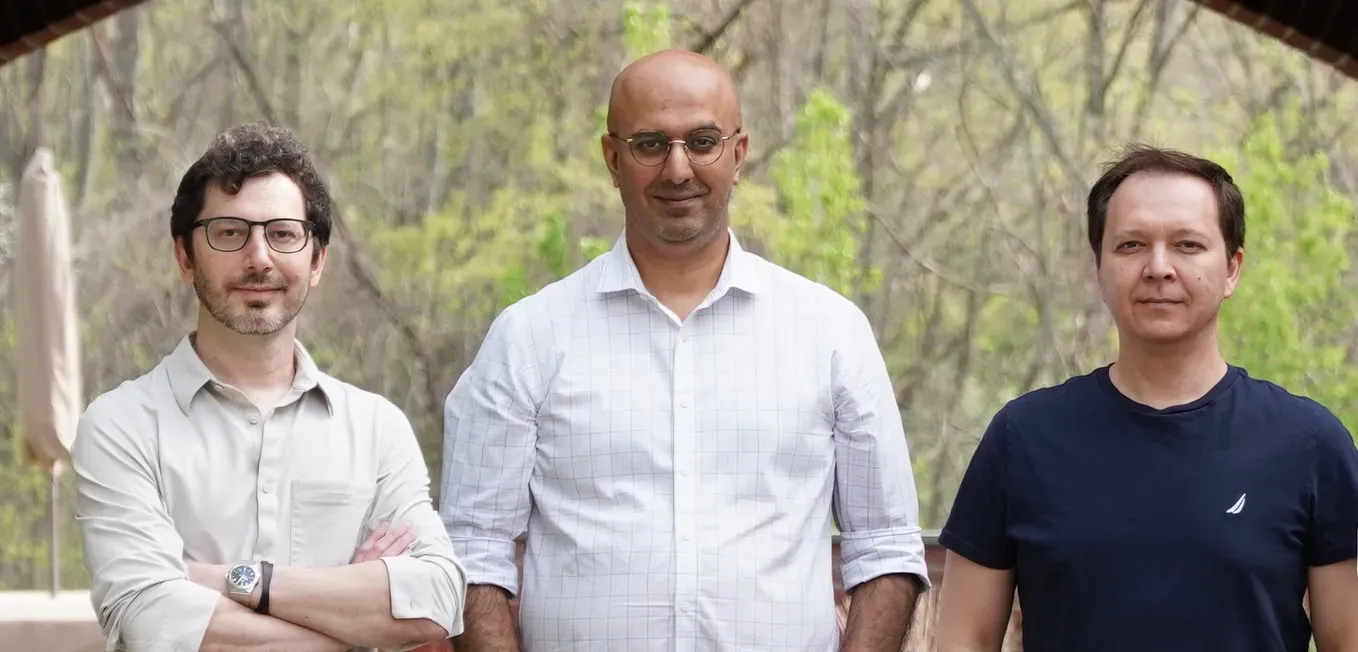
Sooth Labs, a new artificial intelligence lab founded by former Meta Platforms Inc. employees, is raising about $50 million in funding to build AI models meant to help businesses forecast the likelihood of specific geopolitical and market events taking place.

Felicis Ventures is set to lead the round, which would value the startup at roughly $335 million, including the money raised, Sooth’s co-founders told Bloomberg News. The company has also secured backing from Yann LeCun, a former Meta executive and an AI pioneer, as well as from Google Chief Scientist Jeff Dean. Meta Chief Technology Officer Andrew Bosworth is advising the firm.

Financial institutions, including banks and insurance companies, commonly use forecasting algorithms that combine statistical models with machine learning techniques. Sooth aims to do better by training its models on large cross-industry datasets, including data owned by its clients, and allowing that information to be easily queried. It’s also working to develop its models with a mix of inputs, including video, audio and text.

In a demonstration, Sooth’s software let the user query the probability of specific events happening, including the likelihood that the World Health Organization declares another pandemic by 2028 (16%) and that Anthropic PBC goes public this year (33%).

The Pittsburgh-based startup wants to enable businesses to make better decisions in areas like capital allocation and risk management, said Chief Executive Officer Yaser Sheikh. The company said it’s in discussions with potential customers in finance, defense, insurance and real estate.

Sooth’s team includes Ruslan Salakhutdinov, a Carnegie Mellon University professor, and disciple of AI godfather Geoffrey Hinton. Salakhutdinov, frequently cited for his research in deep learning, served as Apple’s first director of AI research before moving on to conduct AI research at Meta. Sheikh is a consulting professor at Carnegie Mellon and previously served as a vice president at Meta.

Sooth’s push coincides with surging interest in prediction markets such as Kalshi and Polymarket, which let people wager on everything from who the next James Bond will be to the chances of a major meteor striking Earth before 2030. Those firms have also raised billions of dollars in funding from investors.

“Because Kalshi and Polymarket have been so successful, the world has started thinking in bets,” said Aydin Senkut, founder and managing partner at Felicis. “Everyone’s mind has shifted to, ‘What do I know that gives me an edge to predict X happening?’”

Source: https://www.bloomberg.com/news/articles/2026-04-22/ai-pioneers-back-startup-building-models-to-predict-events

Can You Actually Model Elon's Tweeting? Two Tools Think So
Analysis
AnecdoteCelebritiesMediaTelecommunication

Can You Actually Model Elon's Tweeting? Two Tools Think So

Two new analytics tools help traders on Polymarket's weekly Elon Musk tweet markets move beyond speculation, though ultimately limited by the unpredictable nature of their human subject.

TechPop Culture

At first glance, weekly Elon tweet markets look unserious.

Then you watch them trade.

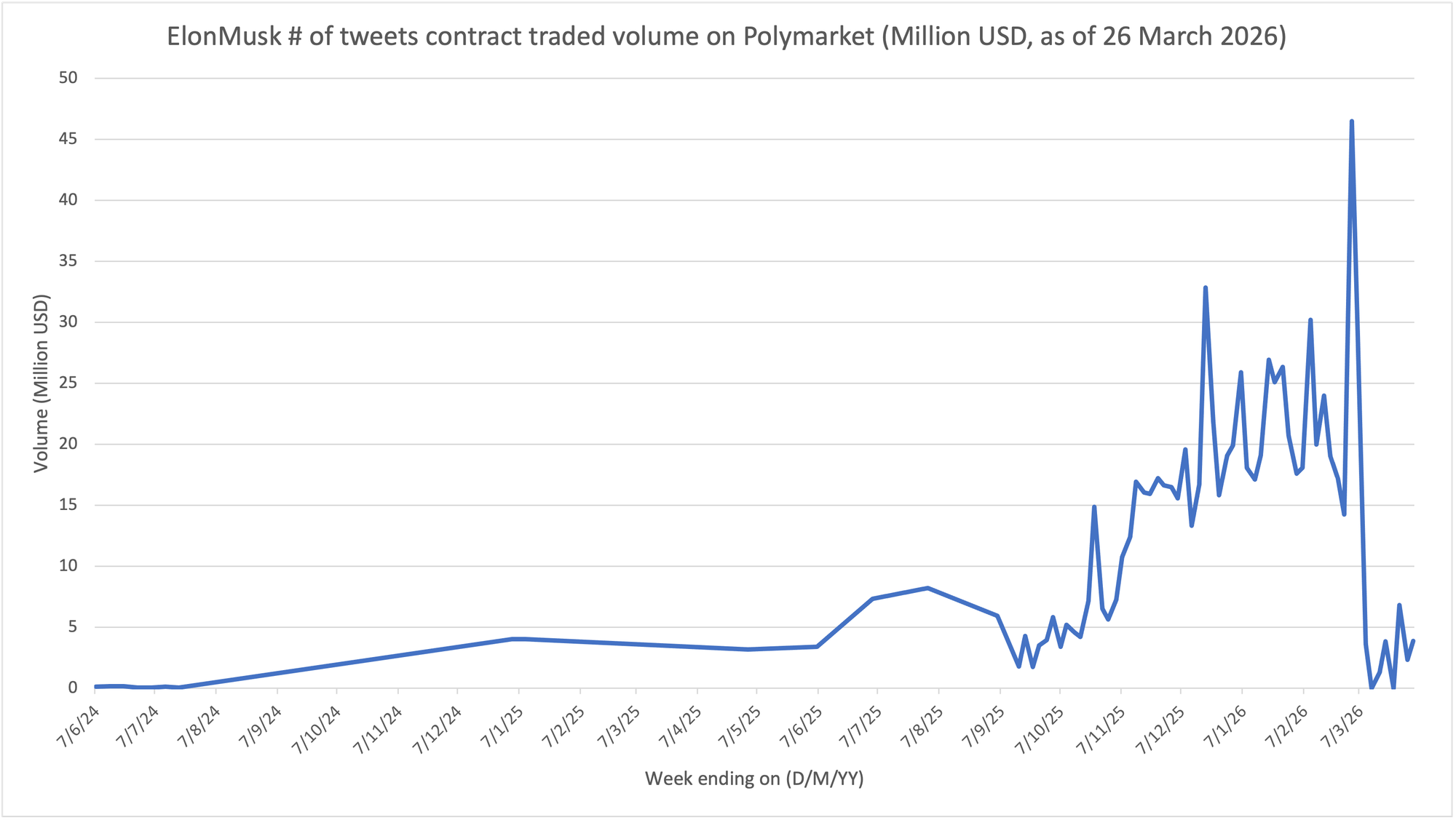
Polymarket launched weekly markets on Elon Musk’s X posting volume in June 2024, and by the last week of February 2026 those markets had grown from about $136,000 to $46.5 million in weekly volume. That is no longer a novelty market. It is a live event contract with real money, real repricing, and real demand for better analysis.

The spike in market volume near late February 2026 sat inside a dense Musk news cycle as Musk-related headlines around SpaceX and xAI increased (data fetched from Polymarket API)

That is where Elon X Forecast and MuskMeter come in.

They do not eliminate uncertainty. Elon is still Elon. They try to do something specific: impose statistical regularity on a subject who may not cooperate.

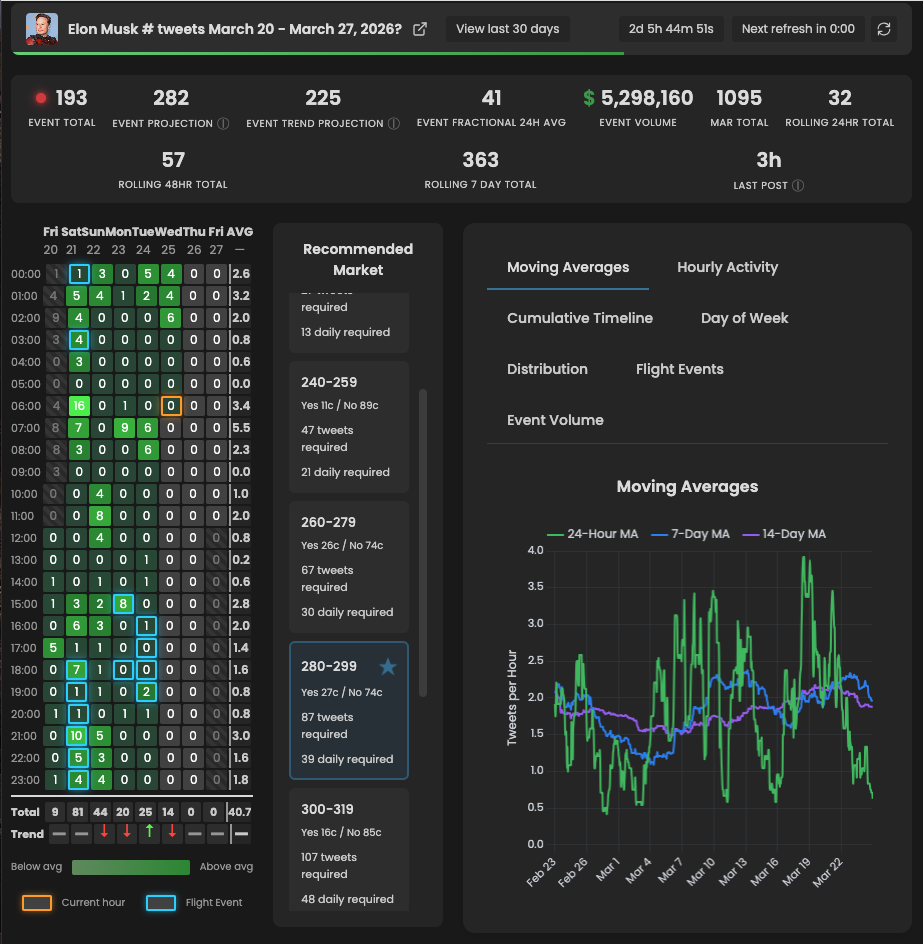
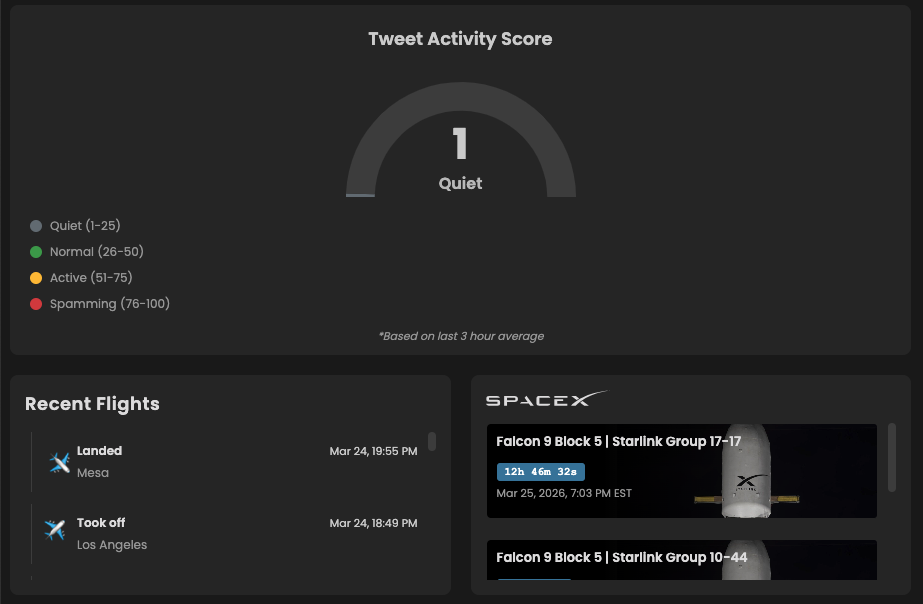
MuskMeter is the live tape. Its site surfaces real-time tweet tracking and organizes the flow into usable views, including moving averages, hourly activity, cumulative timeline, day-of-week distribution, event volume, a tweet activity score based on the last three-hour average, recent posts, the site also tracks flight activity and SpaceX schedules, on the theory that travel days correlate with quieter posting. In other words, MuskMeter is where you go to see what is actually happening right now at a more granular level.

MuskMeter provides metrics and visualizations at the hourly level (MuskMeter.live webpage screenshot as of 25 March, 2026)
Elon Musk's flight activity + SpaceX launch schedule remind us to watch out for surges/declines in tweet activity; while tweet activity score gives an live overview (MuskMeter.live webpage screenshot as of 25 March, 2026)

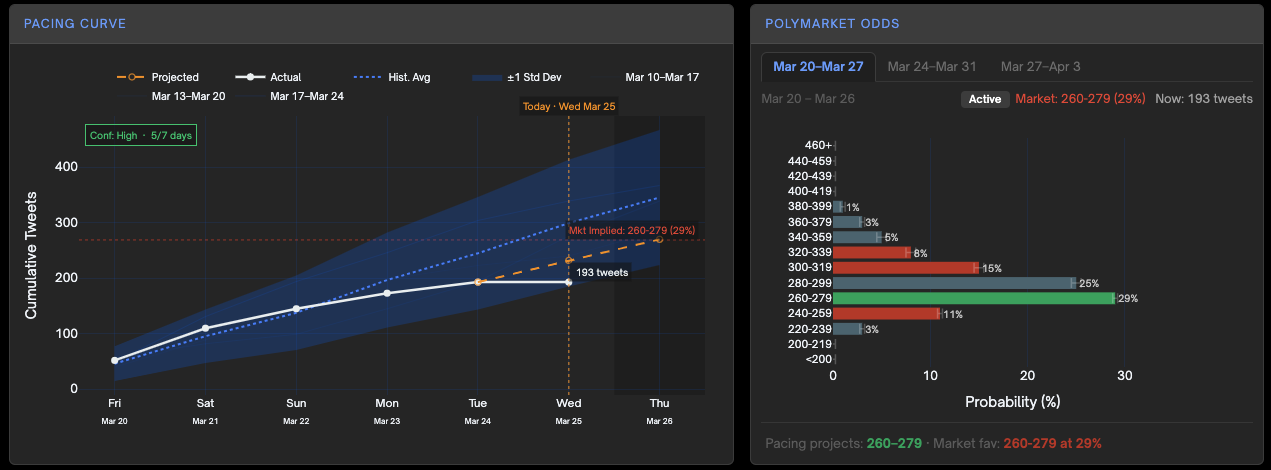
Elon X Forecast is the market lens. The tool claims 86 weeks of historical data as its foundation, built around two hypothesized drivers: momentum and mid-week pacing. The site combines a live pacing curve with current Polymarket tweet-market data, turning it into a dashboard for checking whether the contract price actually matches the observed pace of posting.

The pacing curve shows mid-week progress against historical baselines and spot market price lags (elonxforecast.com webpage screenshot as of 25 March, 2026)
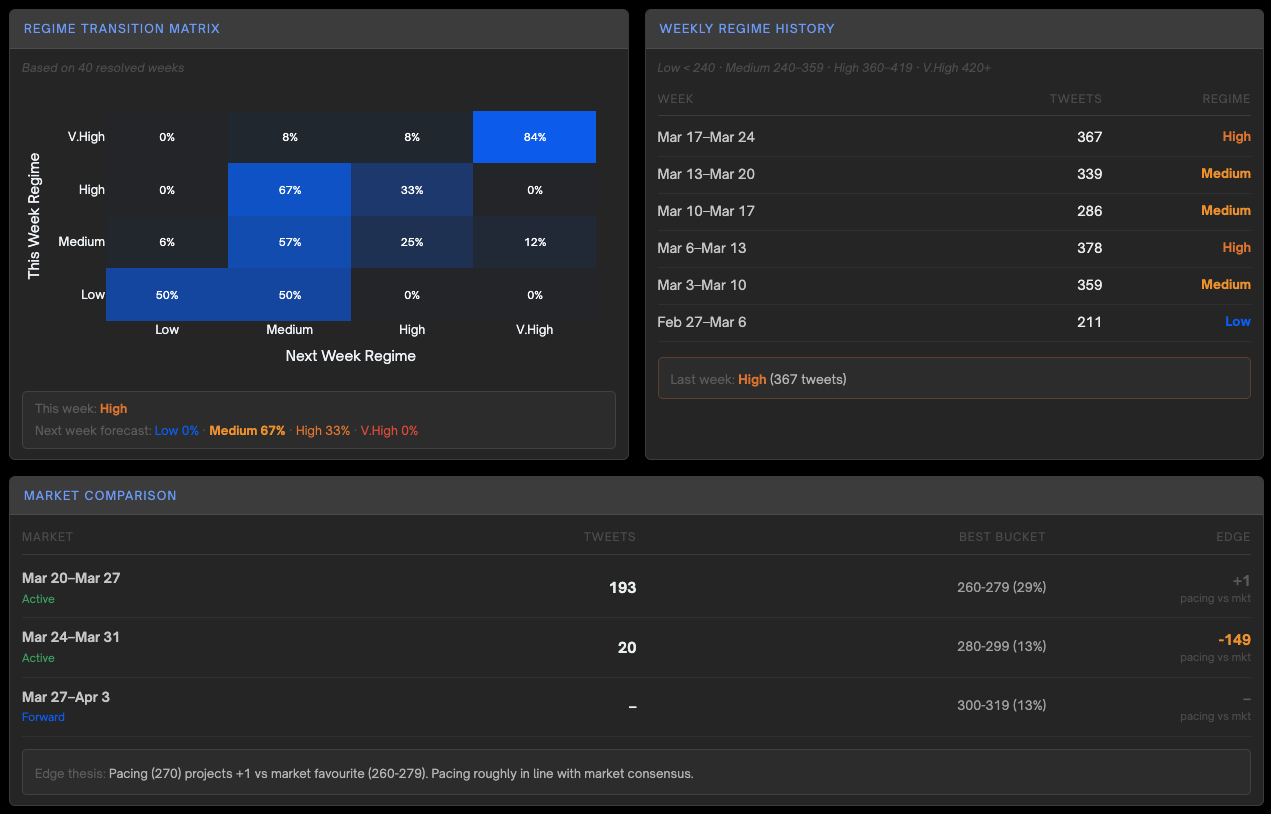
Elon's tweet volume exhibits momentum to some extent as the diagonal entries generally have higher values (elonxforecast.com webpage screenshot as of 25 March, 2026)

Speaking of the tweet volume outliers at some points in time, the tool creator also notes the following:

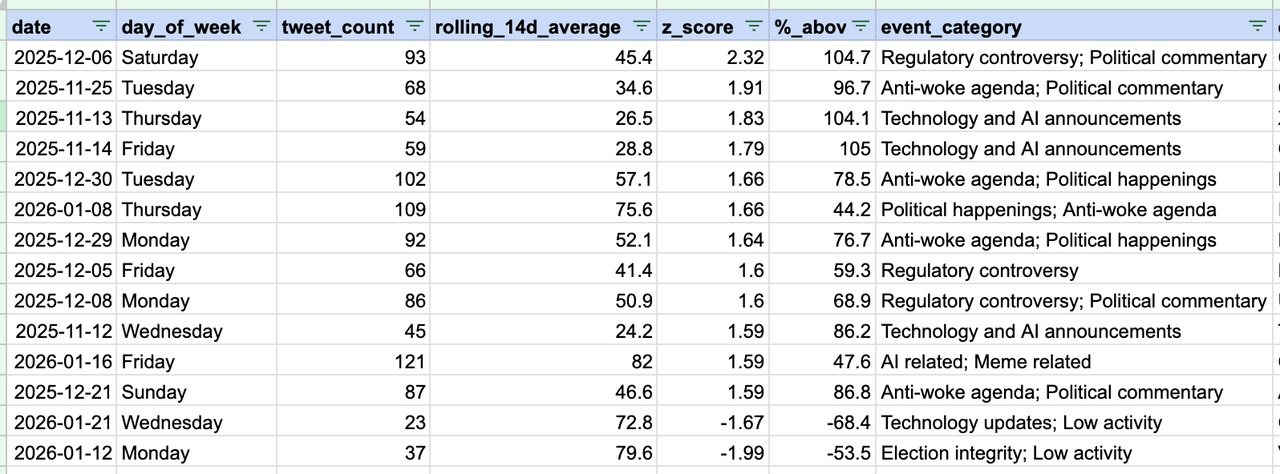
"Most of these departures (from the averages), 85% to be exact, are positive outliers (volume spikes). Looking at the categories, we see some trends:
(1) “Woke Mind Virus” and other political commentaries tend to spark extended threads that can balloon the weekly total.
(2) Tech updates and election integrity topics are normally associated with lower tweet levels."

Days classified as outliers by event category (Source: 🔮 TWEET QUANT)

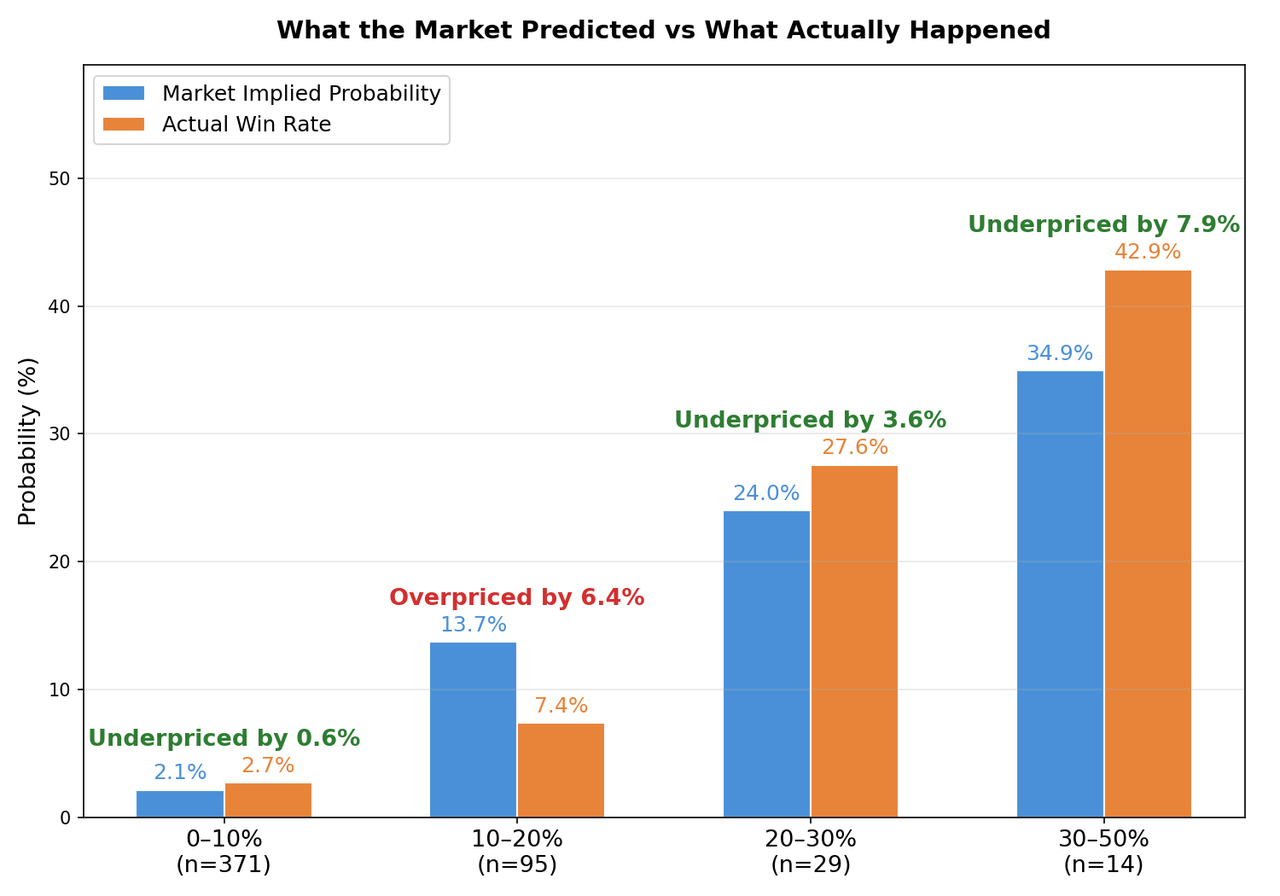
On the other hand, by comparing historical market-implied probabilities and realized win rates (i.e., the actual outcomes), we can see significant market mispricings. The 10-20% bucket appears overpriced, with markets assigning 13.7% odds to outcomes that materialize only 7.4% of the time. Meanwhile, the 30-50% bucket looks underpriced: contracts imply 34.9% odds, yet end up winning about 43% of the time.

This is consistent with the psychological bias called favorite-longshot bias, which describes that people tend to overweight small probabilities and sometimes underweight relatively high probabilities, which can lead them to overpay for longshots and underprice favorites.

Historical calibration against actual realized win rate (Source: 🔮 TWEET QUANT)

If you do decide to trade this market, the most disciplined approach would be to use them in sequence.

Start with MuskMeter, not the odds. Look at the recent-post flow. Check whether activity is clustering in bursts or spreading steadily through the day. Look at the short-run activity score and the moving-average context. This stops you from making the classic mistake of reacting to price before checking the underlying tape.

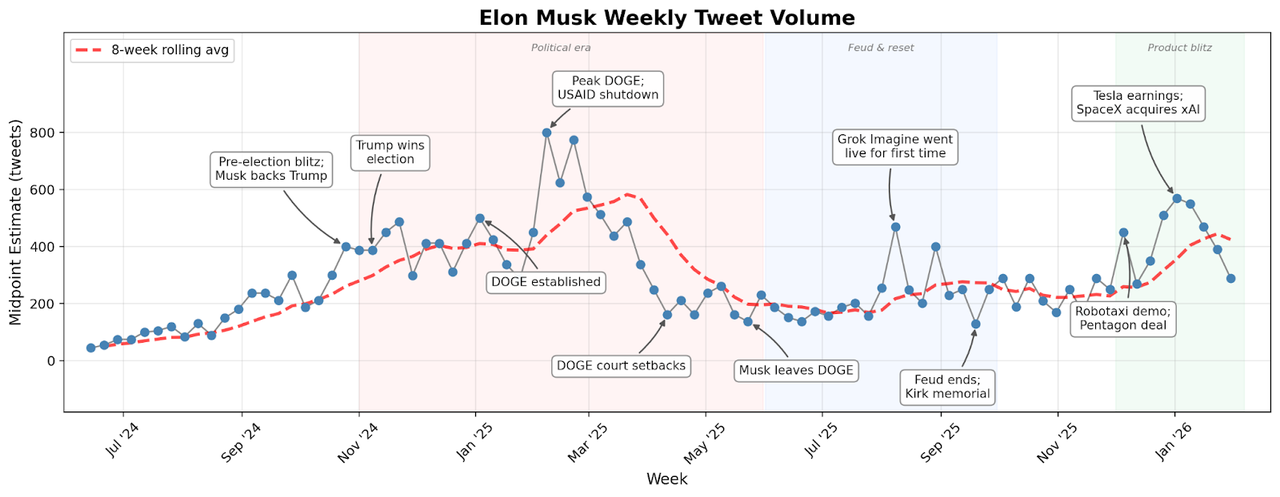
Then move to Elon X Forecast. Here the goal is not just to count tweets. It is to interpret them. There is some evidence supporting that tweet volume exhibits momentum from week to week, that pacing becomes more informative as the week develops, and that outlier event days can push totals far above normal. For example, by Tuesday, about 69% of a typical week’s total tweets had usually already been posted in the last-14-week pacing sample. That means mid-week counts are not just trivia. Instead, they are a basis for projecting the final weekly total and checking whether market odds have lagged reality.

Elon Musk weekly tweet volume (Source: 🔮 TWEET QUANT)

This is why the tools are strongest in combination.

On its own, MuskMeter can make a user too reactive. You see a burst of posting and immediately assume the high bucket is live. On its own, Elon X Forecast can make a user too abstract. You start staring at modeled ranges and forget that markets can reprice violently when a real-world catalyst hits. But together they create a disciplined workflow: MuskMeter for observation, Elon X Forecast for valuation.

A practical routine looks like this.

Before the week starts, use Elon X Forecast to understand the baseline: what range is realistic given prior-week momentum and historical behavior? During the week, use MuskMeter to monitor whether the live flow is confirming or breaking that baseline. Then return to Elon X Forecast to see whether Polymarket prices have adjusted enough. If live activity is running ahead of normal pace and the contract still looks anchored to an older, quieter expectation, that is the point of analysis.

Elon Musk loves the letter X. (Image credit: Emin Sansar/Anadolu Agency via Getty Images)

From curious to confident. Join the sharpest forecasters online, get top contracts, platform updates & market signals - free.

Join Today

These tools are useful, but people should be clear about the bet they are really making. Every model in this space ultimately leans on the same hidden premise that Musk’s future posting behavior will rhyme with his past. Most of the time, that is a fair assumption. The 86-week sample behind Elon X Forecast does show some momentum and pacing effects. But this is not payrolls, CPI, or an election cycle. It is the discretionary behavior of one man, and one who can plainly see that the market is watching his output in real time. That creates a regime-change risk no backtest can diversify away as Elon can abruptly change his behavior at any time.

Musk's X names Polymarket as its official prediction market partner and his xAI integrates data from major prediction markets like Polymarket and Kalshi. (Source: Bloomberg)

And the venue mix says something too. Kalshi currently appears to lean toward broader Musk-themed markets rather than a rolling tweet-count franchise, while Polymarket is still listing weekly Elon tweet contracts. That alone hints at the market-integrity discomfort around an underlying so close to being self-aware.

For traders, the takeaway is not to ignore these tools. It is to understand their limit: your edge is only as durable as the underlying is ungameable.

There is no recent active market for a similar contract on Kalshi (Kalshi webpage screenshot as of 26 March, 2026)

In a nutshell, for the general public, the big takeaway is simple: stop treating the contract like a meme and start treating it like a sequence of signals.

One tool shows the behavior. The other helps translate that behavior into market context.

And that is the real value of MuskMeter and Elon X Forecast: they do not tell you the future with certainty. These tools give you a real informational edge over pure guessing. The question is whether that edge survives contact with a subject who can see you watching.

Recommended reading: 🔮 TWEET QUANT

Useful links: Elon X Forecast, MuskMeter

Disclaimer: The content is for informational purposes only. You should not construe any such information or other material as legal, tax, investment, financial, or other advice. Nothing contained in this article constitutes a solicitation, recommendation, endorsement, or offer by the author(s) or any third party service provider to buy or sell any securities or other financial instruments in your or in any other jurisdiction in which such solicitation or offer would be unlawful under the securities laws of such jurisdiction. The author(s) report(s) no conflict of interest.

AI Speedrun - How AI is helping retail traders exploit prediction market 'glitches' to make easy money
Editorial
Prediction MarketAI InfrastructureAI Speed RunCapital MarketsIndustry Pulse

AI Speedrun - How AI is helping retail traders exploit prediction market 'glitches' to make easy money

A fully automated bot quietly captured micro-arbitrage opportunities on short-term crypto prediction markets, netting nearly $150,000.

TechEconomics & Finance

A fully automated trading bot executed 8,894 trades on short-term crypto prediction contracts and reportedly generated nearly $150,000 without human intervention.

The strategy, described in a recent post circulating on X, exploited brief moments when the combined price of “Yes” and “No” contracts on five-minute bitcoin and ether markets dipped below $1. In theory, those two outcomes should always add up to $1. If they don’t, say they trade at a combined $0.97, a trader can buy both sides and lock in a three-cent profit when the market settles.

That works out to roughly $16.80 in profit per trade — thin enough to be invisible on any single execution, but meaningful at scale. If the bot was deploying around $1,000 per round-trip and clipping a 1.5-to-3% edge each time, it becomes the kind of return profile that looks boring on a per-trade basis but impressive in aggregate. Machines don't need excitement. They need repeatability.

It sounds like free money. In practice, such gaps tend to be fleeting, often lasting milliseconds. But the episode highlights something bigger than a single glitch: crypto’s prediction markets are increasingly becoming arenas for automated, algorithmic trading strategies, and an emerging AI-driven arms race.

As such, typical five-minute bitcoin prediction contracts on Polymarket carry order-book depth of roughly $5,000 to $15,000 per side during active sessions, data shows. That's several orders of magnitude thinner than a BTC perpetual swap book on major exchanges such as Binance or Bybit.

A desk trying to deploy even $100,000 per trade would blow through available liquidity and wipe out whatever edge existed in the spread. The game, for now, belongs to traders comfortable sizing in the low four figures.

When $1 isn’t $1

Prediction markets like Polymarket allow users to trade contracts tied to real-world outcomes, from election results to the price of bitcoin in the next five minutes. Each contract typically settles at either $1 (if the event happens) or $0 (if it doesn’t).

In a perfectly efficient market, the price of “Yes” plus the price of “No” should equal exactly $1 at all times. If “Yes” trades at 48 cents, “No” should trade at 52 cents.

But markets are rarely perfect. Thin liquidity, fast-moving prices in the underlying asset and order-book imbalances can create temporary dislocations. Market makers may pull quotes during volatility. Retail traders may aggressively hit one side of the book. For a split second, the combined price might fall below $1.

For a sufficiently fast system, that’s enough.

These kinds of micro-inefficiencies are not new. Similar short-duration “up/down” contracts were popular on derivatives exchange BitMEX in the late 2010s, before the venue eventually pulled some of them after traders found ways to systematically extract small edges. What’s changed is the tooling.

Early on, retail traders treated these BitMEX contracts as directional punts. But a small cohort of quantitative traders quickly realized the contracts were systematically mispriced relative to the options market — and began extracting edge with automated strategies that the venue's infrastructure wasn't built to defend against.

BitMEX eventually delisted several of the products. The official reasoning was low demand, but traders at the time widely attributed it to the contracts becoming uneconomical for the house once the arb crowd moved in.

Today, much of that activity can be automated and increasingly optimized by AI systems.

Beyond glitches: Extracting probability

The sub-$1 arbitrage is the simplest example. More sophisticated strategies go further, comparing pricing across different markets to identify inconsistencies.

Options markets, for instance, effectively encode traders’ collective expectations about where an asset might trade in the future. The prices of call and put options at various strike prices can be used to derive an implied probability distribution, a market-based estimate of the likelihood of different outcomes.

In simple terms, options markets act as giant probability machines.

If options pricing implies, say, a 62% probability that bitcoin will close above a certain level over a short time window, but a prediction market contract tied to the same outcome suggests only a 55% probability, a discrepancy emerges. One of the markets may be underpricing risk.

Automated traders can monitor both venues simultaneously, compare implied probabilities and buy whichever side appears mispriced.

Such gaps are rarely dramatic. They may amount to a few percentage points, sometimes less. But for algorithmic traders operating at high frequency, small edges can compound over thousands of trades.

The process doesn’t require human intuition once it’s built. Systems can continuously ingest price feeds, recalculate implied probabilities and adjust positions in real time.

Enter the AI agents

What distinguishes today’s trading environment from prior crypto cycles is the growing accessibility of AI tools.

Traders no longer need to hand-code every rule or manually refine parameters. Machine learning systems can be tasked with testing variations of strategies, optimizing thresholds and adjusting to changing volatility regimes. Some setups involve multiple agents that monitor different markets, rebalance exposure and shut down automatically if performance deteriorates.

In theory, a trader might allocate $10,000 to an automated strategy, allowing AI-driven systems to scan exchanges, compare prediction market prices with derivatives data, and execute trades when statistical discrepancies exceed a predefined threshold.

In practice, profitability depends heavily on market conditions and on speed.

Once an inefficiency becomes widely known, competition intensifies. More bots chase the same edge. Spreads tighten. Latency becomes decisive. Eventually, the opportunity shrinks or disappears.

The larger question isn't whether bots can make money on prediction markets. They clearly can, at least until competition erodes the edge. But what happens to the markets themselves is the point.

If a growing share of volume comes from systems that don't hold a view on the outcome — that are simply arbitraging one venue against another — prediction markets risk becoming mirrors of the derivatives market rather than independent signals.

Why big firms aren’t swarming

If prediction markets contain exploitable inefficiencies, why aren’t major trading firms dominating them?

Liquidity is one constraint. Many short-duration prediction contracts remain relatively shallow compared with large crypto derivatives venues. Attempting to deploy significant capital can move prices against the trader, eroding theoretical profits through slippage.

There is also operational complexity. Prediction markets often run on blockchain infrastructure, introducing transaction costs and settlement mechanisms that differ from those of centralized exchanges. For high-frequency strategies, even small frictions matter.

As a result, some of the activity appears concentrated among smaller, nimble traders who can deploy modest size, perhaps $10,000 per trade, without materially moving the market.

That dynamic may not last. If liquidity deepens and venues mature, larger firms could become more active. For now, prediction markets occupy an in-between state: sophisticated enough to attract quant-style strategies, but thin enough to prevent large-scale deployment.

A structural shift

At their core, prediction markets are designed to aggregate beliefs to produce crowd-sourced probabilities about future events.

But as automation increases, a growing share of trading volume may be driven less by human conviction and more by cross-market arbitrage and statistical models.

That doesn’t necessarily undermine their usefulness. Arbitrageurs can improve pricing efficiency by closing gaps and aligning odds across venues. Yet it does change the market's character.

What begins as a venue for expressing views on an election or a price move can evolve into a battleground for latency and microstructure advantages.

In crypto, such evolution tends to be rapid. Inefficiencies are discovered, exploited and competed away. Edges that once yielded consistent returns fade as faster systems emerge.

The reported $150,000 bot haul may represent a clever exploitation of a temporary pricing flaw. It may also signal something broader: prediction markets are no longer just digital betting parlors. They are becoming another frontier for algorithmic finance.

And in an environment where milliseconds matter, the fastest machine usually wins.

Source: https://www.coindesk.com/markets/2026/02/21/how-ai-is-helping-retail-traders-exploit-prediction-market-glitches-to-make-easy-money