

Polymarket offers separate markets on whether AfD will win the most seats in Sachsen-Anhalt (scheduled on Sep. 6), Mecklenburg-Vorpommern (scheduled on Sep. 20), and Berlin (scheduled on Sep. 20).
Polymarket also has a market on the number of these elections AfD will win.
These contracts allow us derive benchmarks for "AfD wins exactly 2 states" and compare them with the directly traded price.
This article provides three ways to benchmark the price for "AfD wins exactly 2 states", without using any polling data, election correlation, or subjective probability. Time series of these benchmarks are plotted and compared to the actual Polymarket prices, using historical hourly data from 6 Jul 19:00 ET to 21 Jul 22:00 ET, fetched directly from Polymarket's public API.
6 Jul 19:00 ET was chosen as the starting time because the 'winning count' market was opened on Jul 6, 2026, 6:04 PM ET, while the individual state markets were open on Feb 11 (both Sachsen-Anhalt and Mecklenburg-Vorpommern) or Dec 2 (Berlin).
Some notations go first. Treating prices as implied probabilities, let S, M and B denote AfD victories in Sachsen-Anhalt, Mecklenburg-Vorpommern and Berlin. Let pS, pM and pB denote their respective prices, while qk denotes the price of AfD winning exactly k states.
The independence benchmark
If the three election outcomes are independent, the probability that AfD wins exactly two is:
The three terms correspond to AfD winning S and M, S and B, or M and B, while losing the remaining state.
At the end of the sample period, pS = 98.45%, pM = 86.50% and pB = 13.05%. This equation produces a two-state probability of 75.96%. The traded price was 77%, leaving a relatively small difference of +1.04%.
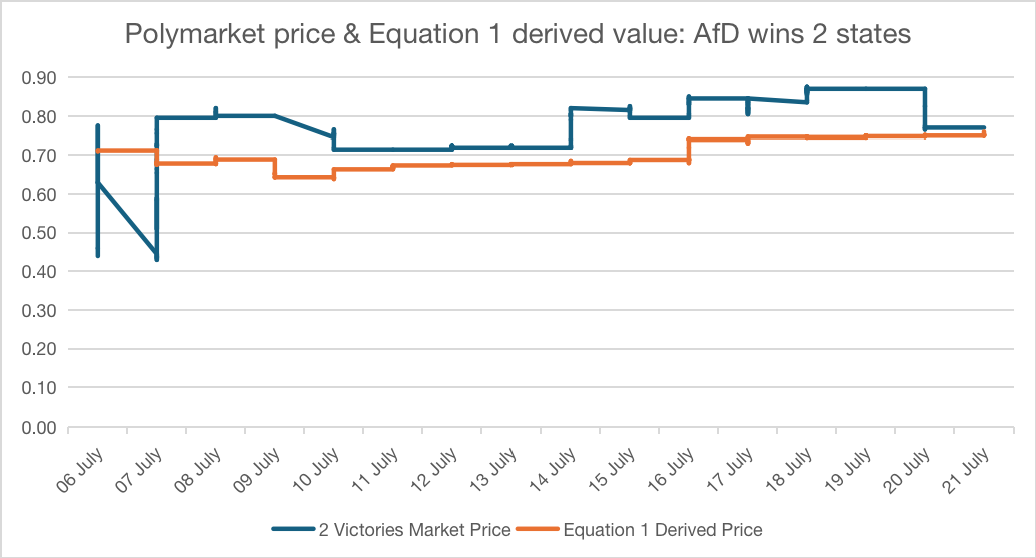
However, the chart below shows that this final agreement is not representative of the full period. After the first 24 hours (during which the price was volatile as the 'winning count' market was newly opened), the market price remained above the independence estimate in every hourly observation, with a median gap of about 9.84%, though the difference seems to converge to 0 as of the latest data.
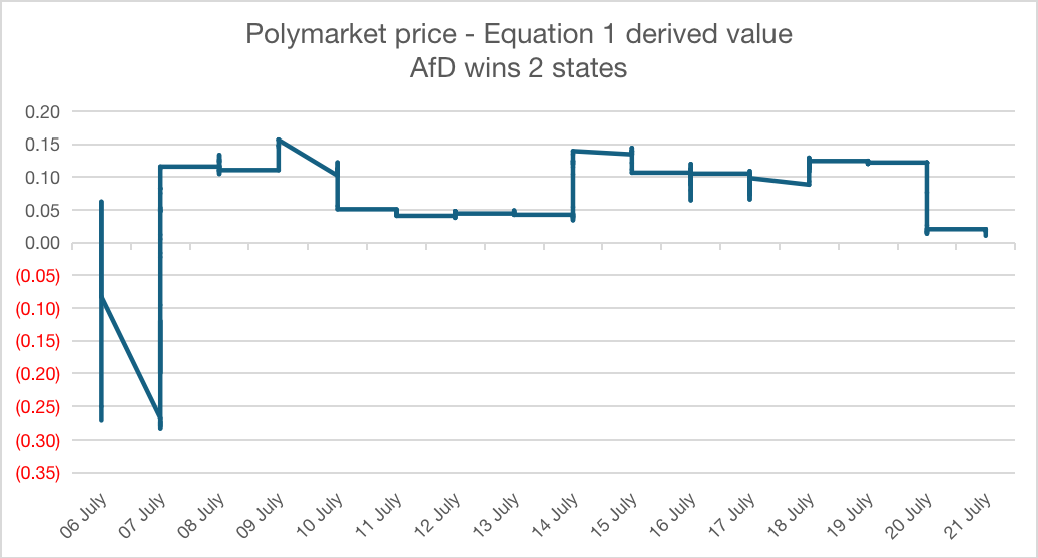
If the prices were otherwise consistent, this pattern would suggest that joint AfD victories in exactly 2 states were being priced, most of the time, as less likely than independence would imply. But it could also reflect ordinary inconsistency between separately traded contracts.
Using the three-state contract as the intersection
The rationale behind the second model is simple. Because Sachsen-Anhalt was priced as an almost certain AfD victory (average price=97.74% during the sample period), exactly 2 total victories should be approximately equivalent to AfD winning exactly one of Mecklenburg-Vorpommern and Berlin. For two events:
The three-state contract represents q3 = P(S ∩ M ∩ B). If P(S) is close to 1, then P(M ∩ B) ≈ q3, giving q3 ≈ pM + pB - 2q3.
At the end of the sample period, q3 = 0.60%, so the equation gives 98.35%. That is 21.35% above the traded 77% price.
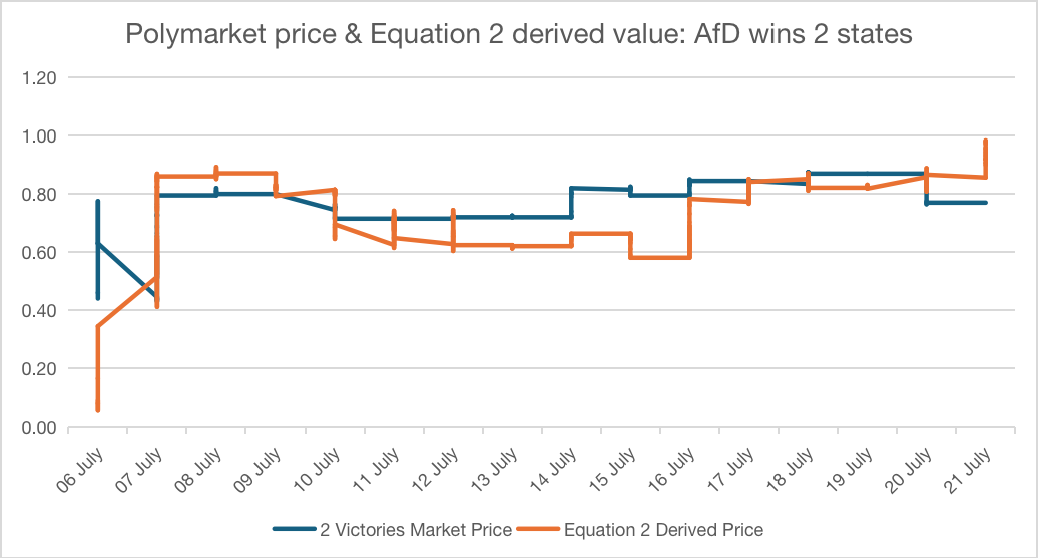
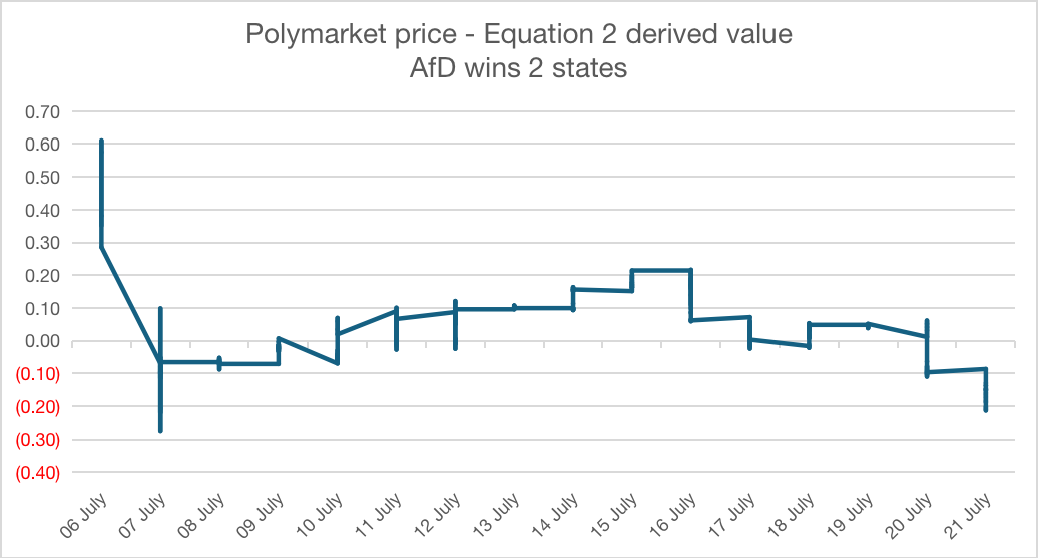
The chart showing the difference between the market price and equation-2-derived value is more volatile than the one using equation 1, because it inherits movements in the three-state contract. In the final 24 hours, the difference remained negative, with a median of approximately -16.90%.
Removing the independence assumption
Equation 1 assumes that election outcomes are independent, which may not be the case. The three elections are exposed to common national factors, including changes in AfD’s campaign developments and major political events. These shared influences are likely to generate positive correlation between the state outcomes.
A stronger benchmark can be derived without assuming any independence. Let N be the number of states won by AfD. Its expected value can be written in two ways:
Because the count outcomes are mutually exclusive and exhaustive: q0 + q1 + q2 + q3 = 1
Subtracting the total-probability identity from the expected-value identity eliminates q1 and gives:
This equation imposes no assumptions about independence between the elections.
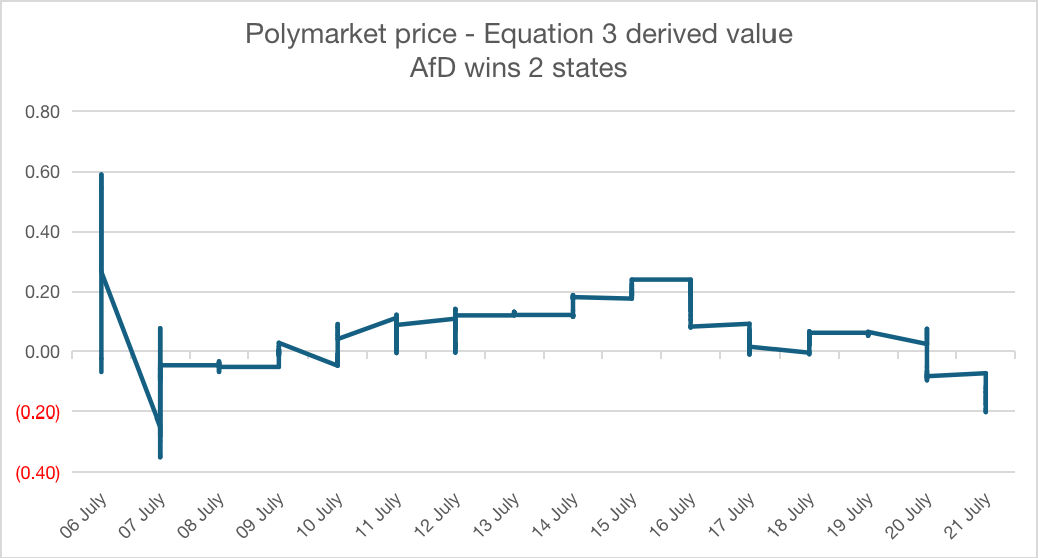
Using the final prices q0 = 0.45% and q3 = 0.60%, this equation gives 97.25%. The traded price was therefore 20.25% lower.
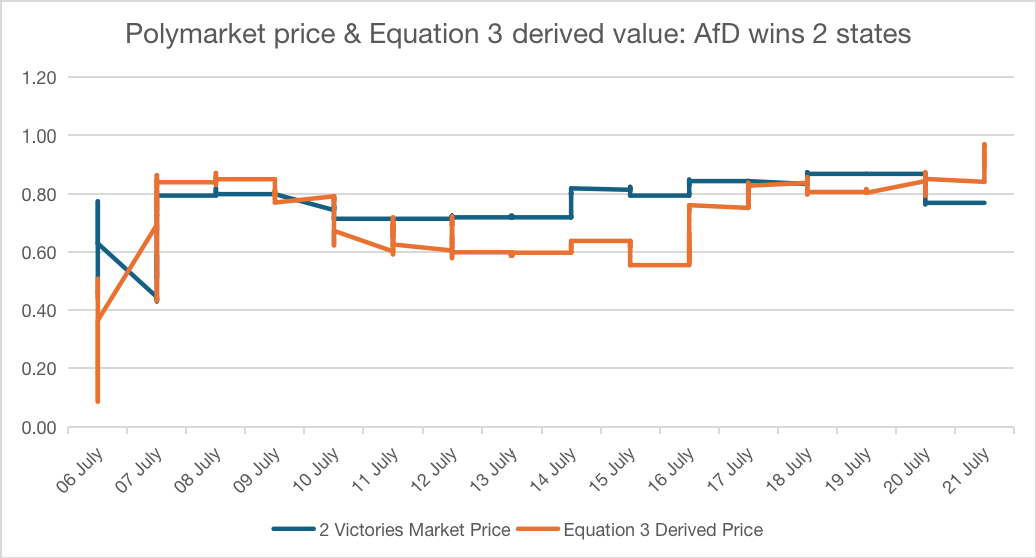
The close agreement between equations 2 and 3 is not accidental. Their difference is pS + q0 - 1. With pS = 98.45% and q0 = 0.45%, equation-2-derived value should be only few percentage points below the benchmark derived using equation 3.
Which benchmark(s) would you use? (Select all that apply)
A small contractual caveat
The count market treats a tie for the greatest number of seats as an AfD victory. The individual state-winner markets instead apply tie-breaking rules to select one winner. In addition, the count market uses a different deadline (Dec 31, 2026) compared to the individual state markets (Jan 31, 2027) in the case where the elections are delayed. The common underlying assumption behind all 3 models is that the underlying event definitions are harmonised, however the impact is likely negligible. Bid-ask spreads, liquidity and execution costs also matter before positions are opened.
The charts could be read as a historical cross-market consistency test. Their clearest message is that the market price, the independence benchmark, and the prices incorporating the three-state contract currently imply very different probability distributions. Perhaps the market is underpriced? Or are the benchmarks flawed?
Disclaimer: The content is for informational purposes only. You should not construe any such information or other material as legal, tax, investment, financial, or other advice. Nothing contained in this article constitutes a solicitation, recommendation, endorsement, or offer by the author(s) or any third party service provider to buy or sell any securities or other financial instruments in your or in any other jurisdiction in which such solicitation or offer would be unlawful under the securities laws of such jurisdiction. The author(s) report(s) no conflict of interest.