

On August 19, the Treasury jacked up its long-end liquidity support buybacks, lifting the operational cap from $2 billion to at least $4 billion, effective September 9 through November 4. Long bonds caught an initial bid, but the rally lacked the legs to change the bigger picture.
The 30-year yield had touched roughly 5.33% the day before the announcement, its highest level in 19 years. By August 25, it was still sitting at 5.17%.
The larger operations do not begin until September 9. The market move so far therefore reflects the announcement’s signaling effect, not bonds that Treasury has already purchased under the new limits.
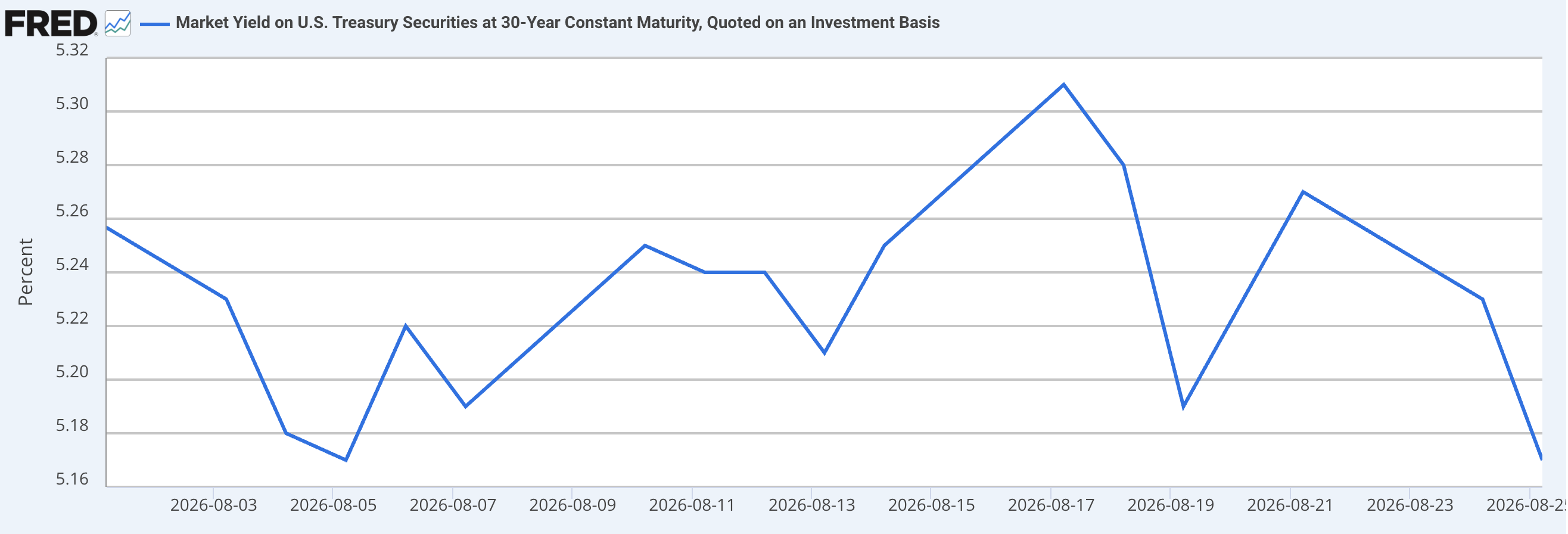
Source: FRED
My take is that Treasury is trying to unclog dealer balance sheets, but the market is worried about how many bonds it will have to absorb and at what price.
 Jiayi ZHANG
What is doing the most to keep the 30-year above 5%?
Is this debt management or QE?
The word “buyback” sounds much bigger than the trade. When the Federal Reserve conducts QE, it creates reserves and removes duration from private portfolios without requiring offsetting Treasury issuance.
Treasury buybacks work differently: they are financed from available cash and incorporated into the government’s broader borrowing needs, with new issuance replacing the securities retired over time.
Treasury can alter the maturity mix through its issuance strategy, but its liquidity-support buybacks are not intended to materially change the overall maturity profile of the debt.
Treasury has said its liquidity-support operations are not intended to change the overall maturity profile of the debt. This is closer to swapping older, awkward securities for cleaner benchmark issuance than taking debt out of circulation. In other words, the Treasury is rearranging the debt, it’s not making it go away.
|
Buybacks
can affect |
Buybacks
cannot directly fix |
|
Off-the-run
liquidity |
Net borrowing
requirements |
|
Bid-ask
spreads |
Federal
deficits |
|
Dealer
inventories |
Rising
interest costs |
|
Trading in
individual securities |
Inflation and
fiscal risk |
|
Benchmark
issuance efficiency |
Structural
demand for duration |
The net supply remains enormous
New Treasury securities, known as on-the-run issues, trade heavily. Older off-the-run bonds do not always move so easily, despite accounting for about 98% of Treasuries outstanding.
This leaves dealers carrying a long list of securities with different coupons and maturities. Some have deep order books, but others need a price concession before a buyer appears.
Against $30T+ marketable debt, throwing $4B at a long-end operation provides localized micro-structure relief, but it’s a drop in the bucket for the macro curve.
Treasury is projecting $739B in net borrowing for Q3 and another $628B for Q4. The government can buy back a few billion dollars of older bonds while issuing hundreds of billions in new debt, but the direction of travel does not change. In fact, the stock of debt keeps growing, and the market still has to absorb it.
The 30-year is charging for uncertainty
At the August 13 auction, 30-year bonds cleared at 5.216%, the highest auction yield since 2001, and tailed the when-issued level by 0.4 bps. This was not a failed auction, but Treasury still had to offer investors considerably more than it did a month earlier. The 10-year sale the day before cleared at 4.683%, its highest auction yield since 2007.
Liquidity is only one part of a Treasury yield. Long-term yields carry expectations for inflation, Fed policy and economic growth, plus a term premium for committing money for decades. This last component, the term premium, becomes more important when the future path of inflation, deficits and issuance is difficult to predict.
Gross federal debt has now crossed $40 trillion. The Congressional Budget Office projects a $1.9 trillion deficit in fiscal 2026, equal to 5.8% of GDP. Net interest costs are expected to reach roughly $1 trillion this year and $2.1 trillion by 2036.
Put it another way, investors are pricing uncertainty over how much debt will be issued, who will absorb it and whether the adjustment eventually arrives through taxes, spending, inflation or higher borrowing costs.
Refinancing old, cheap debt at current yield levels creates a brutal negative feedback loop, compounding future borrowing needs. The 30-year is not staying above 5% primarily because individual legacy bonds are difficult to trade. It remains elevated because investors are demanding greater compensation for inflation, issuance, term-premium and fiscal uncertainty. Buybacks may alleviate the first problem, but they cannot remove the second.The timing creates another problem
That timing matters because Treasury had previously said buybacks would be regular and predictable, rather than tactical or a response to acute market stress. An out-of-cycle increase immediately after a yield spike does not prove that Treasury is targeting yields, but it blurs the line between improving liquidity and managing the market price of long-term debt.
A known buyer may initially discourage short selling; the longer-term risk is that investors interpret the move as an attempted yield cap and test how far Treasury is willing to go.
What would make the long end move?
If Treasury wants lower long-term borrowing costs, market liquidity is a sensible place to start.
For a sustained move lower in 30-year yields, you would probably need some combination of softer inflation data, a dovish pivot from the Fed, stronger structural demand for long bonds, and a more credible fiscal path.
Treasury could shorten its issuance profile by leaning more on T-bills and short coupons, but this would increase rollover risk and leave the budget exposed to short-rate shocks.
The maturity mix can move risk around, but risk remains persistent.
For now, it’s important to see if larger buybacks improve off-the-run trading, narrow spreads and reduce the amount dealers have to warehouse. These are the measures by which a liquidity program should be judged.
As for where the 30-year trades? Watch everything that determines the broader price of long-term debt, such as auction demand, the term premium, inflation expectations, quarterly borrowing estimates and the federal interest bill.
If liquidity improves while the 30-year yield stays above 5%, the program has not necessarily failed, it may simply be solving the smaller problem.
Treasury can make government bonds easier to trade, but it cannot make fewer of them exist.
Where does the 30-year yield finish 2026?
Sources
CME Group: US: 30-Yr Bond Auction
Congressional Budget Office: The Budget and Economic Outlook: 2026 to 2036
Federal Reserve Bank of New York: Liquidity and Trading Dynamics in the Off-the-Run U.S. Treasury Market
Federal Reserve Bank of New York, Liberty Street Economics: Treasury Market Liquidity Since April 2025
Federal Reserve Board: The Fed Explained Monetary Policy
FiscalData.Treasury.gov: Debt to the Penny
Newsquawk: US Sells 30-Year Bonds; Tail 0.4bps
Reuters: Morning Bid - Big, Bad Bond Market
Reuters: US Debt Crosses $40 Trillion Threshold After Doubling Under Trump and Biden
U.S. Department of the Treasury: Daily Treasury Rates
U.S. Department of the Treasury: Quarterly Refunding Statement of Assistant Secretary for Financial Markets Josh Frost
U.S. Department of the Treasury: Treasury Announces Increased Sizes of Nominal Long-End Liquidity Support Buybacks Beginning September 9
U.S. Department of the Treasury: Treasury Announces Marketable Borrowing Estimates
U.S. Treasury Fiscal Data: Treasury Securities Auctions Data
Wolf Street: US Government Sold $742 Billion of Treasury Securities This Week; 30-Year Auction Yield Highest Since 2001, 10-Year Highest Since 2007