India is doing something that appears somewhat contradictory.
On the one hand, India has already achieved its E20 target ahead of schedule, blending 20% ethanol into gasoline in an effort to replace part of its imported oil with domestically produced biofuel. On the other hand, after sugar prices rose rapidly, the Indian government temporarily cut what had been a 100% import tariff to zero and allowed the import of 1 million tonnes of raw sugar. This is India's first sugar import of such a scale in nearly a decade. India is the world's largest sugar consumer, so the policy immediately affected international markets as well. On the day the import policy was announced, sugar futures in London and New York rose by as much as about 4%.
The most intuitive explanation for the rise in sugar prices is that too much sugarcane has been diverted to ethanol production, leaving too little sugar for domestic consumption.
But the data tell a more complicated story. This round of sugar price increases was driven primarily by lower sugarcane output, overly optimistic production forecasts, pre-festival stockpiling, and speculative hoarding. Ethanol was not the source of the supply shock, and the actual volume diverted to ethanol was even lower than originally planned. However, ethanol has already changed the buffer mechanism of India's sugar industry, giving the government greater scope to reallocate the same sugarcane crop among food, fuel, and farmers' incomes.
How Much Did Sugar Prices Actually Rise?
Different news reports give different figures because they are not measuring the same type of price.
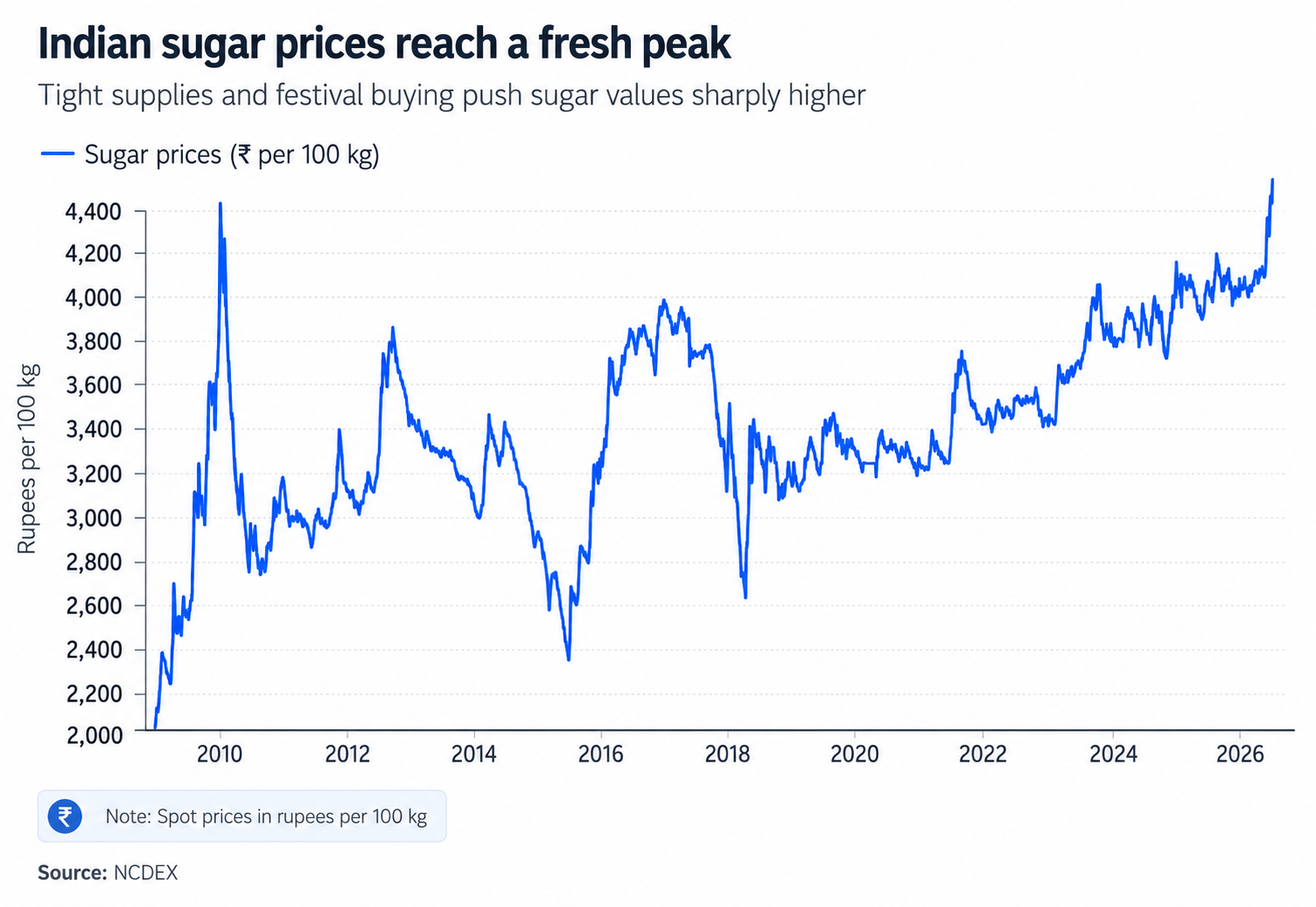
According to the Indian government, the national average retail price of sugar rose from ₹48.18 per kilogram on July 20, 2026, to ₹55.70 on August 20, an increase of about 15.6% in one month. Before this surge, sugar prices had actually been remarkably stable. The Indian government says that between August 2024 and July 2026, consumer sugar prices nationwide rose at an average annual rate of only about 3%. In other words, the increase in August alone was equivalent to roughly five years of normal price growth.
But the Indian Express, citing the modal retail price reported by India's Department of Consumer Affairs, shows that the most commonly quoted retail price rose from ₹45 per kilogram on July 21 to ₹65 on August 21, an increase of about 44%. Mill-gate prices moved just as sharply: by August 20, prices in Uttar Pradesh had reached ₹57 to ₹60 per kilogram, while those in Maharashtra and Karnataka had exceeded ₹62, compared with mostly ₹45 to ₹47 in these regions at the beginning of August.
Take Kolhapur, a major sugar-trading hub in Maharashtra, as an example. Wholesale sugar prices were around ₹4,716 per 100 kilograms in early August, before rising to as high as ₹5,350 by mid-month. The rise in sugar prices was therefore not uniform across the country. It was initially concentrated in producing regions, wholesale markets, and mill-gate transactions, before gradually being passed through to consumers.
International markets were tightening at the same time. Indian government data show that international sugar prices rose from $474 per tonne on June 30 to $552 on August 20, an increase of more than 16% in less than two months. The government estimates that the global sugar supply-demand deficit in the 2026/27 season will be about 3.3 million tonnes.
So there is no contradiction between saying that "sugar prices rose by more than 40%" and that "the national average price rose by about 16%." The former is closer to the modal price in specific markets or to mill-gate quotations, while the latter refers to the national average retail price. Both reflect the same underlying development: India's sugar market shifted rapidly from comfortable supply to tightness in a very short period.
India's Sugar Balance Sheet
Perhaps the most useful way to understand Indian sugar prices is to first build a sugar balance sheet.
💡 Building a balance sheet is an effective way to analyze commodity fundamentals. A balance sheet helps you understand market dynamics, including supply, demand, imports, exports, and inventories.
The core equation is: Ending stocks = Beginning stocks + Production + Imports - Consumption - Exports
If you intend to analyze a commodity seriously, building your own balance sheet is a good place to start.
One distinction is especially important here: "gross sugar production" versus "net sugar production". Gross sugar production refers to the amount of sugar that could theoretically be produced by converting all extractable sugar content in the sugarcane crop into sugar. Net sugar production refers to the amount of crystalline sugar that actually enters the food market after deducting the sugar diverted to ethanol production.
If the figure being used is already net sugar production, ethanol diversion cannot be deducted again as a separate item, or it would be double-counted.
In November 2025, the Indian Sugar and Bio-energy Manufacturers Association, or ISMA, made the following preliminary estimates for the 2025/26 sugar season:
| Item | Initial Forecast |
|---|---|
| Gross Sugar Production | 34.35 million tonnes |
| Diversion to Ethanol | 3.40 million tonnes |
| Net Sugar Production | 30.95 million tonnes |
The latest industry estimates as of August 2026, however, look very different:
| Item | Latest Estimate |
|---|---|
| Gross Sugar Production | 30.90 million tonnes |
| Diversion to Ethanol | 3.00 million tonnes |
| Net Sugar Production | 27.90 million tonnes |
In other words, gross sugar production came in 3.45 million tonnes below forecast, while ethanol diversion was actually 400k tonnes lower than originally planned. The reduction in ethanol diversion therefore partially offset the losses caused by weather and crop damage. It did not create the 3.05 million-tonne shortfall in net sugar production.
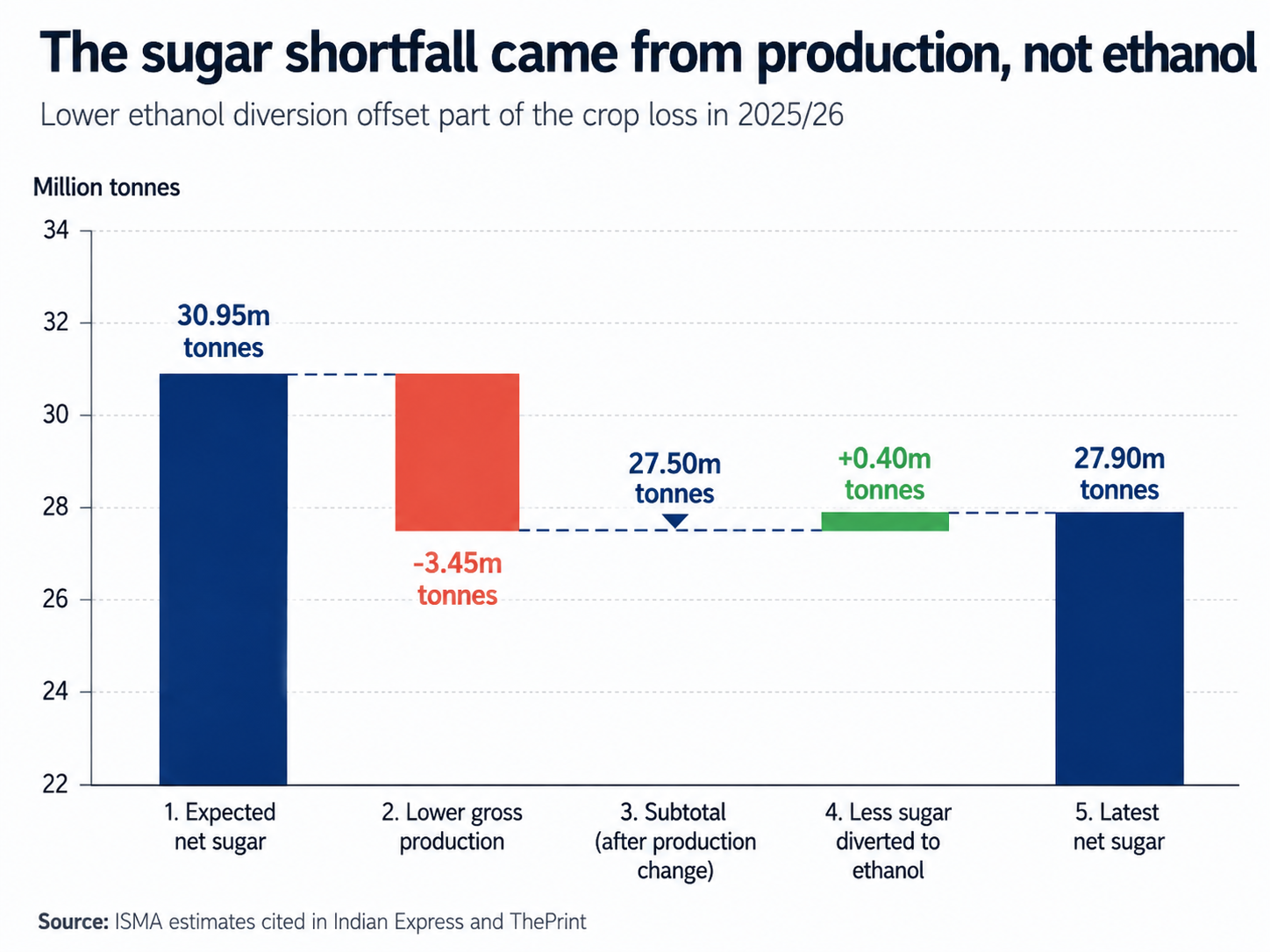
The more important question is why those 3.45 million tonnes of gross production disappeared. In the initial forecast published in November 2025, Maharashtra was expected to produce about 13.0 million tonnes of sugar. The latest estimate was only around 9.92 million tonnes, a shortfall of 3.08 million tonnes, or about 24%. Karnataka was initially expected to produce 6.35 million tonnes but ultimately produced only about 4.72 million tonnes, a shortfall of 1.63 million tonnes, or roughly 26%. Uttar Pradesh, meanwhile, saw production fall from a projected 10.32 million tonnes to about 8.97 million tonnes, a shortfall of 1.35 million tonnes, or around 13%.
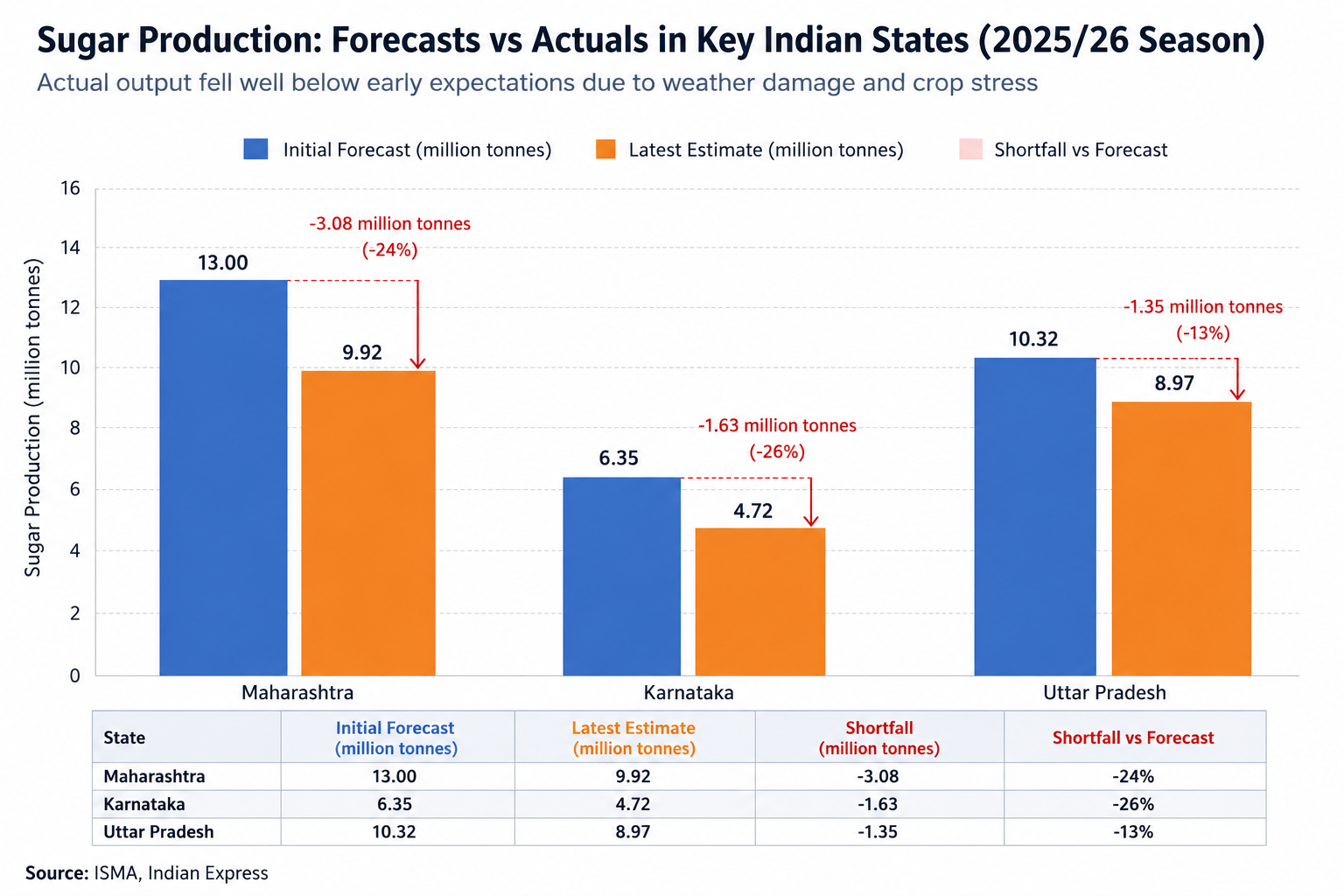
The problems affecting these three largest sugar-producing regions were not the same. Maharashtra, Karnataka, and Gujarat experienced unusually heavy rainfall and a delayed withdrawal of the monsoon between September and October 2025. For sugarcane, more water is not necessarily better. During the maturation stage, the crop needs sufficient sunlight and relatively dry conditions to accumulate sucrose. Prolonged waterlogging reduces soil aeration and limits the amount of sunlight available to the plant. The result can be not only lower sugarcane yields per hectare, but also less recoverable sugar from each tonne of cane.
Uttar Pradesh faced a different problem, driven more heavily by pests and disease. The widely planted Co-0238 variety has become increasingly vulnerable to red rot and top borer infestations, directly reducing both sugarcane yields and sugar recovery rates (Sugar production = Sugarcane crushed × Sugar recovery rate).
This price surge was therefore, first and foremost, a crop and forecasting crisis rather than a crisis suddenly created by ethanol demand.
India Is Not Running Out of Sugar, but Its Buffer Stocks Are Thin
India's net sugar production this season is about 27.9 million tonnes, while domestic consumption is roughly 28.0 to 28.5 million tonnes, so the two are broadly balanced. But India had already exported around 800,000 tonnes of sugar, while beginning stocks were only about 4.8 to 5.0 million tonnes. Depending on the assumptions used for consumption and opening inventories, ending stocks would be roughly 3.4 to 4.1 million tonnes. A more conservative estimate cited by Reuters from ISMA suggests that actual inventories could be only about 3.5 million tonnes when the new crushing season begins in October, down from 5.0 million tonnes a year earlier. That 3.5 million tonnes is equivalent to only about 45 days of normal Indian consumption.
This explains why "India still has enough sugar" and "sugar prices are rising rapidly" can both be true at the same time. Commodity markets do not need to wait until warehouse inventories fall to zero before pricing in scarcity. What matters is the stock-to-use ratio. If a market has six months of inventory, a sugar mill delaying shipments by two weeks does not matter much. If the entire country has only six weeks of inventory left, and large volumes of new-season sugar will not reach the market until after October, then every tonne of physical sugar begins to carry an "insurance" value.
This also helps explain why seemingly speculative behavior began to emerge. The Indian Express reported that some cash-strapped sugar mills had previously sold sugar in advance beyond their government-set monthly release quotas, meaning there could be a gap between reported inventories and the physical stock actually available for immediate sale. Beginning in July, large traders, stockists, and industrial users such as beverage and confectionery companies began building inventories. By August, even some sugar mills themselves started delaying sales in the hope of obtaining higher prices ahead of the festival season.
The government therefore stopped relying solely on inventory figures reported by sugar mills and instructed joint central and state-level teams to conduct physical verification of mill stocks. From August 1 through the end of November, sugar dealers are prohibited from holding more than 400 tonnes, and they cannot retain sugar they have received for more than 30 days. For large industrial users consuming more than 10 tonnes of sugar per month, inventories from September 1 through the end of November cannot exceed 15 days of normal consumption.
The 1 Million Tonnes of Imported Sugar Is Solving a Timing Mismatch, Not an Annual Shortfall
India previously imposed a 100% tariff on sugar imports. In August 2026, the government allowed 1 million tonnes of raw sugar to be imported duty-free by October 31. One million tonnes is equivalent to roughly 12 to 13 days of India's sugar consumption. It is not enough to materially alter India's annual balance, but it can bridge the timing gap between the end of the old crushing season and the arrival of new-season supply.
This timing window is particularly important. India's sugar crushing season typically begins in October, but large volumes of finished sugar often do not reach the market until later. At the same time, festivals such as Dussehra and Diwali fall in October and November, prompting confectionery, beverage, and processed-food companies to begin purchasing several weeks in advance. The government has also instructed some mills to begin crushing from October 15, with the aim of raising October sugar production from the usual 300k to 400k tonnes to more than 1 million tonnes. That would effectively release roughly an additional week's worth of national consumption.
Imports, early crushing, and inventory restrictions are therefore three different policy tools:
- Imports provide a bridge until new-season sugar arrives.
- Early crushing shortens the period during which old inventories must support the market.
- Inventory restrictions force sugar that already exists to move into circulation more quickly.
But something even more interesting happened after the policy was announced. Once the government announced the 1 million-tonne duty-free import quota, domestic ex-mill sugar prices quickly fell by nearly 20% from record highs. By August 25, five international traders and industry officials told Reuters that actual imports might ultimately total only around 500,000 tonnes, roughly half the government quota.
The reason is straightforward. Shipping sugar from Brazil to India takes close to two months. When domestic Indian sugar prices were at record highs, the arbitrage worked because Indian sugar prices were greater than the cost of Brazilian raw sugar plus freight and refining. But after the government announced imports, early crushing, and tighter inventory controls, domestic prices fell before any Brazilian sugar had actually arrived, and the profitability of importing began to disappear. This shows that the expectation that "1 million tonnes of sugar will enter the market in the future" was itself enough to change the returns to hoarding sugar today. This is a classic commodity-market expectations channel.
In addition, India's coastal refineries were already holding around 300,000 tonnes of imported raw sugar intended for refining and re-export. The government allowed these refineries to sell the refined sugar into the domestic market before the end of October, meaning that part of the additional supply does not even need to wait for new cargoes to arrive from Brazil.
It is also worth noting that earlier in the current sugar season, India had allowed exports of up to 2 million tonnes. Actual exports reached about 800,000 tonnes, after which the government banned further exports and shifted to importing sugar. On the surface, this can look like a classic case of "selling first and buying it back later at a higher price." But the scale of the numbers does not support such a simple criticism. The initial forecast for gross sugar production was about 3.45 million tonnes higher than the latest estimate, while actual exports totaled only around 800,000 tonnes. In other words, the forecasting error was more than four times the volume exported. The real difficulty is that sugar policy must determine, before the sugarcane crop has fully matured and been crushed, how much sugar can be exported over the coming months and how much can be diverted to ethanol production.
Why the Same Sugarcane Can Become Both Sugar and Fuel for Cars
Once sugarcane enters a mill, it does not have to be used exclusively for either sugar or ethanol. Mills can alter their product mix at several stages of the production process.
The most ethanol-intensive route is to ferment sugarcane juice or syrup directly. Instead of crystallizing the sucrose into sugar, the mill sends virtually all of the cane's fermentable sugars into fermentation. On a common sugarcane-input basis, this route can produce roughly 80-81 litres of ethanol per tonne of cane, while sacrificing almost all of the crystalline sugar that could otherwise have been recovered. Actual yields vary with cane quality and plant efficiency.
The second route uses B-heavy molasses. Rather than extracting the maximum amount of crystalline sugar, the mill stops crystallization earlier, recovering roughly 9.5%-10% of the cane as sugar and leaving more fermentable sugars in the molasses. Measured on the same basis, the B-heavy route produces roughly 20-21 litres of ethanol per tonne of sugarcane crushed, while preserving substantially more crystalline sugar than direct fermentation.
The traditional C-heavy route prioritizes sugar production. Mills extract roughly 11.5% of the cane as crystalline sugar, leaving only the residual, non-recoverable fermentable sugars in C-heavy molasses. As a result, ethanol output falls to only around 10-11 litres per tonne of sugarcane crushed.
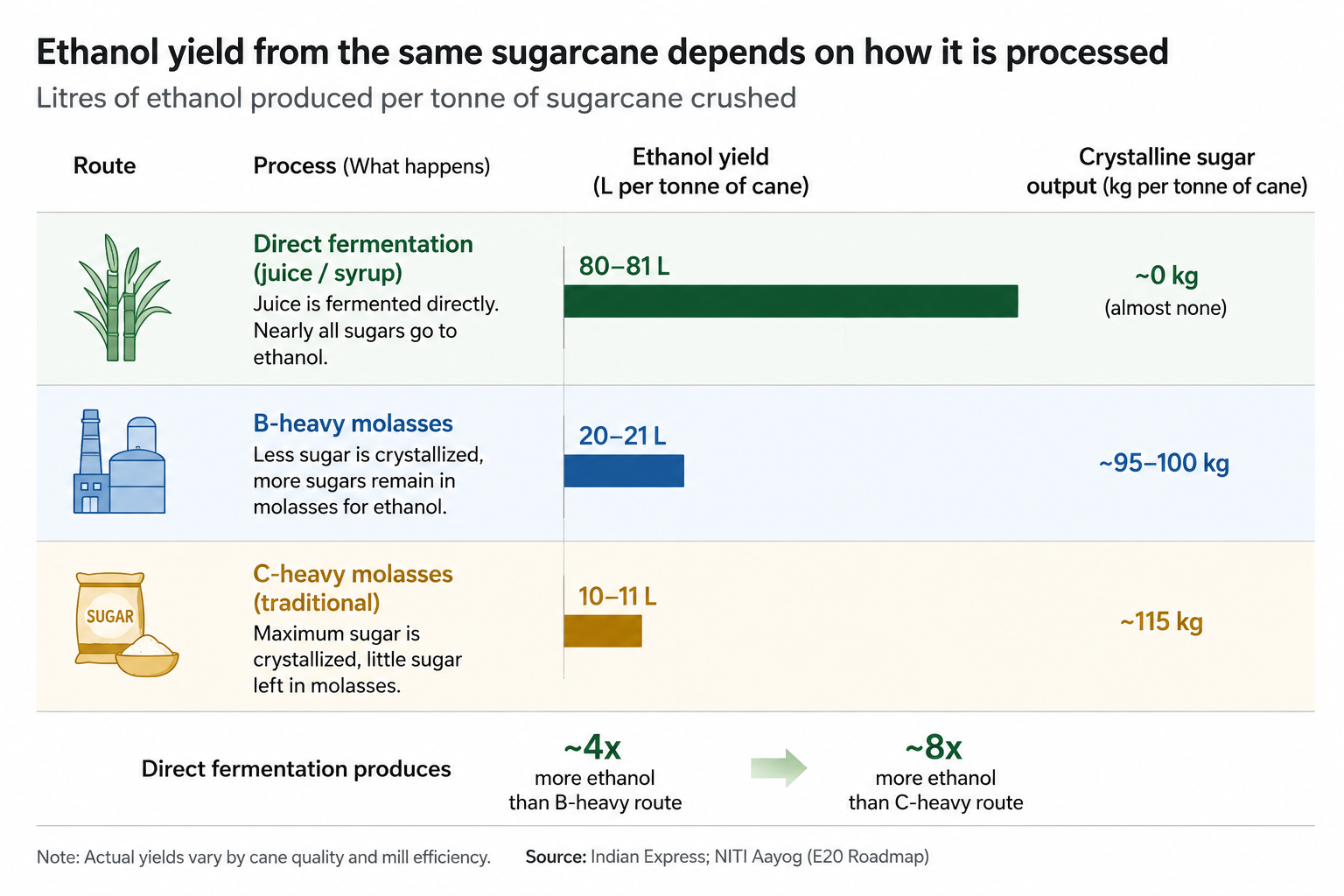
This means ethanol diversion is not a fixed technical outcome, but a variable that can be adjusted through policy. When sugar supplies are abundant, the government can allow more sugarcane juice and B-heavy molasses to be used for ethanol production. When the sugar market is tight, it can prioritize crystalline sugar production and restrict ethanol production to C-heavy molasses or other feedstocks. Reuters reported that the Indian government was considering restricting the use of sugarcane juice and B-heavy molasses in the 2026/27 season, while shifting more ethanol demand toward corn, grains, and C-heavy molasses.
This Is Not a Free Market, but a System Built Around Multiple Policy Prices
India's sugar industry is neither a fully planned economy nor an ordinary free commodity market. It is better understood as a system in which multiple policy-administered prices are layered on top of one another.
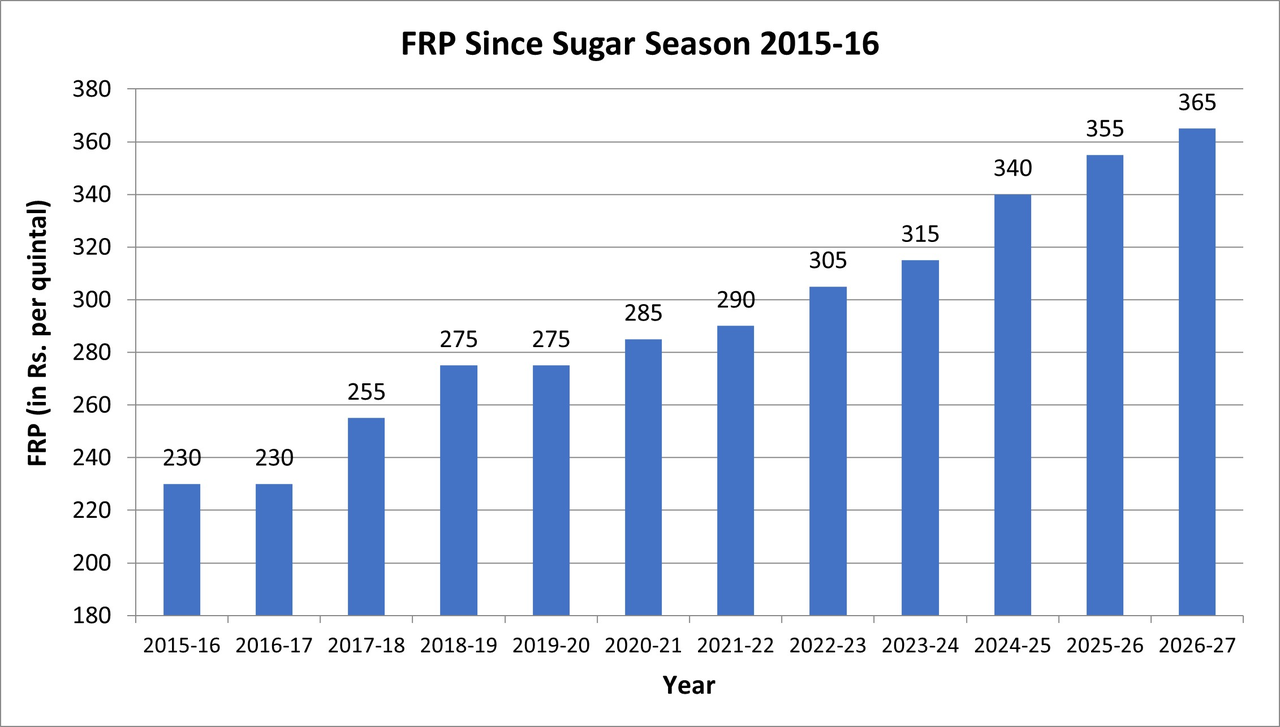
The first price is what farmers receive for sugarcane. For the 2025/26 crushing season, the central government set the Fair and Remunerative Price, or FRP, at ₹355 per 100 kilograms, based on a benchmark sugar recovery rate of 10.25%. For every 0.1 percentage-point increase in the recovery rate, mills must pay an additional ₹3.46. For the 2026/27 season, the FRP was raised further to ₹365 per 100 kilograms, an increase of 2.8%, again based on a 10.25% recovery rate, with an additional ₹3.56 payable for every 0.1 percentage-point increase. The government estimates the A2+FL cost of sugarcane production at around ₹182 per 100 kilograms, meaning the FRP is roughly twice that cost. In states such as Punjab, Haryana, Uttar Pradesh, and Uttarakhand, state governments also set a State Advised Price, which is usually higher than the FRP.
The second price is the Minimum Selling Price, or MSP, for sugar. The Indian government began setting a minimum ex-mill selling price for sugar in 2018 and raised the MSP to ₹31/kg in February 2019. It has not been increased since.
There is a notable asymmetry here. In the 2019/20 season, the sugarcane FRP was still ₹275 per quintal. By 2025/26, it had risen to ₹355, and in 2026/27 it will rise further to ₹365. In other words, from 2019/20 to 2026/27, the benchmark procurement price for sugarcane will have increased by about 33%, while the statutory minimum selling price for sugar remains fixed at ₹31/kg. If the sugar market moves back into severe surplus and prices fall toward the MSP, mill margins will naturally come under pressure.
The third set of prices consists of the procurement prices paid to ethanol producers by state-owned oil marketing companies (OMCs). The main prices for the 2025/26 Ethanol Supply Year are:
| Ethanol Feedstock | OMC Procurement Price |
|---|---|
| Corn | ₹71.86/liter |
| Sugarcane Juice or Syrup | ₹65.61/liter |
| Damaged Food Grains | ₹64.00/liter |
| B-heavy Molasses | ₹60.73/liter |
| FCI Rice | ₹60.32/liter |
| C-heavy Molasses | ₹57.97/liter |
What sugar mills therefore face is a dynamic optimization problem: net revenue per tonne of sugarcane from the sugar route versus net revenue per tonne of sugarcane from the ethanol route.
A very rough but useful order-of-magnitude comparison can be made here. At a sugar recovery rate of 10.25%, one tonne of sugarcane corresponds to roughly 102.5 kilograms of sugar. If the ex-mill sugar price is ₹57 to ₹64/kg, gross revenue from crystalline sugar alone would be about 102.5 × ₹57 = ₹5,843 to 102.5 × ₹64 = ₹6,560. By comparison, using NITI Aayog's estimate of roughly 70 liters of direct ethanol output per tonne of sugarcane and the current procurement price of ₹65.61/liter for ethanol made from cane juice, the corresponding revenue would be 70 × ₹65.61 ≈ ₹4,593.
This is not a complete profitability comparison because the two production routes have different processing costs, by-products, bagasse, molasses, and capital costs. But it helps explain why industry participants interviewed by Reuters argued that, at today's record sugar prices, diverting more sugarcane back into sugar production may not be a bad business proposition for mills.
Why India Places So Much Importance on Ethanol
If you look only at sugar prices in 2026, it might seem that India's ethanol policy has created an additional problem. But over a longer time horizon, the logic is almost exactly the opposite. India typically produces 32 million to 34 million tonnes of sugar a year, while domestic consumption is around 28 million to 29 million tonnes. In a normal year, the problem is often not too little sugar, but periodic oversupply. Surplus sugar depresses prices and ties up mills' working capital, while mills are still required to purchase sugarcane from farmers at government-set prices. If mills cannot sell their sugar, payment arrears owed to farmers rise.
Ethanol changes this cash-flow structure. Mills can divert part of their sugar into ethanol, which is purchased by state-owned oil companies, providing a more stable source of cash flow. In effect, this creates an additional end market for the sugar industry. The Indian government said that as of August 20, 2026, 97% of sugarcane dues for the 2025/26 season had been paid to farmers. Meanwhile, India's ethanol blending rate rose from about 8.1% in 2020/21 to 20% in 2025/26. PPAC data show that the cumulative blending rate remained at 20% from November 2025 through July 2026. Ethanol production capacity, meanwhile, expanded from about 421 crore liters in 2014 to around 2,000 crore liters in 2026, nearly a fivefold increase.
The energy-security rationale is also clear. India currently relies on imports for about 88.5% of its crude oil consumption. The Indian government estimates that from the 2014/15 Ethanol Supply Year through mid-2026, ethanol blending had cumulatively displaced more than 31 million tonnes of crude oil and saved more than ₹1.9 lakh crore in foreign exchange. In effect, India's push toward E20 redirects part of the income that would otherwise flow to foreign oil exporters toward Indian farmers, sugar mills, and grain processors.
But E20 should not be understood as a fuel that is cheaper at any oil price. The Indian government itself acknowledges that when crude oil is around $70 per barrel, the cost of producing E20 may be comparable to, or even higher than, that of pure gasoline. Ethanol begins to show a clearer direct cost advantage only when crude oil rises toward roughly $120 to $130 per barrel. Moreover, replacing 20% of gasoline by volume does not mean replacing 20% of its energy content. Ethanol contains less energy per unit of volume than gasoline. NITI Aayog estimates that for some four-wheel vehicles originally designed for E0 and calibrated for E10, using E20 could reduce fuel efficiency by about 6% to 7%. For engines specifically optimized for E20, the loss could fall to around 1% to 2%.
The main value of India's ethanol policy therefore lies in:
- Reducing marginal dependence on imported crude oil and providing a price buffer when global oil prices surge.
- Redirecting part of fuel spending into domestic agricultural income.
- Providing sugar mills with a stable buyer, reducing surplus inventories and farmer payment arrears during sugar-market downturns.
Grain-Based Ethanol Is Reducing Pressure on Sugar Prices, but It Has Not Eliminated the Food-versus-Fuel Problem
One often-overlooked change is that India's E20 program no longer relies primarily on sugarcane.
Between November 2025 and July 2026, Indian oil companies received 810.67 crore liters of ethanol. Of this, 259.24 crore liters came from sugarcane juice and various types of molasses, accounting for 32% of the total. The remaining 68% came from corn, FCI rice, and damaged or broken grains. This again shows why it is inaccurate to attribute the current rise in sugar prices entirely to E20. Even while maintaining a 20% blending rate, the government can reduce E20's direct impact on the sugar market by increasing the share of grain-based ethanol and restricting the use of sugarcane juice and B-heavy molasses.
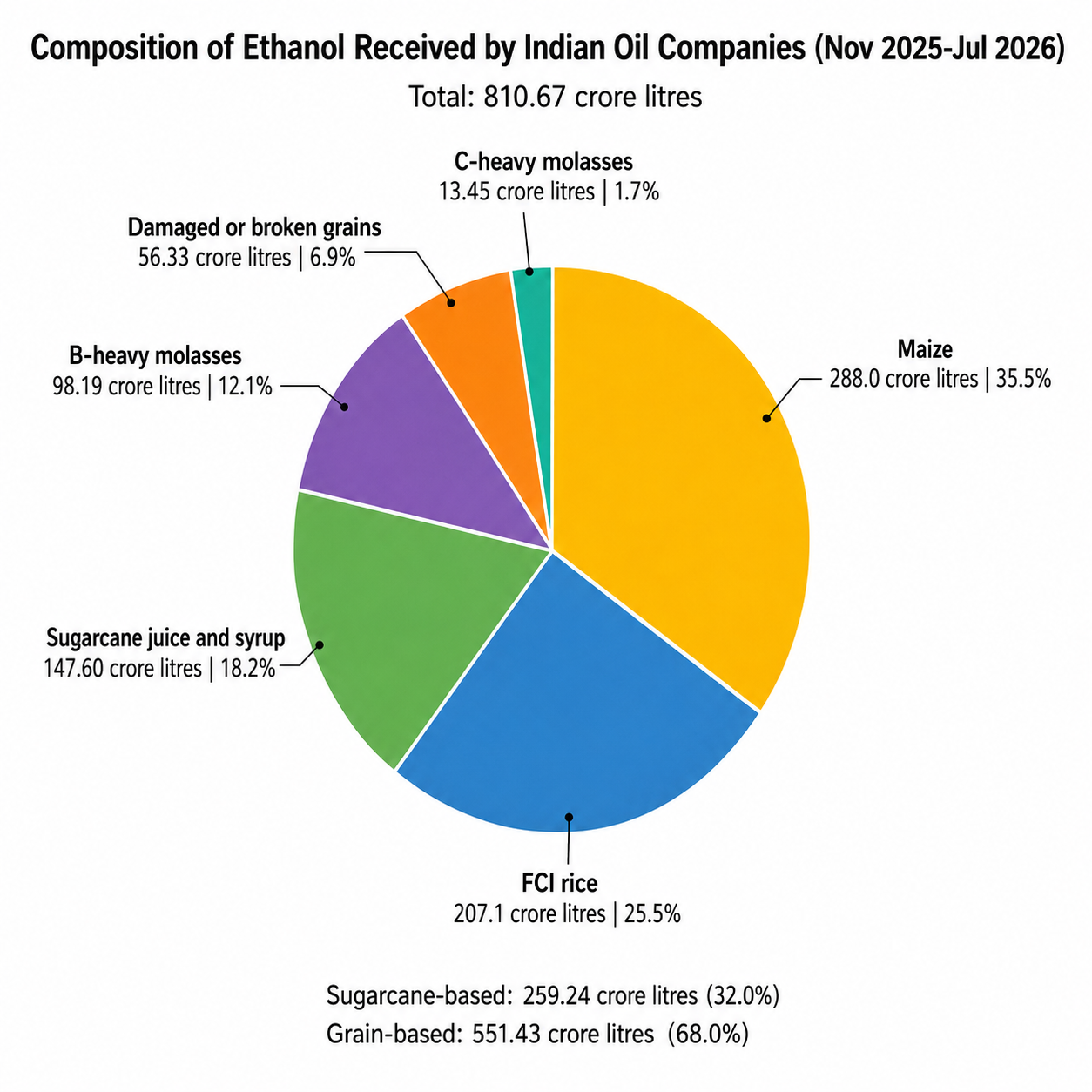
But this does not mean the food-versus-fuel problem has disappeared. It has simply shifted from the sugar market into a broader portfolio of agricultural feedstocks. If the government reduces sugarcane-based ethanol supply next year, it can maintain the 20% blending rate by increasing ethanol production from corn and rice, rather than having to choose between "stable sugar prices" and "E20." But this merely moves the food-versus-fuel trade-off to another set of agricultural commodities. Corn, rice, and sugarcane are substitutable to some extent, but they still compete for land, water, fertilizer, storage capacity, and government procurement. The government emphasizes that only surplus grain remaining after public food distribution and buffer-stock requirements are met can be used for ethanol. This can reduce short-term food-security risks, but it cannot eliminate the opportunity cost of those resources.
India's E20 program today, therefore, is no longer accurately described as a "sugarcane ethanol program." It is better understood as a multi-feedstock biofuel system.
Ethanol Did Not Cause This Crisis, but It Changed How the Crisis Was Transmitted
There are two extreme interpretations of India's sugar-price surge, and neither is accurate.
The first is that "E20 caused the entire increase in sugar prices." The data do not support that view. The originally planned diversion of sugar to ethanol was 3.4 million tonnes, while the actual diversion was about 3.0 million tonnes. The real production shock came from gross sugar output falling roughly 3.45 million tonnes short of expectations. Indian government data also show that the share of available sugar diverted to ethanol has declined from about 12% in 2022/23 to around 9% in 2025/26.
The second is that "ethanol has nothing to do with sugar prices." That is also too simplistic. A diversion of 3.0 million tonnes of sugar is equivalent to roughly 39 days of India's consumption, close to the estimated 3.5 million tonnes of inventories expected at the start of the new crushing season. If the government changes the scale of diversion next year, the marginal supply of sugar available to the food market will change materially.
A more accurate way to put it is this: ethanol did not cause the 2026 decline in sugarcane output, but it determines how much sugar enters the food market after that decline and what options the government has for absorbing the shock. India's current response combines sugar imports, inventory restrictions, earlier crushing, and the possibility of reducing ethanol production from sugarcane juice and B-heavy molasses in the next season. The aim is to rebuild sugar inventories without abandoning E20. Conversely, when sugar is in surplus, mills and the government can increase ethanol diversion, allow exports, and draw down inventories to rebalance the market.
Seen this way, E20 has effectively become an early form of an automatic stabilizer for India's sugar industry. The problem is that the stabilizer is not yet very automatic. Export quotas, ethanol diversion, import policy, and inventory restrictions still depend largely on ad hoc government decisions.
Disclaimer: The content is for informational purposes only. You should not construe any such information or other material as legal, tax, investment, financial, or other advice. Nothing contained in this article constitutes a solicitation, recommendation, endorsement, or offer by the author(s) or any third party service provider to buy or sell any securities or other financial instruments in your or in any other jurisdiction in which such solicitation or offer would be unlawful under the securities laws of such jurisdiction. The author(s) report(s) no conflict of interest.