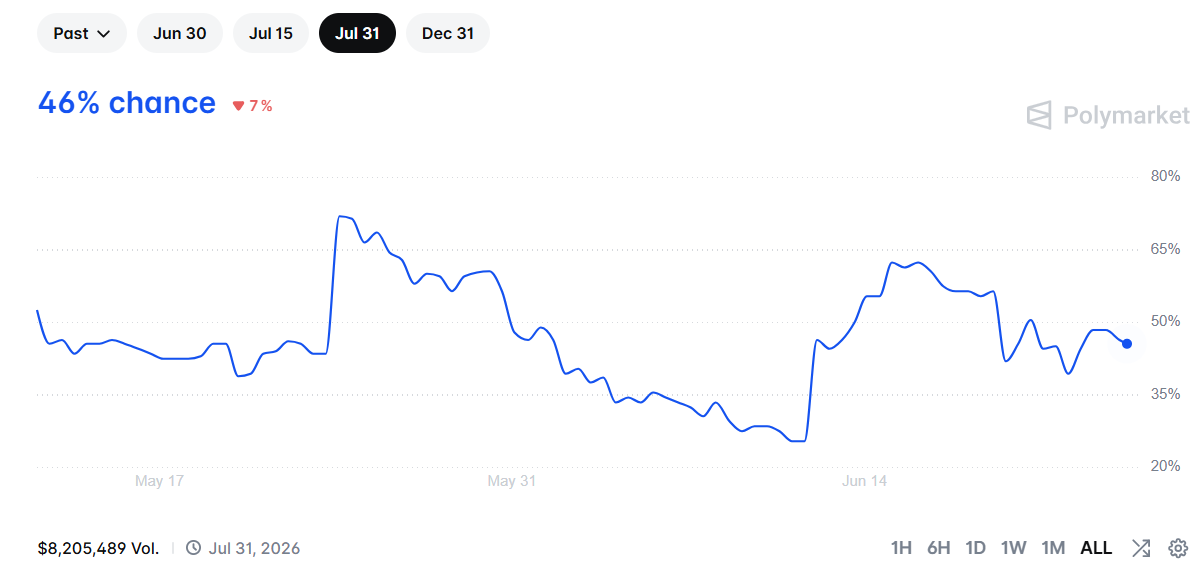
Last week, we argued that reopening Hormuz would be a sequence, not a switch. The July Polymarket market now puts that thesis into a tradable form.
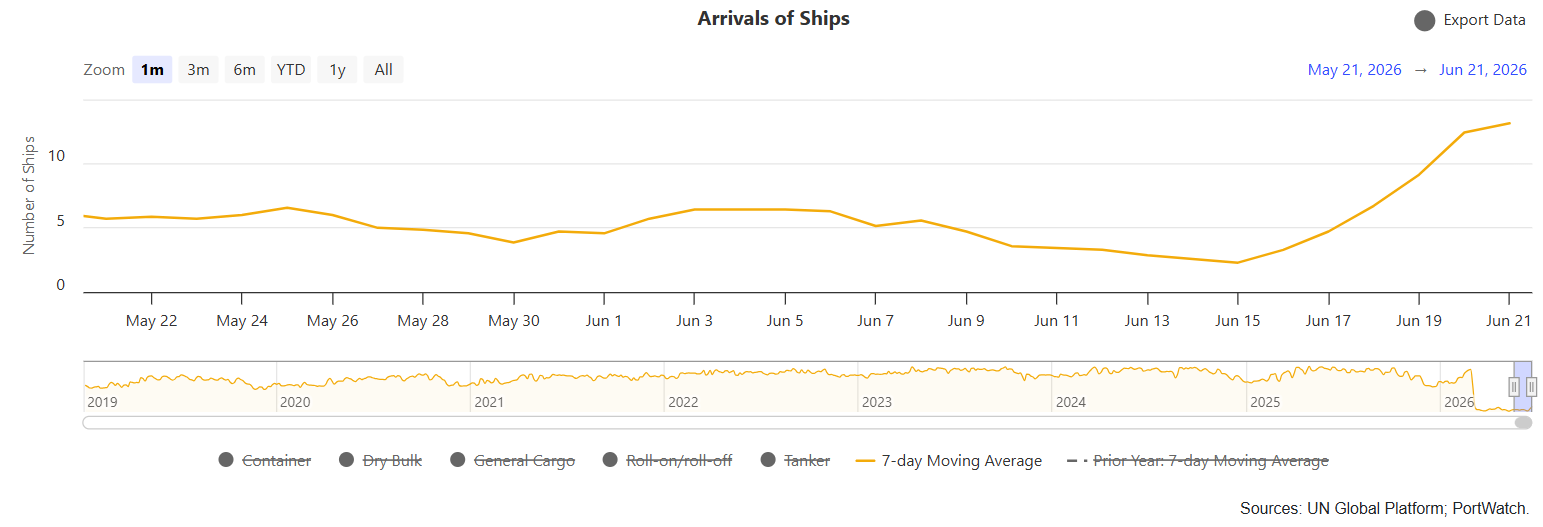
The contract resolves Yes if IMF PortWatch publishes a 7-day moving average of Strait of Hormuz transit calls, or “Arrivals of Ships,” at or above 60 before July 31.
This makes the question narrower than "is Hormuz reopening?" and stricter than "are tankers moving again?"
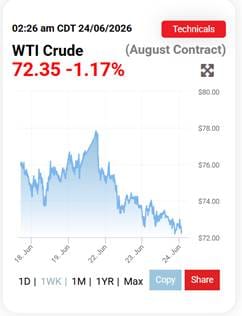
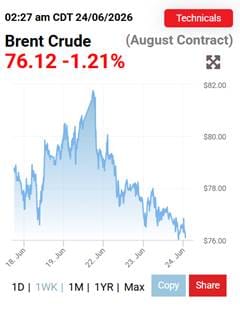
Oil prices are already reacting to better headlines. Brent and WTI have fallen as traders price smoother crude flows through the strait. But the Polymarket contract needs something harder: a broad enough recovery in counted ship traffic to show up in the official data before the clock runs out.
Why July Yes has a real case: Traffic is coming back
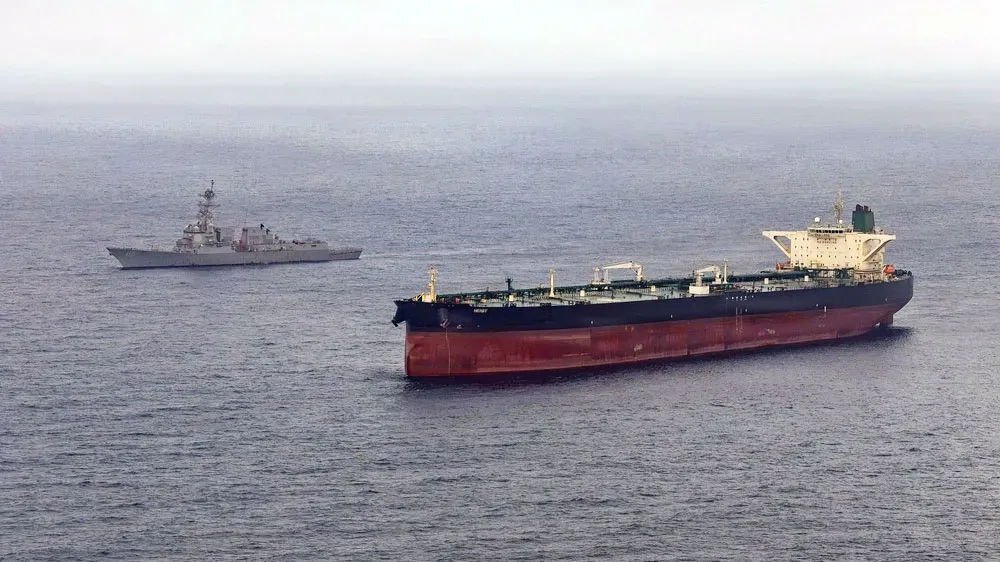
Reuters reported that three stranded supertankers passed through Hormuz, including two Trafigura-operated VLCCs carrying about 2 million barrels each and another VLCC chartered by GS Caltex carrying Saudi crude. Seven empty Qatar-linked LNG tankers also entered the Gulf in recent weeks, an early sign that Gulf gas shipping is trying to restart.
By June 24, Brent was trading at $76.12 and WTI around $72.35, near four-month lows, as traders priced recovering crude flows through Hormuz.
In simple words, this is what a reopening trade should look like: first, the risk premium comes out of oil, then shipowners and charterers test the route, then flows normalize.
So, July Yes has a real case.
Here’s the risk: Early movement versus normal flow
The risk is that traders confuse movement with normalization, and the July market may be giving the 30-day restoration target too much credit.
First off, sailings through Hormuz are still only a fraction of the roughly 125 daily crossings seen before the Iran war began. As of this writing, the seven-day moving average is around 13 versus a required 60.
The market needs a broad and sustained jump across the counted categories, early enough for the average to register before the deadline. A burst of traffic in the final 24 or 48 hours could look bullish on a shipping screen and still fall short of the contract.
A few supertankers leaving the Gulf are important for oil supply. Several LNG tankers repositioning is important for Gulf gas trade. But the PortWatch threshold needs a broader recovery across counted ship categories, not just a handful of high-profile oil and LNG movements.
If the count starts climbing into the 30s or 40s by mid-July, Yes becomes much easier to defend. If it stays stuck in single digits or low teens, the current price should face pressure no matter what.
This is why the July price is too clean.
What could move this market? Three triggers to watch
The first number to watch is the IMF PortWatch seven-day average. If arrivals climb toward 60 before the final week of July, Yes gets support; if traffic remains lumpy into mid-July, the current price should face pressure.
Next, shipping-risk confirmation is important. The Saudi supertanker movements matter, but Reuters also reported that shipping and insurance officials still wanted safety assurances, mine-clearance clarity, and legal guidance.
Commercial risk is the last check. A vessel leaving with crude or LNG may simply be clearing old inventory. Empty tankers moving back in are a stronger sign that operators are willing to resume the trade cycle.
The bottom line
This market comes down to one question: can the reopening become measurable fast enough for the July Polymarket contract?
The contrarian case weakens if three things happen together: the PortWatch average rises early, empty vessels keep entering the Gulf, and insurance costs lower. In this case, July Yes may be cheap.
For now, the headline can say Hormuz is reopening, but the July price asks a lot from the shipping system. This contract needs a harder proof point: traffic has to recover, stay recovered, and show up in the data before the clock runs out.
Sources:
1. IMF PortWatch: IMF - Strait of Hormuz - Daily Transit Calls & Transit Trade Volume
2. Reuters: Gulf oil tanker rates nearly double as Middle East producers ramp up exports
3. Reuters: More vessels transit Hormuz, Qatar-linked LNG tankers return, data show
4. Reuters: Oil extends slide on expectations of smoother crude flows via Hormuz
5. Reuters: Scouring the Strait of Hormuz for mines could take weeks
6. Reuters: Three Saudi-flagged supertankers sail through Hormuz after Iran deal signed, data shows
Is Polymarket underpricing or overpricing July Hormuz normalization at around 46%?
Overpricing it, the ship count has too far to goResult
33.33%
Underpricing it, traffic can snap back fastResult
66.67%
Fairly pricedResult
0.00%
9 Polls
EndedTBD
What is the most important trigger for the July Hormuz market?
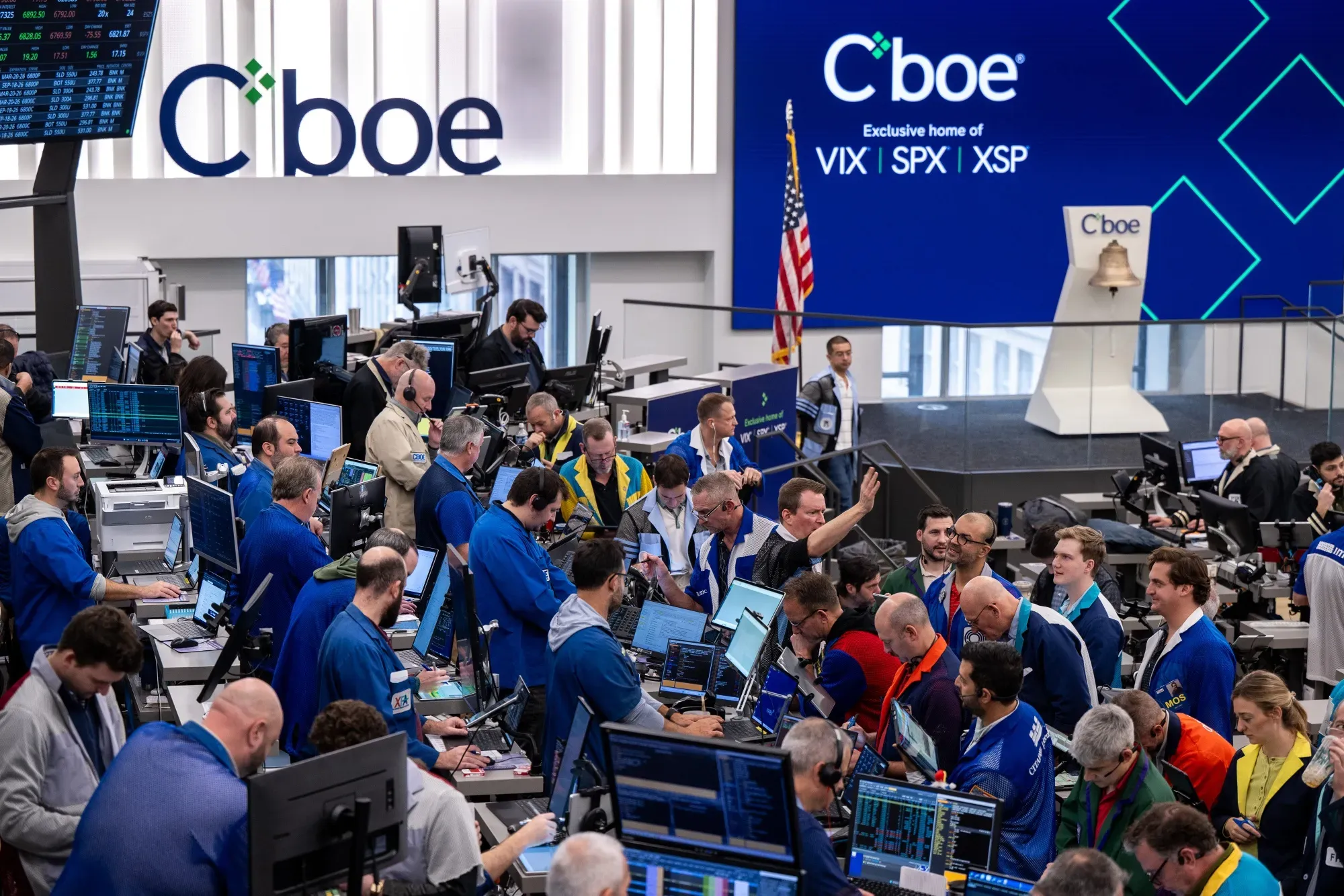
Cboe Global Markets, Inc. announced Tuesday that it has brought back a type of S&P 500 contract after a hiatus of more than a decade, which in the meantime has become a popular mainstay of prediction market platforms Kalshi and Polymarket.
The Chicago-based derivatives exchange operator is listing binary options on the Mini-S&P 500 Index, the company said in a statement on Tuesday. The products will allow customers to place a yes or no bet on whether the S&P 500 will hit a certain threshold.
The options will initially be available through Interactive Brokers Group Inc., with other intermediaries including The Charles Schwab Corp. set to offer the products soon.
Cboe index options have been a favorite tool of retail investors since S&P 500 index options expiring daily came out in 2022. Retail traders have pushed US options volumes to record levels, and contracts with zero-days to expiration (0DTE) accounted for 30% of all volume, according to data from Bloomberg Intelligence.
“Following the success of SPX 0DTE options, we’ve seen continued customer demand for shorter-dated, outcome-based trading, and that created a natural opportunity for Cboe to enter prediction markets,” said JJ Kinahan, head of retail expansion and alternative investment Products at Cboe.
Cboe has tried binary options before. In 2008, it first listed these type of options on the S&P 500 and the Cboe Volatility Index, but they failed to attract investor interest and were pulled off the exchange. The last SPX binary option expired in January 2015 and last VIX binary option ended in August 2017, according to a spokesperson.
Definitely maybe
The options bourse is adding a twist on the traditional event contract binaries, based on a core building block of options trading, known as a ‘vertical spread’. Cboe’s ‘plus’ product pays out a proportional amount if the index moves in the direction predicted by the customer, up to 100% if they meet an upper threshold specified in the contract. While the customer interface will show a single trade, their broker is placing a package made up of a bought option and a sold option.
Behind the scenes, two options trades are taking place: a customer making a bullish trade is buying a lower strike call, and funding the position by selling a higher strike call.
Cboe executives are hoping the products will bring new participants to the options market.
“With the ‘plus’ feature, traders can define their risk beyond the simple ‘yes-or-no’ framework of traditional event contracts. We’re also pairing these products with dedicated educational resources to support more informed customer participation in these markets.”
Nasdaq Inc. also has regulatory approval to launch binary index options contracts, which are expected to list later this year.
Meta Platforms Inc. Chief Executive Officer Mark Zuckerberg has directed a small team to create a prediction market application similar to Kalshi Inc. and Polymarket, but with lower stakes as users won’t likely wager real money.
The standalone product, which is still in development and known internally as Arena, would complement Meta’s other social media offerings by giving people a place to interact around live events like sports games or politics, according to a person familiar with the matter, who asked not to be identified as the details aren’t public. The Times Exclusive: Mark Zuckerberg Directed Meta to Create a Prediction Markets App first reported on the internal effort. A Meta spokesperson declined to comment.
The prediction market industry, which lets people wager on the outcome of various real-world events, has exploded in the face of a newly friendly regulatory environment in Washington. Upstarts like Kalshi and Polymarket have benefitted from that, garnering multibillion dollar valuations. While Arena intends to capitalize on that user interest, the app isn’t currently expected to require real funds. Instead, it would likely engage users through a points system, the person said.
Polymarket has been banned from letting U.S. users trade on its website since 2022. But the company is waging a secret campaign for Americans’ attention on social media, paying creators to film trades on fake websites and hiring overseas workers to make the videos go viral in the U.S., a Wall Street Journal investigation found.
The campaign bolstered the perception that Polymarket lets users make fast and easy money, as the company attempts to bring its offshore website back to the U.S.
In response to our reporting, Polymarket said in a statement that it was “committed to maintaining accurate, fair, and transparent markets. We are part of a rapidly growing industry and are constantly evaluating ways to improve how we’re engaging and earning the trust of our audience.” It said it would conduct an audit of active promotional content.
Polymarket has a data partnership with Dow Jones, the publisher of The Wall Street Journal. We only used publicly available data in our analysis.
Here are three takeaways from our investigation:
Fake bets, fake wins
We reviewed more than 1,100 videos made by 10 of Polymarket’s more than 100 creators. In 70% of the videos, creators appeared to place a bet on websites that looked nearly identical to Polymarket, but were actually dummy sites the company used to film fake trades. Many of the creators didn’t disclose they were paid by Polymarket until we reached out.
Around 10% of the videos went even further, adding outdated footage or fake headlines to imply they won their bets. Those videos depicted the creators winning almost $900,000. We traced how each bet would have actually been resolved and found that in reality, the creators—and anyone who had placed identical bets—would actually have lost more than $166,000.
U.S. advertising law requires brands to be truthful about what they are promoting, although there is some gray area about what is permitted. Commodities law, which governs prediction markets, also bars deceptive and misleading practices. In response to our reporting, a spokeswoman for the Commodity Futures Trading Commission said that prediction markets should be brought onshore, where they can be more effectively policed. A spokesman for the Federal Trade Commission declined to comment.
Polymarket gave its creators bulletpointed scripts and reviewed videos before publishing, people who have worked with the company said. If a video was obviously faked, the creator would be asked to remake it.
An army of social media users
To make the videos go viral, Polymarket worked with thousands of low-wage social-media users—often teens based in Asia—to repost the videos from sockpuppet accounts that hid their Polymarket affiliation. The strategy, called “clipping,” is designed to create the appearance of a groundswell of authentic interest in a product or brand.
In a group chat, a marketing contractor for Polymarket wrote that if users reposting the clips had a social-media account with “Polymarket” or “poly” in the title, they wouldn’t be paid.
Many of the clippers’ videos specifically promote Polymarket’s website, which the company is barred from offering to U.S. traders. But clippers are only paid if at least 60% of their viewers are U.S.-based, according to instructional documents we reviewed.
Insider influencers
Polymarket’s CEO Shayne Coplan says the company is cracking down on insider trading. The company recently launched a webpage devoted to integrity that reads: “Insider trading is strictly prohibited.” Coplan himself described concerns about insider trading on Polymarket as “outlandish and baseless.”
But the company has simultaneously been paying social-media creators to disseminate short clips of online celebrities talking about how easy it would be to use inside information to trade on the platform.
One of those celebrities is Adin Ross, a 25-year-old manosphere phenomenon. Polymarket paid Ross millions of dollars for a marketing deal, according to a person familiar with the negotiations.
Polymarket’s clipping campaign paid to promote a video of Ross saying he could easily use insider information to trade on the release date of an album by Drake, a hip-hop star and Ross’s acquaintance. Representatives for Ross and Drake declined to comment.
We found at least 18 other videos Polymarket paid to promote that discussed opportunities for insider trading.
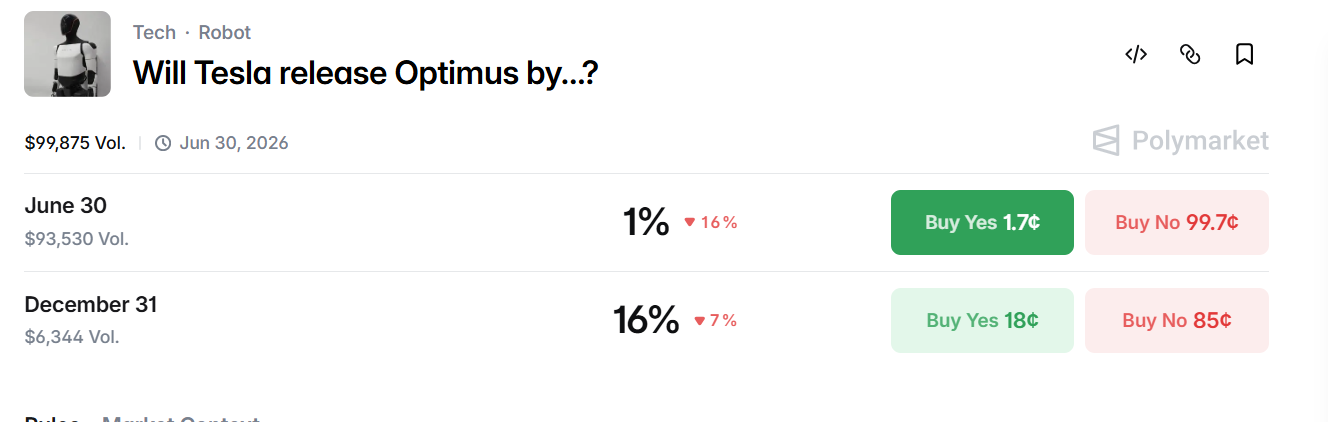
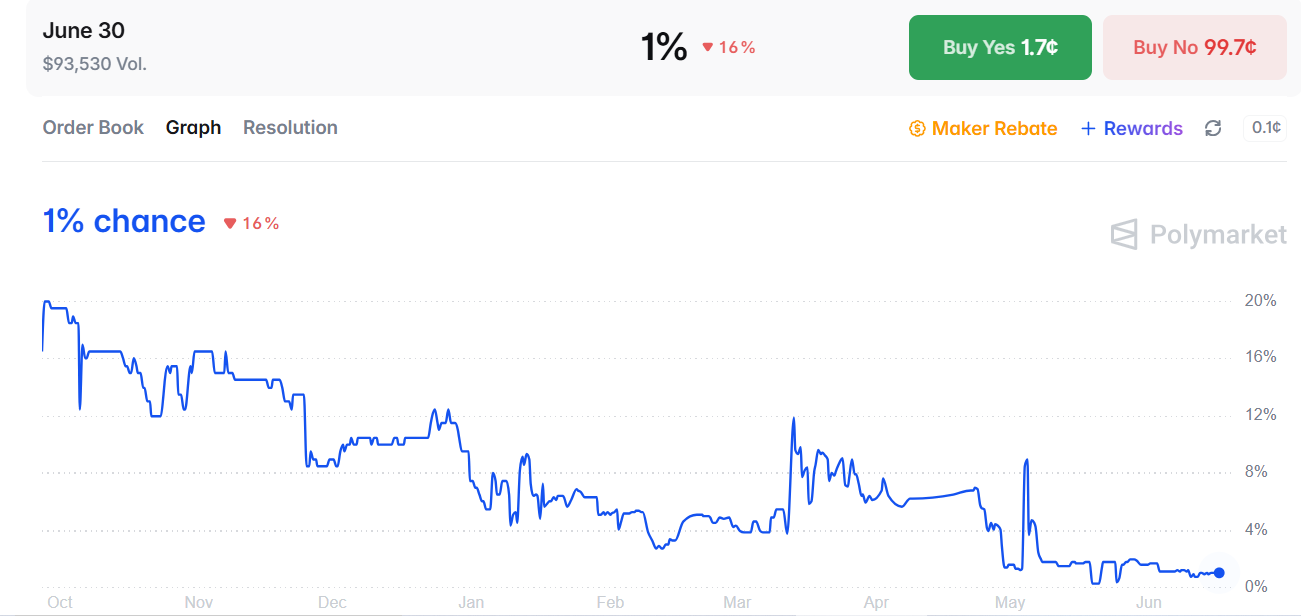
While Polymarket’s Optimus contracts may be priced accurately, the underlying reasons for these valuations are widely misunderstood. Ahead of the June 30 deadline, Polymarket’s contract on the likelihood of Tesla releasing Optimus sits at just 1%, while the consensus for the December 31 deadline is tilted slightly higher at 16%. The prices and the bets aren’t necessarily wrong, but their standard interpretation misses the mark.
Currently, Polymarket is running two Optimus release markets (June 30 and Dec. 31), while Kalshi is running a contract based on the robot's availability for sale in 2026.
Source: PolyMarket
All year long, we’ve seen the prices for these contracts drift downward. The June 30 market currently has an order book of around $93,530 against a lifetime volume of $99,873. It is safe to say the market isn’t expecting Tesla to make a massive Optimus announcement anytime soon, especially with public attention largely divided among Elon Musk's other ventures.
Source: Polymarket
More importantly, resolving these contracts positively requires a very specific event: the availability of the Optimus robot for general purchase via an official Tesla press release, accompanied by a standard consumer checkout feature. Anything less than that—such as product demos, pilot launches, or asking visitors to register their interest without an exact launch date—will not trigger a payout.
Therefore, we can safely assume that these Polymarket contracts have nothing to do with the actual progression of AI or whether Tesla has the wherewithal to build a multi-use robot. They are exclusively pricing the odds of seeing a consumer checkout button.
The True Metric: Industrial Deployment
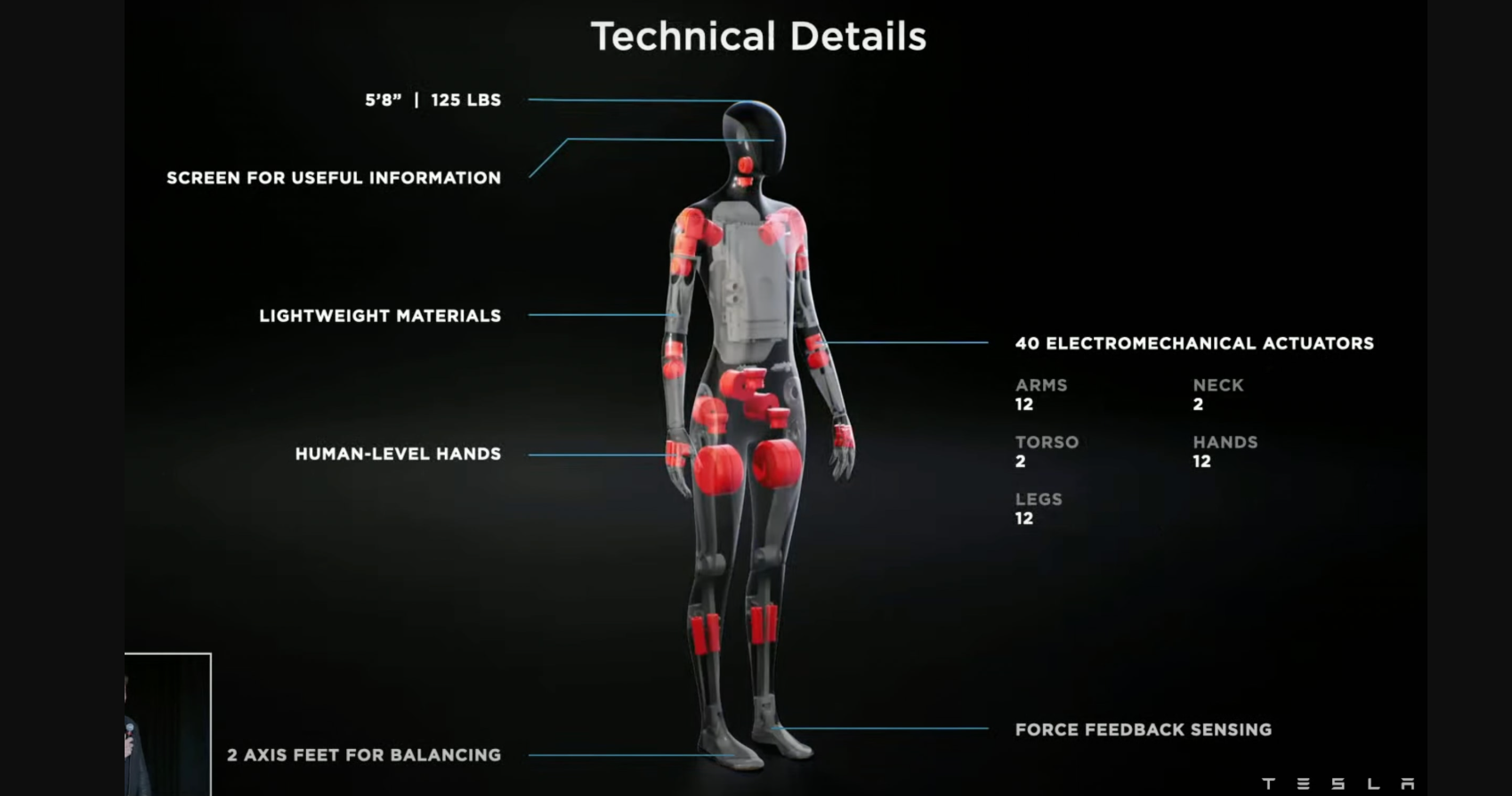
Currently, the market is pricing these contracts fairly accurately because Elon Musk has already informed investors that the earliest consumers could purchase Optimus would be in the latter half of 2027. Furthermore, the 2026 Optimus program is entirely focused on internal usage and a gradual transition toward industrial applications. The first units are slated to be deployed on Tesla’s own production lines later this year before moving to other industries.
Source: Tesla Media Release
This is exactly why citing these prediction contracts as a verdict on the viability of "embodied AI" is erroneous. While a contract might accurately answer its own narrow criteria, it is the wrong medium for the questions most investors are actually asking, such as "Does embodied intelligence actually work?"
The reality is that while Optimus has no presence on the retail floor, the actual leading indicators of embodied AI are purely industrial. This sector is moving incredibly fast, with several companies already running parallel to—or even ahead of—Tesla.
For now, anything linked with Optimus capabilities, pricing and demand would be confined to speculations and forecasts, with contracts serving as the closest source to gauge its prospects in the near term.
It can also be said that the existing contracts are handicapped and limited because of a lack of clear catalysts visible through the company's investor relations department. For Tesla, the key value this year could be assessing total robot hours clocked and rigorous testing before the product is ready for general consumer use.
Figure, for instance, tested its Figure 02 robot at BMW’s Spartanburg Plant in an 11-month deployment. The robot clocked more than 1,200 hours, handled over 90,000 parts, and contributed to the manufacture of 30,000 vehicles. Since then, the company has deployed next-generation units in the same facility, and UPS is slated to become its second paying customer. Furthermore, Figure recently revealed how its Helix control model replaced human-built C++ balance code, reducing new development turnaround time from 12 months to roughly 30 days.
Source: Figure 01
Meanwhile, Chinese manufacturers are already shipping hundreds of humanoid models, and industrial units are actively being deployed on automotive assembly lines. The key variable the broader market is currently blind to is the transition of embodied AI into tangible industrial robot-hours, which is already creating revenue streams and reducing deployment timelines.
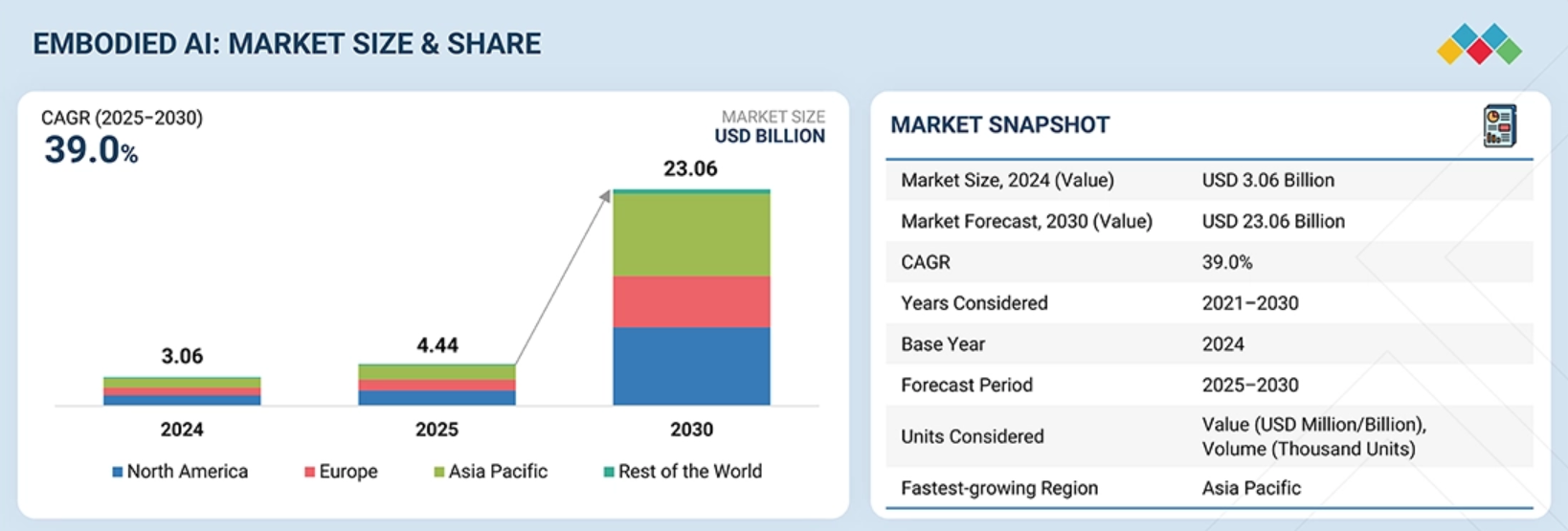
Embodied AI Market Research by Markets & Markets
Two Fundamental Flaws in the Optimus Contracts
Treating the Optimus retail contract as a bellwether for the robotics industry is a decoy. In fact, relying on it commits a double category error by getting two fundamental things wrong:
The Event Type: The contract is pricing a retail consumer launch, not a commercial deployment. Tesla has already hinted at having zero fully useful internal units currently and hasn’t even committed to a concrete production number for 2026.
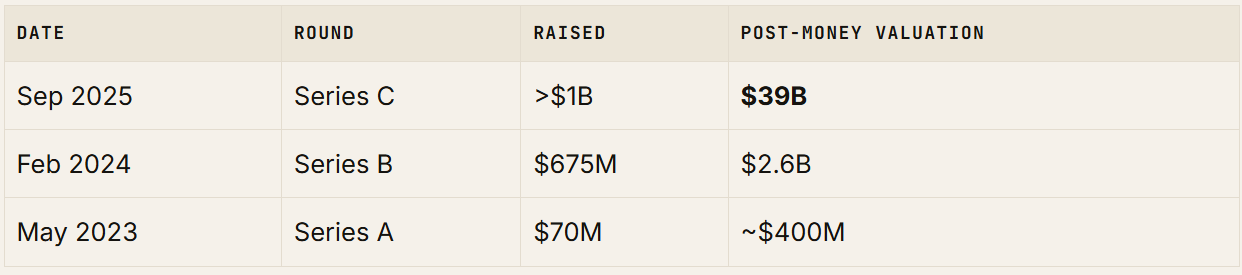
The Industry Benchmark: The market assumes Tesla is the sole vanguard of humanoid robotics. While Tesla’s massive valuation points to its potential, it isn’t actually at the forefront of industrial humanoid deployment. Figure raised over $1 billion at a $39 billion post-raise valuation last year, is already generating revenue via BMW, and is targeting production of 100,000 robots within four years.
Source: Teahose Figure AI Seed Funding Rounds
It wouldn’t be a stretch to say that the existing Optimus prediction contracts are marketing artifacts rather than technical barometers. In time, we will likely see a "Reserve your Optimus" page with a refundable deposit—a standard launch playbook Tesla has previously used for the Cybertruck and Roadster. However, even if Tesla, Figure, and Chinese manufacturers deploy thousands of units in factories globally, these Polymarket contracts could remain unresolved because industrial reality rarely converges with an immediate consumer checkout option.
Looking Beyond the Headlines
Despite their flaws, the year-end contracts still offer valuable insights. Because they rely on a more distinct possibility, they gauge Tesla’s potential capability to expose Optimus to consumer purchase this year, offering a glimpse into the market's read on development timelines.
More importantly, the pricing reflects market bearishness regarding Musk’s notoriously optimistic timelines. While dedicated Optimus factory construction officially began at Giga Texas in May, actual production isn’t likely to begin before July or August. Even when it does, initial units will only support internal factory tasks. Earlier this year, Tesla archived its Model S and Model X lines, with the last units rolling out of Fremont in May, recalibrating the factory space to accommodate Optimus. The company is heavily betting on embodied AI to beef up its revenue, but it is entering a market where competitors are already scaling and serving paying customers.
It is also crucial to look at where the embodied AI industry is heading. The near-term consensus seems modest with Goldman Sachs projecting roughly 502,000 humanoid shipments by the end of 2032 and a total addressable market of $38 billion by the same period, attributing this to AI breakthroughs and a potential 40% drop in manufacturing costs.
Additionally, Morgan Stanley has forecasted a $5 trillion total market by 2050 with around 13 million humanoids in service by 2035, before pushing to 1 billion by 2050.
Ultimately, if you are looking for a better instrument than a headline poll to track embodied AI, look off-market. Watch the metrics that matter: industrial deployment numbers and total robot-hours.
The Optimus contracts follow a prediction pattern similar to Tesla’s Robotaxi markets. While a driverless service is a technological certainty, the prediction contracts for Robotaxis in California are trading at around 11% because they bank on consumer regulatory approval and purchase optionality, not purely on the underlying technology.
Existing prediction markets don’t tell the whole story. As the industry matures, we should expect the narrative to deepen, eventually addressing the frontier-capability questions that investors actually want priced into future contracts.
Will Tesla's Optimus Production Facility Become Operational by July 31?
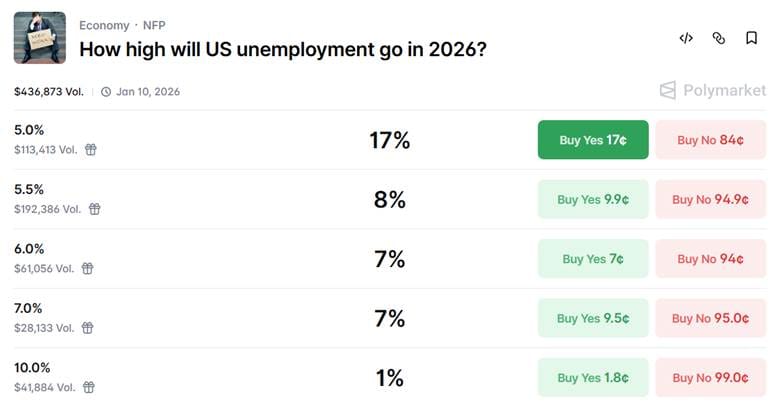
As of this writing, Polymarket traders are giving the 5.0% US unemployment line around 17% odds for 2026.
On the latest headline data, this price is easy to defend. Unemployment is still 4.3%, payrolls are still growing, and the labor market has not cracked. But the contract is broader than a snapshot of today’s economy: it resolves “Yes” if any seasonally adjusted U-3 unemployment rate in a 2026 BLS Employment Situation report comes in at 5.0% or higher.
This means one monthly print is enough, unemployment does not have to finish the year at 5.0%.
This is where the price gets more interesting. At 17%, the market is technically saying the jump from 4.3% to 5.0% is unlikely to happen in any of the remaining Employment Situation reports for a 2026 reference month.
The market has the headline data on its side
The latest jobs report gave traders no obvious reason to panic. The economy still added 172,000 jobs in May, and unemployment did not move from 4.3%. Revisions helped the picture too, with March and April now showing 93,000 more jobs than first reported.
This is a solid defense of the 17% price. The unemployment rate has been stuck in a narrow 4.3% to 4.5% range since July 2025, so 5.0% is still a meaningful move from here. It is close enough to monitor, but far enough that traders can fade it without sounding reckless.
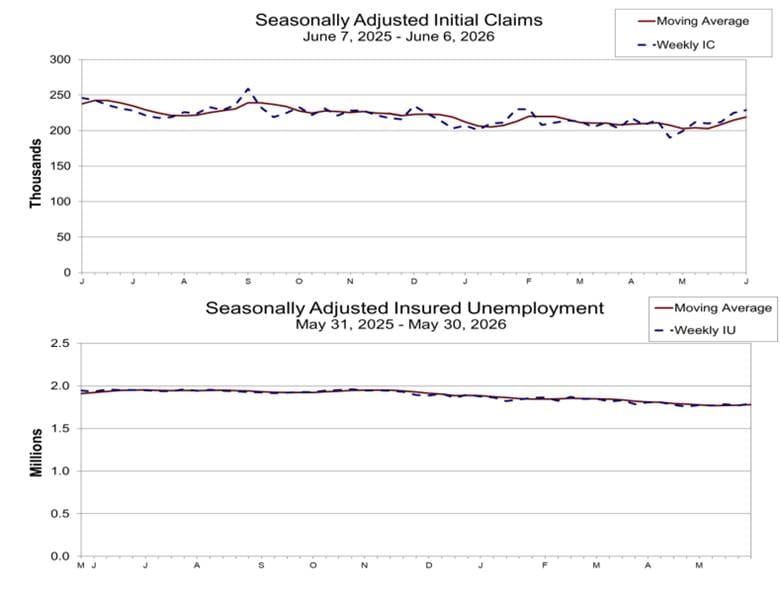
Claims are not giving the 5.0% camp much help yet. Initial claims were 229,000 in early June, with the four-week average at 219,000, so the direction is not alarming. Continued claims have also moved up, which is worth watching, but this still looks more like a labor market losing speed than one already breaking toward 5%.
This is the middle ground behind the 17% price: enough weakness to keep the threshold on the radar, not enough to make a 5.0% print the base case.
The better question is how unemployment gets there
A move to 5.0% can come from fewer companies adding workers, job searches stretching out, and unemployed workers taking longer to get pulled back into payrolls.
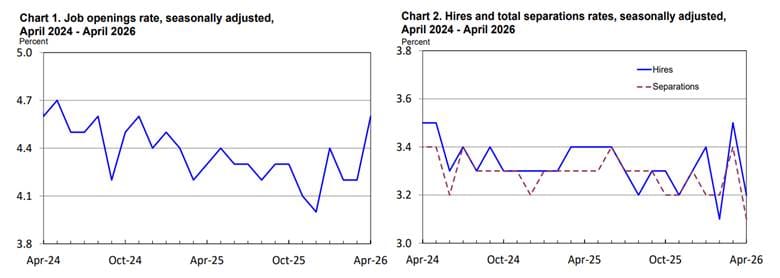
April’s JOLTS report had a split message: openings climbed to 7.6 million, while hires slipped to 5.1 million and separations fell to 5.0 million. For this market, this mix matters more than the headline openings figure. Employers can keep vacancies online while moving more slowly on actual hiring, which is how labor slack can build before the unemployment rate fully shows it.
If hiring stays weak while unemployment edges up to 4.4% or 4.5%, the 5.0% line will look more and more plausible.
The duration data makes the calm look less clean
May also showed more strain in unemployment duration. The long-term unemployed reached 2.0 million, up 524,000 from a year earlier, and workers out of work for at least 27 weeks accounted for 27.5% of all unemployed people. This makes the stable 4.3% headline rate look less settled, because longer job searches can push unemployment higher without one dramatic layoff wave.
Continued claims are a cleaner check on re-employment than initial claims, which can be noisy week to week. A few more readings moving higher would put pressure on the idea that labor softness is staying neatly contained.
This is the narrow challenge to the 17% price, because the market may be right about the current labor picture and still too relaxed about what comes next.
What would make 17% look too low?
The June jobs report is the next major checkpoint, but the contract stays live through every remaining 2026 Employment Situation report. Still, a rise to 4.4% or 4.5% would already change the trade, especially if it comes with softer payroll growth, weaker revisions, or another increase in long-term unemployment.
A payroll print below roughly 100,000 would also carry more weight if prior months are marked down. One soft report can be dismissed, but a soft report that drags the recent trend lower is harder to wave away.
The JOLTS follow-through matters too. If openings stay elevated but hires keep falling, the labor market is telling traders that posted demand is not translating into actual jobs.
The countercase is simple enough. Polymarket’s price holds up if unemployment stays in the low-to-mid 4% range, payrolls remain positive, continued claims stop rising, and wage growth cools without a bigger hit to employment.
For now, traders are treating 5.0% unemployment as a long shot. And it may be right. But because this contract only needs one 2026 print to get there, the real test is whether the next few reports keep the drift from becoming a trend.
The US and Iran have committed to reopening the Strait of Hormuz, the world’s most important artery for shipping oil and natural gas, which has been largely blocked since the two countries went to war in February. However, returning traffic in the strait to prewar levels — if that day ever comes — presents significant challenges. The prediction market Kalshi assigns a 51% probability that traffic will return to normal before Aug. 1 and a 68% probability before Sept. 1.
Here’s a look at the main impediments:
Mine threats
Iran is thought to have mined what was the normal shipping channel through Hormuz, which connects the Persian Gulf to the Indian Ocean and is situated between Iran to its north and the United Arab Emirates and Oman to its south. The threat of mines has forced ships to sail instead near Iran’s coastline or closer to Oman’s. Use of the southern route, overseen by US forces, has already allowed oil flows to creep higher. But the question of how much traffic the alternative routes can handle has not been fully tested.
Clearing the center of the channel of any mines would help to get flows back to normal. However, it’s unclear who would undertake this effort and how demining ships would be protected. The work itself could take weeks.
The risk of attacks
On top of the threat of mines, there’s the risk of further violence that could affect ships and their crews. The fragile ceasefire the US and Iran have had in place since April 8 hasn’t stopped fighting altogether. At least 14 seafarers have died in this conflict, and there have been 46 attacks that damaged ships, according to the United Nations’ International Maritime Organization (IMO).
Merchant sailors are nervous about working in conflict zones at the best of times, so the shipping industry wants to hear unambiguous assurances from both the US and Iran that hostilities have truly ended. Even then, several shipowners said some crews may be reluctant to return to the Persian Gulf, which could reduce the number of vessels sailing to the region to collect cargoes.
Uncertainty about who’s in charge
Until the war began, freedom of navigation was, with a few exceptions, taken for granted in Hormuz, just as it is in all major shipping straits. It’s not clear whether that will remain the case in the future. Iran’s semi-official Fars New Agency Iran Allows Free Hormuz Transit for 60 Days Under Pact: Fars (1) that the future administration of “navigation services” in the strait will be determined by Iran and Oman.
Several shipowners told Bloomberg they’d rather not be forced to communicate with anyone, but especially not an Iranian regime that’s still under US sanctions, when sailing through waters that are meant to be subject to freedom of navigation rules.
The Baltic and International Maritime Council, the world’s top trade group for shipowners, says it must be clarified who, if anyone, will coordinate transits in the future. It suggested that either a United Nations organization, or a neutral state, could be involved.
The possibility of tolls
It’s unclear whether vessels will be charged to pass through Hormuz. US President Donald Trump says Donald J. Trump: The Deal with the Islamic Republic of Iran is now complete. Congratulations to all! I hereby fully authorize. Iran says ships a fee-free period will end after 60 days.
The UN’s IMO said in April that there’s no legal basis for charging Hormuz tolls, and the US has said in the past that paying them would be a sanctionable act. Thus, shipowners are terrified of having to pay Iran for passage and risk getting blacklisted by US sanctions authorities. At the same time, at least one senior US government official acknowledged that paying for transit might become a possibility.
Big energy companies are apt to object to any tolls or fees. Chevron Corp. Chief Executive Officer Mike Wirth said on Bloomberg Television in May that his company would not consider paying to pass through the strait.
Stalled oil and gas production
Stalled oil and gas production is perhaps the biggest impediment to fully normalizing trade flows through the Strait of Hormuz. Before the war, it handled around a fifth of the world’s oil and liquefied natural gas supply. The increased use of bypass routes provoked by the war has reduced the strait’s centrality, but only by a little.
In some cases, oil and gas production was halted because, with Hormuz blocked, exports became impossible. Shutting down a well, even voluntarily, can degrade its efficiency and cause long-term operational losses. In other cases, war damage caused shutdowns. Rebuilding oil and gas infrastructure in the region will cost roughly $42 billion, according to Rystad Energy.
While the infrastructure restarts, tankers previously serving the Persian Gulf that scattered to other routes or were demobilized will need to be repositioned. Rystad analysts said that should take about two months. They assess that the big increase in output from the region will come in August and September, as fields return to productivity. Some 85–90% of the lost volume will be recovered by early in the fourth quarter of the year, they project, rising to 100% only in January 2027.
The US derivatives regulator is launching a review of foreign trading platforms that let US-based individuals directly access their electronic trading systems, according to an agency official familiar with the matter.
The Commodity Futures Trading Commission is examining foreign boards of trade to ensure they are properly managing risks, according to the official who asked to speak anonymously to discuss internal matters.
About two dozen foreign platforms have a so-called FBOT designation, which means their home country’s regulator has an information-sharing arrangement with the agency and their rules are considered comparable with the CFTC.
That label allows the exchange to provide direct access to US traders without separately applying for a US license. The exchanges must enforce rules to maintain market and financial integrity.
Some CFTC officials have expressed concerns about oversight of foreign boards of trade and those that have larger participation from US traders, the official said.
The regulator plans to meet with exchange leaders and clearinghouses as part of its evaluation, which the official said would be the first formal review since the framework was established after the 2008 financial crisis.
The review is not focused on any specific exchange but may result in the CFTC asking some foreign exchanges to register with the US regulator, they said.
Firms with the designation include the almost 150-year-old London Metal Exchange and the Tokyo Commodity Exchange. The most recent entrant is the Singapore-based Abaxx Exchange Pte. Ltd., which got the CFTC’s blessing in November.
The agency has revoked the designation from a handful of exchanges over the past decade at their request because the exchanges, including ICE Futures Canada Inc. and CME Europe Limited, closed, agency records show.
The landmark Dodd-Frank Act led to the regulator establishing the system to register foreign boards of trade.
Ethan Vera thought Luxor Technology’s future was helping Bitcoin miners buy and sell mining hardware.
Instead, the chief operating officer is now building a new business around artificial-intelligence computing infrastructure as soaring demand for graphics processing units, or GPUs, creates opportunities to finance hardware, broker deals and eventually trade computing power itself.
Seattle-based Luxor has assembled a team of more than 20 people to help companies source GPUs, raise debt and equity financing for AI data centers and match buyers and sellers of computing power.
Over the past six months since launching the venture, Luxor has arranged $213 million of AI hardware deals and signed $25 million of contracted computing-power agreements. The company plans to open an office in San Francisco in the coming months, Vera said.
“Everyone was doing Bitcoin compute prior — everyone’s now doing AI compute,” Vera said. “Across exchanges, indexes, trading desks and physical delivery locations, there are so many pieces to it. There will be so many people and companies participating in this new ecosystem of compute as a commodity.”
Luxor is among a growing number of crypto firms seeking opportunities as markets for AI computing power begin to take shape. The shift extends well beyond publicly traded Bitcoin miners, many of which have turned to AI infrastructure as tighter mining economics and Bitcoin’s periodic reward halving have made the business less lucrative.
Hardware brokers, financiers, exchanges and trading firms built around crypto are increasingly expanding into the sector. Many are adapting businesses originally built around mining equipment and digital assets to a new market for trading hardware or compute power itself.
Shares of IREN Ltd., TeraWulf Inc., Cipher Mining Inc. and Hut 8 Corp. have surged after announcing multibillion-dollar agreements with technology companies including Meta Platforms Inc. and Alphabet Inc.’s Google, helping them raise billions of dollars through equity and debt offerings to expand their AI businesses.
For some firms, the opportunity extends beyond supplying AI infrastructure to building the markets around it.
Don Wilson, whose trading firm DRW built one of crypto’s largest liquidity providers through Cumberland, founded Compute Exchange and pricing company Silicon Data, which operate a spot marketplace and benchmark indexes for AI computing power, respectively.
Compute Exchange has seen billions of dollars of notional computing power traded on its platform since launching last year, according to Chief Executive Officer Carmen Li. The marketplace connects major cloud-computing suppliers with AI startups that often need millions of dollars of computing capacity. Because GPU prices vary widely depending on factors like location and hardware configuration, the exchange uses a pricing model to normalize those differences.
When we spoke to DRW’s Don Wilson last year, he talked about building out a GPU market that might be bigger than oil. Now, a year later, he is working with Carmen Li to do just that. Li is the CEO of two companies — Silicon Data and Compute Exchange (where she works alongside Wilson). The former company is building the index for GPU pricing while the latter is a spot marketplace for GPU procurement. This episode — recorded during a live show at City Winery in New York — gets into how Li is building a whole new market for GPUs at her two companies. Source: Bloomberg
Ornn, founded by former traders from Susquehanna International Group and Optiver, has created another suite of compute indexes. Crypto trading venues including Hyperliquid and prediction markets such as Polymarket use the benchmarks to let customers trade or wager on future computing-power prices. FalconX, one of the largest prime brokers for digital assets, also executed its first over-the-counter swap linked to the forward price of compute in May.
“We have this huge theory that the way the US progresses in this artificial intelligence boom is by financial markets and creating different markets around compute,” said Kush Bavaria, co-founder and chief executive officer of Ornn. “It is the same thing that has happened to every other commodity in the world.”
Both Silicon Data and Ornn have announced plans to work with CME Group Inc. and Intercontinental Exchange Inc., respectively, to launch regulated futures contracts tied to their benchmarks.
As computing power becomes an increasingly valuable economic resource, firms that built brokerages, financing businesses and trading infrastructure around digital assets see an opportunity to apply many of those same capabilities to buying, selling and eventually hedging AI compute.
Wilson has said AI compute could eventually become one of the world’s largest commodity markets. Whether that vision becomes reality will depend on whether commercial users embrace the market alongside traders and investors.
For Rory Murray, vice president of digital asset management at CleanSpark Inc., a Bitcoin miner that has expanded into AI infrastructure, the market still has significant hurdles to clear.
“You are definitely going to need a lot of thought about standardization of contracts, liquidity overall in the market and then credit underwriting where you want to know if both parties can meet their obligations,” Murray said.
This year’s World Cup is the first since prediction markets like Kalshi and Polymarket exploded to popularity as a new way to bet on sports.
Fans in the US are free to collectively wager billions of dollars on the tournament, but a growing number of other countries are making it harder to access the platforms offering those bets. Whether fans can bet on how many goals Kylian Mbappe scores or who wins the tournament may depend on where they live. In some cases, fans may not be able to bet at all.
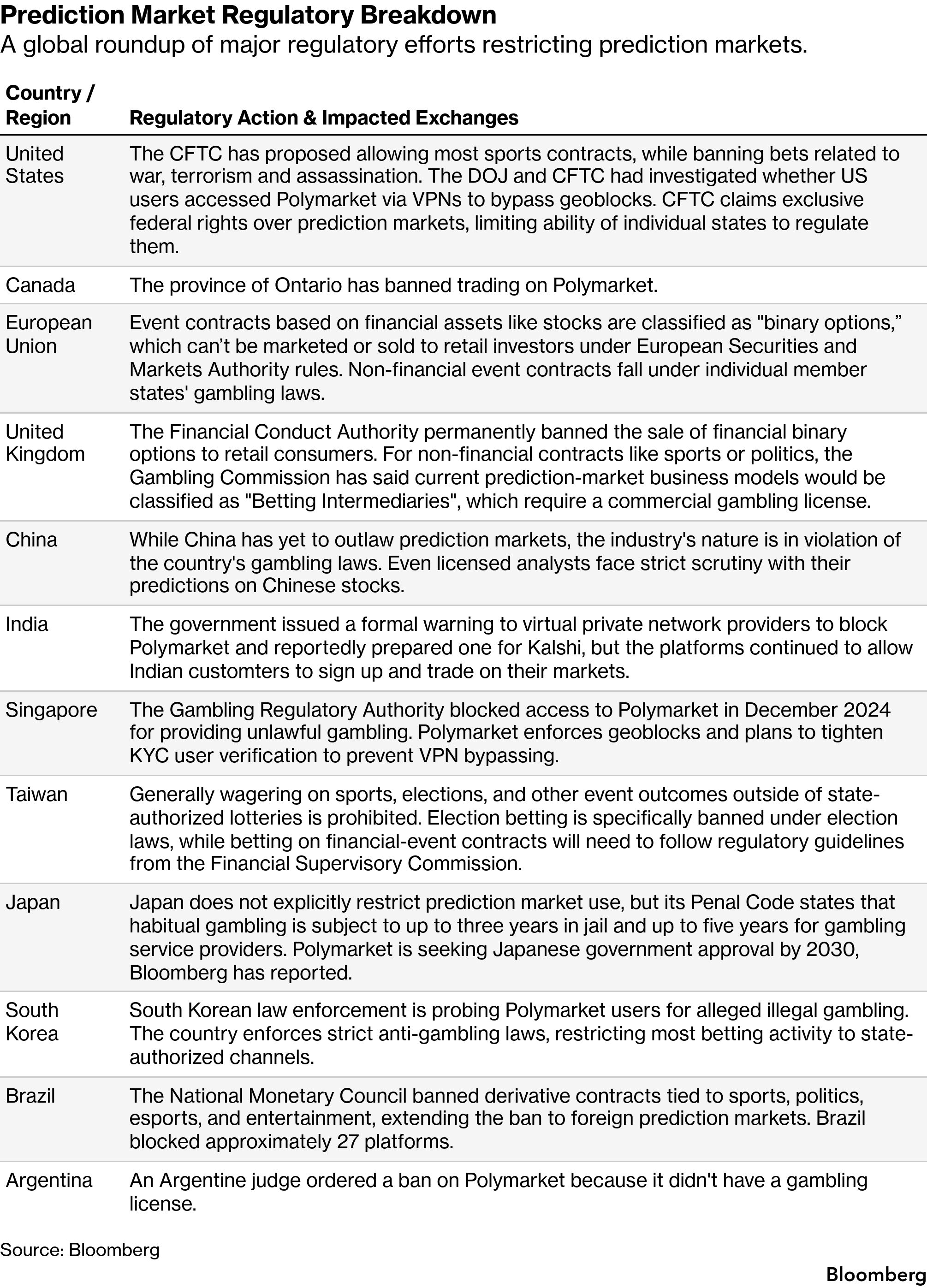
In just the last few weeks, Spain, Indonesia and India have joined the growing list of countries – including most of the European Union and large parts of Asia – that have put in place temporary or permanent measures to cut off access to the Kalshi and Polymarket websites and apps.
Brazil shut down 27 prediction platforms in April, including Kalshi, whose co-founder, Luana Lopes Lara, is Brazilian, leaving the company scrambling shortly after it launched in the country.
Regulators have intensified their scrutiny of prediction markets as the companies have expanded rapidly around the world, offering a new kind of financial contract that straddles the line between gambling and financial speculation.
Some countries view the new types of financial contracts offered by the prediction markets as a form of gambling and subject them to betting laws. Others argue that they should fall under securities or derivatives rules. The startups have used the legal uncertainty around their new products to offer them to customers even as regulators struggle to catch up.
“Prediction markets are entering the same phase every novel financial primitive eventually enters: first hobbyist market, then mass attraction, then legitimacy fights,” said Dovey Wan, founding partner of Primitive Ventures, a backer of prediction market platform Opinion Labs. “The recent bans mean the category has become important enough to regulate.”
Prediction market operators argue their platforms provide valuable information by aggregating collective forecasts on everything from economic indicators to geopolitical events. Critics counter that the contracts can encourage excessive speculation, and also open new opportunities for insider trading, alongside the ethical issues created by making it possible to bet on the war and other matters of life and death.
Explainer: Do Prediction Markets Make Insider Trading Easy?
“Betting isn’t new,” said Chris Holland, partner at Singaporean consulting firm HM Strategy. “What’s new is the structure.” Because prediction market contracts are typically classified as derivatives, they fall outside gambling licensing frameworks, he added. “That gap is an open invitation to insiders.”
Though Kalshi and Polymarket are by far the largest prediction companies, many more are expanding globally, including Opinion Labs, which is backed by Binance co-founder Changpeng Zhao’s family office YZi Labs, and Coinbase Ventures-backed Limitless.
A number of exchanges have cut marketing deals with soccer leagues and teams ahead of the World Cup to increase their visibility around the tournament.
The markets are big business, and growing. On Monday, Piper Sandl analyst Patrick Moley wrote that the World Cup was “like the Super Bowl every day,” and was driving record daily volumes on Kalshi since Friday.
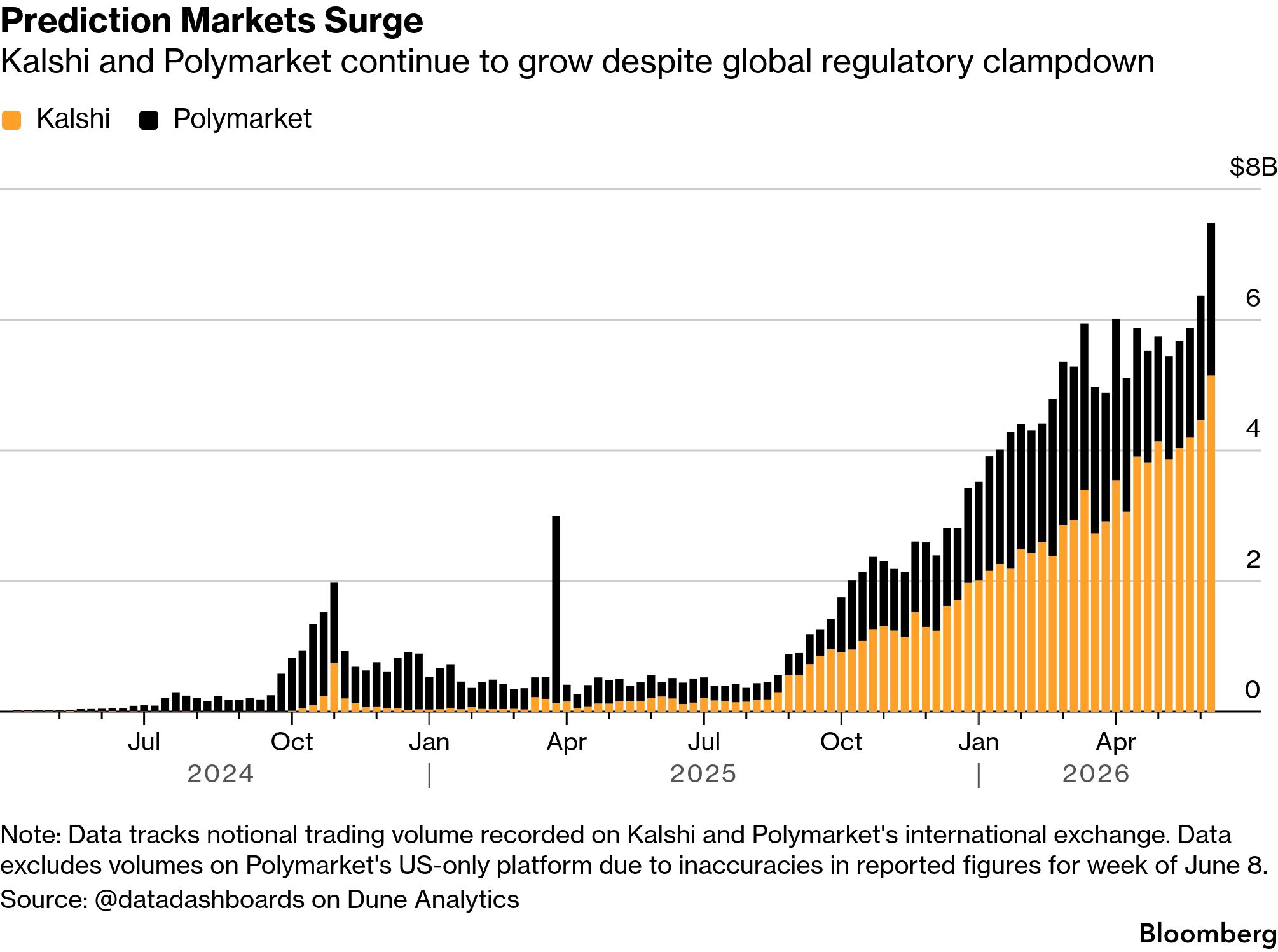
Polymarket recorded around $2.8 billion in notional trading volume across its international and US exchanges in the first week of June, according to user-compiled data on Dune Analytics, up from $2.1 billion a week earlier. Kalshi reported about $4.5 billion over the same period, up from $4.2 billion.
Creating a regulatory framework that restricts the sites is proving a challenge for country-specific regulators. The companies have been rapidly expanding around the world, unlike traditional gambling companies that are generally restricted to a specific jurisdiction. The use of virtual private-networks and cryptocurrencies make it easier to operate without going through local financial firms and regulators, and makes it difficult to completely shut the platforms down.
India’s government said users were able to access “illegal and blocked” prediction markets and said “Polymarket and a few other similar sites” were enabling the use of virtual private networks to circumvent the national ban, The government asked internet providers to cut off access to the platforms.
Polymarket and Kalshi’s terms of service already prohibit people from signing up in certain countries, including many that have recently taken steps to crack down on the sites. They’ve also strengthened safeguards against insider trading and market manipulation as prediction markets face growing scrutiny.
Polymarket is partnering with blockchain analytics firm Chainalysis Inc. to help police its platform related to suspicious trades.
“We welcome the opportunity to collaborate with Spain, Brazil, and other countries on a path forward that supports responsible innovation, transparency, and user protection in prediction markets,” a Polymarket spokesperson said in an email. The firm monitors for insider trading and other illegal activity, consistent with other markets, the spokesperson added.
Opinion Labs has restricted access for users from various jurisdictions and blocked any sanctioned addresses, said Alex Chan, Chief Investment Officer, in an emailed response. “We are working closely with a number of local authorities toward launching compliant local platforms.”
Kalshi and Limitless didn’t respond to email seeking comments.
For now, prediction markets remain legal in a patchwork of jurisdictions, but the direction of travel is becoming clearer: governments are increasingly unwilling to let platforms operate in a regulatory gray zone.
Brent fell around 4% after Reuters reported that the two sides had reached a preliminary agreement to end the war and reopen the Strait of Hormuz, with a formal memorandum expected in Switzerland and broader nuclear and sanctions talks pushed into a 60-day ceasefire window.
A closed Hormuz was the nightmare scenario for energy markets. Once traders saw a path to reopening, the most extreme blockade premium had to come out of the curve. But the more important point is that financial markets can reopen in a minute, while physical energy systems reopen in stages. The peace deal changes the nature of the crisis, but it does not instantly undo the logistical, refining, inventory and demand damage created over the past three months.
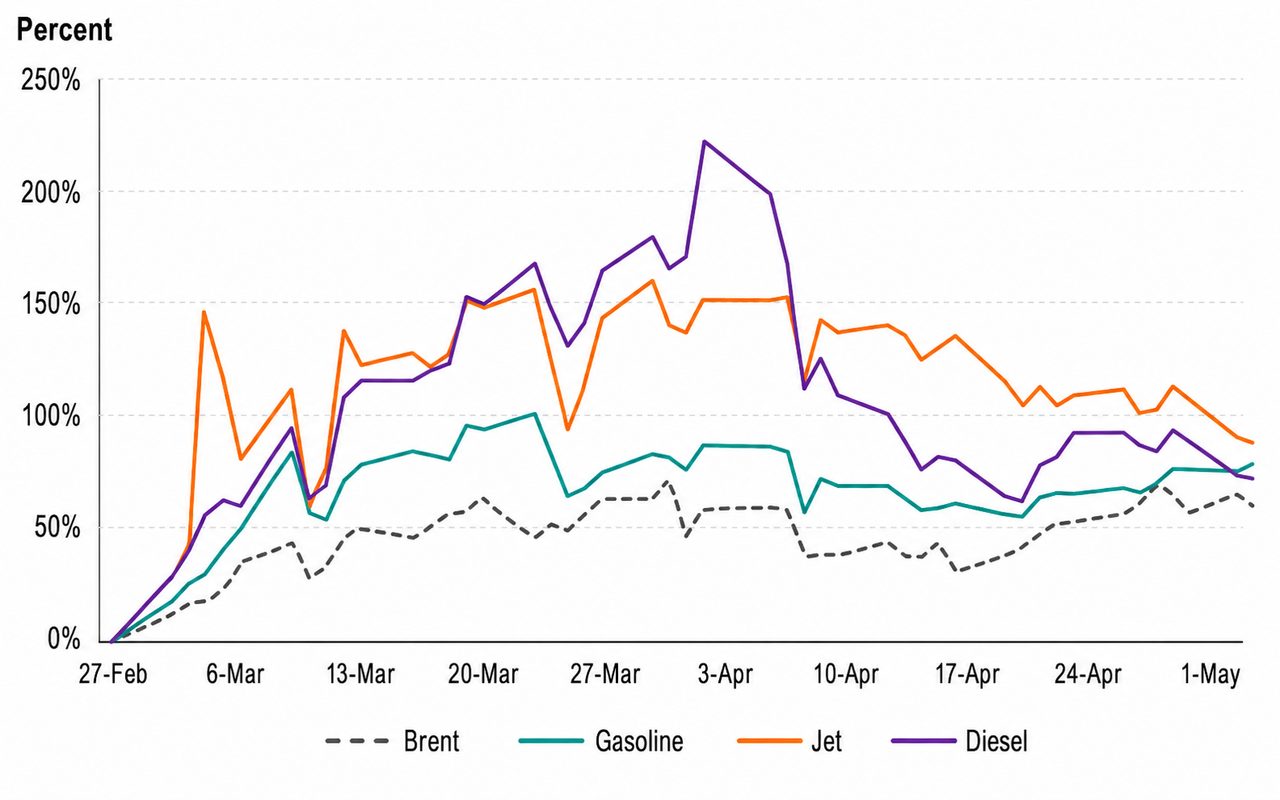
Cumulative percentage changes in Brent and Asian refined product prices since February 27, 2026
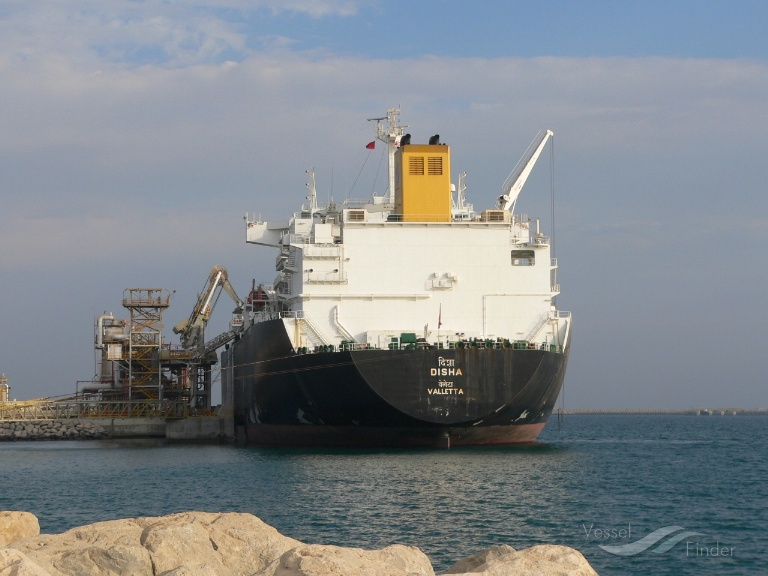
Reuters already shows the gap between headline and reality. On the first trading day after the agreement, only one LNG tanker, Petronet’s Disha, passed through the strait, while shippers continued to wait for details on mine clearance and safety assurances. Kpler estimated 155 oil and chemical tankers in the Gulf area on June 15, while Oil Brokerage’s estimate was 215, and even under unrestricted navigation Oil Brokerage said the traffic pile-up would take 8-10 days to clear. That is the cleanest way to understand the post-deal phase: the blockade risk may collapse quickly, but the physical recovery will be much slower.
The LNG carrier Disha departed the Middle East Gulf after spending nearly four months in the region. (Photo: VesselFinder.com)
This was not another Russia-Ukraine-style oil shock
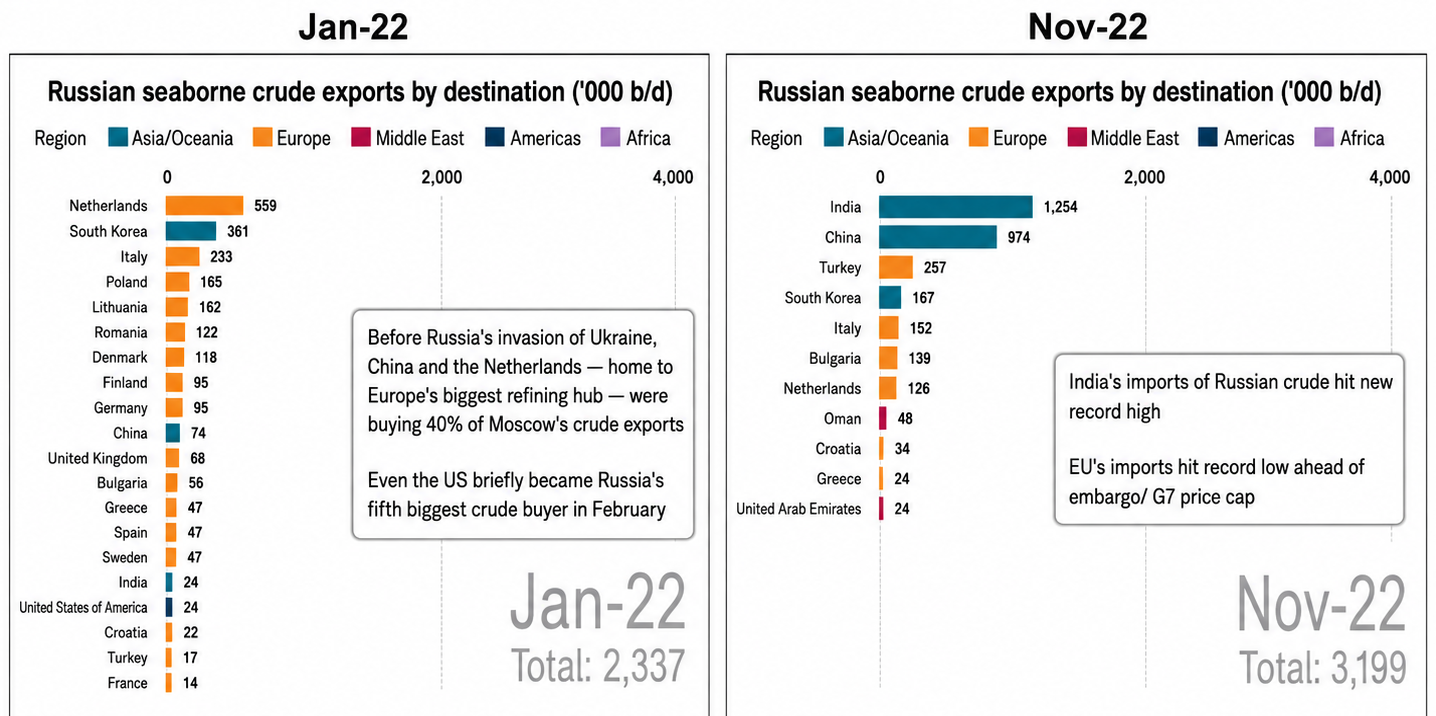
A useful starting point is to distinguish the Hormuz crisis from the Russia-Ukraine shock in 2022. In the Russia case, the first market panic was about whether Russian barrels would disappear. But over time, many of those barrels were rerouted. Russian crude that previously went to Europe increasingly moved to buyers such as India and China. The shock was severe, but it was largely a redirection shock.
Russia’s seaborne crude trade rapidly shifted after the invasion of Ukraine, with flows moving away from Europe and toward Asian buyers such as India and China. (Source: S&P Global Energy)
Hormuz was different. Before the conflict, according to the IEA, roughly 20 million barrels per day of crude and oil products were moving through the strait, equivalent to about 25% of world seaborne oil trade, with around 80% destined for Asia. And the crisis created actual losses of supply rather than merely changing the destination of cargoes.
That distinction is important because re-routing is a price problem, while physical blockage is a system problem. If oil is merely rerouted, the market pays more for shipping, insurance and time. If the oil cannot leave, producers shut in output, storage fills, refiners lose feedstock, and consumers are forced to reduce usage.
The quality problem: not every barrel is the same
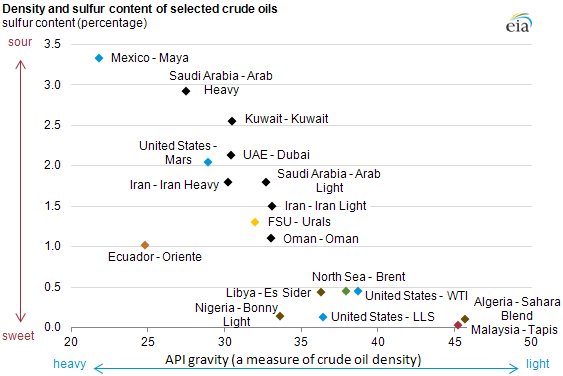
On the other hand, the public discussion often treats oil as a single commodity, but the refining system does not. Middle East Gulf exports are mostly medium-to-heavy sour barrels, and many Asian refiners are configured around those grades. Replacement barrels from the US are generally lighter and therefore less useful for Asian refiners trying to replicate their normal product yield.
This is a major reason why emergency stock releases and alternative supply cannot fully solve the problem. The IEA coordinated stock release helped, but much of the emergency crude available from IEA countries is Atlantic Basin crude, not the medium-heavy sour crude Asian refiners normally want.
In other words, the market does not just need “more barrels.” It needs the right barrels in the right place with the right logistics. That is what Hormuz restores, and it is also why reopening matters so much for Asia.
Crude oils vary widely in density and sulfur content, which affects how easily refiners can substitute one grade for another. Middle Eastern barrels such as Arab Heavy, Kuwait and Dubai tend to be more sour and heavier than light sweet benchmarks like WTI and Brent. (Source: EIA)
Reopening Hormuz is a sequence, not a switch
The first bottleneck is legal and security clearance. A peace framework does not automatically make shipowners comfortable sending vessels through a waterway that was effectively closed for months. Reuters reported that Japanese shippers welcomed the agreement but wanted concrete details, especially around mine clearance, before resuming normal navigation. This is not excessive caution. Tankers are expensive, insurance is sensitive to war risk, and a single incident after reopening would immediately reprice freight and oil markets.
The second bottleneck is maritime traffic. Sources estimated that roughly 150 million barrels of oil were stuck in the Persian Gulf at the end of May, and that even an orderly exit could take up to around 30 days, stretching the recovery well beyond the first wave of vessel exits. Free passage would need to be built over weeks before the wider shipping community regained confidence.
The Strait of Hormuz is a narrow maritime chokepoint, with its tightest passage measuring only around 21 miles across.
The third bottleneck is storage and production. During the closure, production that could not be exported accumulated in onshore storage. Once storage fills, output has to be shut in. Restarting production requires empty tankers to enter the Gulf and drain those storage tanks before oilfields can return to normal. It is estimated that draining onshore inventories could require around 200 VLCCs, with 4-6 weeks needed for up to 5 million barrels per day of shut-in production to return and potentially 2-3 months for the remaining shut-ins.
The fourth bottleneck is infrastructure repair. An important warning is that Gulf producers and refiners would compete for equipment, steel, valves, pipes and skilled labor to repair damaged facilities, meaning the constraint is not only money but also physical repair capacity. This is crucial because energy infrastructure is not software. It cannot be patched globally overnight.
Therefore, the combined result is a staged recovery. First, headlines improve. Then some ships pass. Then insurance normalizes. Then inbound tankers return. Then storage drains. Then production restarts. Then refineries ramp. Then products flow. Only after that does the whole system return to normal.
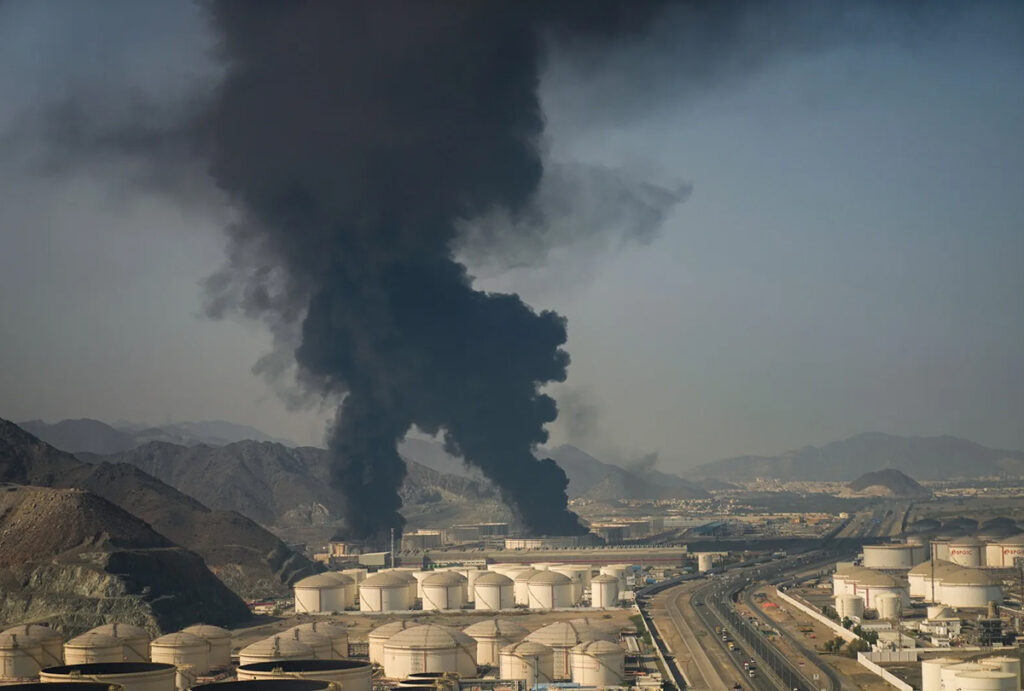
Missile and drone attacks during the conflict have damaged dozens of refineries, oil fields, gas plants, ports, and other critical energy facilities.
Crude can fall before fuels become cheap
Brent reflects the financial market’s changing view of crude availability and geopolitical risk. But consumers do not buy crude oil directly. They buy gasoline, diesel, jet fuel, LPG, naphtha-linked goods and electricity generated through fuel-linked systems.
A disruption of this scale cannot be rebalanced through crude alone and the adjustment has already shifted downstream into refined products. From January through April, crude prices rose roughly 40%, while Asian refined product prices rose 60%-120%, meaning oil products repriced 1.5x-3x faster than crude.
This is why crude prices may fall first while fuel prices remain sticky. A peace deal removes some probability of prolonged closure. But product markets still face refinery outages, crude-quality mismatches, shipping delays and slow ramp-ups. Refiners cannot snap back to full rates after a prolonged shutdown, and that Middle East refinery run cuts near 3 million barrels per day could take 4-8 weeks to restore gradually.
That is also why the first phase of post-Hormuz price action may look contradictory. Crude benchmarks can fall, equity markets can rally, and yet airlines, petrochemical producers and consumers may still face elevated costs. The crude market trades expectations while the product market reflects bottlenecks.
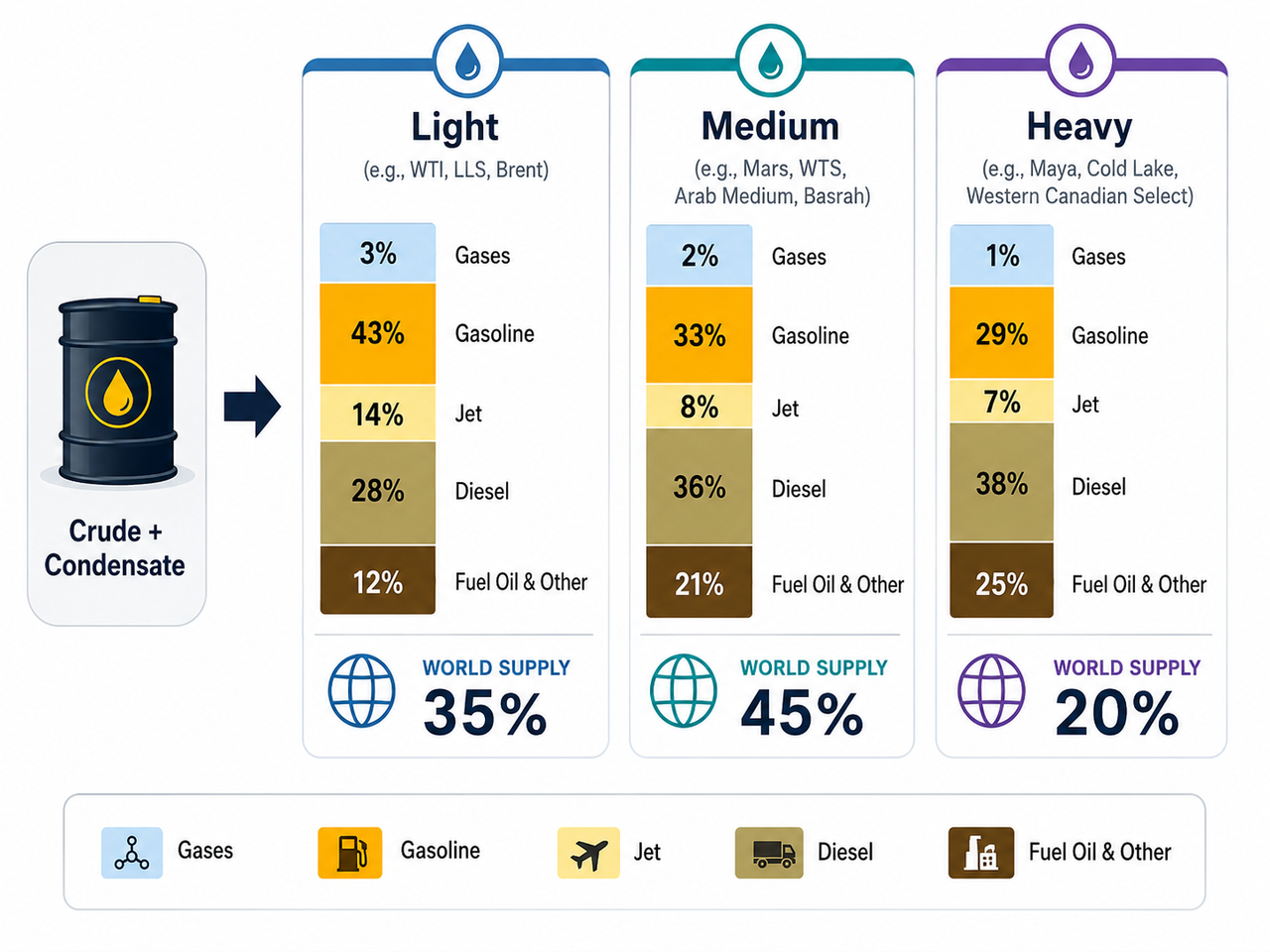
Jet fuel is the clearest example. Jet fuel was the most acutely affected product, with prices nearly doubling across Asia, Europe and the US and jet cracks widening to $80-$100 per barrel over crude. But refining is a mass-balance system. If refiners try to maximize jet fuel, they usually reduce diesel output, and diesel sits at the center of trucking, shipping, rail, agriculture and mining.
This means the reopening of Hormuz does not just answer “where should Brent trade?” It creates a second question: which part of the refined-products system heals last?
Typical refined product yields across different crude grades
Demand destruction does not instantly reverse
The market partially balanced during the crisis because demand was damaged. That sounds bearish for crude, but it is also a sign of economic stress. Sources estimated that observable global oil demand fell by 2.8 million barrels per day in March and 4.3 million barrels per day in April, with losses expected to deepen to around 5.6 million barrels per day in May and 5.0 million barrels per day in June.
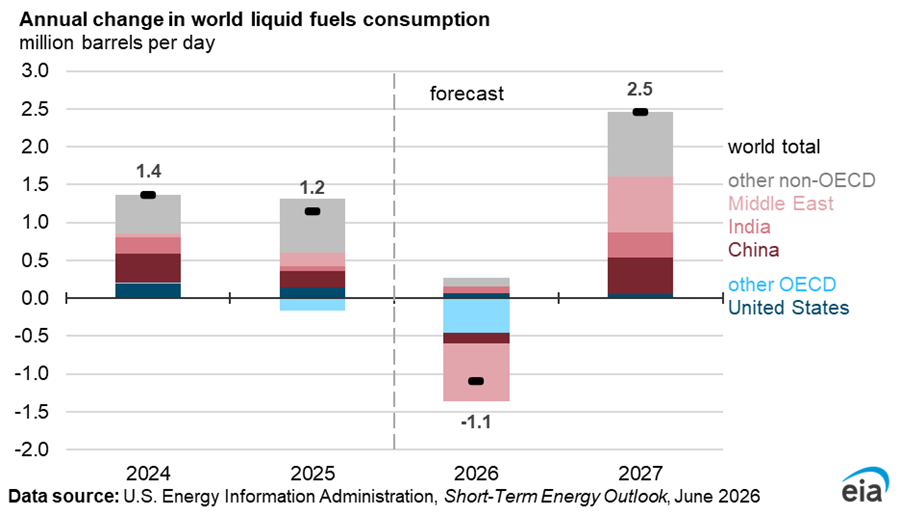
The EIA also says high fuel prices, reduced fuel availability and government initiatives have lowered oil demand, with most of the demand reduction in Asia because the region receives more crude supplies from the Middle East. It now forecasts global oil demand to fall by an average of 1.1 million barrels per day in 2026, compared with its previous expectation for growth, before rebounding by 2.5 million barrels per day in 2027 as prices drop and supply flows return later in 2026.
The IEA’s May Oil Market Report estimates that output from Gulf countries affected by the Hormuz closure was 14.4 million barrels per day below pre-war levels, while refinery crude throughputs are forecast to fall by 4.5 million barrels per day in 2Q26 because of infrastructure damage, export restrictions and lower feedstock availability.
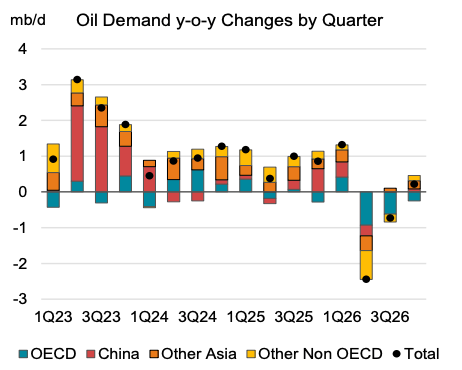
Global oil demand growth has weakened sharply since 2023, with 2026 showing outright year-on-year declines in several quarters as China, other Asian economies and non-OECD consumers absorb the impact of higher prices and supply disruption. (Source: IEA)
This creates a rebound problem. When supply returns, demand does not automatically jump back to its old path. Airlines may have cancelled routes. Petrochemical plants may need to restart gradually. Households may have adjusted behavior. Governments may keep conservation measures in place. Inventories may be rebuilt before end-use demand fully recovers.
That means the post-reopening market may go through two opposing forces. On one side, supply improves and crude prices fall. On the other side, demand gradually recovers as fuel availability improves. The net price path depends on which side moves faster.
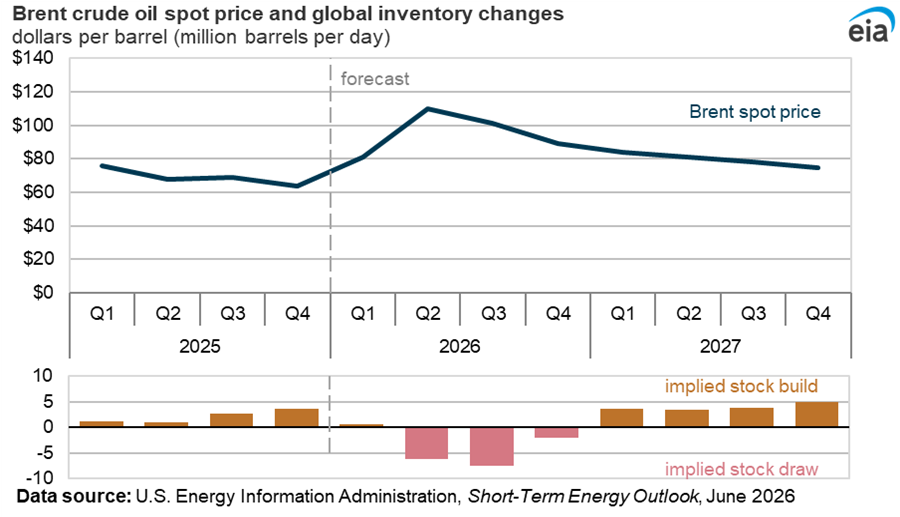
The EIA captures this tension well. Because global inventories have been drawn down sharply, it expects oil prices to remain elevated until flows normalize and inventories are replenished, and it estimates global inventories will fall by 6.3 million barrels per day in 2Q26. The IEA similarly says observed global inventories, including oil on water, were drawn down by 250 million barrels over March and April, and that resuming flows through Hormuz remains the single most important variable in easing pressure on energy supplies, prices and the global economy.
What happens next
The cleanest way to think about the next phase is not “open or closed,” but “how fast does the system heal?”
In the best case, the formal agreement is signed, mines and security concerns are cleared quickly, insurers lower war-risk premiums, shipowners resume passage, empty tankers enter the Gulf, storage begins to drain and refinery runs step higher over the next 4-8 weeks. In that scenario, crude prices probably remain under pressure because the market moves from scarcity fear to recovery pricing. Product prices would also ease, but with a lag because refineries and feedstock supply chains need time.
In the middle case, the strait technically reopens, but shipowners remain cautious, political terms are unclear, the 60-day negotiation period creates headline risk and traffic normalizes only gradually. This is the scenario implied by Reuters’ early shipping reports: one tanker passes, many remain stuck, and confidence has to be rebuilt over weeks rather than hours. In this case, Brent may be capped by peace optimism, while product cracks, freight rates and Asian fuel stress stay elevated.
In the downside case, the agreement becomes a ceasefire in name but not in practice. Any renewed military action, mine incident, insurance shock or dispute over Iran’s nuclear program could quickly reintroduce the risk premium. This risk is not theoretical because Reuters reported that the preliminary pact leaves Iran’s nuclear program to later talks and that Lebanon remained a sticking point in negotiations.
The most interesting possibility is that crude becomes bearish before the real economy becomes comfortable. If tankers exit and producers rush to recover revenue while demand remains depressed, crude could fall faster than refined products. That would not mean the shock is over. It would mean the bottleneck has shifted from crude availability to product availability, refinery configuration and end-user recovery.
What to watch
The key indicators now are different from the indicators during the closure. During the crisis, the main question was whether Hormuz could reopen. After the agreement, the key indicators are tanker transits, oil-on-water, inbound VLCC flows, refinery runs, and the stability of the US-Iran negotiation process.
A simple rule is useful: Brent tells you how the market prices the probability of reopening; oil product cracks tell you how the physical system is actually healing.
That is the deeper story of Hormuz. The peace deal is a turning point, but not a reset button. The visible blockade may end on a date. The energy shock unwinds through the supply chain over weeks or months.
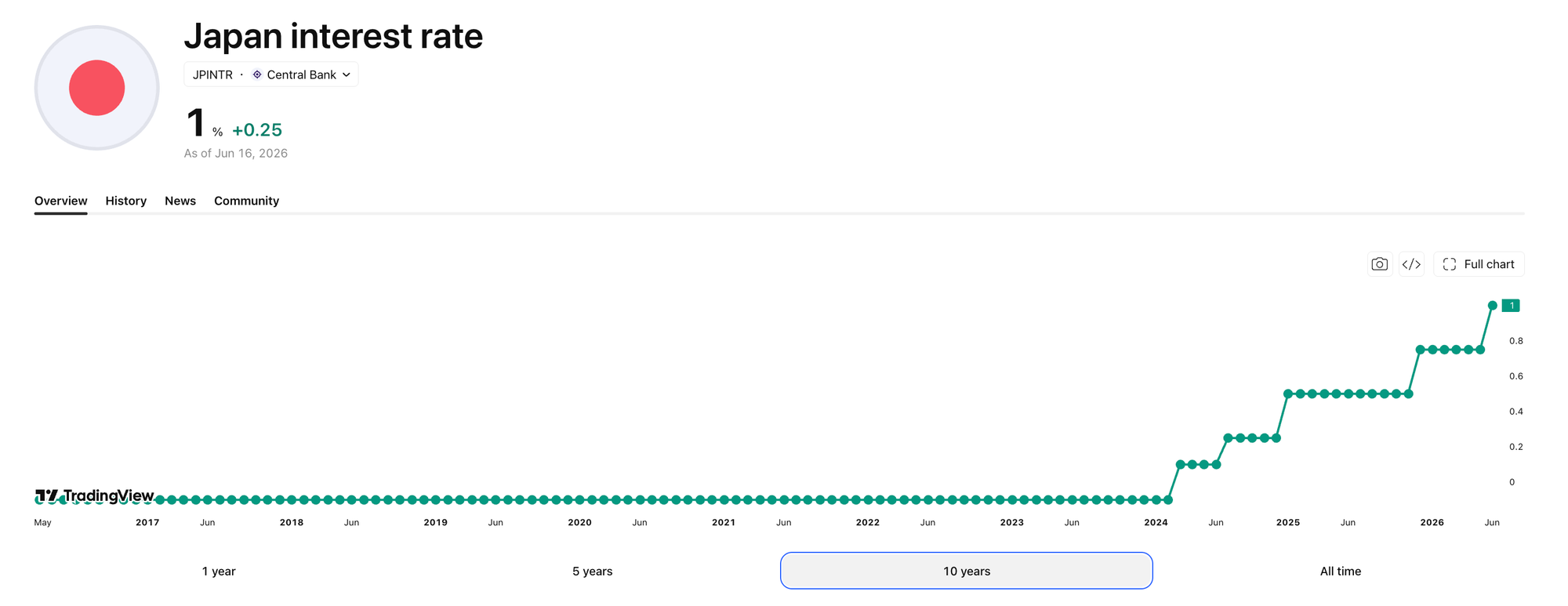
The Bank of Japan has raised its policy rate to around 1.0%, with the decision approved by a 7–1 majority. The complementary deposit facility rate will also rise to 1.0%, while the basic loan rate increases to 1.25%. The new guideline takes effect from June 17, 2026.
This is more than a routine rate hike. For decades, Japan was the global symbol of ultra-low rates, weak inflation and persistent monetary easing. Now the BOJ is moving further away from that old regime. The key question for investors and macro watchers is not simply whether Japan has tightened, but whether this is the beginning of a longer tightening cycle.
The BOJ’s own explanation shows why the decision matters. Japan’s headline inflation picture is mixed: CPI excluding fresh food has recently been below 2%, partly because government measures have reduced the household burden of higher energy prices. But the BOJ is worried that crude oil costs, business-to-business price pass-through and rising medium- to long-term inflation expectations could push underlying inflation above its 2% target.
Viewpoint: the BOJ is no longer reacting only to current inflation; it is trying to manage the risk that Japan’s wage-price cycle becomes durable.
That makes the next few months highly important for event-based forecasting. If inflation rebounds, wage growth remains firm and the yen stays weak, expectations for another rate hike could rise. A Reuters survey before the meeting showed economists broadly expected a move to 1.0%, with many also expecting the BOJ to raise rates again to 1.25% later in 2026.
But the BOJ is not tightening in a straight line. It also noted that Japan’s economy has recovered moderately, while some weakness remains due partly to the Middle East situation. Higher crude oil prices may hurt corporate profits and household real income, even as they raise inflation pressure. In other words, Japan faces a policy trade-off: raise rates too slowly and inflation expectations may drift higher; raise too fast and growth may weaken.
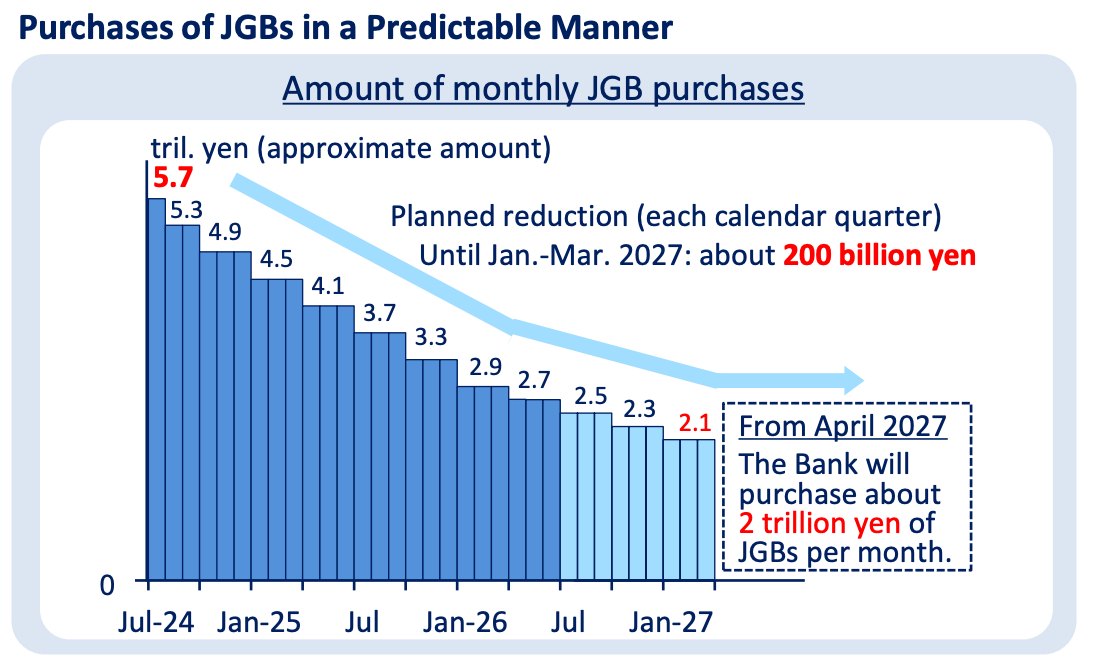
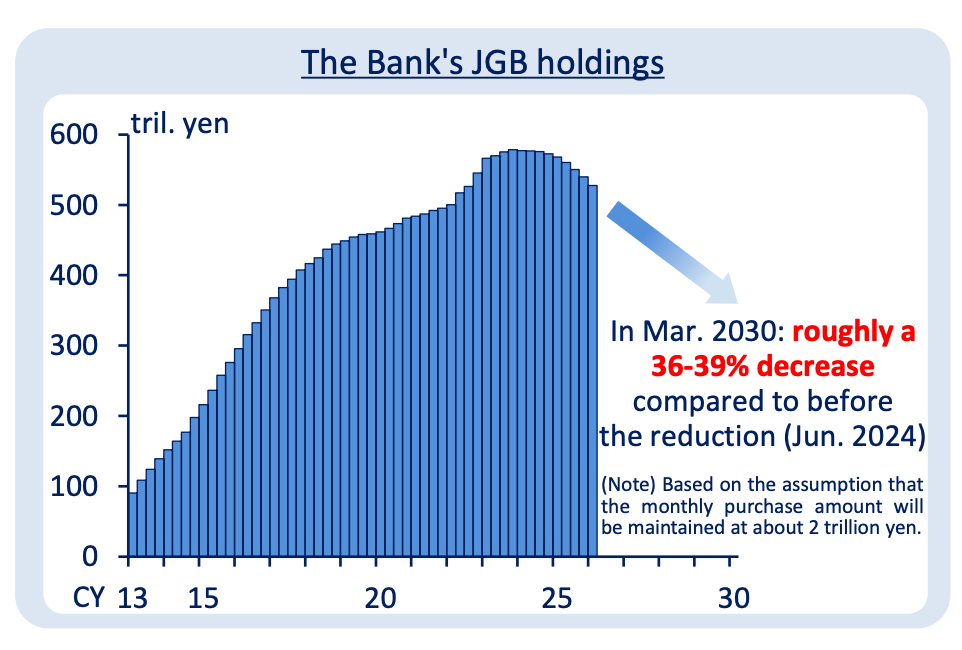
The central bank’s bond policy adds another layer. The BOJ will continue reducing monthly JGB purchases by about ¥200 billion each calendar quarter until January–March 2027, then hold monthly purchases at about ¥2 trillion from April 2027. The BOJ estimates its JGB holdings could fall by roughly 36–39% by March 2030 compared with before the reduction began in June 2024.
Still, the BOJ is keeping a safety valve. It says long-term rates should generally be formed in markets, but it is prepared to respond flexibly if long-term rates rise rapidly, including by increasing JGB purchases.
This creates several clean forecasting questions: Will Japan hike again by year-end? Will core CPI return above 2%? Will the yen strengthen after the hike, or will rate differentials and energy import costs keep it under pressure? Will the BOJ slow its JGB purchase reduction if bond yields spike?
The BOJ’s message is clear: Japan’s era of emergency monetary policy is fading. The open question now is whether this normalization stays gradual, gets interrupted, or accelerates.