Clear Street, a broker to hedge funds and sophisticated traders, is partnering with Kalshi Inc. to give its clients access to event bets, as the fast-growing prediction markets industry seeks to increase its appeal to Wall Street.
Clear Street’s futures commission merchant will join Kalshi’s exchange and clearing house. The broker will also launch swap capabilities for exchange-traded fund issuers tied to prediction markets.
“Prediction markets are emerging as a regulated, fast-growing asset class, and our institutional clients want access to clearing, risk management and swap product capabilities for this growing space,” Andy Volz, chief commercial officer of Clear Street, said in a statement.
Prediction markets have soared in popularity on the back of strong interest from retail traders, drawn in by the ease of binary bets on everything from current affairs to award shows. Kalshi and Polymarket, the two leading platforms, processed $23.3 billion in notional trading volume last month, according to user-compiled data on Dune Analytics, with sports accounting for a majority of that figure.
The platforms say event contracts can be useful for businesses seeking a more precise way to hedge their exposure to real-world events such as weather or geopolitical turmoil. Kalshi completed its first block trade last month, a functionality that will likely make event contracts more appealing to institutions that need to deploy capital at scale.
For Clear Street, the expansion follows an aborted initial public offering earlier this year, which was pulled amid a selloff of brokerage stocks. The company had $1.1 billion of customer assets in its futures brokerage at the end of February, according to data from the Commodity Futures Trading Commission.
A top Wall Street regulator is considering changes to a weekly report covering the position of traders just as prediction market exchanges and offshore venues start to offer more contracts in the oldest corner of the derivatives market.
The Commodity Futures Trading Commission is asking for public input on its Commitments of Traders reports, which is widely relied on by hedge funds and other traders to help craft their strategies.
“After significant outreach and communication with the agricultural community and commercial end users, the Commission is examining the current structure and publication of our COT Reports,” CFTC Chairman Michael Selig said in a statement Thursday.
That review comes after Kalshi Inc., a leading prediction markets platform, announced in mid-April the exchange would be offering a new commodities trading hub. But unlike industry stalwarts like CME Group Inc. and Intercontinental Exchange Inc. that support trading of grain, energy and numerous other derivatives, prediction markets don’t have to furnish information that is compiled into COT reports.
Kalshi agreed to limit its trading hours on new financial contracts tied to crops like corn to the same hours as traditional exchanges, Bloomberg reported earlier Thursday, following agriculture industry concerns about the products.
The CFTC said Thursday it is considering whether the one-of-a-kind data set should be published more frequently, and if doing so would risk revealing which companies or trading firms were taking large positions in a given market.
The agency also asked whether binary options, which can include the types of contracts traded on CFTC-licensed prediction markets, should be included in the reports.
Hyperliquid, the decentralized crypto exchange that has emerged as one of the most active trading venues in digital assets, is proposing to add prediction markets to its platform — a direct challenge to Kalshi and Polymarket as the fast-growing sector draws new competitors.
The proposal, known as HIP-4 and currently in public testing, would let traders bet on real-world outcomes on a platform that has increasingly drawn notice from Wall Street for the speed and ambition of its product expansion.
Hyperliquid is traditionally focused on perpetual futures — contracts with no expiry that involve large amounts of leverage, and therefore risk. For prediction markets, the contract design would be simpler. A market on whether US inflation in July could exceed 3.5%, for example, would generate two tokens — one for each outcome. Traders buy or sell either side, and the winning token settles at a fixed value when the answer is known.
Unlike Hyperliquid’s perpetual products, the proposed contracts would not include leverage, reducing the risk of forced liquidations that frequently occur in crypto markets.
What makes Hyperliquid a credible threat, at least on paper, is not the contract structure but the platform underneath it. What began as a niche venue for crypto derivatives has rapidly evolved into one of DeFi’s most ambitious marketplaces — adding contracts linked to oil, gold, silver and US equities, drawing billions in trading volume, and building and shipping new products at a speed that traditional venues cannot match. In March, Hyperliquid handled $219 billion in total volume, according to data site Hydromancer.
“Sophisticated traders will be able to take advantage of portfolio margin and figure out ways to generate alpha from these two different market types,” said Sunny Shi, an investor at crypto fund Syncracy Capital. “A way that you wouldn’t be able to see like on Polymarket or Kalshi, where today most of it is just betting. It’s just like single-sided betting.”
HyperCore will support outcome trading (HIP-4). Outcomes are fully collateralized contracts that settle within a fixed range. They are a general-purpose primitive that are useful for applications such as prediction markets and bounded options-like instruments. There has been…
— Hyperliquid (@HyperliquidX) February 2, 2026
Some important details remain unresolved, including how Hyperliquid would decide which events qualify for contracts, what governance process would approve new markets, or when HIP-4 would move beyond testing to a full launch. A Hyperliquid representative declined to comment.
The platform’s growing popularity was on display during the Iran crisis, when oil-linked contracts saw more than $1 billion in volume in a single day, providing one of the earliest reads on how traders were pricing geopolitical risk while traditional commodity markets were closed. An equity-linked contract tracking the Nasdaq 100 has drawn more than $60 million in open interest. The platform has attracted backing from firms including Paradigm and Pantera Capital, and an $888 million Nasdaq-listed fund now holds its native token.
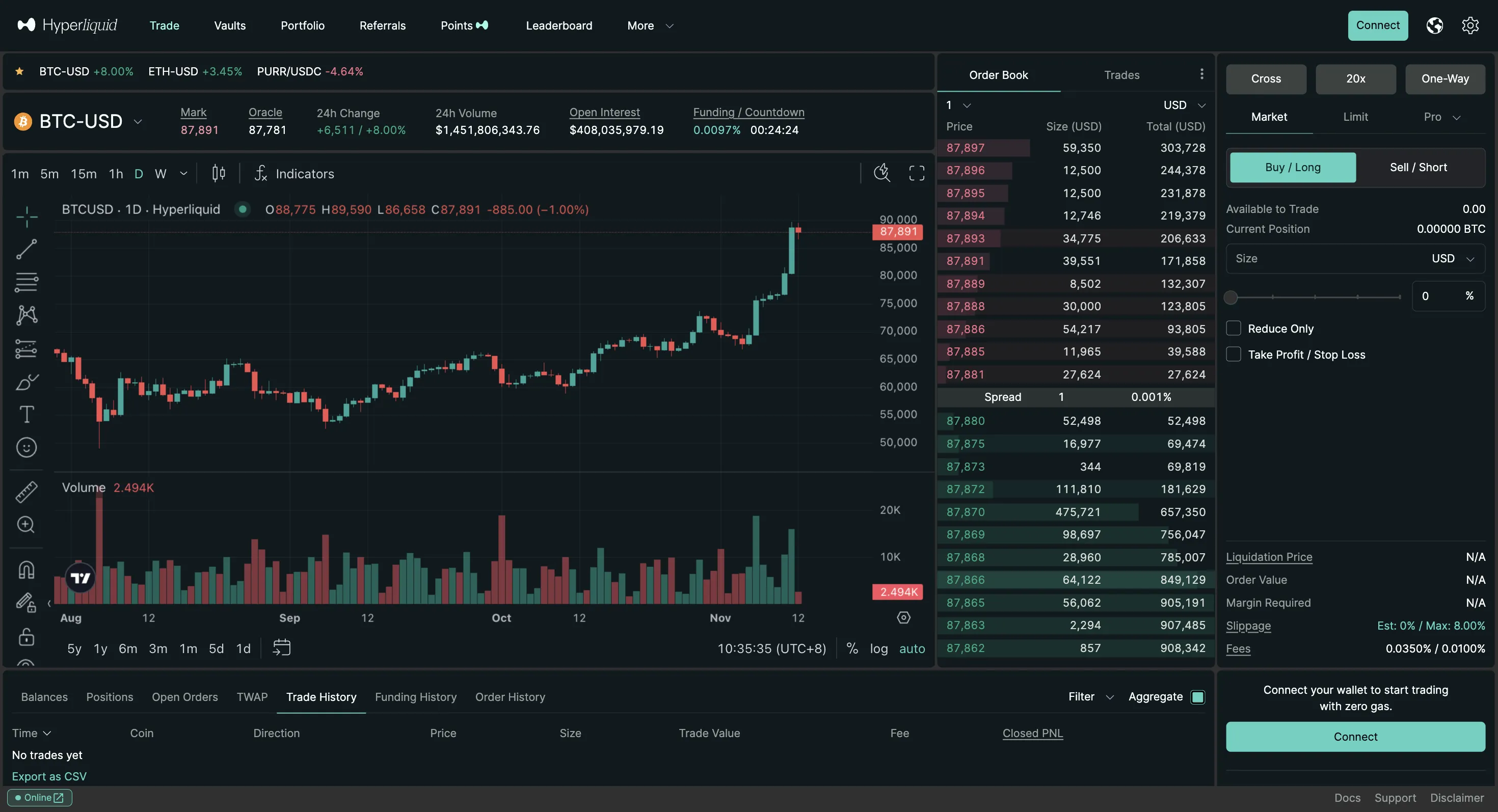
The Hyperliquid app Source: Hyperliquid
Polymarket and Kalshi already offer binary outcome contracts, and prediction markets are increasingly accessible through mainstream brokerages including Robinhood, Interactive Brokers and Coinbase. What Hyperliquid is proposing is distinct in at least two ways. First, the prediction markets would be native to a platform where traders are already active in crypto, commodities and equity-linked contracts — giving the product instant distribution rather than requiring it to build an audience from scratch. Second, the contracts would sit inside the same trading system as those other products, meaning a single user could manage event bets, Bitcoin positions and oil exposure within one account.
The competition is moving in both directions. As Hyperliquid pushes into prediction markets, Polymarket and Kalshi have been exploring perpetual futures and other derivatives — products that would bring them closer to the kind of multi-asset trading Hyperliquid already offers. A spokesperson for Polymarket didn’t respond to requests for comment. A Kalshi representative didn’t comment on the competitive landscape.
The overlap between user bases is already visible. Analysis by the on-chain researcher Fleck shows that roughly 3.3% of Polymarket users are also active on Hyperliquid, but those overlapping traders account for about 12% of Polymarket’s total volume — suggesting that the most active speculators already have a foot in both worlds.
The timing of Hyperliquid’s entry is notable. The prediction market industry has spent the past two years trying to move toward regulatory legitimacy — Kalshi winning CFTC approval, Polymarket returning to the US, Washington warming to the sector, and venture capital flowing toward platforms building within the regulatory framework. Hyperliquid cuts against that grain: an offshore, decentralized exchange, which restricts US users from accessing its platforms, proposing to offer event-like contracts at a moment when much of the industry is betting that the future lies in regulated markets. For supporters, that freedom is the point — faster product development and access for users in markets that US platforms do not serve.
Industry participants expect early adoption to be gradual, with activity concentrated outside the US in markets that have not had access to mainstream prediction platforms, such as cricket betting in countries like India.
“Historically prediction markets have been very centered around sports, geopolitical events and elections, with most of the activity coming via sports,” said Rajiv Patel-O’Connor, a partner at Framework Ventures.
Prediction markets are being touted on social media as a lucrative side hustle for young Americans squeezed by rent and student loan bills. In reality, most traders are losing money, and a significant amount in many cases.
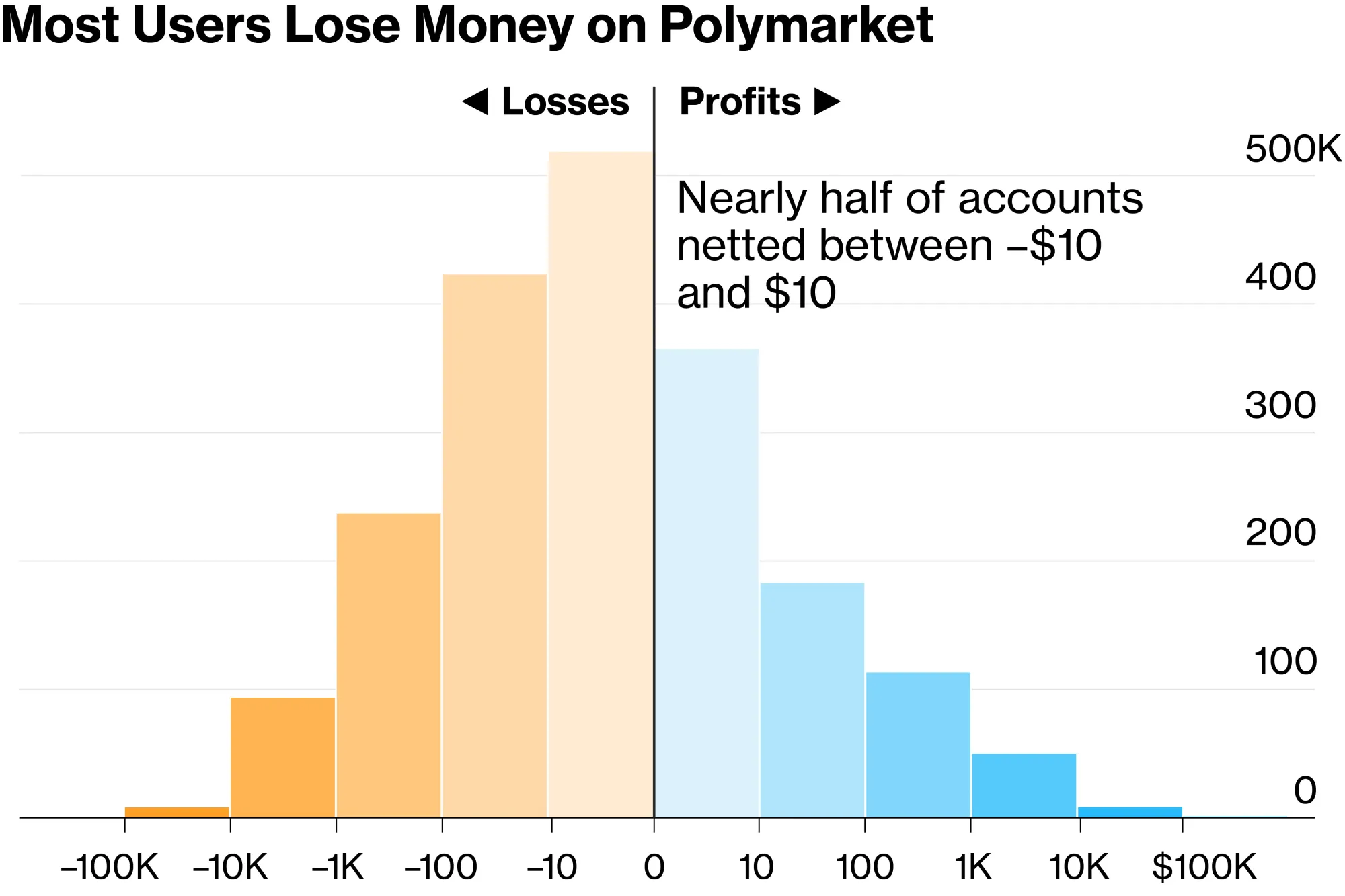
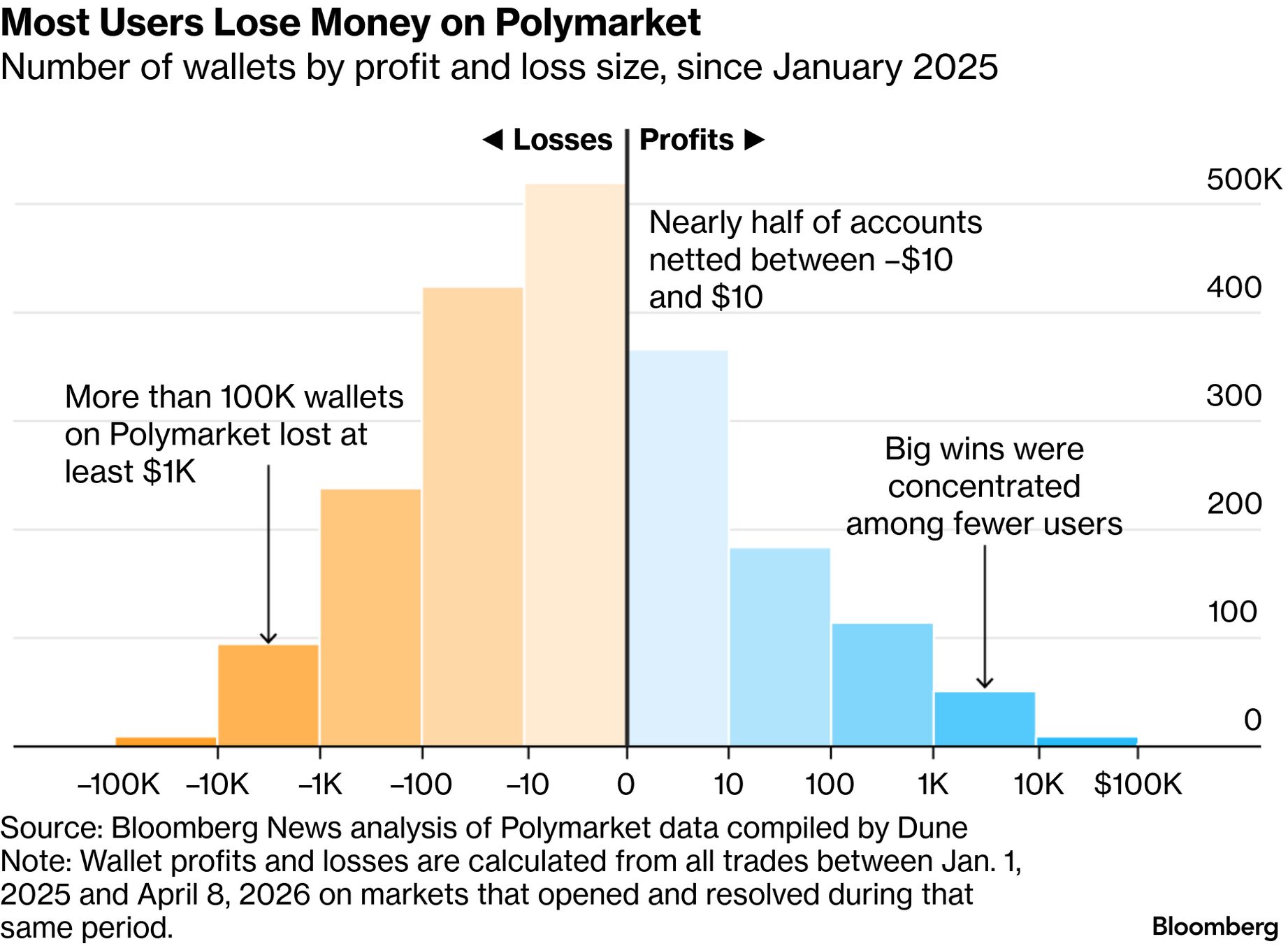
Over 100,000 accounts lost at least $1,000 on Polymarket, one of the largest prediction markets, according to a Bloomberg News analysis of every wallet active since the beginning of 2025. That is almost twice the number that made at least that much.
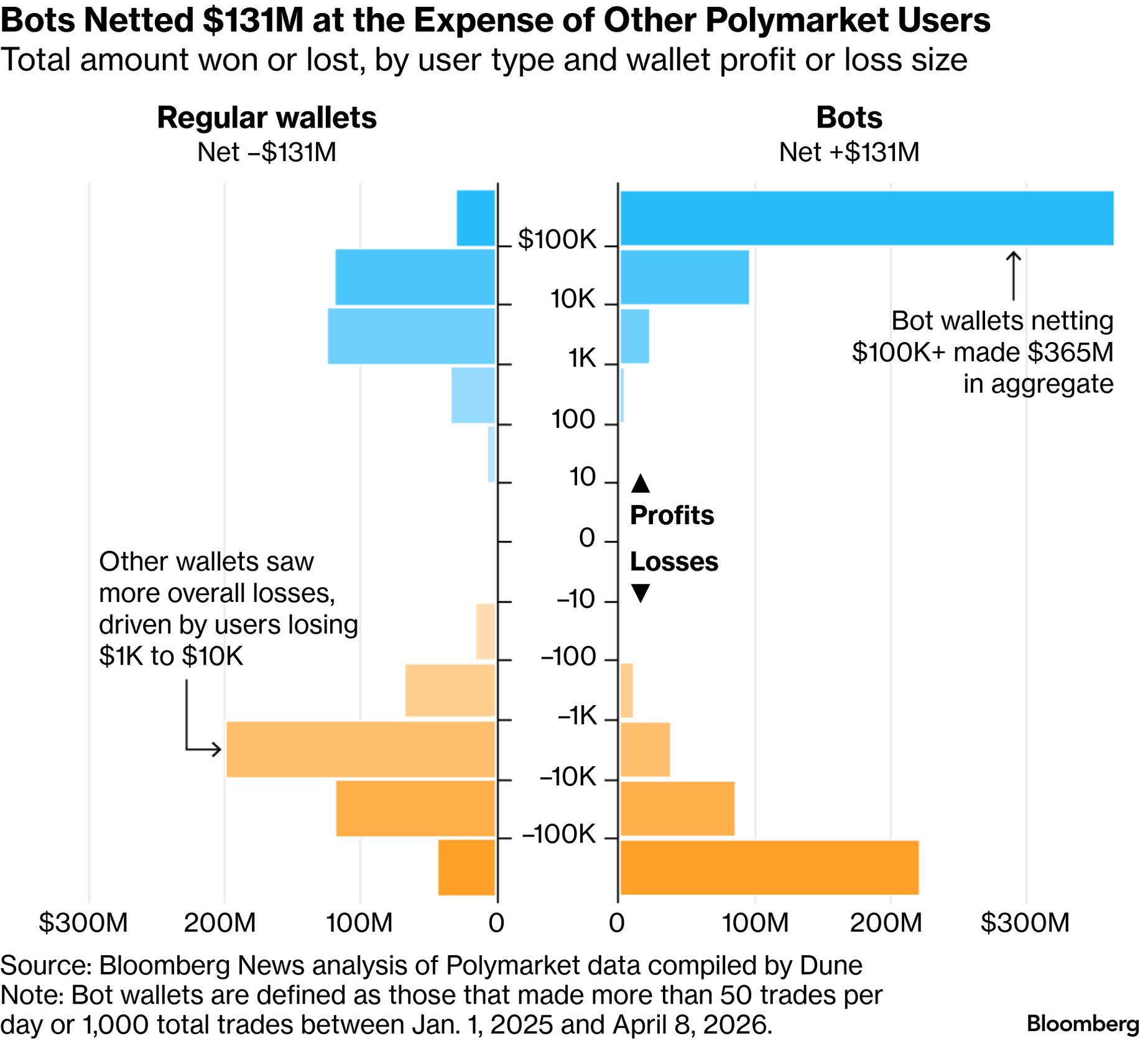
Among the winners, a majority of the profits were raked in by a tiny slice of what look to be automated bots, based on the Polymarket trade records compiled by the data firm Dune. Everyone else, in aggregate, lost $131 million.
Most Users Lose Money on Polymarket
Polymarket’s blockchain ledger, which offers a public record of every wallet on the exchange, gives an unusual window into the financial fortunes of the millions of people who have begun trading on prediction markets over the last year as the nascent industry has exploded, opening up betting on everything from the elections to the Super Bowl to regime change in Iran.
Almost half of the two million wallets active since early 2025 made or lost less than $10, indicative of people experimenting with this new form of betting. Even among this group, most ended up in the red.
“If you want to participate and you want to make a living out of this, you better be pretty darn good,” said Charles Martineau, a professor at the University of Toronto’s business school.
Martineau recently co-authored a paper that found that since 2022 around 69% of traders on Polymarket lost money, while the top 1% captured three-quarters of the profits. Martineau said that his students, who have been obsessed with prediction markets over the last year, were taken aback by his findings.
“You’d be surprised how many of them did not anticipate that you would see such concentrated gains — that so few make money,” he said.
A spokesperson for Polymarket declined to comment on the recent research findings.
There is no indication that Polymarket customers are doing worse than those on Kalshi or other event betting platforms. Polymarket is just the biggest venue to offer a public blockchain record of all accounts. A report from analysts at Citizens earlier this year suggested that users are losing proportionately more on Kalshi than they do on sports betting apps, though Kalshi rejected that analysis.
One of the main selling points of event betting exchanges is that, unlike on sports gambling apps, there is supposedly no sportsbook or house that makes money when customers lose. The key innovation of prediction markets is that they allow buyers and sellers to meet on an exchange to bid on the odds of an event occurring, rather than relying on a house to set odds.
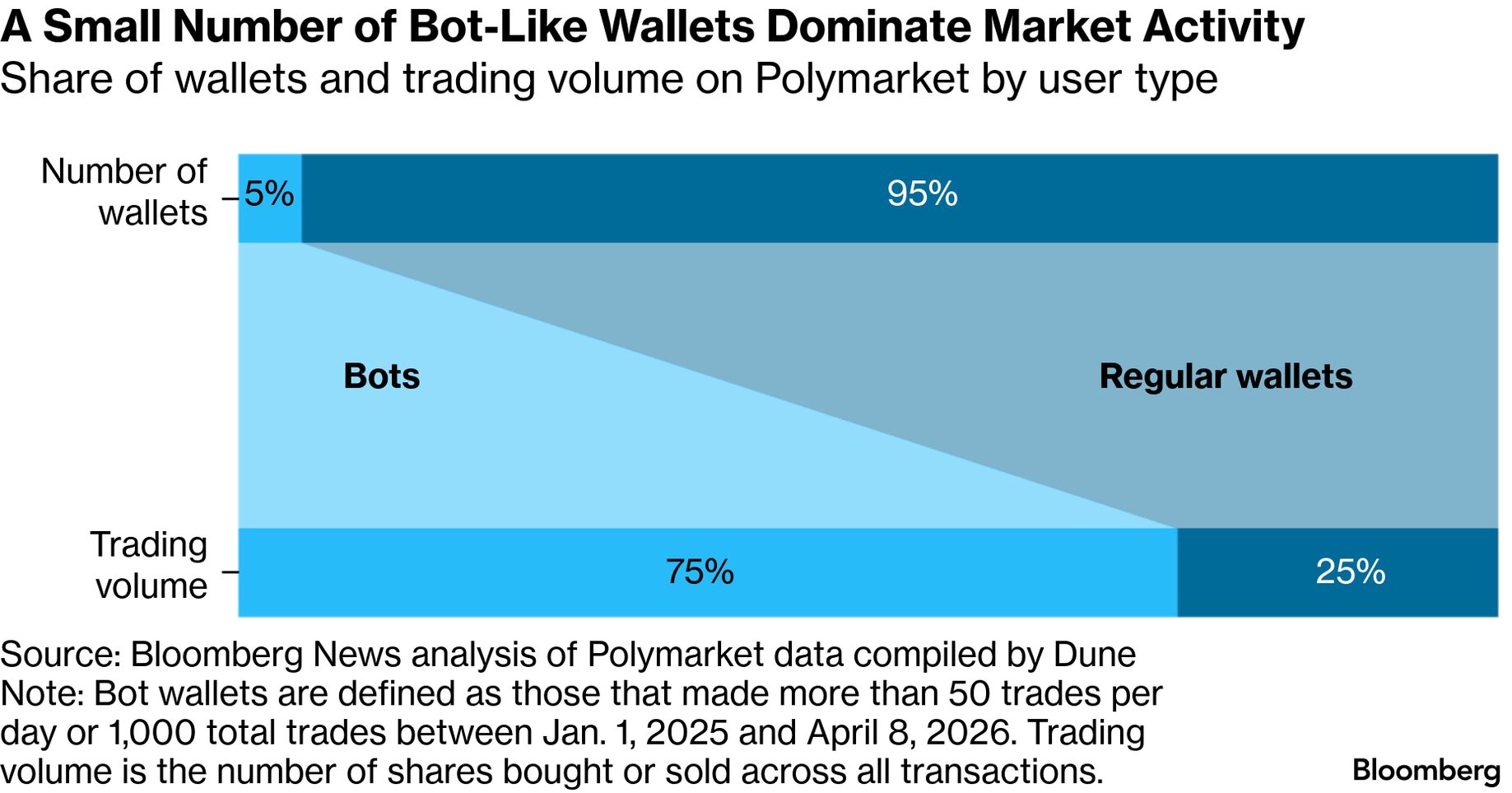
While prediction markets have been described as peer-to-peer, the Polymarket records suggest the role of the sportsbook is now largely being played by the sort of automated, high-frequency traders that have long dominated other financial markets. The most active accounts on the site were a small proportion of wallets, but accounted for most of the trading volume.
A Small Number of Bot-Like Wallets Dominate Market Activity
Joshua Della Vedova, a professor at University of San Diego’s business school, constructed a method for categorizing traders that labeled any wallet as a bot if it traded an average of at least 50 times on any day it was active or 1,000 times over the course of the data.
Using Della Vedova’s definition, Bloomberg’s analysis found that since the beginning of 2025 the typical bot averaged 89 trades on each active trading day — compared to 2.2 for non-bots — with trades spread across a greater diversity of markets.
These high-volume accounts collectively turned a profit of $131 million, mostly concentrated among 823 users that netted more than $100,000 each. The less active traders, meanwhile, lost the equivalent amount when all their wins and losses were added up.
Bots Netted $131M at the Expense of Other Polymarket Users
Della Vedova found that the bots did not outperform because they were better at predicting outcomes, but rather because they got into markets earlier and at better prices.
The accounts that Della Vedova identified as retail traders actually picked the right outcome more frequently, but they ended up losing much more money — tens of millions of dollars in aggregate — because they traded late, at bad prices.
“Retail investors, despite being correct, are losing money,” he said. “The execution edge is an underrated aspect of trading.”
Even among the bots, in both Della Vedova’s research and the Bloomberg analysis, a majority lost money. But the gains from the winners were so large that, as a group, they came out on top.
The Polymarket findings echo a long history of research on the underperformance of retail traders in an array of traditional financial markets. But while retail stock traders generally do worse than the overall market, their results are cushioned by the fact that few stocks end up worthless. Not so in prediction markets, where the consequence of a bad bet is losing 100% of your money.
Watch: Prediction Markets Make the World a Casino
Despite the unparalleled transparency it provides, the Polymarket data still only offers a partial picture of how customers are faring. The blockchain does not provide information on who owns each wallet, so one trader might control multiple wallets pursuing different strategies, potentially taking both sides of the same contract at various points.
Polymarket has also faced allegations that it hosts a high volume of so-called wash trading, coming from customers who are seeking cryptocurrency rewards, rather than a return on their trading. This sort of activity, though, would be unlikely to influence statistics on profits and losses because it would come from people who are trying to rack up lots of trades without taking long-term positions.
The University of Toronto researchers found that the profits in the system flowed mostly to so-called market makers, who offer to trade at a given price rather than just taking the prices that are already available on the exchange. The market makers did particularly well on sports wagers, with the winnings on certain categories, like weather, distributed more evenly, they found.
Pat Akey, one of the co-authors of the study, said that profitable traders generally have a clearly defined trading strategy and money to leave sitting on the exchange — not the sort of thing you’d expect from an inexperienced bettor looking to cover their monthly bills.
“I don't think prediction markets are bad — they can serve a role,” said Akey, a professor at ESSEC Business School. “I just don't think they can be viewed as a good way to supplement your rent.”
Professors’ picks offers a weekly curated selection of FT articles by and for business school faculty to connect classrooms to current events and to develop students’ critical thinking.
Read all submissions atwww.ft.com/bschoolpicks. Save this link inmyFTto receive emails alerting you to each new edition. Search the tags for relevant teaching topics. Encourage students to join the debate in the comments section beneath the article.
Financial Risk Management
Vanguard chief warns of ‘financial exploitation’ by prediction markets
The big state gamble on prediction markets
Tags: Prediction markets, Investing vs gambling, Financial regulation, Ethics in finance
Summary: In 1906, the Victorian polymath Francis Galton came across a weight-judging competition at a Plymouth country fair. Eight hundred participants, from expert butchers to indifferent clerks, paid sixpence to guess the weight of a slaughtered ox. Galton expected a demonstration of collective folly, believing the average voter was capable of very little. Instead, the average guess, 1,197 pounds, came within a pound of the true weight. This “wisdom of crowds” episode suggested that under the right conditions, a crowd can be not merely intelligent, but uncannily precise. A century later, platforms like Polymarket and Kalshi attempt to industrialise this logic, treating the future not as a mystery, but as something to be priced, aggregated and settled. The question is whether modern markets still preserve the conditions that make crowds wise.
Classroom application: In line with what I hope to achieve via “Eight Bridges” (a set of eight curated programmes to connect classrooms with industry events for fostering students’ critical thinking and improving their employability), a classroom discussion of these articles forces students to connect financial market design (incentives, information, structure) with real-world regulation and ethics. It sharpens their ability to distinguish between investing, speculation and gambling, and to see how business models and product design can blur those boundaries.
Questions:
Galton’s fair illustrates four conditions for collective intelligence: diversity, independence, decentralised knowledge and an aggregation mechanism. In today’s prediction platforms, which of these conditions are most compromised? How would you redesign markets to restore them without killing liquidity or engagement?
John Maynard Keynes described the stock market as a “beauty contest” in which participants pick the faces others will find prettiest, rather than those they themselves like. When prediction-markets prices are tweeted, charted and fed into campaigns, traders start trading on other traders’ beliefs rather than underlying facts. At what point do these Keynesian “beauty contest” dynamics undermine informational efficiency, and what should regulators or platforms do to curb reflexive, screen-watching behaviour — where prices reflecting beliefs about beliefs — without suppressing price discovery?
Data suggest that a large majority of users on some platforms lose money, while a tiny fraction captures the bulk of profits. Does such extreme pay-off concentration represent a healthy reward for skill and information or evidence of an exploitative structure?
The CFTC as a regulator resembles a Galton‑era ox‑cart trying to catch a bullet train, juggling derivatives, crypto and prediction markets with limited resources and muddled rules. What two institutional changes would most improve its ability to police prediction markets?
Insider‑trading concepts were built for identifiable corporate insiders, not pseudonymous event traders. One subsection of CFTC Rule 40.11 — meant to fence off contracts on terrorism, war, assassination and gaming — appears to ban such contracts outright; another outlines a 90-day review to assess whether they are contrary to the public interest. Should regulators aim to: (a) fully ban insider trading on prediction markets, (b) tolerate it with strong enforcement only against the worst abuses, or (c) carve out specific groups/events (eg public officials, war markets) for strict prohibition?
Vanguard’s boss calls many prediction markets “a form of financial exploitation” and stresses a “really important distinction between investing and gambling”. On what criteria should regulators, platforms and asset managers distinguish between legitimate speculation and exploitative gambling? How might the incentives of different business models (Vanguard, Polymarket/Kalshi, Robinhood) shape how each defines and positions the boundary between investing and gambling?
Krishnan Ranganathan, Guest faculty at Indian business schools
Sooth Labs, a new artificial intelligence lab founded by former Meta Platforms Inc. employees, is raising about $50 million in funding to build AI models meant to help businesses forecast the likelihood of specific geopolitical and market events taking place.
Felicis Ventures is set to lead the round, which would value the startup at roughly $335 million, including the money raised, Sooth’s co-founders told Bloomberg News. The company has also secured backing from Yann LeCun, a former Meta executive and an AI pioneer, as well as from Google Chief Scientist Jeff Dean. Meta Chief Technology Officer Andrew Bosworth is advising the firm.
Financial institutions, including banks and insurance companies, commonly use forecasting algorithms that combine statistical models with machine learning techniques. Sooth aims to do better by training its models on large cross-industry datasets, including data owned by its clients, and allowing that information to be easily queried. It’s also working to develop its models with a mix of inputs, including video, audio and text.
In a demonstration, Sooth’s software let the user query the probability of specific events happening, including the likelihood that the World Health Organization declares another pandemic by 2028 (16%) and that Anthropic PBC goes public this year (33%).
The Pittsburgh-based startup wants to enable businesses to make better decisions in areas like capital allocation and risk management, said Chief Executive Officer Yaser Sheikh. The company said it’s in discussions with potential customers in finance, defense, insurance and real estate.
Sooth’s team includes Ruslan Salakhutdinov, a Carnegie Mellon University professor, and disciple of AI godfather Geoffrey Hinton. Salakhutdinov, frequently cited for his research in deep learning, served as Apple’s first director of AI research before moving on to conduct AI research at Meta. Sheikh is a consulting professor at Carnegie Mellon and previously served as a vice president at Meta.
Sooth’s push coincides with surging interest in prediction markets such as Kalshi and Polymarket, which let people wager on everything from who the next James Bond will be to the chances of a major meteor striking Earth before 2030. Those firms have also raised billions of dollars in funding from investors.
“Because Kalshi and Polymarket have been so successful, the world has started thinking in bets,” said Aydin Senkut, founder and managing partner at Felicis. “Everyone’s mind has shifted to, ‘What do I know that gives me an edge to predict X happening?’”
Polymarket, the long-time leader in prediction market trading volume, has fallen behind its chief rival as it faces a growing list of operational stumbles in its attempt to reach a crucial audience: US customers.
A string of delays, in addition to the startup’s disruptive approach to an already disruptive industry, has drawn blowback from customers and lawmakers, and at times even tested the patience of its biggest investor, Intercontinental Exchange Inc., according to people familiar with the situation.
The setbacks are shaping a battle for the soul of a booming industry that is trying to change the nature of both gambling and finance by offering a new way to bet on just about anything.
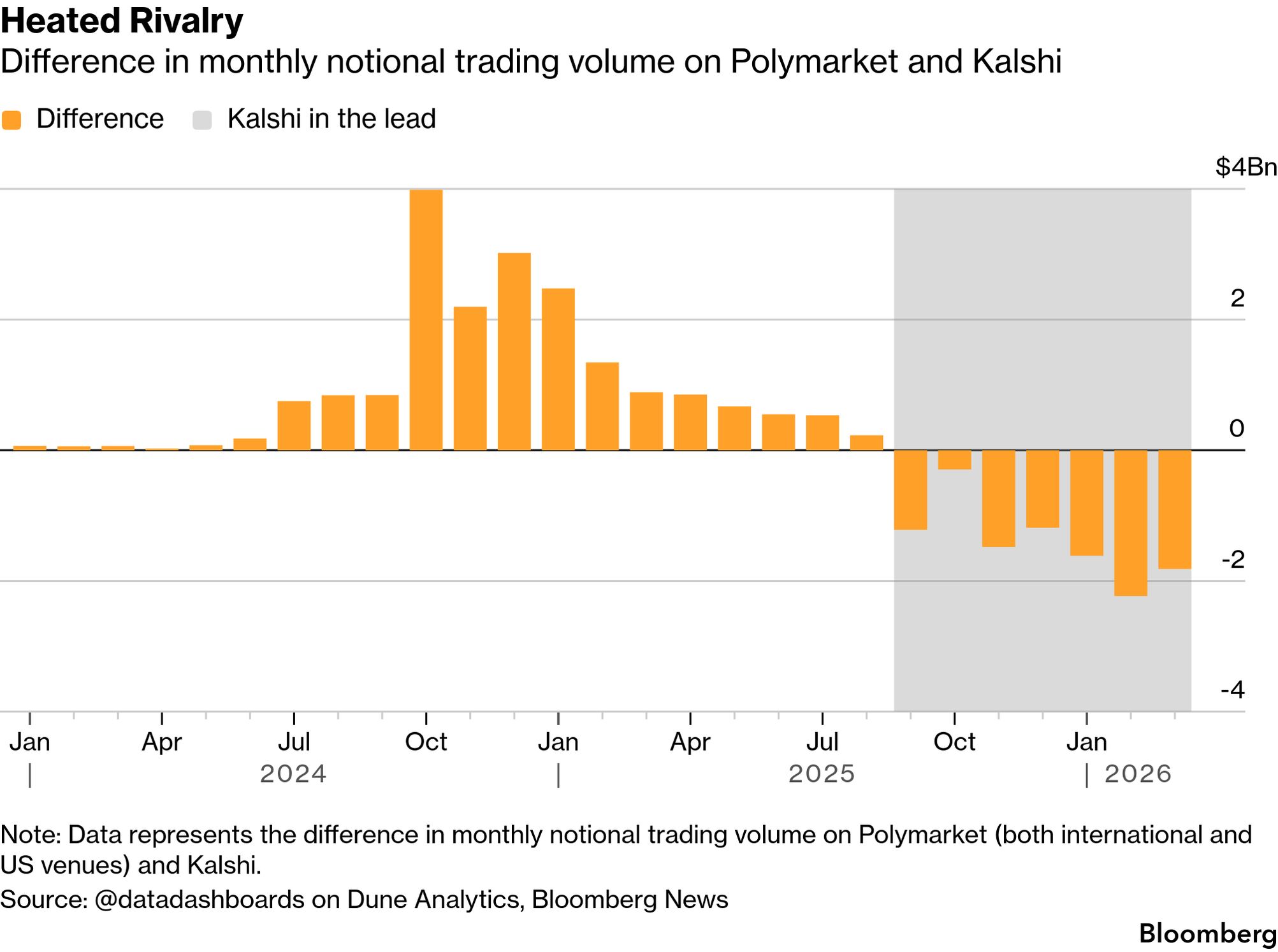
For most of the last few years, Polymarket had more trading volume than any other prediction market exchange, and it continues to grow and attract as much attention as any player in an industry it dominates along with Kalshi Inc. Recently, though, its global trading volumes have been eclipsed by those of its main rival, according to user-compiled data on Dune Analytics.
Kalshi also moved ahead of Polymarket when it announced new fundraising last month that pushed its valuation to $22 billion. Polymarket was recently valued at $15 billion when it received a $600 million investment from ICE, Bloomberg reported this week.
Source: @datadashboards on Dune Analytics, Bloomberg News
Note: Data represents the difference in monthly notional trading volume on Polymarket (both international and US venues) and Kalshi.
Gaffes, delays in product rollouts and Coplan’s unconventional management style are contributing to the strains on various fronts, said the people, who asked not to be named describing private business relationships.
An anything-goes spirit pervades the prediction market space and no purveyor — including Kalshi — has been immune to growing pains, as state officials fight to shut down the exchanges in court and critics accuse them of escalating a gambling epidemic.
But while Kalshi has recently gone to pains to paint itself as a friend to regulators and big institutions, Polymarket has stood out for its willingness to buck regulatory and financial conventions. It has let customers wager on topics — like war and nuclear detonations — that its competitors and some lawmakers have said should be illegal. It has also been slower than rivals to crack down on insider trading and continues to rely on a blockchain network on its offshore exchange that allows users to operate pseudonymously.
The brash attitude was a selling point during its meteoric ascent, giving it a reputation as a crypto-native disruptor, a prized quality in Silicon Valley and among people close to President Donald Trump. The president’s son is an adviser and investor, through the venture fund 1789 Capital, where he’s a partner. Now, though, those same qualities are creating tension as the nascent industry tries to go mainstream.
“What worked to this point isn’t what will push Polymarket and the prediction market industry to the next stage,” Matt Lamers, a data analyst at prediction markets analytics platform EventWaves, wrote in a recent post on Substack chiding the company for being out of step with the industry on several issues. “As a huge believer in prediction markets, I hope Polymarket starts acting more responsibly.”
A spokesperson for Polymarket said the company is taking a deliberate approach, and that new technologies take time to mature.
“As a company, we’re focused on safety and integrity,” the spokesperson said. “We’d rather be slower and methodical, than just launching and causing issues.”
Prediction markets like Kalshi and Polymarket are booming. They also face a widening legal battle with US states and criticism over alleged user insider trading. Here’s how they got so controversial. Source: Bloomberg
Many of the challenges relate to Polymarket’s difficulty launching in the US, the single biggest market, and one where its competitors are already operating. Its offshore exchange made it an industry leader when US regulators were holding back domestic prediction markets. Now, though, the center of gravity has moved to the US after the Trump administration embraced the industry.
Polymarket’s US app, which it has been teasing since last year, remains in beta mode with relatively little trading, despite securing the necessary licenses. The slow progress has been due, in part, to the blockchain-based architecture of Polymarket’s international exchange, giving it a separate set of challenges from its primary rivals, people familiar with the planning said. Meanwhile, smaller competitors that came later have already launched fully operational US platforms.
The chief executive officer of ICE, Jeffrey Sprecher, said in an interview that he remains a believer in the potential of the business, and the independent, entrepreneurial approach of Coplan — who he called a “genius.” He has, though, offered Coplan advice on what they should do to enter the US more quickly.
“You’re not going to be a prime time company unless you can access the US legally,” Sprecher recalls telling Coplan about the company’s efforts to enter the US. “They are starting to realize this isn’t easy.”
ICE invested $1 billion in Polymarket last year at a $9 billion valuation. Last month, the exchange operator said it invested an additional $600 million, showing a willingness to provide funding at the higher valuation of $15 billion, according to people familiar with the deal.
Jeffrey Sprecher on the floor of the NYSE on Nov. 13, 2025. Photographer: Michael Nagle/Bloomberg
While Coplan’s quirks are in many respects standard fare for charismatic tech CEOs, some business associates, who declined to be named discussing private meetings, expressed frustration with his focus and timing. He is regularly late to private meetings, has attended at least one of them barefoot, and is easily distracted, texting and taking phone calls in the middle of conversations, the people said.
He has been late to public functions and the company’s biggest promotional event, a pop-up bar in Washington, received negative media coverage for a rough opening after numerous technical snafus. A few weeks earlier, the company’s first pop-up promotion — a grocery store — also opened late.
The company, meanwhile, has backtracked and apologized for botched launches, including a recent rollout of new fees that surprised and confused many customers, according to posts on its chat boards.
“The rollout was terrible,” a person identified as a Polymarket employee wrote on the company’s official Discord chat room for customers. “We’re adding way more checks before anything like this can be pushed out in the future.”
On Monday, trading on the exchange went down for more than an hour, as part of a scheduled restart that was expected to last five minutes. Over the weekend, the company said it was delaying an upgrade of its exchange infrastructure for at least a week.
Such setbacks may be temporary: even well-funded startups experience technical issues. The Polymarket spokesperson said that it would not be possible to “build the most interesting consumer financial product of the last few years without being a methodical operating machine.”
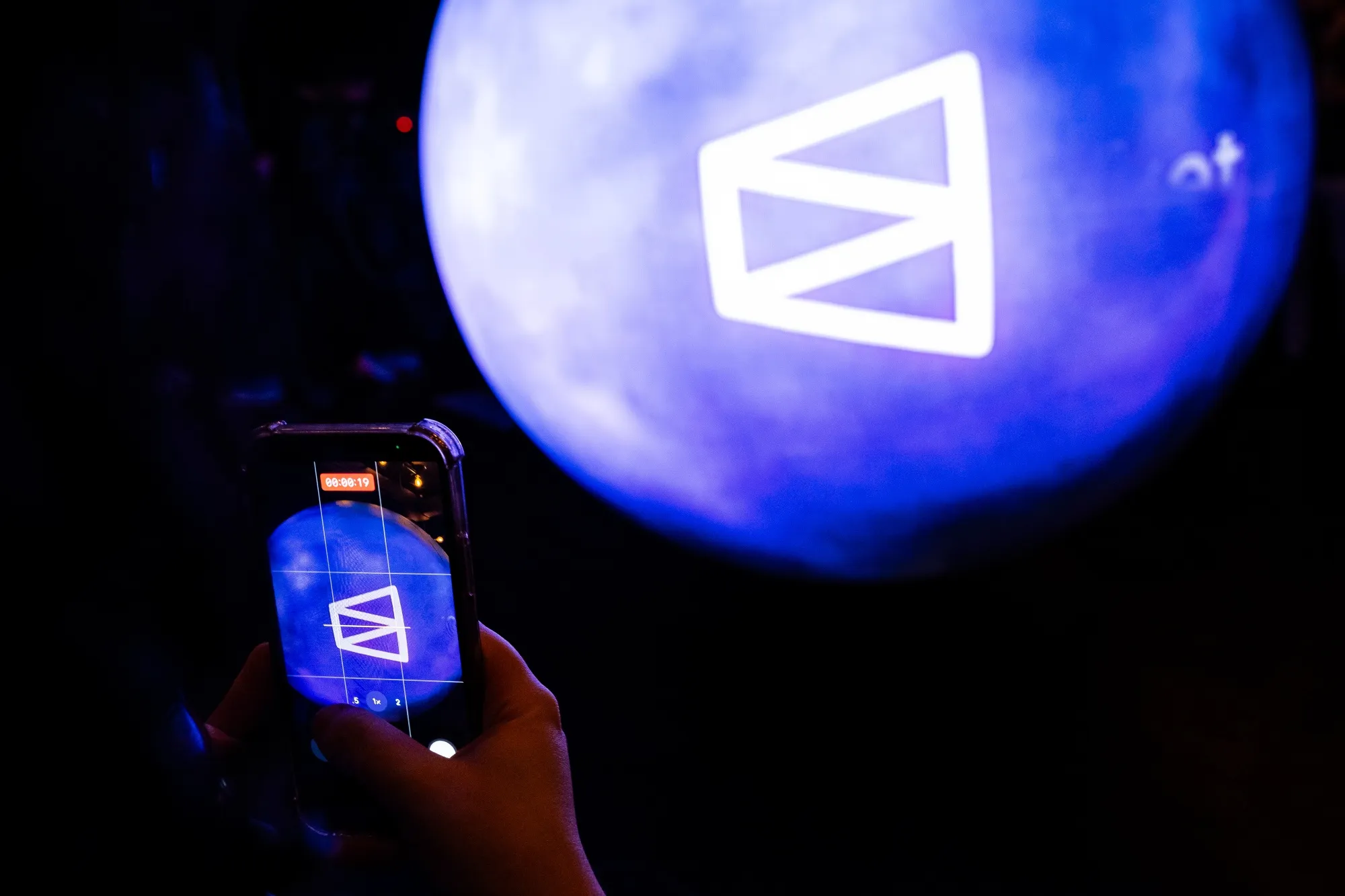
An attendee takes photos of the Polymarket logo during the opening of The Situation Room by Polymarket pop-up bar in Washington. Photographer: Graeme Sloan/Bloomberg
Rivals have been looking to capitalize on the growing list of problems. The head of the Coalition for Prediction Markets, which represents Kalshi and a number of other large players in the industry, recently took to social media to distance the coalition from Polymarket.
“Good to see the press differentiating between unregulated platforms where these scandals keep happening and U.S.-based regulated ones, where they don’t,” the coalition’s head, Sean Patrick Maloney, wrote on social media in response to a recent news story about alleged insider trading on Polymarket.
The current difficulties are hardly the first hurdles that Polymarket has faced, and it has overcome big ones in the past. In 2022, the startup reached a settlement with US regulators that forced it to shut off US customers. Two years later, the FBI raided Coplan’s apartment as part of a probe into Polymarket’s adherence to the settlement.
The Trump administration later dropped the probe and Sprecher has said that the way Coplan handled the FBI raid showed that he had real “grit.”
Kalshi picked a different path and spent those earlier years challenging the Commodity Futures Trading Commission to win US approval for regulated contracts, which allowed it to take off once the Trump administration signaled that it would allow the markets to expand more quickly in the US. The exchange’s most popular topic for trading is sports, setting the stage for its legal standoffs with states.
Coplan has been indicating that Polymarket was preparing to launch its regulated US business since last summer, when it purchased a CFTC-regulated exchange and opened a waiting list for customers.
“I’ve waited a long time to say this: Polymarket is coming home,” he wrote on social media in July.
Polymarket has acquired QCEX, a CFTC-regulated exchange and clearinghouse, for $112 million.
This paves the way for us to welcome American traders again.
I've waited a long time to say this:
Polymarket is coming home 🇺🇸🦅 pic.twitter.com/Qjd5ZbUwKi
— Shayne Coplan 🦅 (@shayne_coplan) July 21, 2025
Some analysts were surprised when the US app didn’t launch by the beginning of the football season last fall, a crucial time for sports betting, and even more when the Super Bowl and March Madness came and went. This has been more glaring because DraftKings and FanDuel, two gambling companies, both got their own prediction market operations up and running before the Super Bowl.
“I know from even before they launched here, their plan was to have product parity with Kalshi by the Super Bowl,” said Jordan Bender, managing director of gaming equity research at Citizens. “Clearly that didn’t happen. And I think a lot of it is the infrastructure is taking a long time to get up and running.”
Select customers have been invited to use a test version of the US app, but the volumes were roughly one-twentieth of Kalshi’s in March, according to the Dune data.
Isaac Rose-Berman, a consultant on gambling and prediction markets, said that “it’s frankly embarrassing” that a company of Polymarket’s size would not have a functioning US app. “As of right now, they’ve done a poor job onboarding liquidity. There are problems with their matching engine. User experience is bad,” he said.
In the meantime, Polymarket’s international exchange has come under scrutiny for skirting US rules. Its blockchain system allows people to sign up without the identity checks required by regulated financial exchanges. While its terms of service bar US customers, traders have spoken publicly about circumventing the company’s restrictions by using a virtual private network that obscures a user’s location.
The company has also offered controversial products that are not available elsewhere. It apologized last month for listing a contract tied to the likelihood of downed US pilots in Iran being rescued — what critics called a “death contract.” It has, though, continued to offer other markets tied to military conflict, which Kalshi and other exchanges have said they consider to be illegal in the US. Democrats in Congress sent a letter to the CFTC urging the agency to intervene to stop Polymarket.
“We don’t want to stifle the value of social good that can come out of these markets, on important geopolitical events,” the Polymarket spokesperson said. “That said, we also are extremely focused on the integrity of our markets and are fully collaborative with all relevant law enforcement authorities.”
The company has spent relatively little on lobbying in Washington relative to other big players in the space.
Still, Coplan was invited in February to join the CFTC’s new Innovation Advisory Committee. Polymarket has also struck major marketing partnerships with media companies and top-tier sports leagues. It agreed to pay more than $200 million to become the official prediction market partner of Major League Baseball, according to a person familiar with the deal.
Sprecher said that he understands the risks that come with Polymarket’s bold strategy, but also thinks it offers huge upside, which he expressed through the kind of odds that Polymarket itself might offer.
“My Polymarket on these things is either a complete wipeout or they are going to be home runs,” Sprecher said. “And obviously we are betting they are going to be home runs.”
Kalshi Inc. is getting closer to launching a new product that will take it deeper into crypto trading with so-called perpetual futures.
The prediction market firm plans to launch the product, tied to the prices of cryptocurrencies, in the coming weeks, according to a person familiar with the plans who was not authorized to discuss non-public information. The products will be Kalshi’s first foray beyond the event contracts it offers on its prediction markets.
The company has turned event contracts into a booming new industry, offering a way to bet on the outcome of real-world events like sports games and elections.
Kalshi already allows customers to wager on the future price of crypto tokens using its standard event contracts. Crypto trading has become one of the fastest-growing categories on Kalshi with monthly volumes surpassing $1 billion in March for the first time, according to user-compiled data on Dune Analytics.
Perpetual futures, on the other hand, are a type of derivative with no expiration date, made popular by the crypto industry. Perps, as they are known, are attracting interest from traditional financial firms and the chair of the Commodity Futures Trading Commission, Kalshi’s regulator, has said recently that he hopes to bring them under the agency’s oversight soon.
Kalshi plans to first offer perpetual futures on crypto prices before expanding into commodities and other asset classes, the person said. Bitcoin and several other cryptocurrencies are expected to be included at launch, the person added. The launch was first reported by The Information.
The company plans to accept US dollars as collateral for its perpetual products, the person said, with the goal of introducing stablecoin collateral as soon as the second quarter.
An event to celebrate the launch was expected to occur on Monday but was postponed, the person said. A Kalshi spokesperson declined to comment.
Kalshi last month secured a license allowing it to offer margin trading, an important step toward attracting sophisticated institutional investors and a prerequisite for launching perpetual futures.
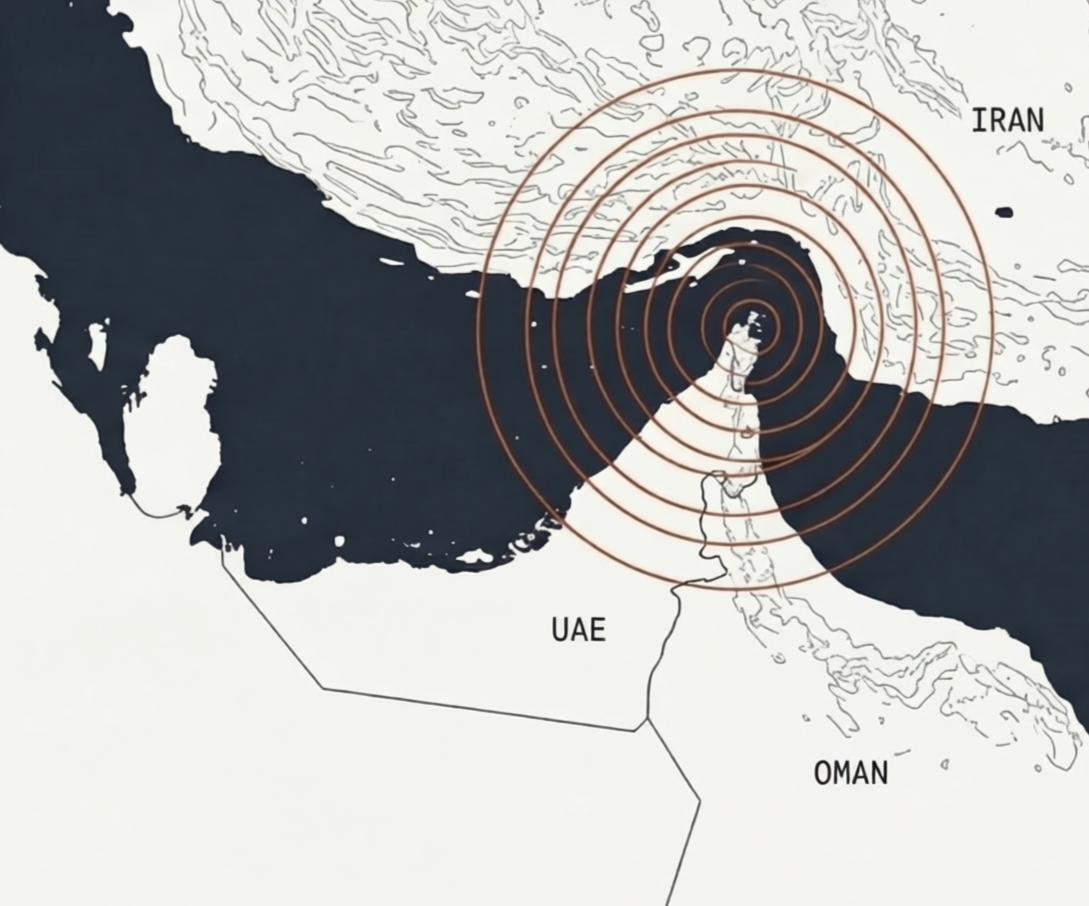
This is the third and final article in my Hormuz Strait March 2026 Analysis Series.
In the series, I break down the wider architecture of vulnerability behind Hormuz, trace the real transmission channels from Gulf disruption into the global economy, explain how different prediction markets are pricing different slices of the same crisis, and test whether these contracts have genuine economic value as hedging instruments.
💡 Sign up to Receive Future Updates and Articles if You Haven’t Done So.
Sign up for Prediction Markets
Your complete guide to prediction markets: how they work, where to trade, why they matter, and current updates.
Click on the Bookmark to read Article 2 of the Series
This piece asks a simple question: do Hormuz event contracts actually work as hedges? I test them against real commodity-linked exposures and compare where they help, where they fail, and why.
The answer is more conditional than it first appears. Some contracts do contain real hedging value. But they are also highly volatile instruments, and the contracts that look best on paper do not always protect the portfolio when stress actually hits.
Setup
The aim of this article is to assess the effectiveness of using Hormuz-related event contracts to hedge against conventional commodity exposure (i.e. usual business exposure) from the perspective of different economic agents, namely: an Asian airline operator, a crude oil exporter in the gulf, and a European oil trading company.
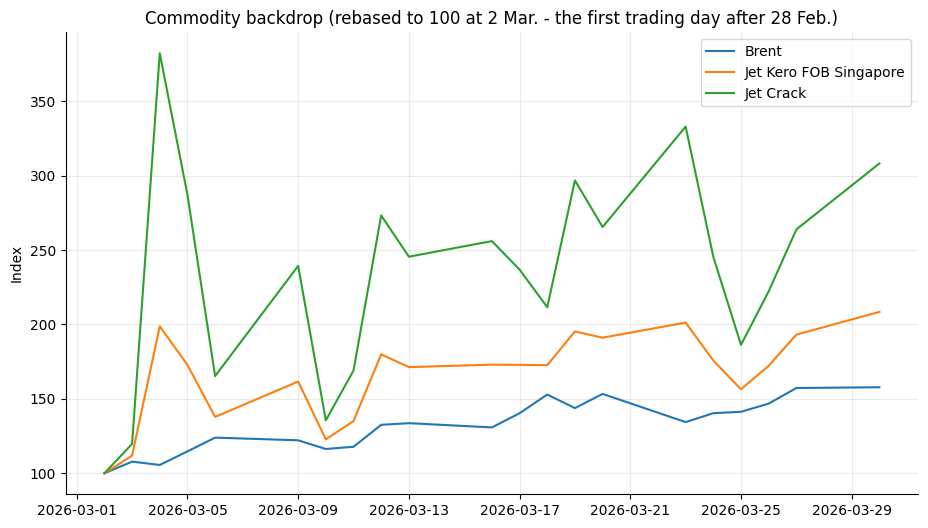
Jet crack = Jet Kerosene Spot Price - Brent Spot Price, which reflects the refining premium of jet fuel.
In practical terms, this exercise compares an unhedged commodity-only position with a two-leg portfolio that adds the event contract. Daily P&L is measured using changes in the commodity price and changes in the event-contract price (which approximates the probability of the event happening).
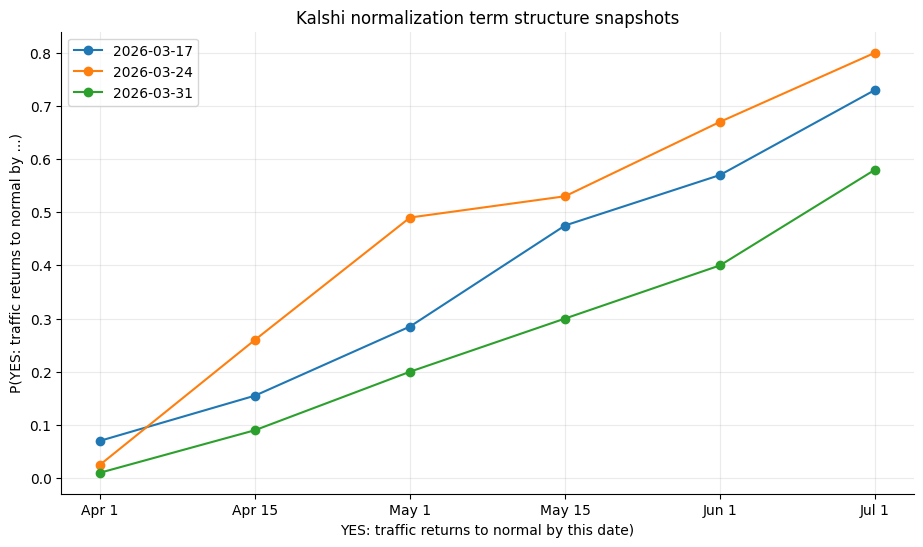
The market prices indicate lower probabilities of Hormuz Strait normalization at the end of March.
Estimating hedge ratio
In the two-leg portfolios, the event contract notional is multiplied by a factor (i.e. the hedge ratio), so that the event leg is large enough to matter in the portfolio to provide a hedging effect.
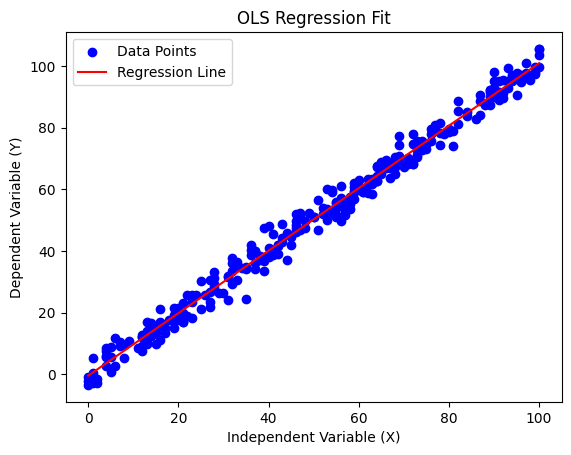
The OLS method is used. It estimates the hedge ratio by regressing daily commodity-leg P&L changes on daily event-contract price changes, then uses the fitted coefficient to size the event leg. This is closer to a standard minimum-variance hedge and usually gives more stable, easier-to-interpret results.
The aim of an OLS estimation is to find the line-of-best-fit based on available scatter points.
Portfolio demo using Kalshi's strait normalization contract
Asian airline operator
The airline portfolio is defined as short Jet Kero plus long NO on strait normalization.
The economic intuition is straightforward: if Hormuz disruption persists, prompt aviation fuel stress should remain elevated, hurting the fuel consumer but helping a position that benefits from delayed normalization.
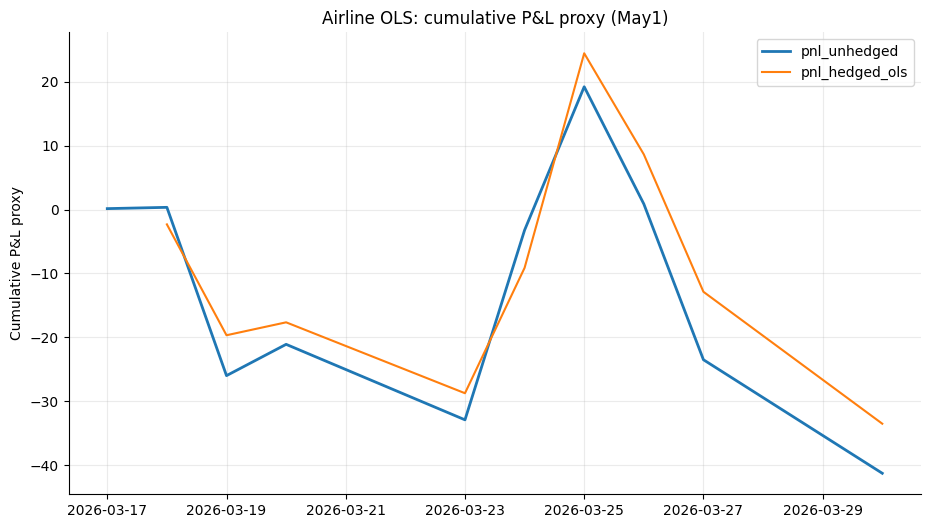
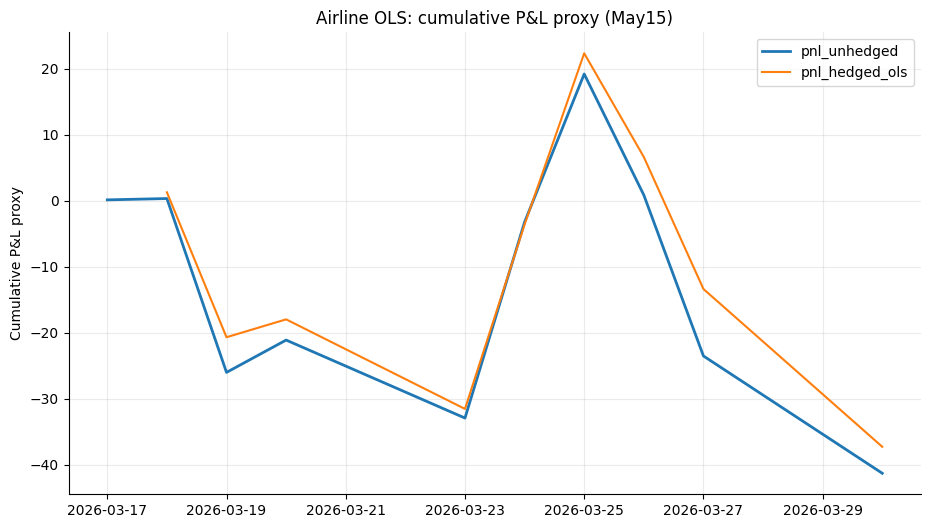
For short Jet + long NO on normalization, the 15 May tenor reduces volatility only marginally, from 19.15 to 18.26, but it does improve the worst day from -26.35 to -23.96. That is a meaningful tail improvement, even if the overall variance reduction is modest. In contrast, the 1 May tenor increases both portfolio volatility and worst day loss.
The implication is that the airline case does not support the idea of event contracts as a full daily hedge for jet exposure. At best, the normalization contract works as a small persistence overlay or tail-risk buffer.
This fits the economics. Airline fuel costs are driven not only by the existence of disruption, but also by refinery margins, regional product balances, and aviation-specific supply conditions. A normalization contract is therefore directionally relevant, but it is not tightly enough linked to prompt jet fuel pricing to serve as a strong day-to-day hedge.
Crude oil exporter in the gulf
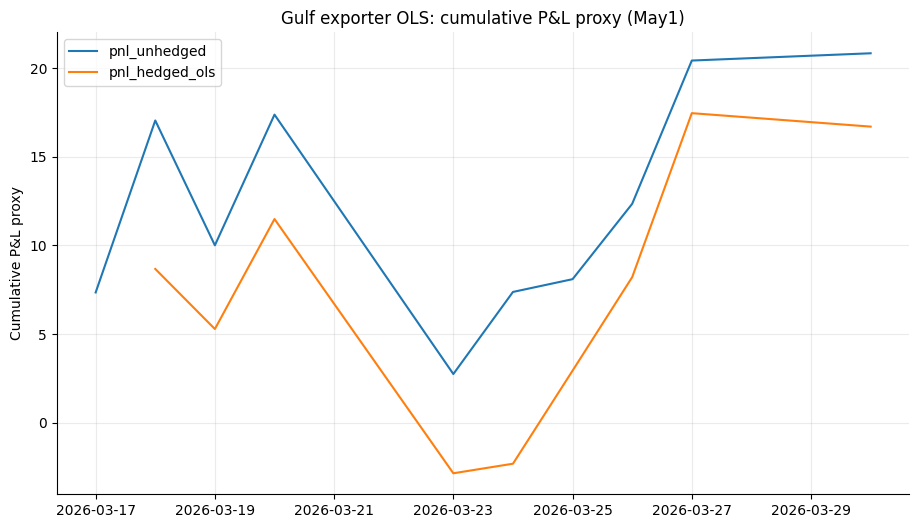
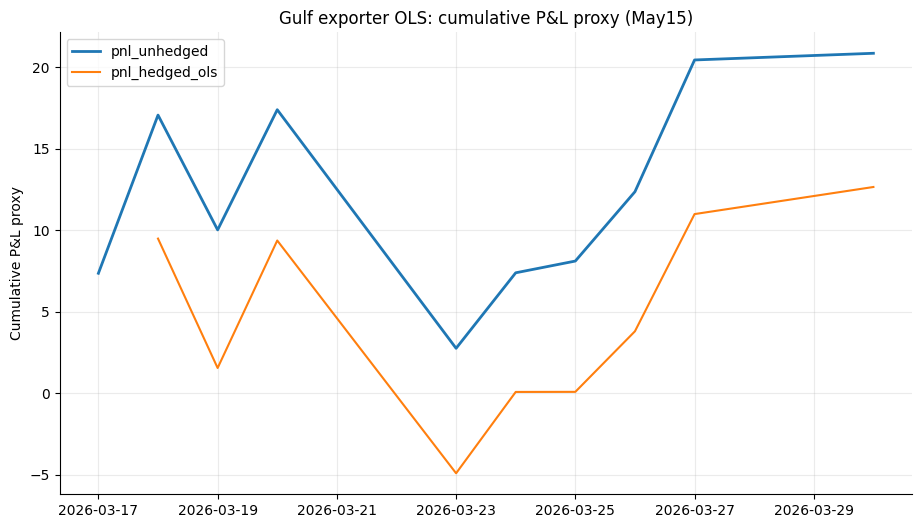
The Gulf exporter portfolio is defined as long Brent plus long YES on strait normalization.
This is not a conventional hedge in the usual sense. Instead, it is a stylized way of mapping the exporter’s two opposing exposures: a Gulf disruption can support crude prices, which is helpful, but it can also impair physical export access, which is harmful. The event leg is therefore meant to capture the route-access side of the business.
For Brent-linked portfolios, normalization contracts do show some hedge content. In the 1 May OLS results, long-Brent portfolios reduce volatility from 7.27 to 7.00, but the improvement in worst-day loss is very small, from -14.63 to -14.34. The 15 May tenor does better on the worst day, limiting the loss to -14.27. But it also increases the portfolio variance from 7.27 to 7.40.
The result is therefore best read as conceptually useful but quantitatively modest. The business logic is strong: Brent and normalization do map onto the two sides of the exporter’s exposure. But the event contract is not powerful enough, in this short sample, to generate a dramatic hedge improvement. It works better as a way to decompose the exporter’s risk into price and access, rather than as a stand-alone risk-reduction tool.
European oil trading company
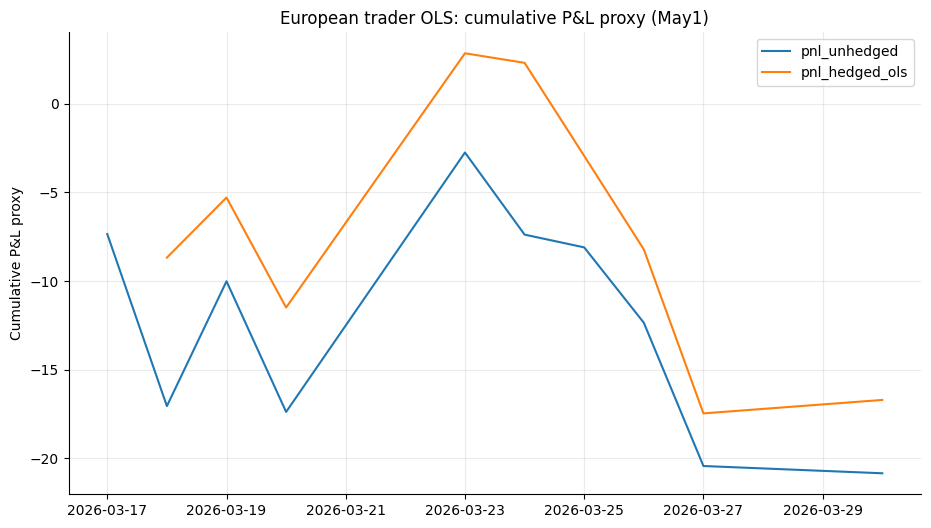
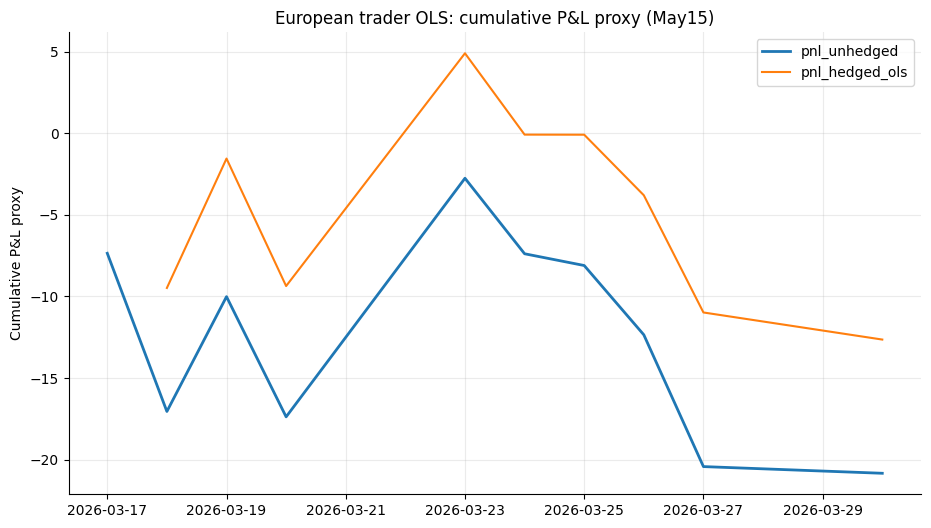
The European crude trading company is defined as short Brent plus long NO on strait normalization.
This is the cleanest case economically. A trader exposed to higher crude replacement costs suffers when disruption persists and crude prices rise. The portfolio therefore combines a commodity leg that loses when Brent rises with an event leg that gains when normalization is delayed.
The results show that this portfolio is actually the most convincing of the three.
The 1 May tenor reduces volatility from 7.27 to 7.00, and the worst day improves from -9.70 to -9.25. The improvement is not large, but it is consistent across both volatility and tail loss. This is the cleanest example of a normalization contract acting like a real hedge rather than just a directional overlay. However, the 15 May tenor increases the portfolio variance from 7.27 to 7.40, but the worst day loss reduces from -9.70 to -9.48.
Limitations
The commodity legs are only proxies for real business exposure. Platts Jet Kero FOB Singapore Price is used to represent airline fuel risk exposure, and Europe Spot Brent Price (data from U.S. EIA) is used to represent crude-linked exporter and trader risk. In practice, each business would face a much more complex exposure set.
The sample window is short and event-specific. The portfolio tests are concentrated in a narrow March 2026 window, which means the estimated relationships are heavily shaped by one crisis regime. This is especially important for the OLS results, since the fitted hedge ratios reflect co-movement within this particular episode instead of a stable long-run relationship.
From curious to confident. Join the sharpest forecasters online, get top contracts, platform updates & market signals - free.
The section above uses the data for the event 'When will traffic at the Strait of Hormuz return to normal?' on Kalshi for illustration. To see how the portfolios perform when the commodity leg is combined with other Hormuz-related contracts on Kalshi, I conducted more analysis and summarized the metrics in the Excel file below.
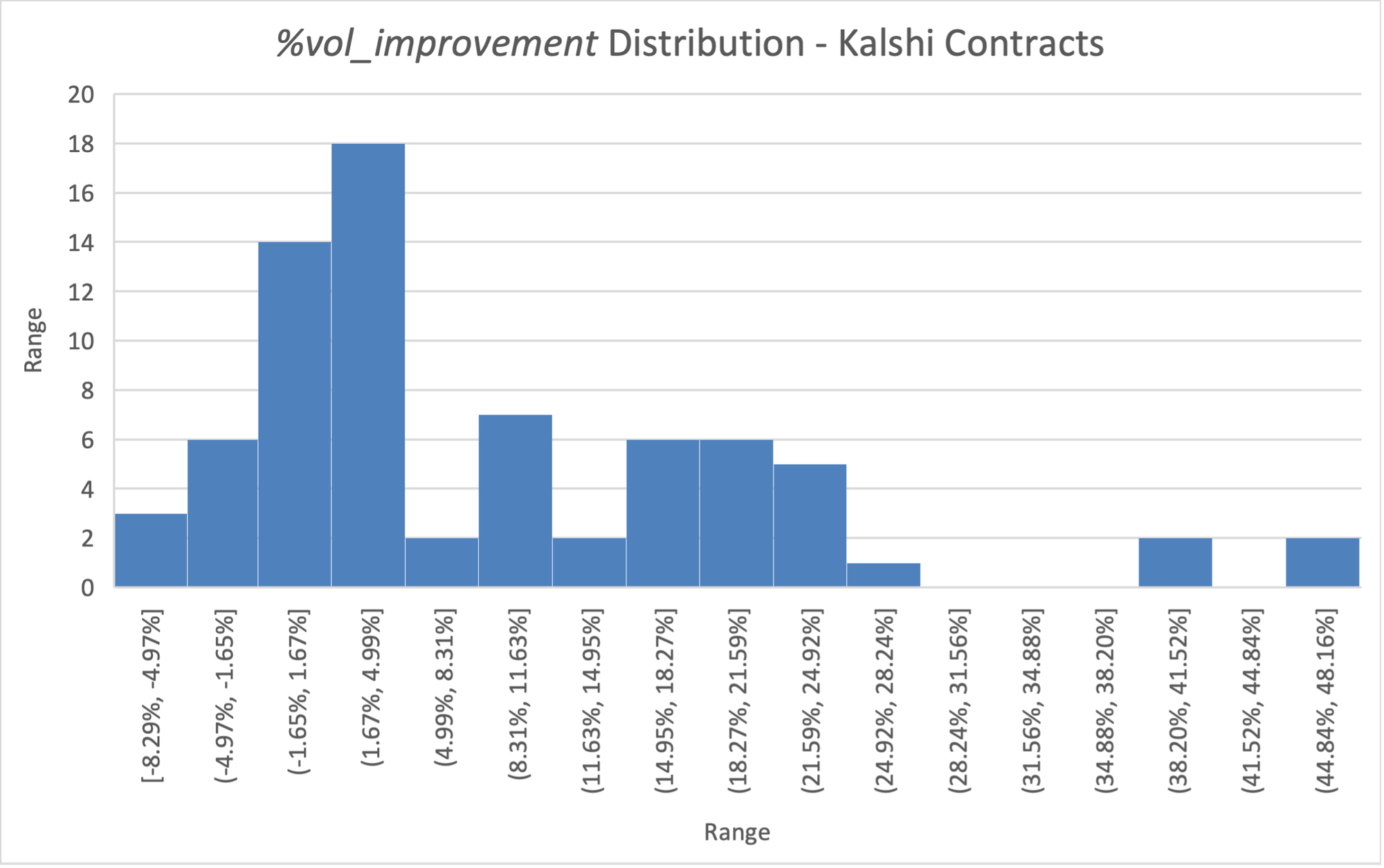
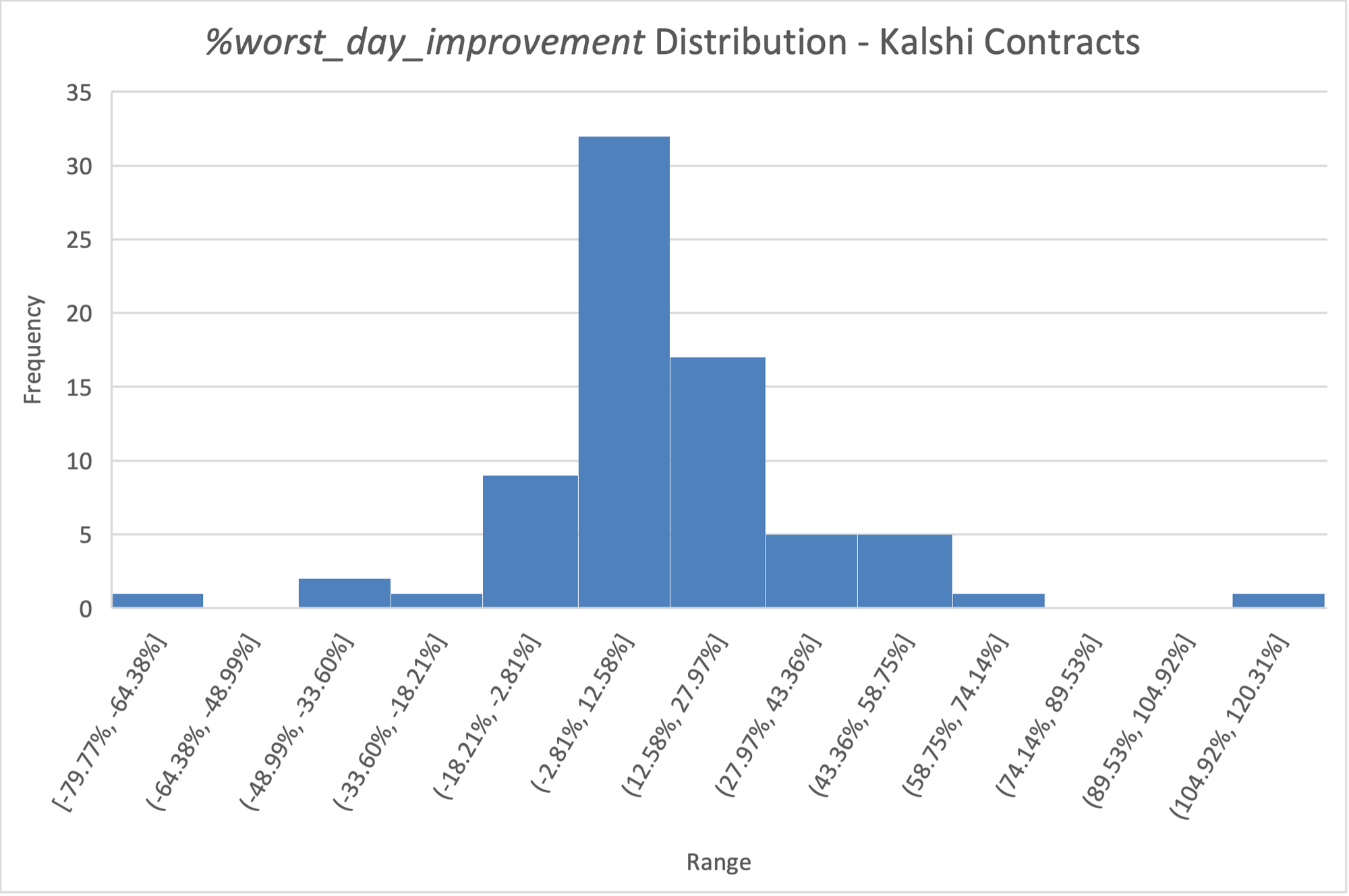
Across all 74 combinations, 62 reduces the overall portfolio volatility. On the other hand, 45 improves the worst-day performance, while 18 worsens the worst-day loss and the remaining 11 has the same worst-day performance.
The comparison shows three main patterns.
First, not all event contracts hedge equally well. The strongest headline improvements in volatility often come from traffic-based contracts, but many of these results are based on very short effective samples of only 6 observations as many contracts are weekly contracts, and some of the best-looking volatility reductions are paired with worse worst-day outcomes. That means some contracts look attractive on variance alone but do not actually protect the portfolio on the most adverse days.
Strait normalization contracts
Average of n_obs
9.67
Average of %vol_improvement
2.01%
Average of %worst_day_improvement
2.54%
Strait traffic contracts
Average of n_obs
7.88
Average of %vol_improvement
11.45%
Average of %worst_day_improvement
12.04%
All contracts
Average of n_obs
8.31
Average of %vol_improvement
9.15%
Average of %worst_day_improvement
9.73%
Second, the results confirm that Brent-linked portfolios are easier to hedge than jet-linked portfolios. Across the tested combinations, event contracts generally fit better with crude-related exposures than with outright jet fuel exposure. The airline-style cases often show either weak volatility improvement or a trade-off in which volatility falls but worst-day loss deteriorates.
'Long Brent' portfolios
Average of n_obs
8.32
Average of %vol_improvement
11.89%
Average of %worst_day_improvement
13.76%
'Short Brent' portfolios
Average of n_obs
8.32
Average of %vol_improvement
11.89%
Average of %worst_day_improvement
9.06%
'Short Jet Kero' portfolios
Average of n_obs
8.29
Average of %vol_improvement
3.46%
Average of %worst_day_improvement
6.23%
All portfolios
Average of n_obs
8.31
Average of %vol_improvement
9.15%
Average of %worst_day_improvement
9.73%
Third, the more stable and economically interpretable results tend to come from normalization contracts, even though their raw improvements are smaller than the traffic-related contracts. These contracts usually do not deliver dramatic hedging gains, but they are less likely than short-lived traffic thresholds to produce extreme metrics. In that sense, they seem more useful for representing the broader state variable of disruption persistence, rather than for mechanically minimizing short-window variance.
Strait normalization contracts
Average of n_obs
9.67
Standard Deviation of %vol_improvement
6.97%
Standard Deviation of %worst_day_improvement
13.26%
Strait traffic contracts
Average of n_obs
7.88
Standard Deviation of %vol_improvement
12.57%
Standard Deviation of %worst_day_improvement
28.61%
All contracts
Average of n_obs
8.31
Standard Deviation of %vol_improvement
12.13%
Standard Deviation of %worst_day_improvement
25.97%
A practical implication follows. The “best” contract should not be chosen by volatility reduction alone. A more credible hedge candidate is one that improves both overall stability and stress-day performance, while also being supported by a reasonable sample length.
Portfolio Demo Using Polymarket Contracts
I combined the commodity leg with selected Hormuz-related contracts on Polymarket. The portfolio performance metrics are summarized in the Excel file below.
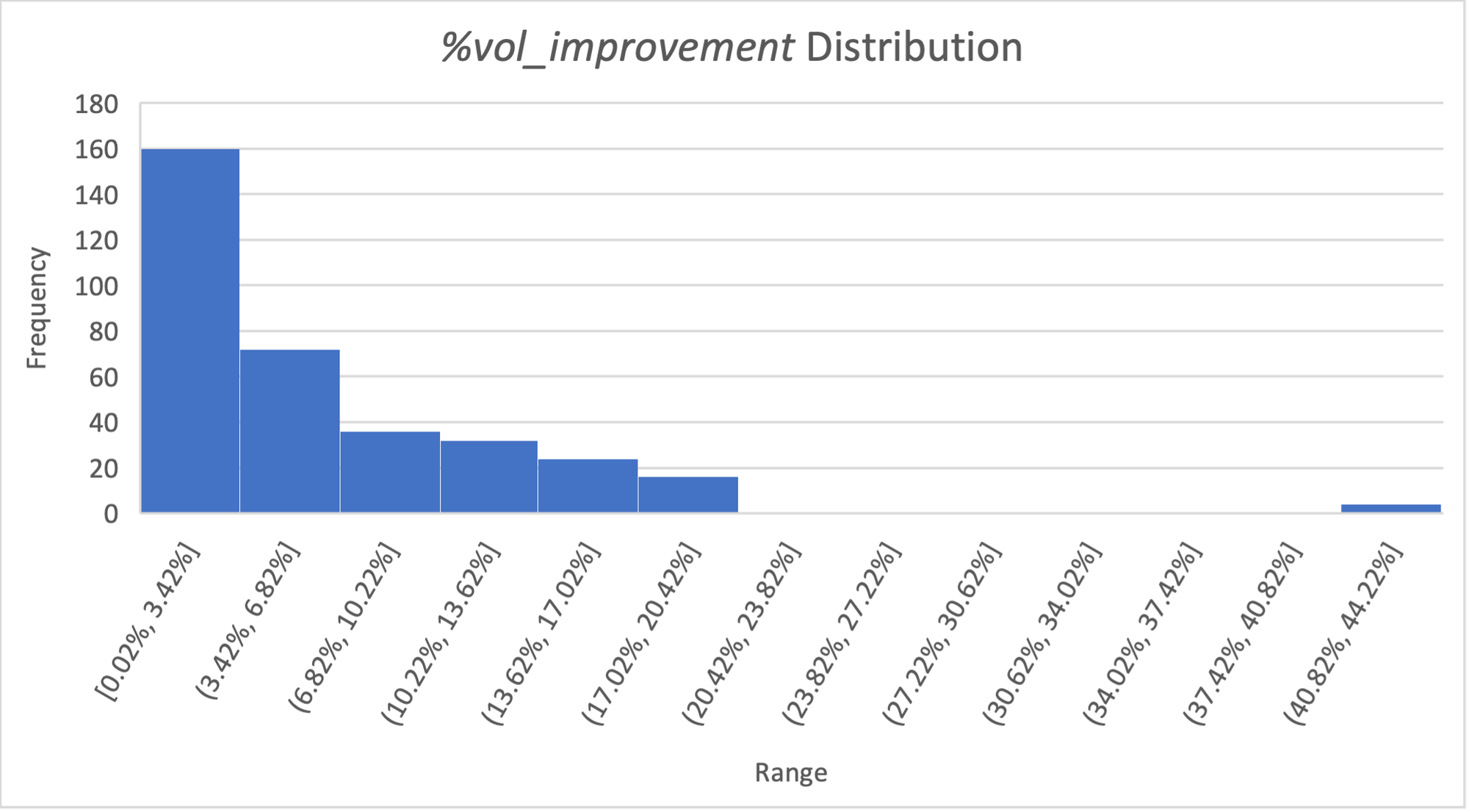
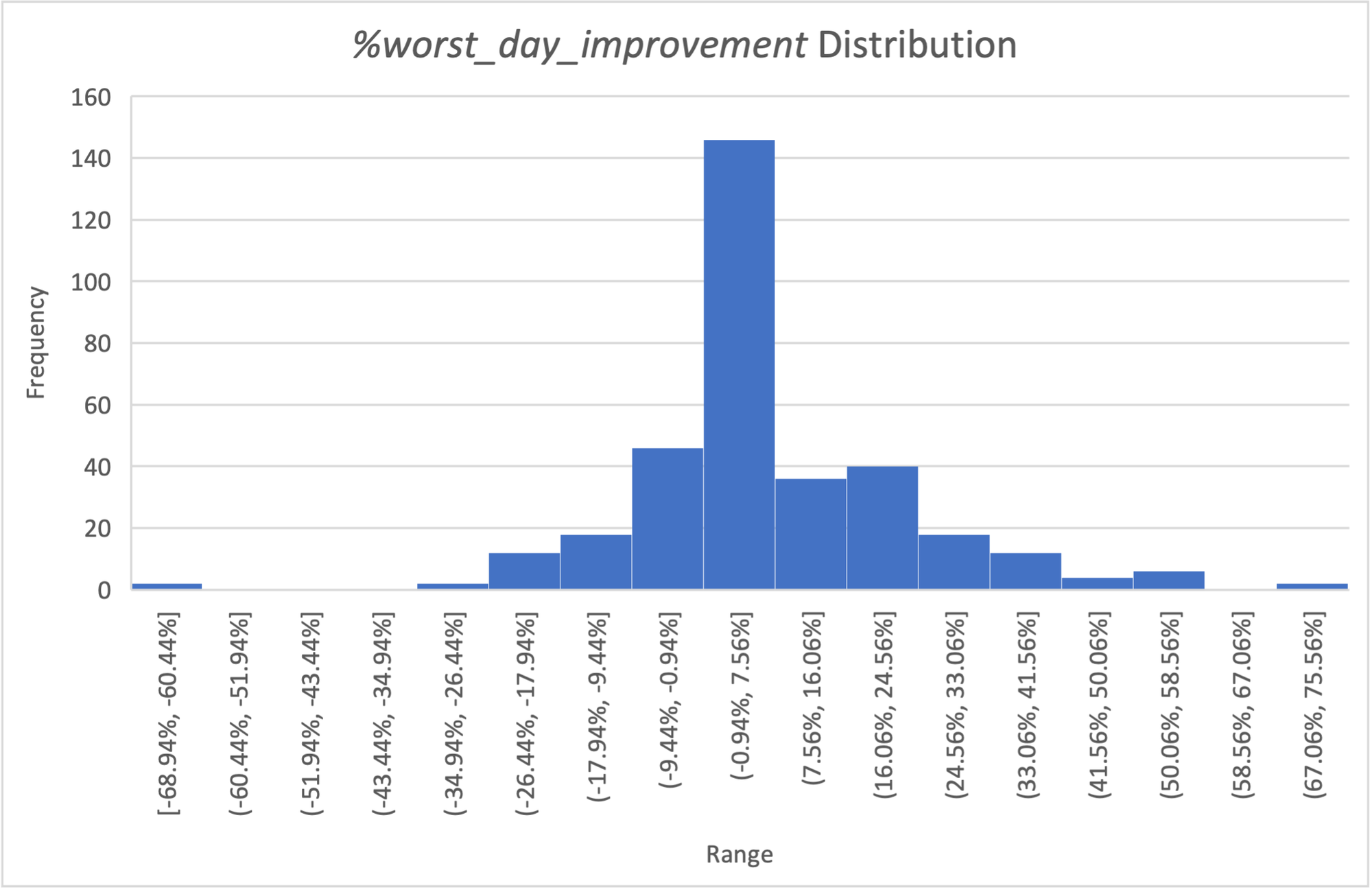
When using Polymarket contracts, the event contracts work much better as hedges for Jet Kero than for Brent. Across the eligible set, the average percentage volatility reduction is about 6.89% for both long and short Jet Kero, versus only about 4.51% for both long and short Brent.
The sample is also fairly short, with 344 eligible combinations ('eligible combinations' means combinations with number of observations greater than 5), a median of 11 observations, and a range of 5 to 22 days, so the strongest results should be treated as directional rather than definitive.
'Long Brent' portfolios
Average of n_obs
12.66
Average of %vol_improvement
4.51%
Average of %worst_day_improvement
10.46%
'Long Jet Kero' portfolios
Average of n_obs
10.59
Average of %vol_improvement
6.89%
Average of %worst_day_improvement
4.17%
'Short Brent' portfolios
Average of n_obs
12.66
Average of %vol_improvement
4.51%
Average of %worst_day_improvement
2.68%
'Short Jet Kero' portfolios
Average of n_obs
10.59
Average of %vol_improvement
6.89%
Average of %worst_day_improvement
9.28%
All portfolios
Average of n_obs
11.43
Average of %vol_improvement
5.92%
Average of %worst_day_improvement
6.66%
The best-performing hedges are concentrated in ship traffic / ship count contracts and ceasefire contracts. By contrast, the contract family “US escorts commercial ship through Hormuz by...?” looks much weaker on average.
Avg. # of ships transiting Strait of Hormuz on April 3?
Average of n_obs
5.00
Average of %vol_improvement
9.10%
Average of %worst_day_improvement
6.61%
US x Iran ceasefire by...?
Average of n_obs
16.07
Average of %vol_improvement
7.44%
Average of %worst_day_improvement
11.31%
How many ships transit the Strait of Hormuz this week? (Mar 17-23)
Average of n_obs
10.00
Average of %vol_improvement
6.62%
Average of %worst_day_improvement
4.33%
Avg. # of ships transiting Strait of Hormuz end of April?
Average of n_obs
5.00
Average of %vol_improvement
6.28%
Average of %worst_day_improvement
5.51%
Avg. # of ships transiting Strait of Hormuz end of March?
Average of n_obs
15.50
Average of %vol_improvement
5.01%
Average of %worst_day_improvement
8.16%
How many ships transit the Strait of Hormuz this week? (Mar 10-16)
Average of n_obs
10.94
Average of %vol_improvement
4.61%
Average of %worst_day_improvement
6.32%
Strait of Hormuz traffic returns to normal by end of April?
Average of n_obs
15.50
Average of %vol_improvement
3.69%
Average of %worst_day_improvement
2.86%
US escorts commercial ship through Hormuz by...?
Average of n_obs
9.40
Average of %vol_improvement
2.08%
Average of %worst_day_improvement
1.37%
All
Average of n_obs
11.43
Average of %vol_improvement
5.92%
Average of %worst_day_improvement
6.66%
Every eligible combination shows a positive volatility reduction, which is reasonable because the hedge ratio is fitted in-sample by OLS. That means variance reduction is partly mechanical. The more informative metric is 'worst_day_improvement', and here the picture is mixed: 222 combinations improve the worst day, but 108 actually make it worse.
Bottomline
Hormuz event contracts are not fake hedges. But they are not clean hedges either. Their value is narrow, conditional, and highly path-dependent. They work best when they capture something ordinary commodity hedges miss, especially disruption persistence, recovery timing, or a specific operational state. That is why the strongest cases in the article are not broad “bet on Hormuz” trades, but targeted overlays tied to a clear business exposure.
The catch is that event contracts are highly volatile instruments in their own right. In many combinations, the hedge leg is so jumpy that adding it can raise total portfolio volatility rather than reduce it, even when the economic logic looks sound. That is exactly why some portfolios improve on the worst day while still becoming noisier overall. A contract can look brilliant in a summary table and still be a messy hedge in practice.
So the real lesson is not that Hormuz contracts “work” or “do not work.” It is that they work only when the contract design, the underlying exposure, and the sizing method all line up. Used carefully, they can hedge the state variable that commodity markets leave unpriced. Used carelessly, they just add another source of volatility to a book that was already hard to manage. These are not replacements for commodity hedging. They are precision tools, and precision tools cut both ways.
Weather Prediction Markets Are Booming. Can They Improve Forecasts?
Disclaimer: The content is for informational purposes only. You should not construe any such information or other material as legal, tax, investment, financial, or other advice. Nothing contained in this article constitutes a solicitation, recommendation, endorsement, or offer by the author(s) or any third party service provider to buy or sell any securities or other financial instruments in your or in any other jurisdiction in which such solicitation or offer would be unlawful under the securities laws of such jurisdiction. The author(s) report(s) no conflict of interest.
Charles Schwab Corp. is likely to launch prediction markets linked to financial events as competitors including Robinhood Markets Inc. expand their presence in the space.
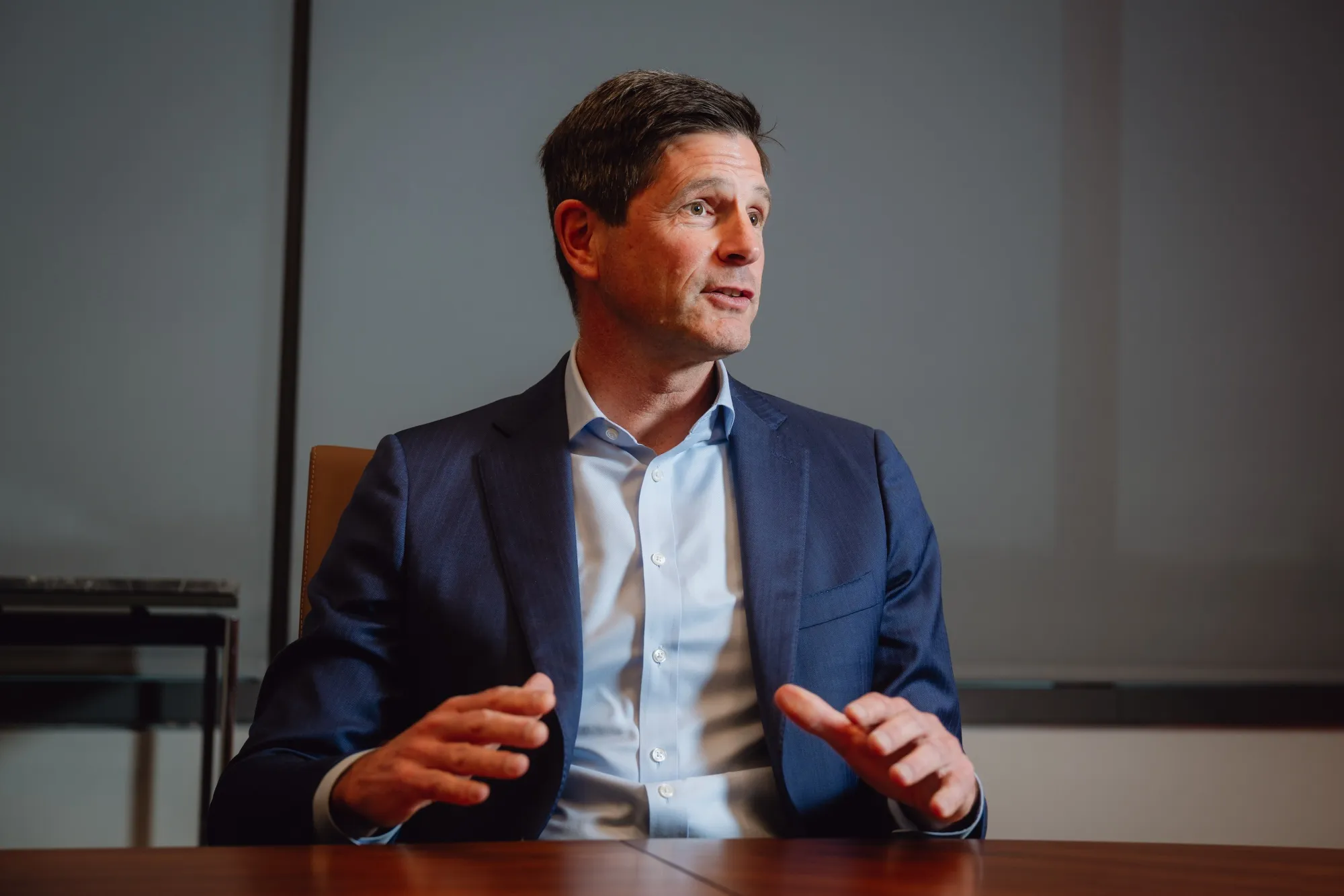
Schwab is “taking a hard look” at prediction markets, Chief Executive Officer Rick Wurster said on a conference call Thursday, but would stay away from allowing customers to place wagers on sports or pop culture given the firm’s focus on building clients’ long-term wealth.
Rick Wurster Photographer: Desiree Rios/Bloomberg
“Prediction markets that are not aligned to that are not something we want to pursue,” Wurster said on the call with analysts to discuss first-quarter results.
Prediction markets are not on the top of clients’ lists of demands, he said, but Westlake, Texas-based Schwab is “ready to move when and if needed, and when we do, we’ll stay away from gambling.”
Every quarter, Wall Street’s hordes of analysts engineer financial models, parse alternative data and jostle for access to executives as they attempt to predict company earnings. New research suggests the anonymous bettors on Polymarket might give them a run for their money.
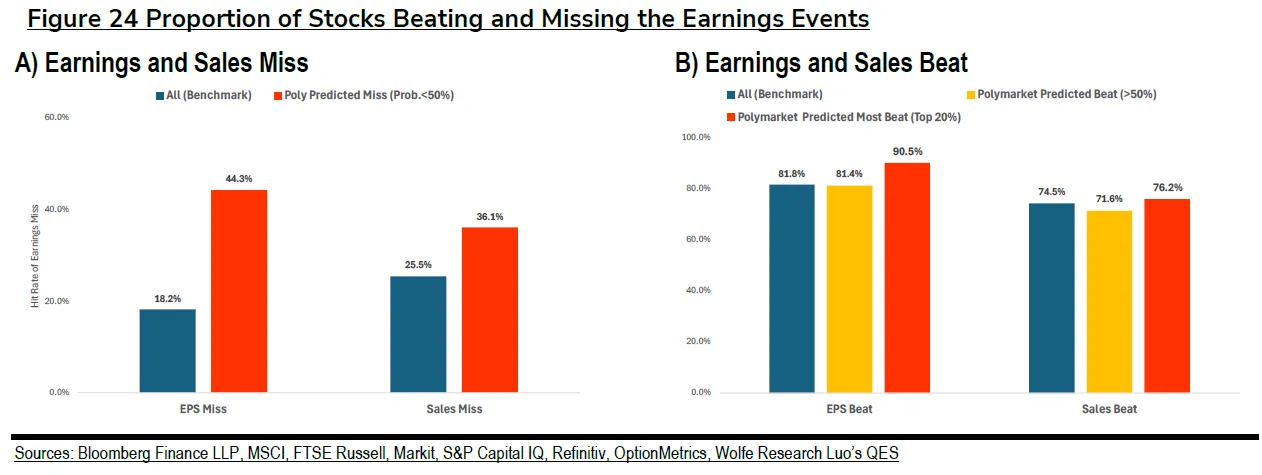
A report from brokerage Wolfe Research finds that when Polymarket users bet that companies are likely to miss earnings estimates, the firms do so at a rate of 44%, more than double the historic benchmark of 18%. When bettors are very confident that a company will exceed estimates, that comes to pass 90% of the time, above the 81% norm.
“The accuracy is possibly due to crowdsourcing,” Yin Luo, who runs quant research at Wolfe, wrote in an email. “In this case, investors betting on Polymarket earnings releases are likely to be much more diverse than consensus earnings (which are based on only sell-side analysts).”
Source: Wolfe Research report Source: Wolfe Research
It’s the latest indication that prediction markets may be a useful source of information for investors, and one day emerge as a rival to sell-side analysts, whose job it is to forecast earnings. A working paper from London Business School and Yale University researchers updated in early April concludes that the nascent platforms are highly accurate, incorporate new information more quickly than analysts and avoid some of the biases built into Wall Street estimates.
The researchers propose that prediction markets may be especially accurate because users are putting their own money on the line, and they uncovered signs that those who wager on earnings markets are unusually sophisticated. They also suggest that insider trading may be a factor.
Whatever the driving force behind the performance, the two studies underscore the promise of earnings-linked event contracts, which so far account for only a small fraction of activity on platforms like Polymarket and its chief rival, Kalshi. The research bolsters the companies’ argument that while sports betting constitutes a majority of their volume, these novel derivatives will eventually play a major role on Wall Street.
Predicting whether or not a company will beat earnings forecast can be complicated. For one, the vast majority of stocks routinely beat estimates, in part because corporate executives are incentivized to guide expectations lower in hopes of generating a surprise positive performance.
Since September, Polymarket has allowed users to wager on earnings via yes-or-no contracts on whether certain large stocks will beat the consensus estimate. In order to compare the accuracy of those bets to Wall Street estimates, Wolfe looked at about 430 earnings releases covered by Polymarket, or roughly a quarter of such events for Russell 1000 names over the time period.
“The signal they generate will offer an increasingly rich and high-frequency lens through which to study information aggregation, belief formation, and the pricing of uncertainty across virtually every domain of event space that moves the market,” the Wolfe researchers wrote of prediction markets.
While exchange operators and other financial players are investing heavily in prediction market platforms, it’s still early days. Earnings markets had just $795,315 in volumes on Polymarket in the most recent week, or 0.03% of the total, according to user-compiled data on Dune Analytics.
Vinesh Jha, who runs an alternative data platform that also crowdsources earnings estimates, said he can see Polymarket being used as a complementary source of information. But it’s likely too early for wide adoption as an input into quantitative fund managers’ trading systems.
“The beat/miss dichotomy is less interesting than knowing what earnings will be (and, further, what the market reaction will be),” the founder of ExtractAlpha wrote in an email. “It’s far too soon to tell, and this data is much too thin.”
The study revised earlier this month by LBS and Yale academics sheds light on why earnings markets might be accurate despite having muted volumes. Users who bet on earnings tend to make money on prediction markets, while most traders lose, suggesting the former might be particularly sophisticated.
“Informed traders need uninformed traders to make money,” wrote Roberto Gomez-Cram, Yunhan Guo, Howard Kung and Theis Ingerslev Jensen. “Earnings market traders are a relatively skilled subset.”
The study also found that earnings markets for companies audited by one particular accounting firm are more accurate than markets for companies with other auditors. The researchers declined to name the firm, citing inconclusive evidence, but the finding raises questions about whether some participants in Polymarket’s earnings markets may be trading on material non-public information.
Polymarket did not respond to a request for comment on these findings.
Predictions market platform Kalshi Inc. is boosting its commodities offerings with new contracts for everything from corn and coffee to diesel and natural gas as the war in Iran attracts more traders to the betting trend.
The company said commodities markets have “exploded both in volume and volatility” over the past year as political uncertainty prompts investors to use prediction markets alongside traditional hedging tools such as futures and options.
Prediction markets — where people bet against each other on the outcomes of real-world events — have seen a rapid rise in popularity. The platforms have made it possible to wager on anything from sports to elections and even the weather. Kalshi last month secured a license allowing it to offer margin trading, a feature that would make it more appealing to sophisticated institutional investors.
Kalshi’s new commodities hub tied to the world’s most important physical markets is a “significant expansion of the breadth of commodities listed on the platform,” the company said in a Wednesday statement.
New contracts for soybeans, wheat, sugar, copper, nickel and lithium will be added alongside existing markets for oil, gold and silver, Kalshi said. The company said they provide access to markets that historically were capital-intensive and often limited to institutions.
Kalshi’s existing contracts appear to be catching on as well. The most-popular contract tied to oil and gas — a wager tracking where the price of a barrel will end up on Friday — has attracted around $1.3 million in trading volume so far this week.
The move comes as the US and Iran considered an extension to a two-week ceasefire — an easing a tensions that has helped to moderate oil prices. Traders remain on edge with the Strait of Hormuz still largely shuttered, halting cargoes of fuel and fertilizer.
“Uncertain times call for more stringent risk management, and commodities markets sit at the heart of many of the world’s most important supply chains,” Kalshi said in the statement.