Premier info portal for prediction markets. The start point of information market.
Prediction markets will grow to $1 trillion by 2030, Bernstein estimates
News
SignalsInsightPrediction Market

Prediction markets will grow to $1 trillion by 2030, Bernstein estimates

Prediction market volumes are booming in 2026, on pace to more than quadruple this year alone and reach an estimated $1 trillion in the next four years, according to Bernstein.

Economics & Finance

Prediction market volumes are booming in 2026, on pace to more than quadruple this year alone and reach an estimated $1 trillion in the next four years, according to Bernstein.

Volumes have already surged in the first few months of this year, the investment bank wrote in a report Tuesday, with Kalshi and Polymarket, the two largest platforms, seeing about $60 billion in market volume year-to-date — more than the $51 billion in total prediction market volume in all of 2025.

Growth rates for the platforms rival the artificial intelligence boom, according to Bank of America. Analyst Julie Hoover in a note last week called Kalshi one of the “fastest growing non-AI companies” in the U.S. Weekly trading volume on Kalshi — which controls more than 90% of the U.S. prediction market — has surged to more than $3 billion today from about $100 million a year ago, she wrote.

While prediction market volumes initially jumped in 2024 around the U.S. presidential election, they eventually surpassed those levels in 2025 as sports, cryptocurrency and macroeconomic contracts became popular.

$1 trillion by 2030

Bernstein analyst Gautam Chhugani now estimates that total market volumes in 2026 will reach $240 billion, a 370% increase compared to last year. At a compound annual growth rate of roughly 80% between 2025 and 2030, Chhugani sees prediction market trading volume of $1 trillion a year by the start of the next decade.  

Chhugani expects increased regulatory clarity at the federal level will boost the potential market, and that blockchain tokenization and integration with cryptocurrencies is enabling more liquidity. The makeup of traded contracts is also likely to change, he said.

A Polymarket advertisement in a subway station in New York, US, on Thursday, Feb. 5, 2026. Kalshi and Polymarket, which have been assailed by critics for encouraging financial risk taking by making betting more accessible, are now using the promise of free groceries to win over New Yorkers. Photographer: Michael Nagle/Bloomberg via Getty Images

A Polymarket advertisement in a subway station in New York, US, on Thursday, Feb. 5, 2026.Michael Nagle | Bloomberg | Getty Images

“We expect [the] institutional market to develop around economics, business and political contracts, as investors seek more direct and discrete exposure to events,” he wrote. While sports contracts make up more than 60% of trading volume today, he sees that being cut in half by 2030. “We also expect hedging demand from corporates, [and] insurance firms exposed to specific event risks.”

While Kalshi and Polymarket dominate the space, new names are building a presence. Robinhood, DraftKings and Underdog are all starting or have already launched their own prediction market verticals, Bank of America’s Hoover said.

Public proxies

Robinhood and Coinbase Global are the key public market proxies for the private prediction market companies, Chhugani said. Robinhood’s prediction markets hub is now a year old, generating $350 million in annual recurring revenue, and accounting for some 30% of Kalshi total volume. The market is the digital finance platform’s fastest-growing business, and could encourage Robinhood to develop its own exchange, the analyst said. 

While Chhugani’s long-range estimates assume the resolution of long-term regulatory risk, in the near-term state and federal regulators and the prediction markets themselves are engaged in a pitched battle. “Legal action is now pending in 14 states, plus another 4 congressional bills [are] also pending amid concerns around insider trading,” Hoover wrote. 

The Commodity Futures Trading Commission headquarters in Washington, DC, US.

The Commodity Futures Trading Commission headquarters in Washington, D.C.Ting Shen | Bloomberg | Getty Images

Some states have begun legal action against prediction markets, citing their authority to regulate sports betting, while the Commodity Futures Trading Commission is fighting states, claiming it has the only authority to regulate prediction markets. 

Still, Chhugani has faith that this won’t derail the multi-year outlook.

“Despite ongoing state-level legal challenges, we expect platforms like Kalshi, Polymarket, and public proxies (HOOD, COIN) to benefit from increasing regulatory clarity and growing alignment with federal regulators (SEC, CFTC) — a key driver of market legitimacy and mainstream adoption,” he wrote.

Robinhood excludes some prediction markets over manipulation fears
News
BusinessPrediction Market

Robinhood excludes some prediction markets over manipulation fears

Robinhood is aggressively expanding into prediction markets but is excluding riskier contracts such as “mention markets” amid mounting concerns over manipulation, insider trading and regulatory scrutiny.

Economics & Finance

US broker Robinhood has excluded some prediction markets from its push into the fast-growing sector over concerns they encourage manipulation and insider trading.

Jordan Sinclair, president of Robinhood UK, said the company was “very focused on market abuse, insider trading”.

“We don’t necessarily offer all prediction markets or all event contracts. There are some we’ve chosen aren’t right for our customers and that is, I think, the way you can kind of navigate that world,” he said.

Suspiciously well-timed bets on prediction markets have sparked fears that insiders could be using privileged information, gaining an unfair advantage over other users and posing a threat to the security of sensitive information.

The FT reported last month that the US attack on Iran was preceded by a number of unusually large and well-timed bets on prediction market Polymarket. In February, Israeli authorities charged two people with using classified information to bet on military operations on Polymarket.

Last year, the organisers of the Nobel Peace Prize investigated a potential leak after bets on Venezuelan opposition leader María Corina Machado surged in the hours before her award was announced.

Sinclair cited so-called mention markets as a particular type of event contract that Robinhood did not offer “for exactly some of those concerns”.

Traders use mention markets, which are popular on both Kalshi and Polymarket, to place wagers on the words that will be used during certain speeches or events, such as a White House press briefing or a corporate earnings call.

In February, a since-fired editor at MrBeast, the most subscribed channel on YouTube, was fined $20,000 and reported by Kalshi to federal regulators for insider trading. Kalshi offers multiple contracts on what MrBeast will say in future videos.

Sinclair added that “there are other types of brokers or platforms that may not necessarily be regulated or offer regulated contracts that may choose to do something different”.

Robinhood partnered with Kalshi to offer prediction markets last year, a move into what the company sees as a key growth area that it expects to generate $300mn in annual revenue. It has a smaller deal with rival ForecastEx. It has no deal with Polymarket, Kalshi’s main competitor.

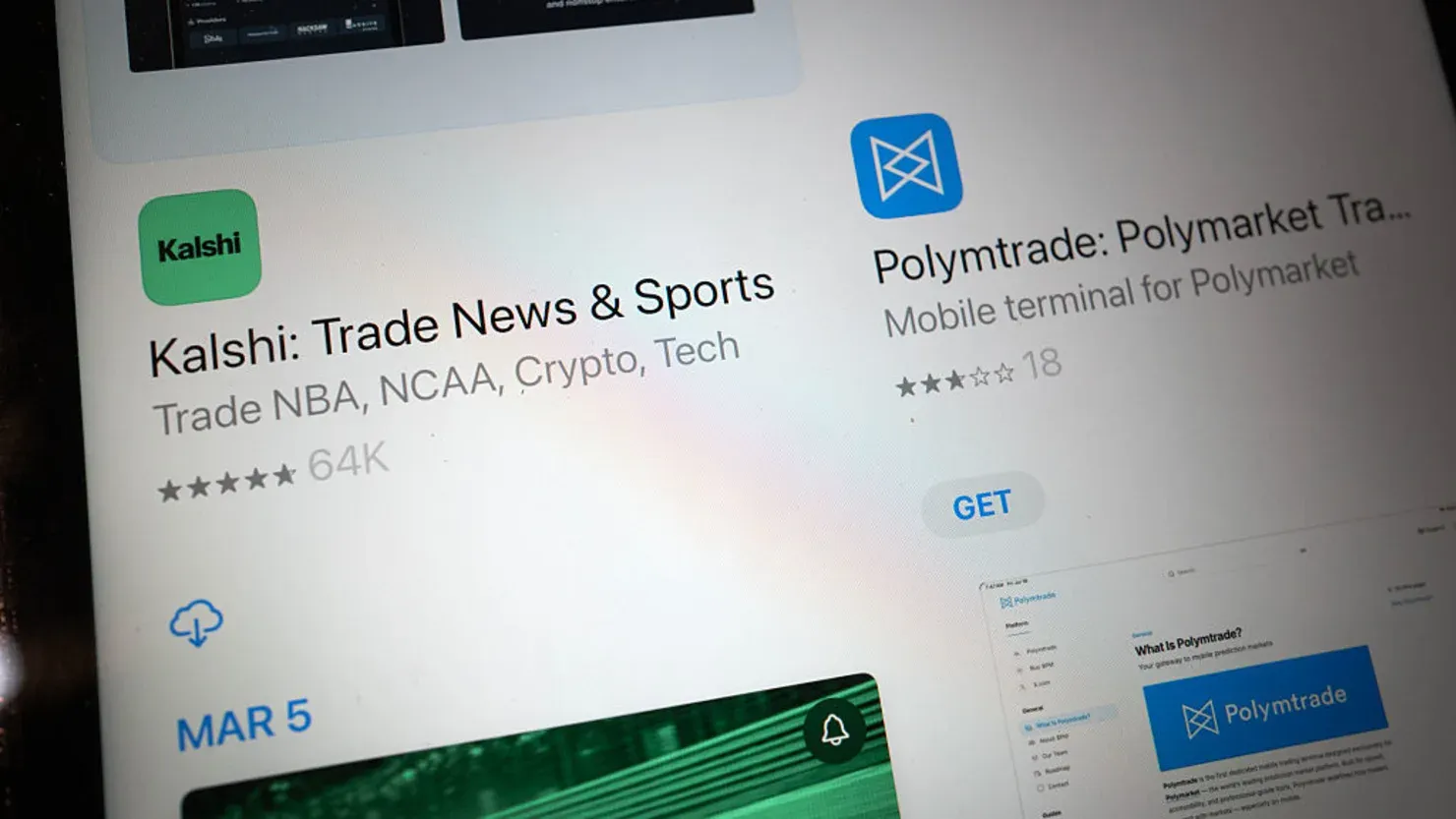
Kalshi, the largest regulated US prediction market, requires prospective traders to verify their identity and address. Polymarket, meanwhile, allows people to trade on its popular international site — which traders in restricted countries including the US and UK report accessing through VPNs — by connecting a crypto wallet, often without requiring any further identification.

Funds can also be deposited and withdrawn using a basket of cryptocurrencies, so Polymarket does not learn customer banking details.

Through the US-regulated Kalshi and ForecastEx, Robinhood users can bet on the outcomes of sports games, elections, entertainment and financial events as well as other occurrences such as whether the US will confirm the existence of aliens before 2027.

Recommended

Personal Finance

Prediction markets: the hunt for the new ‘dumb money’

Illustration of a man pulling the lever of a slot machine as cash flows in and coins flow out

Late last year, Robinhood and quantitative trading firm Susquehanna International Group purchased a futures and derivatives exchange, LedgerX, in an effort to reduce the brokerage’s reliance on Kalshi.

Prediction markets were Robinhood’s “fastest growing business ever” in 2025, with more than 12bn contracts traded on the platform, according to chief executive Vlad Tenev.

“We’re just at the beginning of a prediction market supercycle that could drive trillions in annual volume over time,” Tenev said on an earnings call in February.

Source: https://www.ft.com/content/84ddcfaf-f16a-481e-9986-c3e8af5653ac

Global Chokepoint - What Exactly Is a Hormuz Bet? - Article 2 of the Hormuz Series, March 2026
Editorial
GeopoliticsOil & GasPrediction MarketGlobal ChokepointAnecdote

Global Chokepoint - What Exactly Is a Hormuz Bet? - Article 2 of the Hormuz Series, March 2026

A guide to Hormuz contract design, market structure, and why 7 days is more meaningful than 2 or 14.

Economics & FinancePolitics

This is the second article in my Hormuz Strait March 2026 Analysis Series.

In the series, I will break down the wider architecture of vulnerability behind Hormuz, trace the real transmission channels from Gulf disruption into the global economy, explain how different prediction markets are pricing different slices of the same crisis, and test whether these contracts have genuine economic value as hedging instruments.

💡 Sign up to Receive Further Updates if You Haven’t Done So.

Hormuz Is Not Just an Oil Story - Article 1 of the Hormuz Series, March 2026
A Hormuz shutdown would not stay in the Gulf. It would spread through fuel, freight, fertilizer, helium, and food.

Click on the Bookmark to read Article 1 of the Series

This article moves from the physical system to the market layer. When traders bet on "Hormuz" on Kalshi or Polymarket, what exactly are they betting on? I break down the contract taxonomy and explain why the 7-day threshold matters so much.

The core idea is simple: not every disruption is a true closure, and not every Hormuz contract is a bet on the same underlying reality.

CTA Image

Learn More if You Don’t Know How an Event Contract Works Before Proceeding

Learn more

One easy mistake in this story is to treat every Strait of Hormuz contract as if it were betting on the same thing. It isn’t.

Some markets are trying to answer a physical question: Are ships actually moving through the strait again?

Others are asking a political question: Has there been a formal ceasefire? Others sit somewhere in between: Has a military escort regime emerged that could allow limited passage even without peace?

That is why clean taxonomy matters. Without one, it is very easy to compare markets that sound related but are actually pricing different slices of the same crisis.

3.1 A quick way to think about the market universe

The easiest framework is to split Hormuz-related contracts into four buckets:

Direct disruption

What the contract is really asking
Has the strait become meaningfully closed or impaired?
Best example
Kalshi: Will Iran effectively close the Strait of Hormuz for 7+ days?
Resolution style
Narrow event definition
What it isolates
A true disruption regime

Traffic-state

What the contract is really asking
How much shipping is actually moving? Has traffic normalized?
Best example
Polymarket / Kalshi: When will the traffic return to normal?
Resolution style
External data + threshold
What it isolates
Physical shipping throughput

Diplomatic settlement

What the contract is really asking
Has there been a formal ceasefire or agreed halt in fighting?
Best example
Polymarket: US x Iran ceasefire by...?
Resolution style
Official announcement / media consensus
What it isolates
Formal political de-escalation

Military-facilitation

What the contract is really asking
Has a security response emerged that could reopen passage?
Best example
Polymarket: Which countries will send warships through the Strait of Hormuz by...?
Resolution style
Confirmed transit through the strait
What it isolates
A pathway to guarded or partial reopening

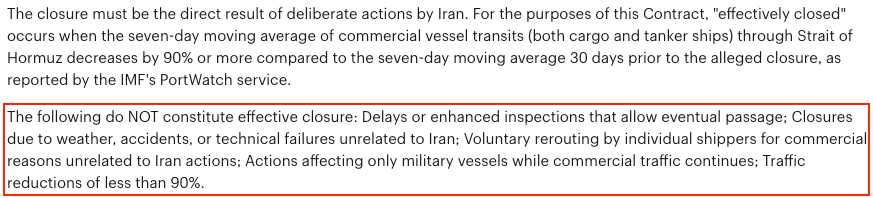
A direct disruption contract prices a real operating shutdown, not just higher tension. Kalshi’s 7+ day closure market is narrower than the headline suggests: delays, inspections, or other frictions that still allow eventual passage do not count as an “effective closure”. In other words, it is trying to capture a true disruption regime rather than generic geopolitical stress.

Market rules: Will Iran effectively close the Strait of Hormuz for 7+ days? on Kalshi

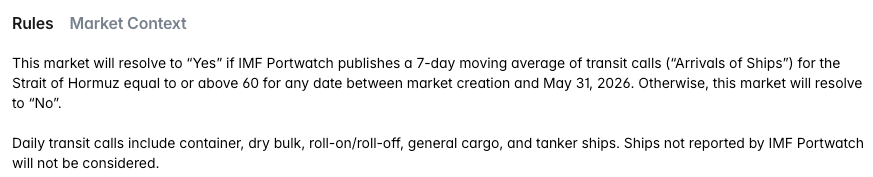
A traffic-state contract prices measurable throughput. The clearest example is the Polymarket traffic-normalization market, which resolves to “Yes” only if IMF PortWatch shows a 7-day moving average of transit calls of at least 60 by April 30. Kalshi’s return-to-normal and weekly traffic markets use similar threshold logic. These contracts are not about peace, they are about the actual traffic flow.

Market rules: Strait of Hormuz traffic returns to normal by end of May? on Polymarket

A diplomatic-settlement contract prices formal political de-escalation. Polymarket’s “US x Iran ceasefire by…?” market requires an official, mutually agreed halt in direct military engagement. Informal pauses or backchannel de-escalation do not count. That makes it fundamentally different from a traffic market. It prices a political state, not operating throughput. It is also much deeper, with roughly $65.6 million in volume versus about $1.64 million for the traffic-normalization market on Polymarket.

Market rules: US x Iran ceasefire by April 7? on Polymarket

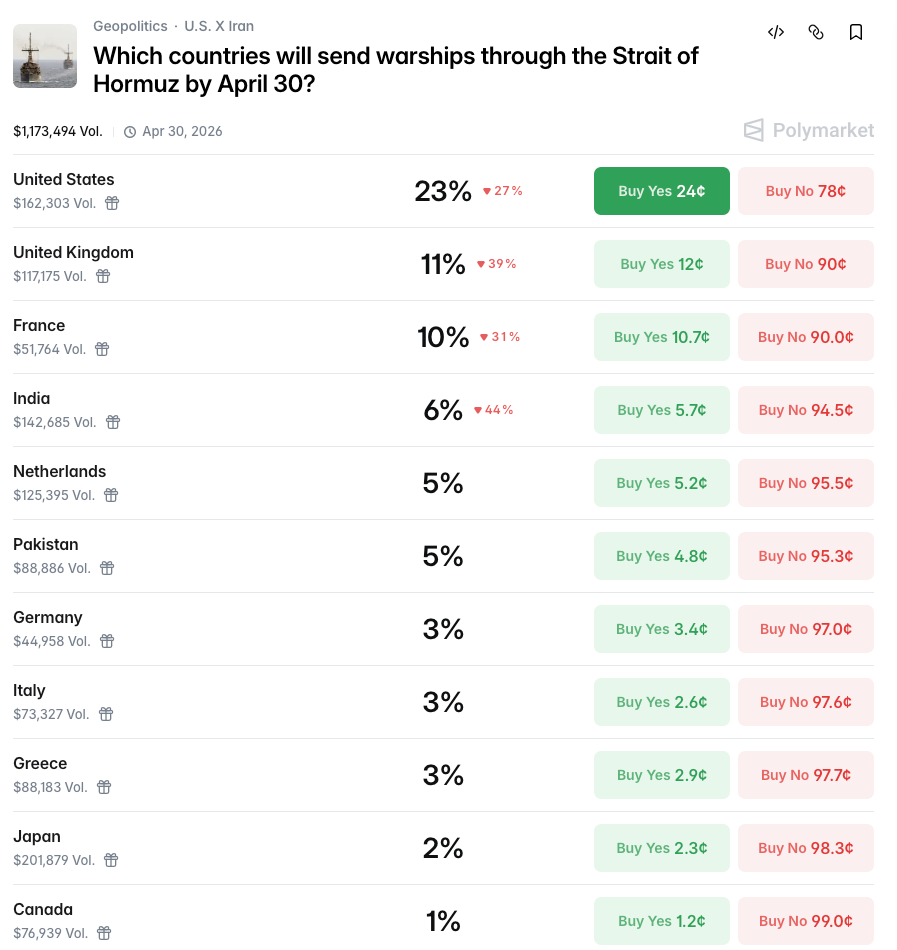
Finally, military-facilitation contracts price whether a security mechanism emerges that could enable partial reopening. Polymarket’s warship-transit market is the clearest example. It resolves based on confirmed warship passage through the strait itself, not just broader naval presence in the region. So it is best read as a market on a possible reopening mechanism, not on peace or traffic directly.

3.2 Why Kalshi and Polymarket feel a bit different

The cleanest practical difference between the two platforms is: Kalshi looks more like a threshold-and-throughput platform; Polymarket looks more like a layered geopolitical menu.

Kalshi’s Hormuz contracts are mostly binary or threshold-based. Polymarket, by contrast, is more willing to use multi-outcome structures. The ceasefire market is a date array, and the warship market has 11 outcomes.

The warship market on Polymarket has 11 countries that you can bet on.

That is not just a cosmetic design choice. Binary threshold products are naturally good at answering “Has this physical condition been met?”. Multi-outcome products are better at expressing timing distributions or outcome identity. That gives Polymarket a wider narrative range, but it also means you have to read the rules more carefully because similar headlines can resolve on very different criteria.

In that sense, the two platforms are often better viewed as complementary than as direct substitutes.

From curious to confident. Join the sharpest forecasters online, get top contracts, platform updates & market signals - free.

Join Today

Why "7 Days" Matters: Not 2 Days or 14+ Days

The contract "Will Iran effectively close the Strait of Hormuz for 7+ days?" on Kalshi has attracted around $7.3M traded volume, despite the fact that the first market ("Before 2027") was opened in early-January and the remaining markets ("Before May" and "Before August") were opened on 1st March as follow-ups. This contract probably has the highest traded volume among Hormuz-related events (excluding broader Iran-related events) across Kalshi and Polymarket.

This naturally triggers curiosity for prediction market operators and active thinkers: "Why does a 7-day closure of the Hormuz Strait receive so much attention? Why isn't the contract focusing on a shorter or longer period of closure?"

It is important to be explicit that primary rule pages from Kalshi and Polymarket do not publish white papers outlining this exact economic rationale. The market rules clearly define how the markets will resolve, but they do not explicitly justify why 7 days was chosen over 5 or 10 or another number.

Conclusion first: this threshold is the best inference drawn from the broader maritime and economic environment, though the choice is also likely driven by prediction market platforms' practical need to aggregate low-volume trade data into statistically robust, standardized weekly trading cycles. Or it could be that, though less likely, this is just an arbitrary threshold set by Kalshi.

4.1 Not every disruption is a closure

In this context, defining the "effective closure" of a vital maritime chokepoint cannot rely on the binary rhetoric of state actors or a single day of halted traffic.

Maritime traffic data, primarily sourced from the Automatic Identification System (AIS), is inherently volatile on a day-to-day basis. Daily transit counts are subject to transient factors, including normal berthing delays at major transshipment hubs, fluctuations in loading schedules, and environmental impediments such as heavy seas.

In a conflict environment, this baseline volatility is compounded by tactical anomalies, including GPS jamming, AIS spoofing, and vessels intentionally "going dark" to avoid targeting.

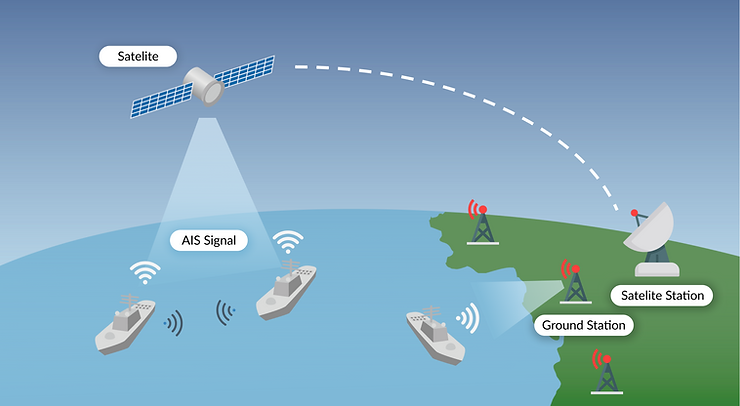
The Automatic Identification System (AIS) is a short-range coastal tracking system, developed to provide identification and positioning information to both vessels and shore stations.

Consequently, brief disruptions lasting only one to three days are frequently driven by tactical noise rather than a persistent disruption regime. The history of the Hormuz Strait shows that short gaps in transit may be the result of temporary inspections, military exercises, localized incidents, or environmental hazards.

Thus, resolving a contract based on a 24- or 48-hour disruption would risk triggering a "false positive", rewarding speculation on temporary headline volatility rather than a structural regime shift with true global economic consequences.

4.2 Why is 7 days a meaningful threshold?

A 7-day window represents the precise horizon where transient friction transforms into a structural crisis.

Operationally, some contracts on Kalshi and Polymarket utilize a 7-day moving average of vessel transits through the Strait in their resolution rules, in order to filter out daily AIS noise and capture a full weekly operational cycle.

This contract on Polymarket uses the 7-day moving average of transit calls as a condition of "normalization".

Economically, the commercial insurance landscape undergoes a total transformation by the 7-day mark. The most potent mechanism for closing a maritime chokepoint is the withdrawal of commercial insurance rather than physical blockade.

When kinetic escalation occurs at Hormuz, marine insurers activate "72-hour War Cancellation Clauses", creating a 3-day notice period that forces shipowners to exit the risk zone or secure replacement coverage at significantly higher rates before existing policies are cancelled.

Following the expiration of these notices, the market enters a phase of weekly resets. War-risk coverage is often repriced every 7 days to reflect the rapidly evolving threat environment, usually resulting in multi-fold premium increases that can possibly reach 10% of a vessel's hull value. If the strait is inaccessible for 7 days, the initial wave of covered voyages has ended, and the global fleet operates under a prohibitively expensive new insurance regime.

Container ships that normally travel through the Red Sea are looking for alternative routes. (Image credit: Jim Allen/FreightWaves)

4.3 Why not 14+ days?

A 14+ day threshold would capture a very serious disruption, but for an event contract it is usually too late.

By the time a Hormuz disruption has lasted two weeks, shipping lines have often already rerouted vessels, insurers have already raised war-risk costs, and freight markets have already repriced. At that point, the market is no longer asking whether the disruption is real. It is already dealing with the consequences.

That is why a 7-day threshold works better. A one-week threshold is long enough to filter out short-lived noise, but still able to hedge against uncertainties before the global economy fully adapts to the new normal.

CTA Image

Singapore Minister Says Worst Case on War is Not Fully Priced

Learn More
Do Hormuz Event Contracts Actually Hedge Anything? - Article 3 of the Hormuz Series, March 2026
Testing when Kalshi and Polymarket contracts hedge real commodity exposure, and when they do not.

Click on the Bookmark to read Article 3 of the Series

Disclaimer: The content is for informational purposes only. You should not construe any such information or other material as legal, tax, investment, financial, or other advice. Nothing contained in this article constitutes a solicitation, recommendation, endorsement, or offer by the author(s) or any third party service provider to buy or sell any securities or other financial instruments in your or in any other jurisdiction in which such solicitation or offer would be unlawful under the securities laws of such jurisdiction. The author(s) report(s) no conflict of interest.

Weather Prediction Markets Are Booming. Can They Improve Forecasts?
News
InsightBusinessPrediction Market

Weather Prediction Markets Are Booming. Can They Improve Forecasts?

Weather-focused prediction markets are rapidly expanding from niche bets to tools for testing AI models and pricing climate risk, promising sharper forecasts but raising concerns over manipulation and social value.

Economics & Finance

A few days before Christmas, Howard Qin was scrutinizing weather forecasts on two laptops at home in Shanghai when he noticed prices of contracts for New York City snowfall creeping higher on the prediction market Kalshi. He checked the Times Square webcam for specks of white — affirmative.

The recent Stanford math graduate and lifelong weather buff had spent about $200 on predictions that total NYC snowfall that month would top various thresholds — for example, more than 2 inches. Now the value of his shares was rising.

There was just one wrinkle: Qin had a classical guitar recital to attend that night. “I’m not going to bail on my concert just to trade on this. That would be a little extreme,” he recalls thinking. He sold and netted $327.79 — a 57% gain and his biggest win yet.

That was 2024. Two years later, Qin, now 24, is still making small bets “just for fun,” including on Central Park snowfall during January’s megastorm (he won a few dollars). What’s changed is the sheer number of people placing bets on weather markets — and the amount of money flowing through them. Trading volume for the January snowstorm topped $6 million on Kalshi, one of the largest weather contracts ever traded on the rapidly growing platform.

That’s still tiny compared with Kalshi bets on sports and elections. But weather trades are gaining traction, drawing in casual participants, weather experts and AI-driven weather-tech firms testing their wares. As these markets grow, weather nerds and climate researchers are debating whether prediction markets can improve forecasts by aggregating knowledge — and, in turn, inform investment and policy — or whether they’re simply zero-sum games in which uninformed gamblers make (or lose) a quick buck.

Testing Weather Models

Qin got into weather betting to test his meteorological knowledge. So he was excited when his managers at Windborne Systems — a weather-tech startup that launches balloons and uses the data to power an AI forecasting tool — encouraged him to use the company’s models to make trades during his internship.

“It’s a great market to play around with to test out your predict accuracy,” said Chief Executive Officer John Dean. He described the effort as “dogfooding,” a Silicon Valley term for using a company’s own product to identify bugs and make improvements.

The approach has had concrete payoffs. Through trading, Dean said he realized data from official weather stations — used by Kalshi and Polymarket to settle contracts — can be noisy. A sensor’s temperature readings may spike in direct sun, making conditions seem hotter than they are. Windborne subsequently adjusted how it preprocesses its model-training data.

There is also the straightforward motivation of money to be made.

Established weather vendors sell their data — such as temperature, wind speed and cloud cover — to energy traders and hedge funds, who trade using that information. Marvin Gabler, co-founder and CEO of Swiss-based weather forecasting startup Jua, sees a way to unlock even more value: by trading on prediction markets with insights generated by his company’s models.

Last year, Gabler set up a separate investment vehicle, pooling funds from friends and family, and is trading on maximum-temperature contracts on Polymarket using Jua’s forecasts. So far, “relative returns are high,” he said, though market volume and liquidity “are still too low for a well-sized fund.” He declined to share further specifics.

Better Forecasts?

Not every person trading these markets is an expert in meteorology. In fact, one of the best performers on crypto-powered platform Polymarket is a total novice: A 23-year-old law student in Germany, who goes by the username Hans323 on the website, is currently the sixth-highest profit earner of all time on Polymarket’s weather markets. His bets tracking daily temperatures across cities like London and New York have become a touchstone in prediction market circles, followed by eager eyes wanting to copy his strategies and turn a profit themselves.

Prediction markets may already be outperforming traditional weather forecasts, according to an analysis published last month by Patrick Brown, head of climate analytics at Interactive Brokers. He compared the implied forecasts of his firm’s prediction markets to ones from the US National Weather Service and found the former were more accurate. The key difference, Brown contended, was that prediction markets better “incentivized human judgment.”

“There is a direct financial reward for being accurate and a direct financial penalty for being inaccurate. This creates a dual effect of attracting accurate individuals and systems into the market while deterring those who are inaccurate,” Brown wrote.

Still, some weather bettors are skeptical of the idea that their aggregated wagers produce any useful information. While Dean says weather prediction markets can reflect human intuition — unlike AI weather forecasts — Atte, a 40-something Finnish freelance software developer who is also among the top weather traders on Polymarket, describes his weather bets as “completely worthless.” That’s despite his raking in some $33,000 on them since October.

“I would prefer to be societally useful,” said Atte, who goes by 1-800-LIQUIDITY on Polymarket and declined to share his full name because of safety concerns. He has sought jobs at AI startups that would put his coding chops to use, but for now he’s applying them to weather markets, including writing software to automate trades.

As the climate veers further into uncharted territory — the last 11 years were the hottest on record and the warming may be accelerating — critics also worry that the gamification of weather could bring perverse consequences, including data manipulation and the sabotaging of weather stations.

Other prediction markets may have already seen foul play. Late last year, a live map of the Russia-Ukraine war produced by a Washington, DC, think tank was mysteriously altered — long enough for Polymarket to resolve a bet that Russians had captured a city they hadn’t. And in March, an Israeli reporter claimed Polymarket users tried to pressure him to change a story involving a missile strike outside Jerusalem.

Polymarket did not respond to emailed questions.

Science Markets

Beyond the open-access platforms of Kalshi and Polymarket, scientists are building bespoke trading platforms that they hope will draw out societally useful information. There, weather experts with little or no betting or professional investing experience are stepping into betting pools designed to discover insurance-relevant risk — and infusing their slow-moving research with adrenaline.

Mark Roulston is a Ph.D. planetary scientist who spent a decade at investment firm Winton Group, incorporating weather and climate information into quantitative trading strategies. He developed a passion for prediction markets as a way to help institutions extract hidden information from diverse groups of researchers, who are invited to bet on their expertise using other people’s money.

That’s the first and biggest difference between Roulston’s effort and conventional markets: A sponsor supplies the betting money, rather than the losers funding the market. The sponsor always “loses,” in the sense that it’s giving away money without placing a bet. But it “wins” by cultivating the intelligence expressed by the participants, who keep whatever money they win.

“We create markets not because we think, ‘Oh, this is something lots of people will want to bet on,’” Roulston said. “We create a market because there’s an end user — like a reinsurance company — that says ‘We would like better predictions of this.’” He says this approach is closer to the vision for prediction markets advocated by economic luminaries such as Nobel Prize winner Kenneth Arrow.

Winton Group backed Roulston’s first formal prediction effort in 2018, which aimed to forecast UK spring and summer temperature and precipitation.

“It was very addictive, actually,” said Kristian Strommen, a climate science and weather forecasting researcher at the University of Oxford. Making live forecasts is “very different from what you do in academia — writing a paper, and there’s no immediate application of anything.”

That experience also taught participants about the mutable shape of expertise in a betting market. Strommen’s team of half a dozen or so ended up placing second in the competition of 24 teams, behind a one-man operation.

After registering solo, “I actually ended up winning the competition, much to the annoyance of those guys,” said Andrew McRae, at the time a fellow Oxford researcher.

McRae, who still participates in Roulston’s markets, now on a team with Strommen, said he won in part because his solitary position made him hyperconscious of how he was spending his time. He knew his colleagues’ strength and combined size meant their model was probably more nuanced. So he looked for small bits of leverage, making improvements on the margins by writing programs that allowed him to trade faster than other teams and by betting on underpriced outcomes, rather than on likeliest outcomes.

“It felt a lot more like a real financial market where there’s lots of other participants on there, and the market is sort of correct,” he said. “And it’s just like, I’ve got a little bit of information on top of that.”

The Scor Foundation for Science, the philanthropic arm of a French reinsurer, announced in late 2024 it would support Roulston’s group, known by its acronym, CRUCIAL, and housed at Lancaster University. Scor is interested in the approach because it can draw diverse insights out of researchers more efficiently than if it were to hire dozens of them at once, said Philippe Trainar, CEO of the Scor Foundation and chief economist of Scor SE.

Roulston runs annual competitions on the number of Atlantic and Pacific cyclones and has four live markets to gauge when the next El Niño will hit — likely bringing record global temperatures with it.

The complexity of climate change may make the topic unsuited for popular online prediction markets, said Madison Condon, an associate professor of law at Boston University, who writes about climate models and projections. There’s definitely space for scientists to pool knowledge outside of complex Earth system models, she said, but markets may not be “the best way for synthesizing that domain knowledge or expert judgment.”

“It’s not like a basketball game,” she said. Projecting what climate change may do to hurricanes, or if the next El Niño is on its way, “is just a different type of knowledge than polling the population would give you.”

Betting on the weather isn’t new. The first weather derivatives began trading in the 1990s, and insurers have long scrutinized the costs of weather and climate risks to underwrite policies. But the market for offloading weather risk remains relatively small. Meanwhile, intensifying climate threats are exposing cracks in the insurance industry as extreme weather makes some places uninsurable.

Some industry veterans see prediction markets as a potential solution to the problem — or at least a disruption of the status quo.

While weather derivatives are constrained by low liquidity and parametric insurance is costly, prediction markets open the floodgates to more traders, said Jim Huang, who spent a decade at the Chicago Mercantile Exchange working on product strategy and is now building a weather-focused prediction market platform called WeatherBook.

That can help boost liquidity and improve the pricing of weather risks — “something that I don’t think insurance or derivatives will be able to achieve, even if you give it more time,” he said.

‘Put Your Money Where Your Mouth Is’

One of the earlier generation of prediction markets can also trace its history back to weather predictions, though in this case the bets were made in pursuit of a childhood fantasy: a snow day.

Like all other 9- and 10-year-olds, Dean and John Aristotle Phillips spent the night before snowstorms in their North Haven, Connecticut, home praying that school would be canceled the next day. It was the mid-1960s. Then one day they realized they could do something more than pray: They could bet.

“It was money,” John Phillips said. The two sides were snow day and no snow day. “You had to have the money to bet with. There was no credit, no margin.”

The brothers’ snow day prediction market was the first partnership in entrepreneurial careers that soon led them to a snow-shoveling business, John’s design of a nuclear bomb from public sources as a Princeton junior, work in election data and technology, and, in 2014, the launch of one of the first major online prediction markets, PredictIt.

Once the boys’ wintertime taunt, “Put your money where your mouth is” is now “kind of the motto of PredictIt,” Phillips said.

The betting platform started as a nonprofit collaboration between Victoria University of Wellington, New Zealand, and the Phillips’ data and consulting company, Aristotle International Inc. A US nonprofit called the Prediction Market Research Consortium Inc. took over the university’s role last year, with Aristotle still running it day to day.

For investors, betting itself can be an efficient way to deliver actionable policy information that complements normal due diligence, Phillips said. An investor considering putting money into a wind turbine firm, for example, must weigh factors spanning business, policy and geopolitics.

“The real thing is, what’s the government going to do in this regard?” Phillips said. “To me, that’s a really fertile area for these markets to contribute.”

Source: https://www.bloomberg.com/news/articles/2026-04-10/what-are-weather-prediction-markets-and-do-they-work
Singapore Minister Says Worst Case on War Not Fully Priced
News
GeopoliticsCommodityInflation

Singapore Minister Says Worst Case on War Not Fully Priced

Singapore warns that markets remain complacent about the Iran war’s impact as Strait of Hormuz disruptions threaten Asia’s energy security, inflation, and growth.

PoliticsEconomics & Finance

Singapore’s top diplomat warned the economic fallout from the war in Iran could worsen and markets have yet to factor in the worst-case scenario.

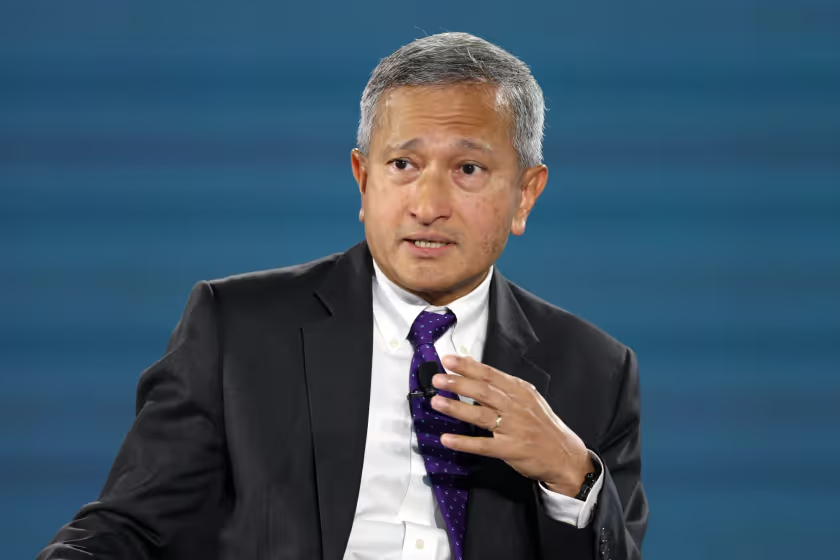
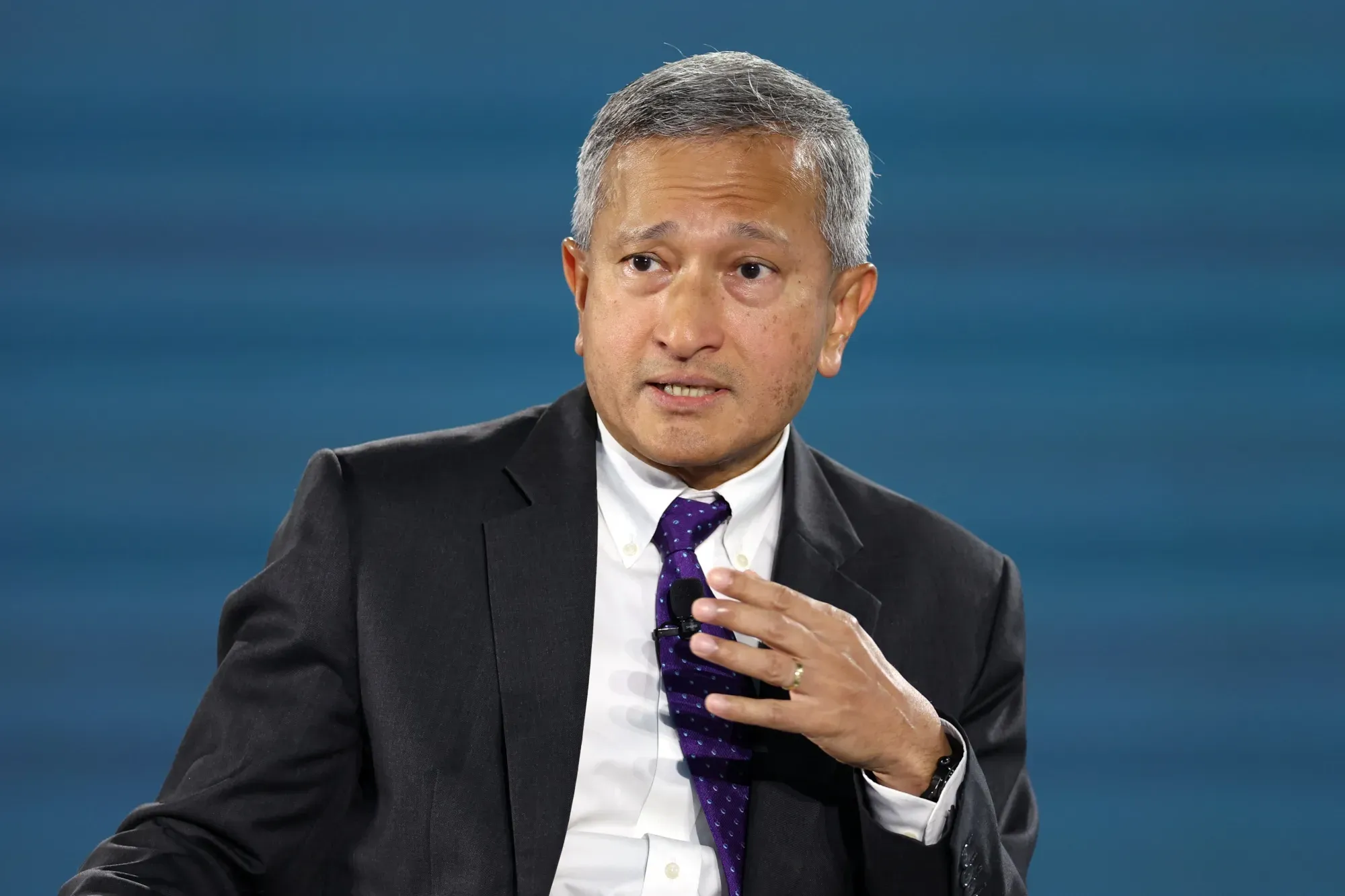
“I’ve stopped trying to get into prediction markets,” Foreign Affairs Minister Vivian Balakrishnan told Bloomberg Television’s Avril Hong at an Investment Management Association of Singapore conference on Tuesday, referring to US President Donald Trump’s latest deadline to Tehran.

“I’m quite sure the markets are not fully pricing the worst-case scenario,” Balakrishnan said. “How’s that for a note of soberness.”

Markets have been whipsawed by mixed messaging on the war in Iran. Traders were cautious ahead of Trump’s latest Iran deadline expiring on 8 p.m. Eastern Time.

Since the global conflict began in late February, global equities are down less than 6% while oil prices have soared. Even the dollar, a reliable haven in times of geopolitical uncertainty, has weakened since touching a 2026 high late last month.

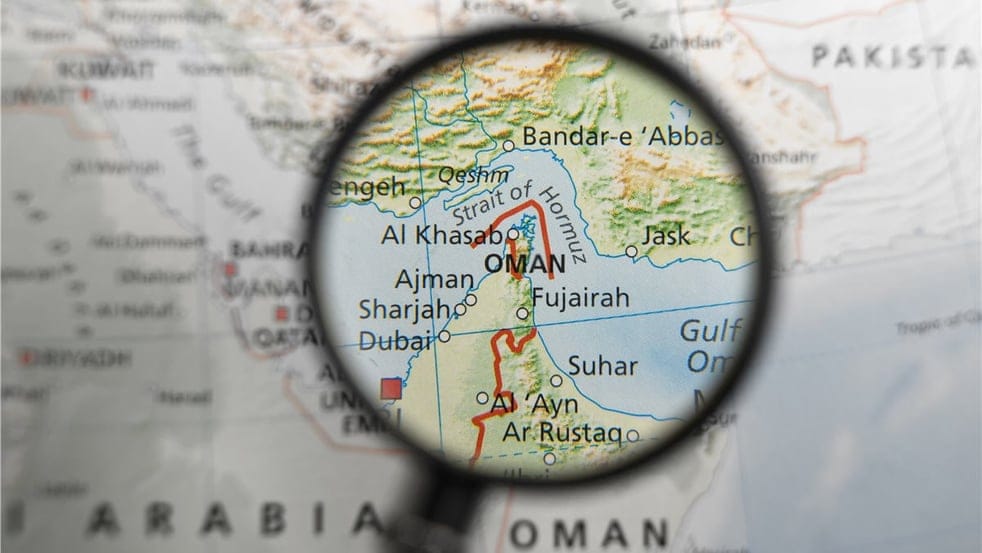
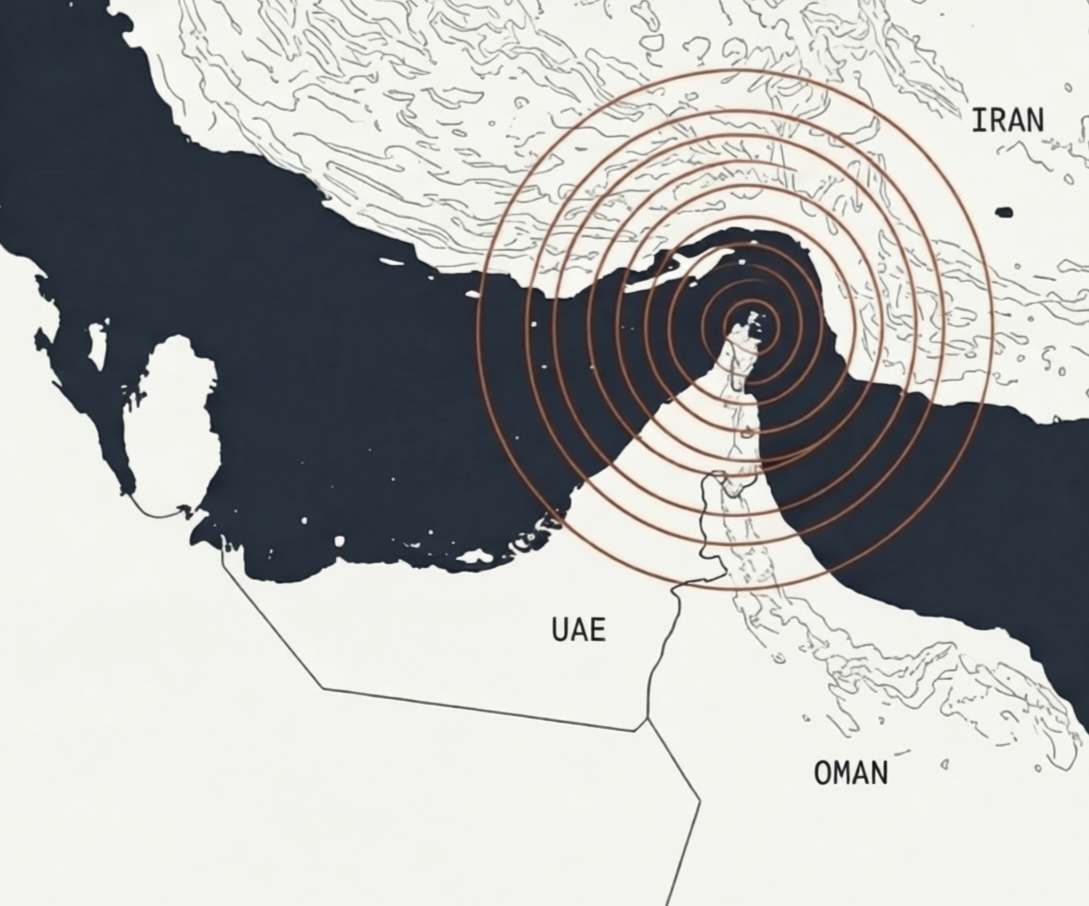
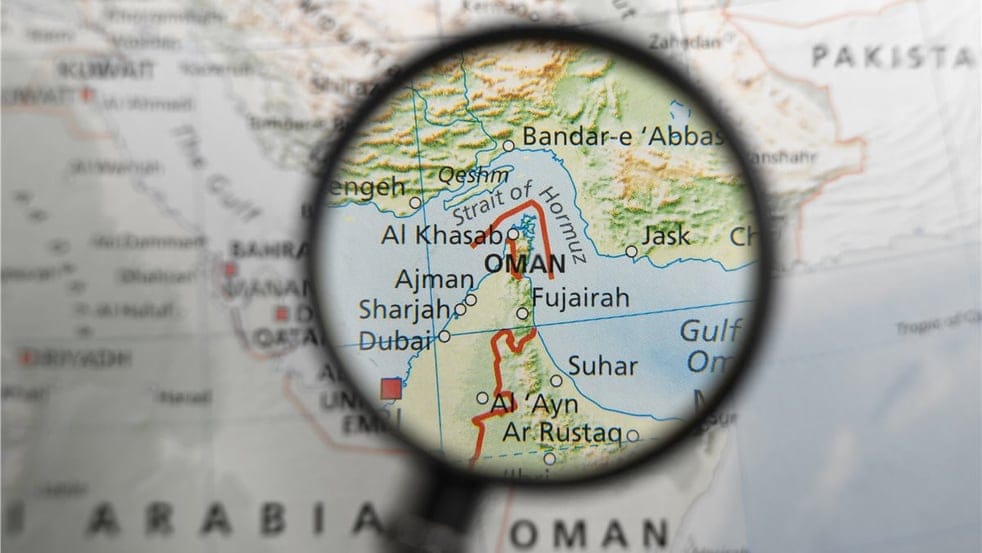
The effective closure of the Strait of Hormuz has disrupted a critical artery for oil and gas shipments to Asia, forcing buyers to scramble for alternative supplies and pushing prices higher. The chokepoint handles about a fifth of the world’s LNG supply.

Governments are already warning of a more challenging outlook as higher import bills feed into inflation and growth. Singapore imports nearly all of its energy and relies on natural gas for more than 90% of its electricity generation, leaving it highly sensitive to swings in global fuel prices and supply disruptions.

“We’re trying to be upfront with our people and tell them this is serious, this could get worse,” Balakrishnan said. “We all need seat belts.”

Source: https://www.bloomberg.com/news/articles/2026-04-07/singapore-minister-says-markets-not-pricing-in-worst-case-on-war

Global Chokepoint - Hormuz Is Not Just an Oil Story - Article 1 of the Hormuz Series, March 2026
Analysis
EconomicsCommodityOil & GasGlobal ChokepointGeopoliticsAnecdote

Global Chokepoint - Hormuz Is Not Just an Oil Story - Article 1 of the Hormuz Series, March 2026

A Hormuz shutdown would not stay in the Gulf. It would spread through fuel, freight, fertilizer, helium, and food.

Economics & FinancePolitics

This is the first article in my Hormuz Strait March 2026 Analysis Series.

In the pieces that follow, I will break down the wider architecture of vulnerability behind Hormuz, trace the real transmission channels from Gulf disruption into the global economy, explain how different prediction markets are pricing different slices of the same crisis, and test whether these contracts have genuine economic value as hedging instruments.

💡 Sign up to Receive Further Updates if You Haven’t Done So.

Hormuz is usually discussed as an oil story. But that framing is too narrow. What sits behind it is a much larger architecture of vulnerability, one that links shipping, energy, industrial inputs, and ultimately the global cost of living.

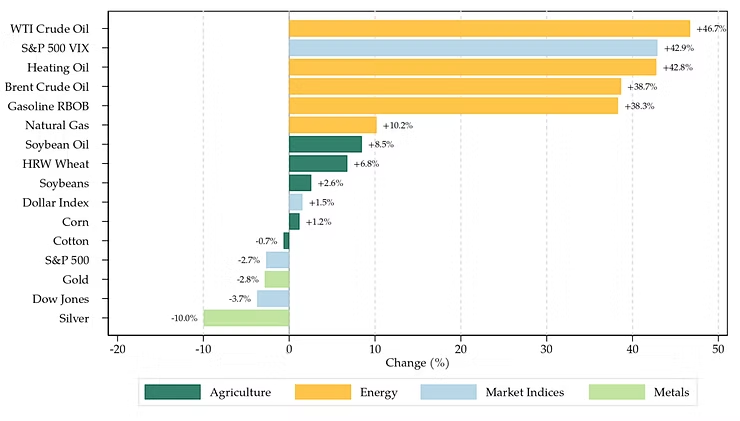
Market Response to Operation Epic Fury (Changes Between February 27 and March 9, 2026). (Source: NDSU)

Why Hormuz Matters: The Architecture of Global Vulnerability

The Strait of Hormuz functions as the “physiological aorta" of the global energy and industrial system, a critical node where a single physical blockage initiates a systemic cascade across disparate markets.

1.1. Quantifying the Flow: Beyond Crude Oil

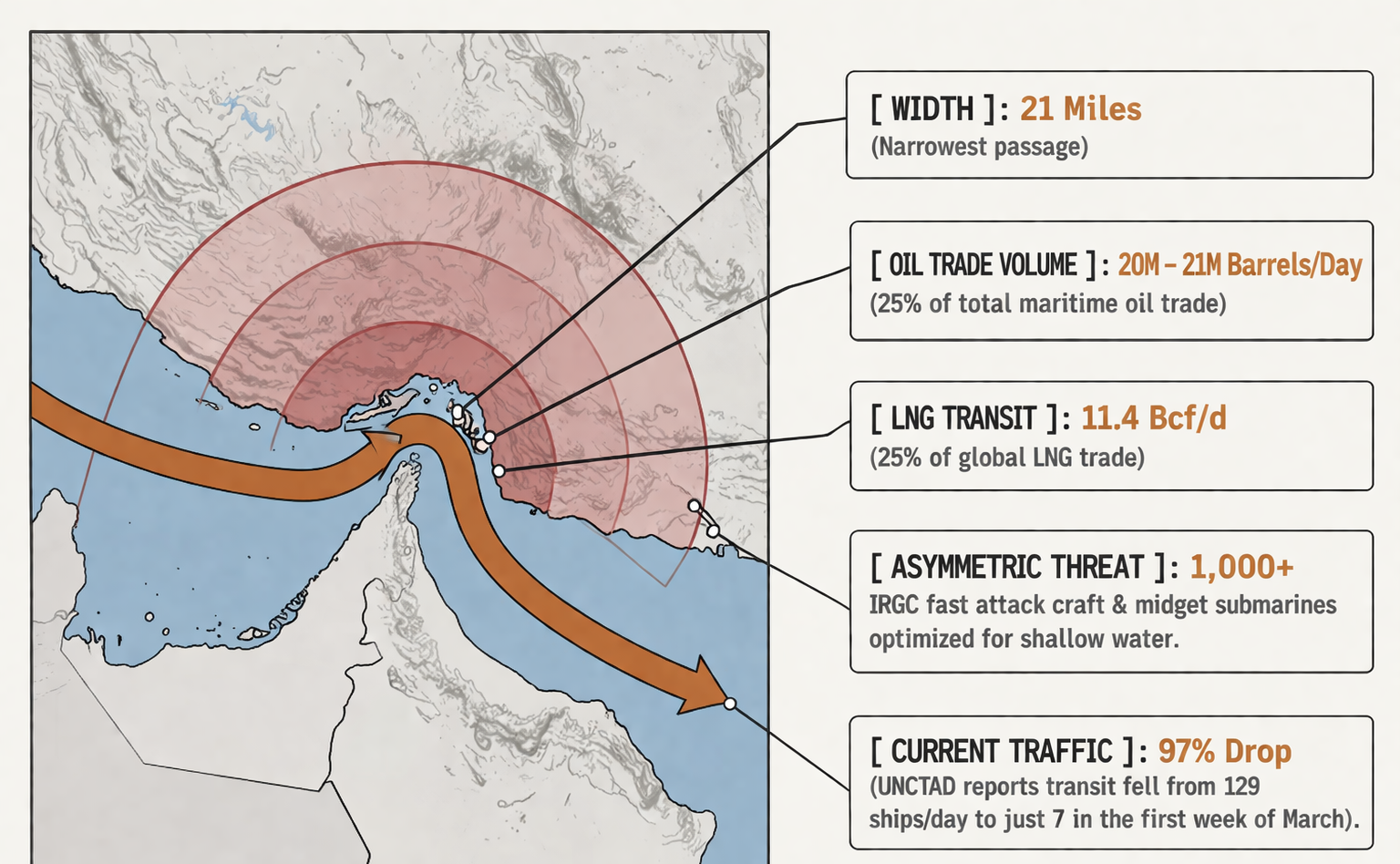
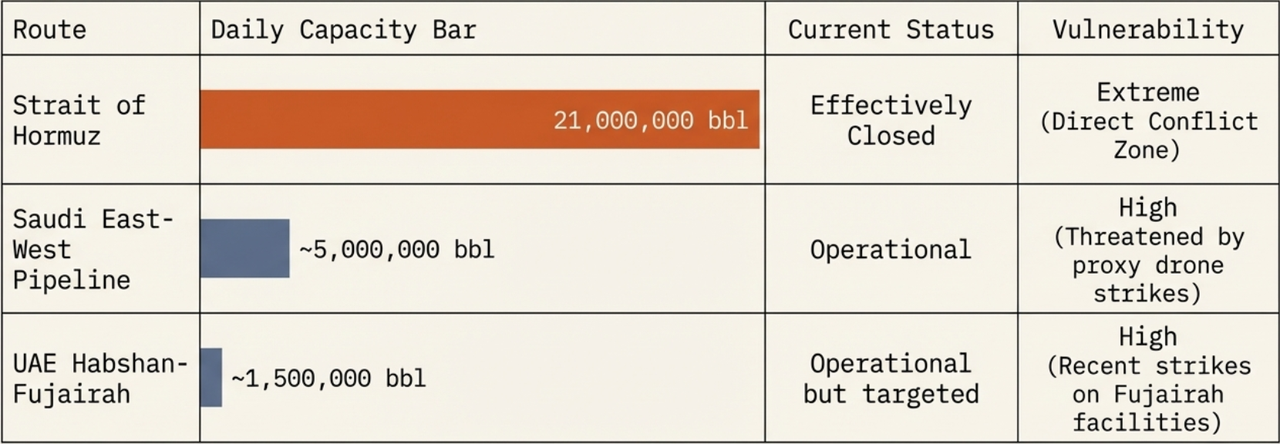
In the first half of 2025, the waterway facilitated the flow of approximately 20.9 million barrels per day (mb/d) of petroleum liquids. This volume represents 25% of total maritime oil trade and roughly 20% of world consumption.

The systemic vulnerability is articulated through the breakdown of specific flows:

  • Crude Oil: Approximately 14.7 mb/d. Represents approximately 34% of all global crude oil trade.
  • Refined Products: Approximately 6.1 mb/d, including essential industrial feedstocks and fuels (e.g. Gasoline, Diesel, Jet Fuel). Around 15% of global refined products trade.
  • Liquefied Natural Gas (LNG): The Strait carries 11.4 billion cubic feet per day of LNG, or 20% of the global LNG trade. The export architecture of the region creates a near-total dependency for major producers, with 93% of Qatari LNG and 96% of UAE LNG relying on this single exit.
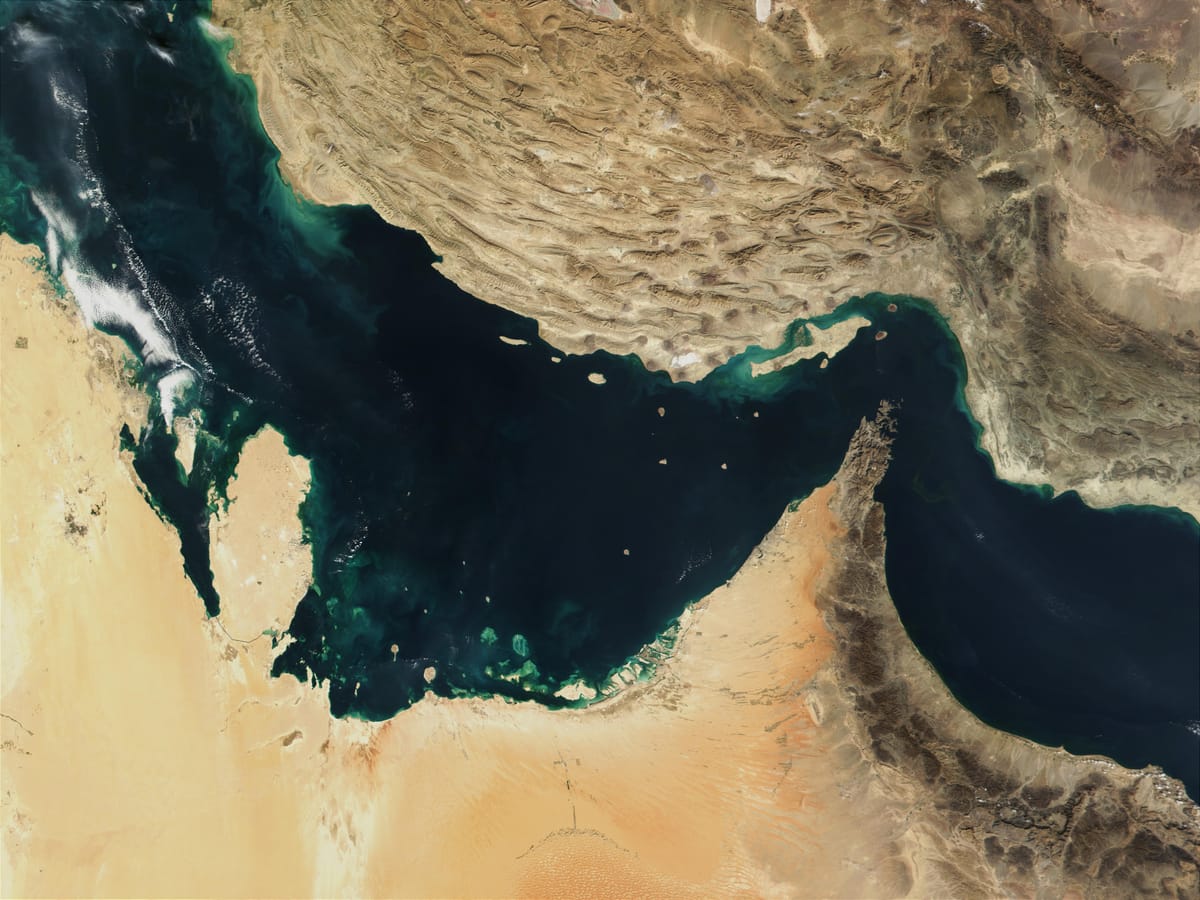
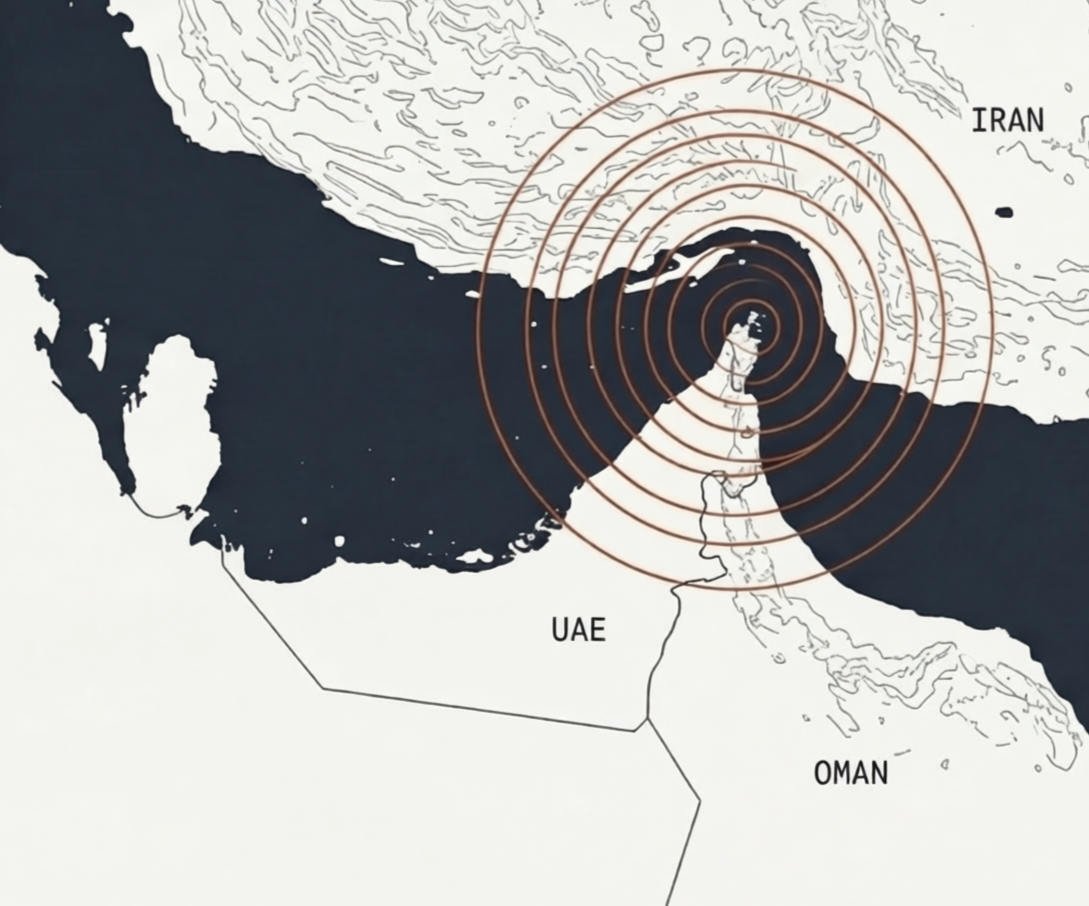
The Strait of Hormuz is a vital marine chokepoint.

1.2. The Asymmetry of Exposure: Asia Gets Hit the Hardest

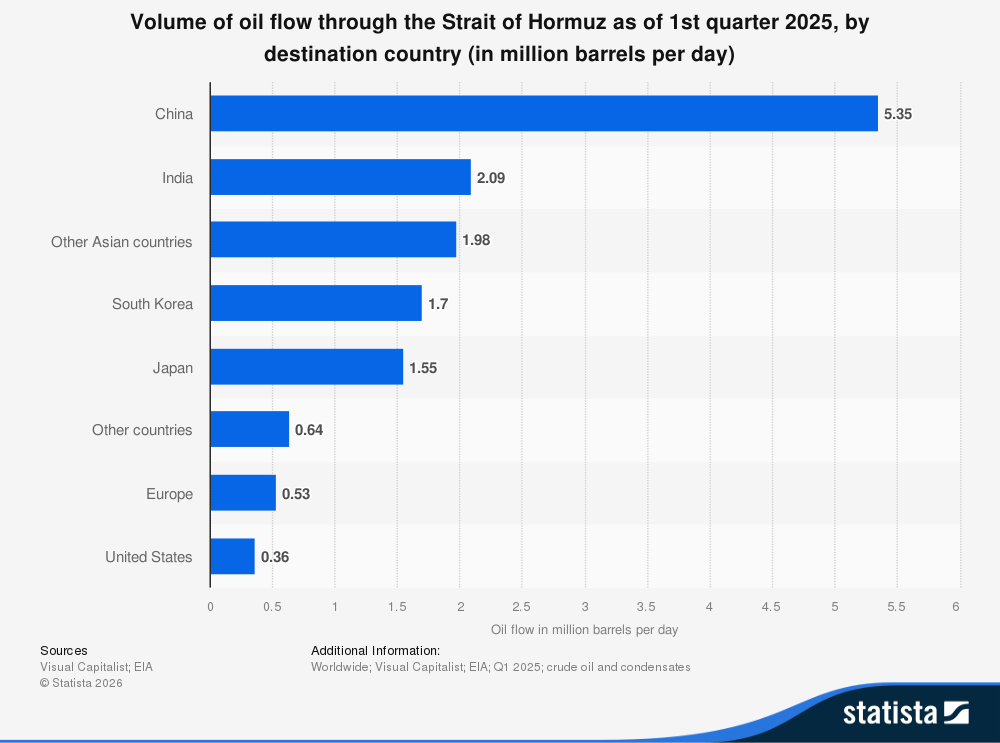
Global exposure to a Hormuz disruption is highly asymmetric, concentrated primarily in Asia, where over 80% of the oil and LNG passing through the Strait is destined.

Regional Dependency & Risk Profiles:

  • Japan: Faces a critical 87% energy import reliance, with a staggering 95% of its crude oil locked into Gulf-origin routes.
  • South Korea: Maintains an 81% energy import reliance, with over 70% of its oil supply tied to the Strait.
  • China: Receives 38% of its total oil flow via the Strait, importing 30% of its LNG through the chokepoint.
  • India: Its 88% overall crude import reliance ensures it cannot escape the global price shock. However, India has developed a "geoeconomic cushion" by moving 70% of its crude to non-Hormuz routes, providing significantly more resilience than its East Asian peers.

By contrast, the U.S. faces very limited direct risk, largely due to its role as a net exporter of oil and gas and its comparatively low levels of imports through the Strait.

Over 80% of the oil and LNG passing through the Strait of Hormuz is bound for APAC countries. (Source: Statista)
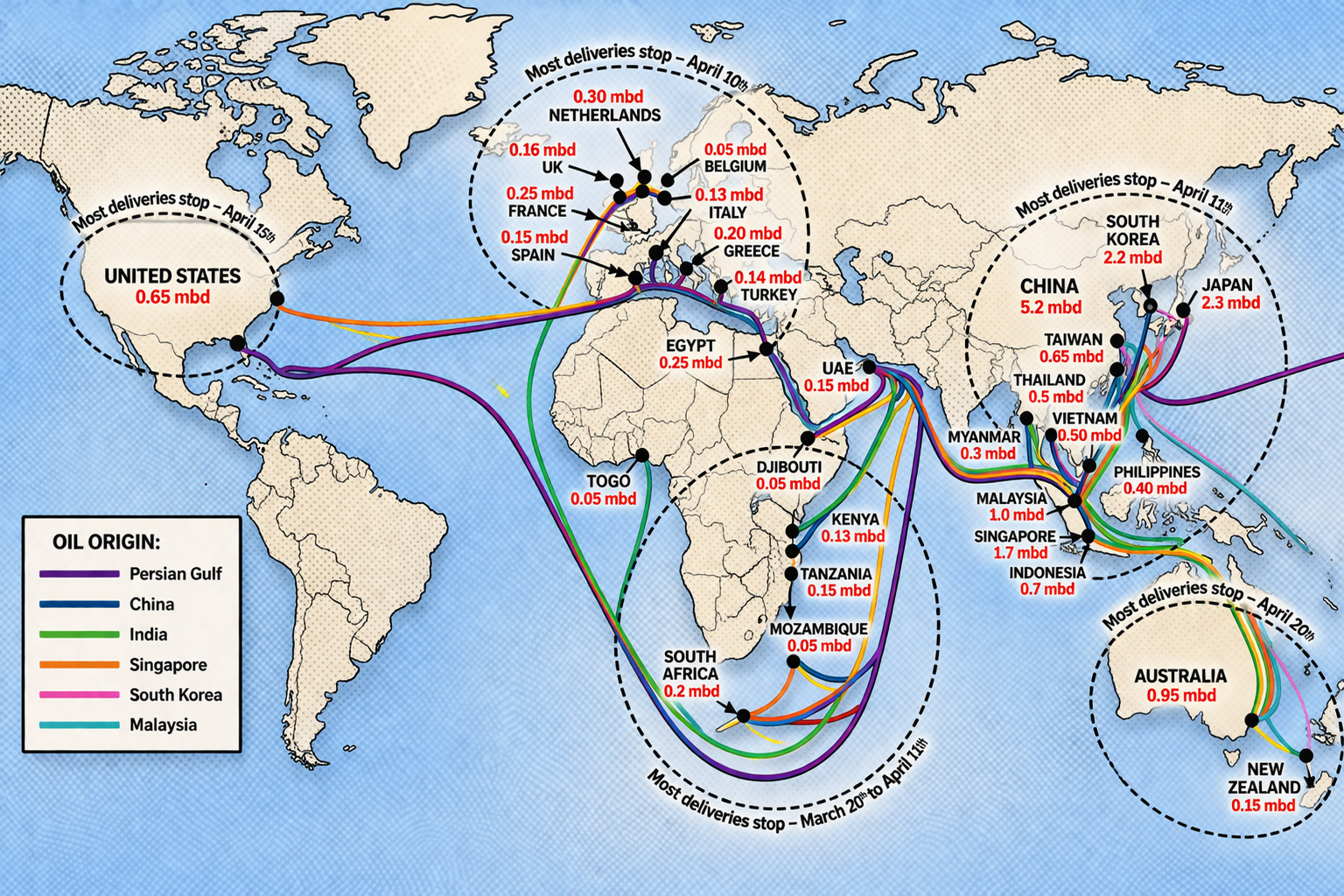
Most oil deliveries from the region would stop in April, as ships already en route arrive while no new tankers depart. (Source: Kpler)

1.3. The Bypass Illusion: Capacity vs. Reality

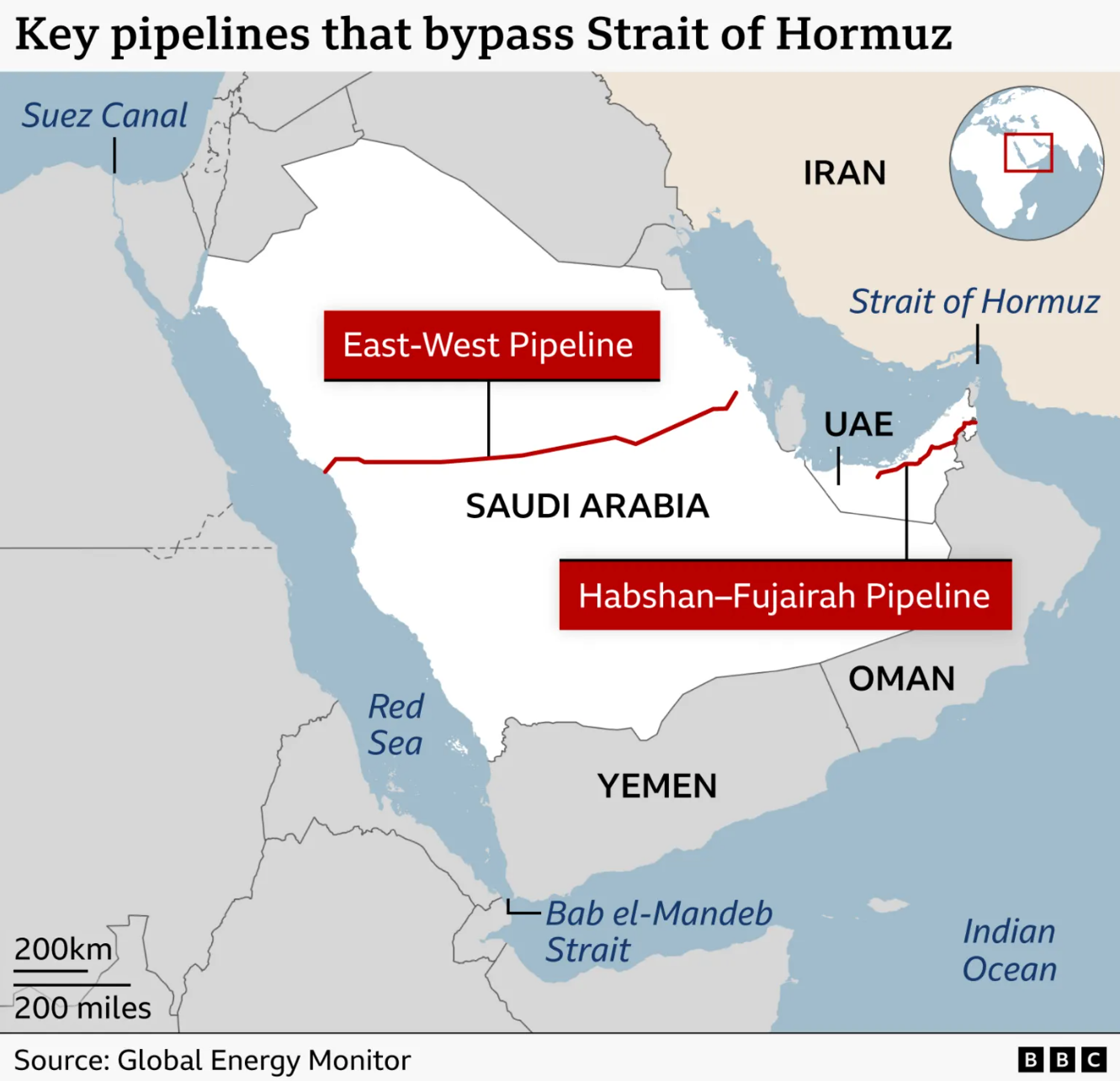
Substitute routes offer a "bypass illusion" that fails under the pressure of a true systemic shock. While the Saudi East-West and UAE Habshan-Fujairah pipelines provide a theoretical combined additional available capacity of 3.5-5.5 mb/d (data from IEA; existing utilisation and operational constraints are taken into account), they are insufficient to offset a 20+ mb/d deficit.

Two key pipelines bypassing Strait of Hormuz. (Source: BBC)

The reason is that these alternatives face two structural failures:

  1. Cargo Incompatibility: Pipelines are restricted to carrying crude oil and cannot transport refined products or LNG.
  2. Physical Vulnerability: These routes are not "safe havens". The drone strikes in March on the port of Fujairah and infrastructure in Yanbu demonstrated that bypass routes are targeted during active conflicts, effectively tightening the ceiling on reroutable flows.
Bypassing the Strait of Hormuz is a mathematical impossibility.

In summary, Hormuz is not a gate to be opened. It is a fuse that, once lit, necessitates a total re-pricing of the global industrial order.

Transmission Channels: The Anatomy of a Systemic Collapse

This systemic infection moves from energy prices to industrial inputs, eventually manifesting as a global cost-of-living crisis as shortages in fertilizers, high-tech gases, and refined fuels hit downstream sectors far removed from the Persian Gulf.

2.1. Logistics and Vessel Traffic: The Immediate Halt

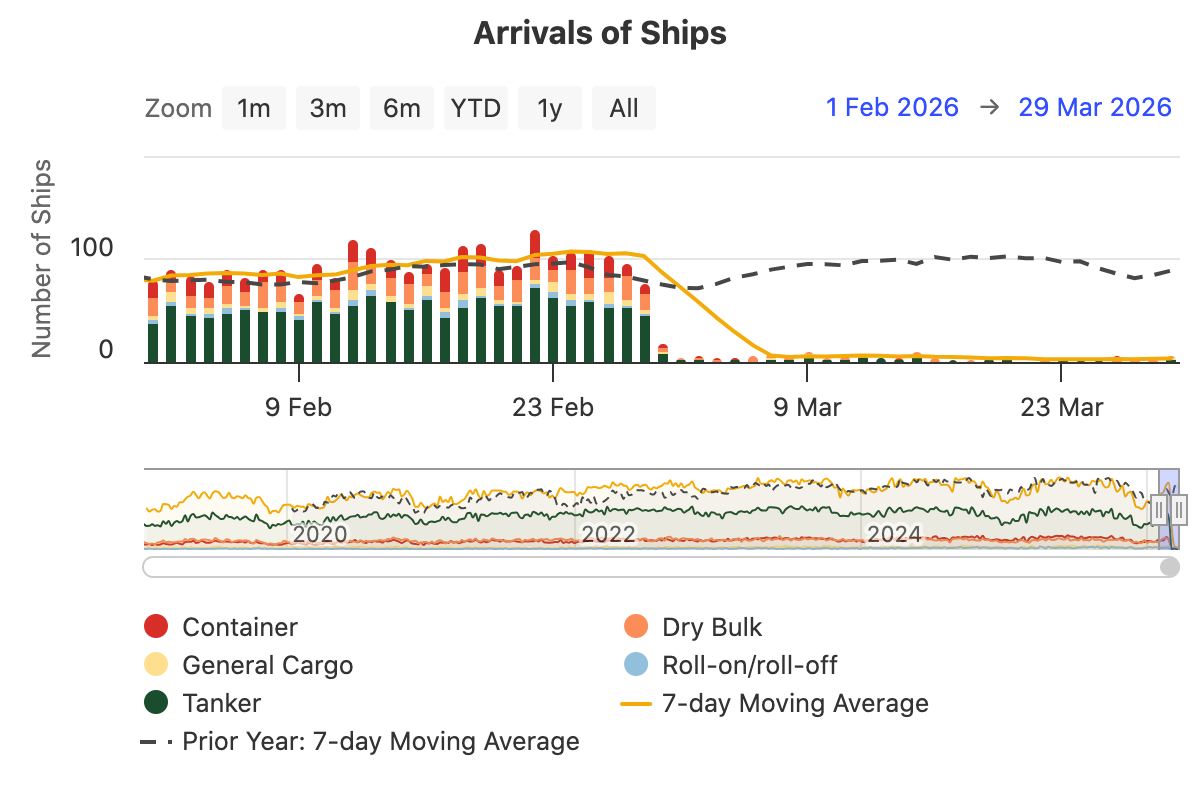
The primary physical reaction to the 2026 crisis was a near-total collapse in commercial activity. Real-time IMF PortWatch data showed a 97% reduction in commercial transits, declining from an average of 129 daily transits in February to as few as 3 in the first week of March.

Number ships passing through the Strait of Hormuz. (Sources: UN Global Platform, IMF PortWatch)

2.2. The Insurance and Freight Premium could Make Transit Commercially Unattractive

The JWC (Joint War Committee) and marine insurers can act as a de facto commercial choke point. By expanding Listed Areas and repricing or restricting cover, they can make Hormuz transits sharply more expensive even without a formal blockade.

In March 2026, war-risk premiums rose from 0.25% of vessel value in normal conditions to around 1–3% in many cases, and, in some extreme mid-March cases, as high as 7.5–10% of hull value for higher-risk vessels. That pushed voyage insurance costs into millions of dollars and materially constrained commercial traffic, though shipping was also curtailed by direct crew-safety concerns rather than insurance alone.

Hormuz may remain nominally open, but commercial shipping can still seize up when war-risk pricing explodes.

2.3. Downstream Energy: The Refined Products Squeeze

In Asia, the naphtha shortage created an immediate crisis for the petrochemical sector, as a large share of Asia’s petrochemical feedstock imports comes from the Middle East, with dependence especially high in Northeast Asia (roughly 70% for Japan and about 50–54% for South Korea).

Major users, including South Korea’s YNCC and Indonesia’s Chandra Asri, were forced to declare force majeure, a legal declaration that they cannot fulfill contracts due to extraordinary circumstances, as their feedstock supplies were depleted.

YNCC, South Korea's largest ethylene producer, was forced to reduce its operating rates.

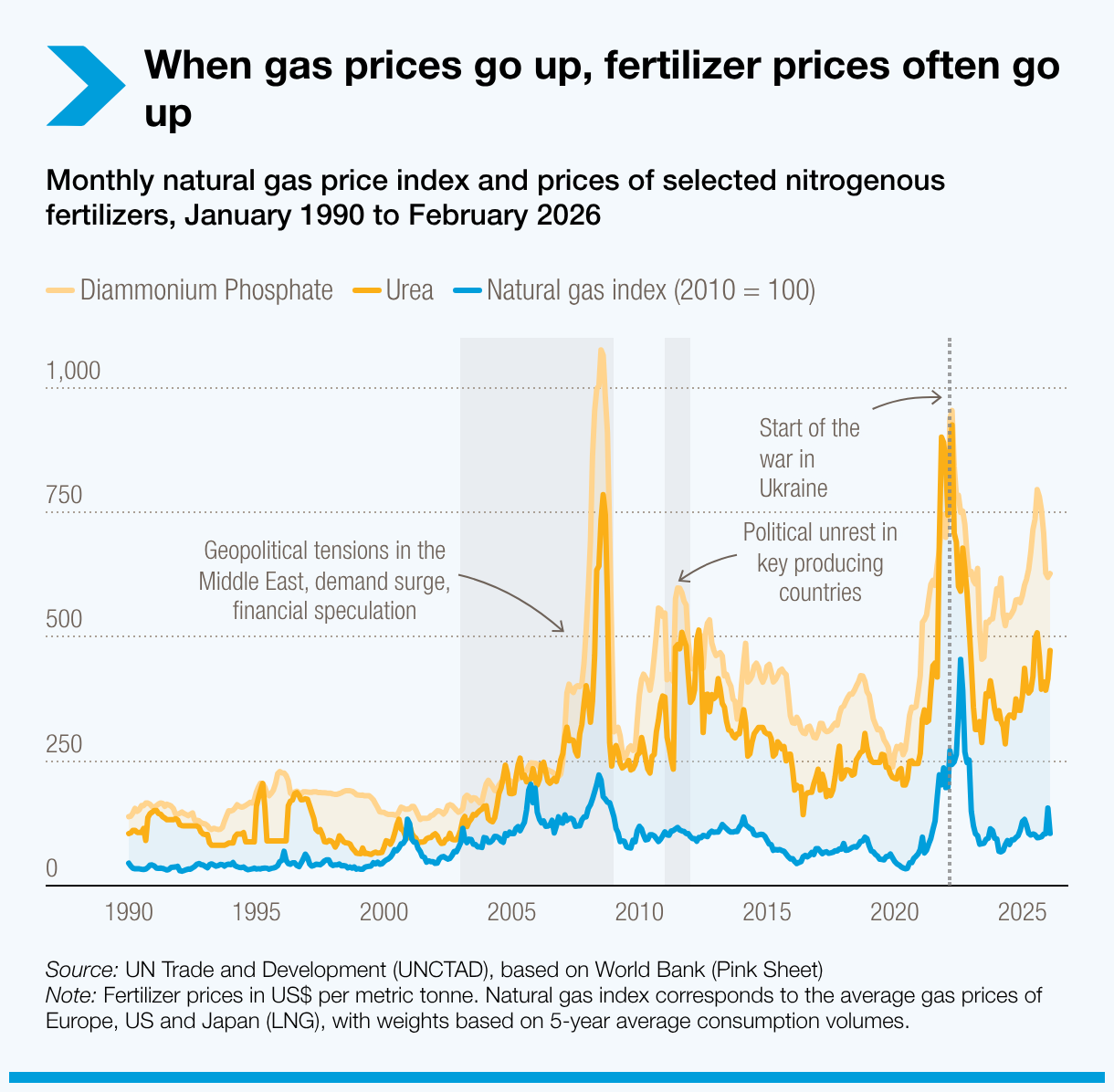
The Strait also matters through fertilizer supply chains. The region accounts for 34% of global urea, 20% of ammonia, and nearly 50% of global seaborne sulfur trade.

Qatar Fertiliser Company's official website states that it is one of the world's largest single-location urea exporters, with an annual production of 5.6 million tons of urea, which could account for up to 14% of global supply.

Meanwhile, a recent Reuters report indicates that the disruption to Hormuz has tightened global fertilizer supply, prompting China to release its fertilizer reserves ahead of schedule, and that approximately one-third of seaborne fertilizer supply is related to Hormuz.

This creates direct transmission into food systems, as stress in Gulf energy and chemical exports can spill into fertilizer availability and pricing, and from there into food production costs and, potentially, food inflation.

This relationship exists because gas is mainly a feedstock + fuel in nitrogen fertilizer production, while sulfur is a by-product of oil and gas processing. (Source: UN Trade and Development)

2.5. Helium and High-Tech Bottlenecks

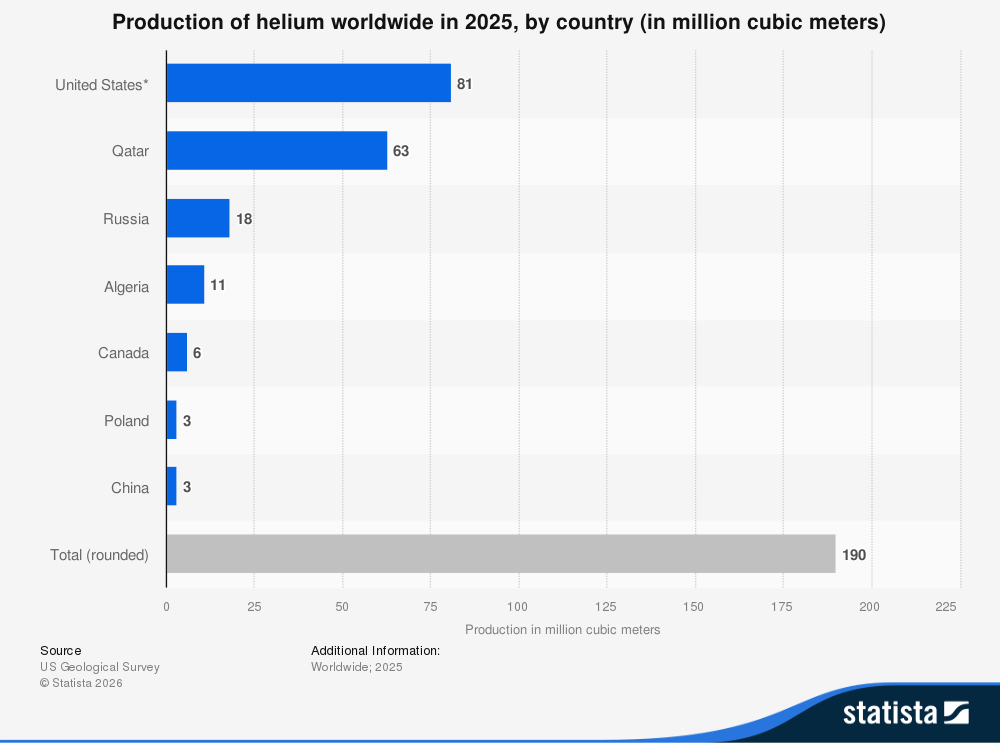
An overlooked transmission channel is the "Helium Link". Helium is extracted from Qatari LNG processing, and the region accounts for 30-38% of global supply. Because helium is non-substitutable, a halt in transits can spill into sectors that rely on helium as a specialized industrial input, including semiconductor manufacturing and certain medical applications like MRI systems.

Qatar was the world's second largest producer of helium in 2025. (Source: Statista)

Market stress shows up within days, as spot supply is tighter and buyers scrambles for alternative cargoes. Reuters reported this had already begun affecting tech supply chains by March 26, and Air Liquide, a leader in the helium market, said on March 25 that a short-term helium shortage was already expected.

Large users often have some buffer stock or contracted supply. But helium is hard to stockpile for long in liquid form. It typically needs to be transported within roughly 40-60 days of liquefaction. That means a short disruption may be absorbed, but a multi-week disruption starts to bite much harder later.

Helium is highly effective at transferring heat, making it ideal for rapid cooling. (Image credit: Shutterstock/aPhoenix photographer)

2.6. Timing, Sequencing, and Persistence

The economic significance of a Hormuz disruption depends not only on size but also on duration.

Some effects appear almost immediately, such as changes in traffic, freight, insurance, and headline energy prices. Others are slower and depend on inventories, contract structures, and the ability of firms to draw on buffers or alternative supply.

The longer the disruption lasts, the more likely it is to move from transport and pricing shocks into a broader industrial and food-system problem.

CTA Image

The Dark Edge Case of Prediction-Market Era Exposed?

Learn more

💡 This is the First Article in the Series. Sign up to Receive Further Updates if You Haven’t Done So.

What Exactly Is a Hormuz Bet? - Article 2 of the Hormuz Series, March 2026
A guide to Hormuz contract design, market structure, and why 7 days is more meaningful than 2 or 14.

Click on the Bookmark to read Article 2 of the Series

Do Hormuz Event Contracts Actually Hedge Anything? - Article 3 of the Hormuz Series, March 2026
Testing when Kalshi and Polymarket contracts hedge real commodity exposure, and when they do not.

Click on the Bookmark to read Article 2 of the Series

Disclaimer: The content is for informational purposes only. You should not construe any such information or other material as legal, tax, investment, financial, or other advice. Nothing contained in this article constitutes a solicitation, recommendation, endorsement, or offer by the author(s) or any third party service provider to buy or sell any securities or other financial instruments in your or in any other jurisdiction in which such solicitation or offer would be unlawful under the securities laws of such jurisdiction. The author(s) report(s) no conflict of interest.

Federal Preemption or State Sovereignty? A Legal Analysis and Prospective Assessment of Kalshi v. Nevada
Analysis
InsightRegulatoryBusinessPrediction Market

Federal Preemption or State Sovereignty? A Legal Analysis and Prospective Assessment of Kalshi v. Nevada

Kalshi and Nevada clash over jurisdiction—federal law vs. state gambling rules. It now comes down to how nine Supreme Court justices read the statute.

Economics & FinancePolitics

What went wrong between Kalshi and Nevada?

Kalshi is having a legal war with Nevada, unsurprisingly. On the one hand, you have the traditional Las Vegas casinos celebrating their long-standing monopoly on sports betting as the lifeblood of the state, funding its residents and public infrastructure. On the other hand, you have a new entrant riding the halo of being a federally regulated "financial product." The tension was never hard to spot, and it was always going to end up in court.

The US, founded on federalism, is no stranger to the question of state versus federal authority. And on this particular question: "who should win?" , this piece might just be your reference if you ever consider investing in an event contract on this topic.

If you don't know yet what is prediction market

Learn more

Kalshi's position: federal jurisdiction, full stop

Kalshi argues that the federal agency, not the state, should have exclusive jurisdiction over prediction markets. Through its years-long legal uphill battle, Kalshi has established that its core product, the event contract, carries legal status as a "derivative," placing it squarely under the CFTC's (Commodity Futures Trading Commission) jurisdiction over "all trading accounts, agreements, contracts, and transactions" under the CEA (Commodity Exchange Act).

Kalshi further argues that event contracts, with real economic utility such as risk hedging and price discovery, structurally qualify for the "bona fide business" exception to the statutory definition of gambling.

This view that event contracts are fundamentally different from traditional gambling, which is merely speculative, has been publicly backed by the current CFTC acting chairman Michael Selig. Pointed out by Selig in his X post in March 2026, Arizona's Attorney General's criminal charge against the prediction market exchange should be qualified as a 'jurisdictional dispute' rather than a 'criminal charge' against operation of illegal gambling, further confirming the underlying jurisdictional tension.

Nevada's counter: silence isn't preemption

Nevada, however, argues that the CEA's text and history simply do not reach state gambling law, and that shifts the burden onto Kalshi to prove Congress clearly intended to displace it. Nevada's deeper argument is that neither field preemption nor conflict preemption is established here: the CEA was enacted to address price manipulation in commodity markets, not to federalize state gambling regulation, and Congress never contemplated displacing state gaming authority at all.

The state leans on Wyeth v. Levine (2009): when Congress has not clearly stated its intent to preempt an area of historic state police power, courts must presume that power survives. Gambling regulation sits squarely in that category. Mere silence on the field of prediction markets, according to Nevada, is not field preemption, rather it is just silence.

So who would actually win?

The case currently sits at the state court level. The Ninth Circuit denied Kalshi's emergency motion to block Nevada from enforcing its gaming regulations, and a Nevada state court judge then granted a temporary restraining order blocking Kalshi from operating in the state, with both hearings scheduled in April.

Will the case eventually arrive at the Supreme Court? Professionals have predicted most likely yes, may or may not because of Kalshi, the need for this jurisdictional question to be resolved lingers. Assume that it did, and how the nine sitting justices might split becomes worth an analysis.

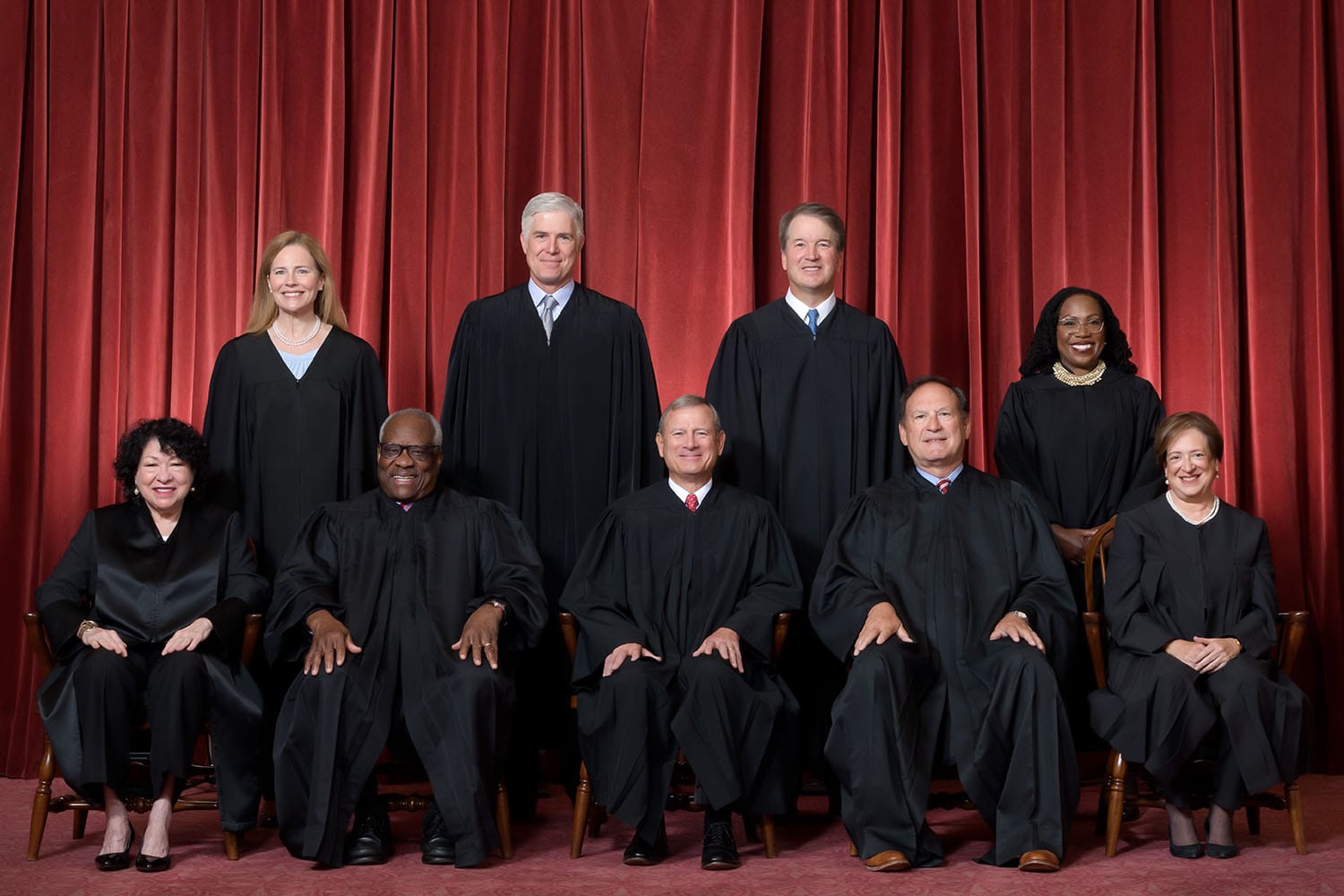
The Supreme Court as composed June 30, 2022 to present. Front row, left to right: Associate Justice Sonia Sotomayor, Associate Justice Clarence Thomas, Chief Justice John G. Roberts, Jr., Associate Justice Samuel A. Alito, Jr., and Associate Justice Elena Kagan.  Back row, left to right: Associate Justice Amy Coney Barrett, Associate Justice Neil M. Gorsuch, Associate Justice Brett M. Kavanaugh, and Associate Justice Ketanji Brown Jackson. Credit: Fred Schilling, Collection of the Supreme Court of the United States

The split isn't going to be the usual left-right divide. It’s messier. Justice Gorsuch, notably faithful to textualism, is very likely to persist in the position he staked out in Virginia Uranium, Inc. v. Warren (2019): that preemption arguments must be grounded in statutory text rather than in vague federal interests. In Virginia Uranium, Gorsuch was also joined by Justice Thomas, an equally committed textualist, and Justice Kavanaugh, who has consistently resisted finding any congressional delegation of legislative power to federal agencies absent a clear statement to that effect. 

On the other side stand Roberts and Alito, both of whom dissented in Virginia Uranium. Roberts has long favored the narrowest ruling available in any given case, making a sweeping declaration, that CFTC registration categorically overrides all state gambling regulations nationwide, an unlikely outcome from his pen. Alito presents a more genuinely uncertain picture: he has historically favored federal regulatory uniformity in commercial fields, but his record on state autonomy cuts in the other direction and makes his ultimate vote hard to predict.

The three liberals, Sotomayor, Kagan, and Jackson, are expected to side with Nevada, but their real concern is the precedent. If a federal registration alone is enough to wipe out a state's entire gaming regulatory architecture, that logic doesn't stop at Kalshi. Every federally regulated platform suddenly has a template to bypass state law entirely.

Which leaves the ultimate disposition turning on Kavanaugh and Barrett, whose votes are less predictable than those of their colleagues. Kavanaugh has a well-documented record of rejecting the practice of deferring to federal agencies on their own interpretation of ambiguous statutory language. That said, as a pragmatic textualist, there remains a chance he reads the specific CEA provision differently and lands in Kalshi's favor. Barrett, despite being a textualist, has criticized state court overreach in her dissent in Mallory v. Norfolk Southern Railway Co. (2023), but her vote will likely depend on how she reads "exclusive jurisdiction" in the CEA itself.

Given the analysis above, two scenarios emerge as most likely:

The first and most probable: a ruling substantially in favor of the states. Thomas, Gorsuch, and Kavanaugh on the conservative side, combined with Sotomayor, Kagan, and Jackson from the liberal bloc, form a plausible six-vote majority for the proposition that the CEA does not clearly preempt state gambling regulation. If Barrett's reading of the statutory text leads her to the same conclusion, that majority expands to seven, a ruling that would carry significant precedential weight and effectively close the door on similar preemption arguments by other federally regulated platforms seeking to bypass state law.

The second scenario: a Roberts compromise. Rather than resolving the case on broad preemption grounds, Roberts may draw a functional distinction between event contracts with genuine economic utility and those that are more speculative: i.e., sports results, elections. The line is not easy to draw, but it gives the Court a way to resolve this dispute without writing a rule that governs every prediction market product in existence. It's the outcome most consistent with Roberts' institutional instincts, leaving the broader regulatory debate open rather than closing it.

A clean ruling in Kalshi's favor, one that broadly establishes federal preemption of state gambling regulation, remains the least likely outcome on the board. It would require Roberts, Alito, Kavanaugh, and Barrett to coalesce around a broad federal preemption ruling, which is a configuration that runs against both the weight of Virginia Uranium and the judicial philosophy of at least two members of that coalition. Absent an extraordinary intervention by the Trump administration explicitly advocating for comprehensive federal preemption of state gambling law, the doctrinal obstacles to this result appear substantial.

The Long Game

Kalshi is fighting a tough war, and its exponential growth in market size hasn't made the legal picture any brighter. Kalshi may win an intermediate victory at the Ninth Circuit, but that doesn't guarantee a permanently comfortable position. Should a similar case eventually draw the Supreme Court's attention, the odds would not be in its favor. Kalshi's best option is likely a sit-down negotiation with state regulators or a push on Congress, both of which implicate further uncertainties. And personally, as an outside observer, I wouldn't take my bet if this event were ever listed as a contract, for the sake of my trading track record.


Disclaimer: The content is for informational purposes only. You should not construe any such information or other material as legal, tax, investment, financial, or other advice. Nothing contained in this article constitutes a solicitation, recommendation, endorsement, or offer by the author(s) or any third party service provider to buy or sell any securities or other financial instruments in your or in any other jurisdiction in which such solicitation or offer would be unlawful under the securities laws of such jurisdiction. The author(s) report(s) no conflict of interest.


‘Death Markets’ and Attack Ads: Prediction Rivalry Turns Nasty
News
RegulatoryBusinessPrediction Market

‘Death Markets’ and Attack Ads: Prediction Rivalry Turns Nasty

A fierce public spat between Kalshi and Polymarket is exposing deep regulatory and ethical divides in the booming prediction market industry just as Washington scrutiny intensifies.

PoliticsEconomics & Finance

Kalshi Inc. and Polymarket are slinging weighty accusations at each other as the prediction market rivalry heats up and the nascent industry comes under intense scrutiny in Washington.

While the platforms have sparred frequently in the past, the rhetoric has escalated in recent days after Kalshi launched a pointed advertising campaign and its employees publicly criticized Polymarket.

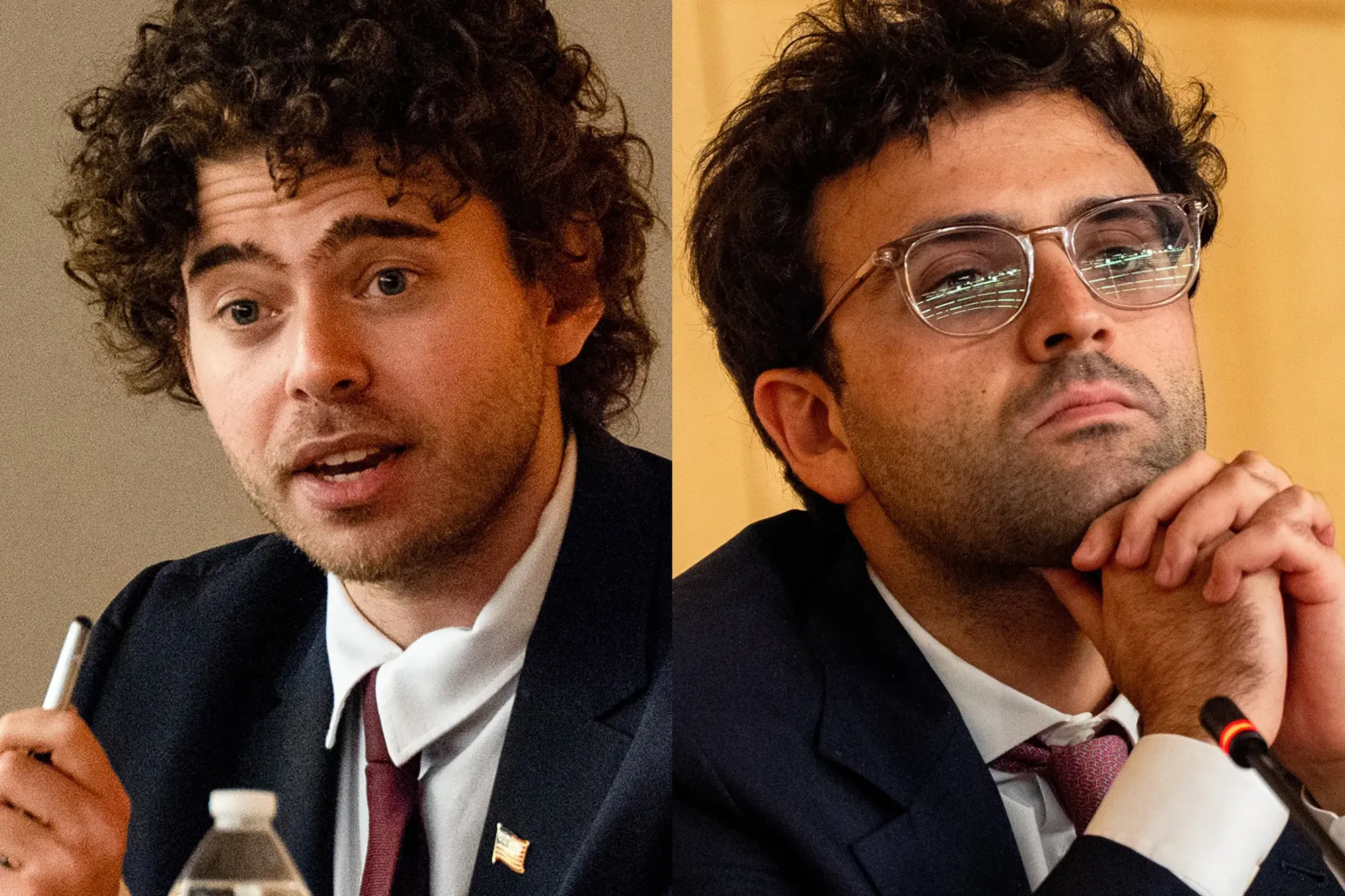
“Polymarket’s irresponsible, dangerous, and illegal behavior threatens legal American prediction markets,” Benjamin Freeman, who works on political and election markets at Kalshi, wrote in a social media post on Monday.

The accusations quickly sparked a heated back-and-forth between the companies.

“We welcome competition, but believe the discussion should be grounded in facts. Misinforming the public only harms the industry as a whole and participants,” Polymarket said in a statement.

Elisabeth Diana, a spokesperson for Kalshi, responded: “That’s laughable, coming from a company whose majority of trading volume is offshore and unregulated, and whose policies allow death markets.”

The feuding comes as Polymarket and Kalshi battle for leadership of the fast-growing prediction market industry, which has opened up a new way for Americans to wager on everything from sports to elections. The startups have both registered one record trading week after another, with nearly $6 billion in notional trading volume between them in recent weeks, according to user-compiled data on Dune Analytics.

Differences in how the exchanges are set up and operate are at the heart of the dispute. Kalshi’s platform is based in the US and overseen by the Commodity Futures Trading Commission, while Polymarket’s primary exchange operates offshore. Polymarket has used its operations outside the US to list contracts tied to military conflict — including the war in Iran — which Kalshi has said are unethical and illegal.

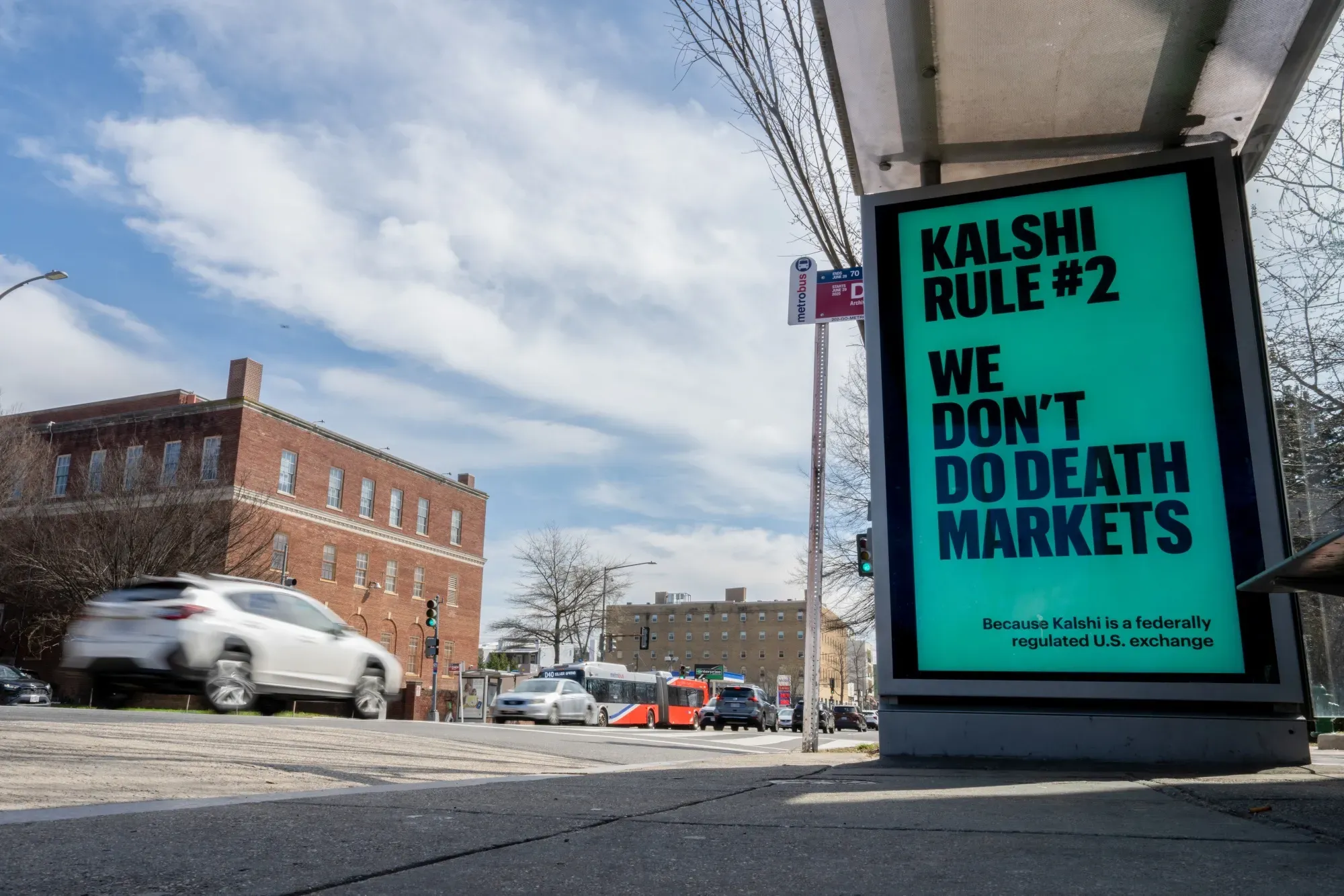
“We don’t do death markets,” one of Kalshi’s ads reads.

The Kalshi marketing, which is presented as a list of the company’s rules, began showing up at bus stops and subway stations in Washington at the beginning of this week.

“Rule #1: We ban insider trading, because Kalshi is a federally regulated US exchange,” says one. The subtext, apparent to industry observers, is that Polymarket’s main exchange is outside the reach of US regulators.

Congress has focused on insider trading following allegations of improper bets tied to US military activities in Iran and Venezuela. Kalshi has been more proactive in confronting the issue — fining and suspending customers it has accused of wrongdoing. Polymarket has taken a more hands-off approach, though it recently announced its own rules on insider trading as scrutiny grew.

“We want to highlight those big distinctions,” said Diana, the Kalshi spokesperson. “We think it’s at a point where there’s a lot of conflation between Kalshi and Polymarket and the approach to regulation.”

In addition to its offshore exchange, Polymarket also has a US-regulated platform that is currently in beta mode. The company said in a statement that both its venues enforce “the same strict market integrity standards, including prohibitions on insider trading and manipulation, with active monitoring and ongoing engagement with regulators and law enforcement.”

A few months back, Kalshi co-founder Luana Lopes Lara tried to lower tensions between the rivals. She wrote in an October social media post that she hopes the industry can move beyond “destructive infighting” and work together.

That now appears unlikely, especially after a Kalshi adviser and former CFTC commissioner, Brian Quintenz, joined the fray. Responding to reports that prosecutors are probing insider trading, Quintenz suggested on social media this week that the investigation should focus on Polymarket. Quintenz declined to comment further when contacted by Bloomberg News.

Source: https://www.bloomberg.com/news/articles/2026-04-01/-death-markets-and-attack-ads-prediction-rivalry-turns-nasty

Kalshi Approved for Margin Trading as It Lures Wall Street Pros
News
RegulatoryLegalPrediction Market

Kalshi Approved for Margin Trading as It Lures Wall Street Pros

Kalshi won approval to offer margin trading via a new futures commission merchant unit, positioning it to court institutional investors and accelerate mainstream adoption.

Economics & Finance

Kalshi Inc. has secured a license allowing it to offer margin trading to users, a feature that would make the prediction market platform more appealing to sophisticated institutional investors.

The company has been approved to operate a futures commission merchant through an affiliate called Kinetic Markets LLC, according to a March 24 filing with the National Futures Association.

Prediction market exchanges offer yes-or-no wagers on the outcome of events from sports to elections, making them accessible to even novice users. Yet, at their core, the contracts offered by the platforms are similar to classic financial derivatives such as futures.

Adding margin trading to the mix would allow users to open positions without putting up the full amount of capital, a practice frequently deployed by hedge funds and other investment firms.

Kalshi declined to comment on the license, but its Chief Executive Officer Tarek Mansour said on Friday that a margin trading product would be coming “soon,” and that making the platform more capital efficient for institutional investors was a priority.

“Institutions are very aware of the cost of capital,” he said during a panel discussion moderated by Bloomberg News. “If you want to put a $100 hedge, you have to put $100 in the clearinghouse. That’s too expensive for an institution.”

Kalshi doesn’t expect to launch margin on event contracts immediately, but could consider making it available sooner for other types of products it has in the pipeline, a person familiar with the matter said. It will only be available to institutions initially, they added.

Retail traders have turned prediction markets into one of the fastest-growing parts of the financial universe, with weekly notional volume hitting a record high of more than $3 billion on Kalshi earlier this month. The platforms are also attracting investment from traditional exchange operators, and getting institutional investors on board is seen as a crucial next step in their development.

Already, brokers to hedge funds and other investors have started the process of opening up client access to event bets on Kalshi.

“Institutions want to see certainly, liquidity, the ability to margin,” Toby Moskowitz, a finance professor at the Yale School of Management and principal at AQR Capital Management, said on a separate panel on Friday. “But we need to get to that point to get that institutional involvement.”

US regulations would require users accessing margin products on Kalshi to undergo additional identity checks, such as providing employer information. ID requirements have become a hot-button issue as the platforms grapple with high-profile instances of insider trading.

Lawmakers in the US have put forward several pieces of legislation aimed at tackling insider trading, and earlier this week, Kalshi banned athletes and government officials from accessing markets they might hold influence over.

Source: https://www.bloomberg.com/news/articles/2026-03-27/kalshi-approved-for-margin-trading-as-it-lures-wall-street-pros

Kalshi, Polymarket Founders Back New Prediction Market VC Fund
News
InsightRegulatoryBusinessPrediction Market

Kalshi, Polymarket Founders Back New Prediction Market VC Fund

A new $35 million venture fund, 5c(c) Capital, backed by prediction-market rivals Kalshi and Polymarket and top VCs, signals growing institutional confidence in regulated betting exchanges.

Economics & Finance

A new venture capital fund focused on prediction markets is launching with initial investments from a long list of prominent investors including two of the industry’s biggest players, Polymarket’s Shayne Coplan and Kalshi Inc.’s Tarek Mansour, according to an investment document viewed by Bloomberg News.

The investment firm, 5c(c) Capital, is named for the section of the Commodity Exchange Act related to prediction markets. It appears to be the first fund focused on the nascent industry, and underscores the rapid growth of exchanges like Kalshi and Polymarket, which have opened up betting on a wide array of real-world events, such as elections and sports.

“We want to capitalize on the second-, third-, and fourth-order effects of what we built ourselves,” the founders of the new fund, who both previously worked at Kalshi, wrote in the document.

5c(c) Capital is planning to raise up to $35 million with about 20 portfolio companies over the next two years, the document says.

A spokesperson for Kalshi confirmed that Mansour is involved. Polymarket did not immediately respond to a request for comment.

The joint participation of Mansour and Coplan is notable because the two have otherwise been fierce rivals.

The pitch document lists more than twenty prominent investors offering early support, including a portfolio manager at Millennium Management, several crypto-focused venture capital funds, and the founders of other prediction market companies such as PredictIt.

A representative for Millennium did not immediately respond to a request for comment.

Marc Andreessen, the founder of Andreessen Horowitz, invested through a separate fund, Moneta Luna, along with the other leaders of that firm, Elena Silenok and Chris Dixon, Silenok confirmed.

Other notable limited partners include Jeremy Levine, CEO of Underdog Fantasy, a gambling company, and Jacob Fortinsky, the CEO of Novig, a sports-focused prediction market, both of whom confirmed their involvement.

One of the founders of the new fund, Adhi Rajaprabhakaran, was the second trader to join Kalshi Trading, the platform’s separate market-making arm, and now the author of 50 Cent Dollars, a popular blog on prediction market infrastructure and business.

“Adhi is a talented investor and we are excited to back him,” Silenok said.

Noah Zingler-Sternig, the other founder, was the head of operations at Kalshi and led the exchange’s integration with brokerage Robinhood Markets Inc.

Rajaprabhakaran and Zingler-Sternig declined to comment.

Prediction markets have faced blowback from state gaming regulators who have argued in court that they offer unlicensed sports gambling. But the platforms are overseen at the federal level by the Commodity Futures Trading Commission, which has, under its new chair, Michael Selig, supported the exchanges in their legal battles with states.

The document says the fund could invest in trading firms that make markets on prediction markets and analytics platforms that help participants track the markets. Sports have been the most popular subject for trading over the last year, but the founders say that there are still big opportunities in the space.

“At the moment, prediction markets might appear to be just about sports, but that is only the latest chapter in what we believe to be a very long story,” the founders said in the pitch document, which forecasts the industry could reach $10 trillion in trading volume over time.

Source: https://www.bloomberg.com/news/articles/2026-03-23/kalshi-polymarket-founders-back-new-prediction-market-vc-fund

SEC, CFTC Move to Define Which Digital Assets are Securities
News
EconomicsRegulatoryLegalPrediction Market

SEC, CFTC Move to Define Which Digital Assets are Securities

US securities and derivatives regulators jointly issued long-awaited crypto asset guidance, narrowing what counts as a security and signaling they’ll move ahead without waiting for Congress.

PoliticsEconomics & Finance

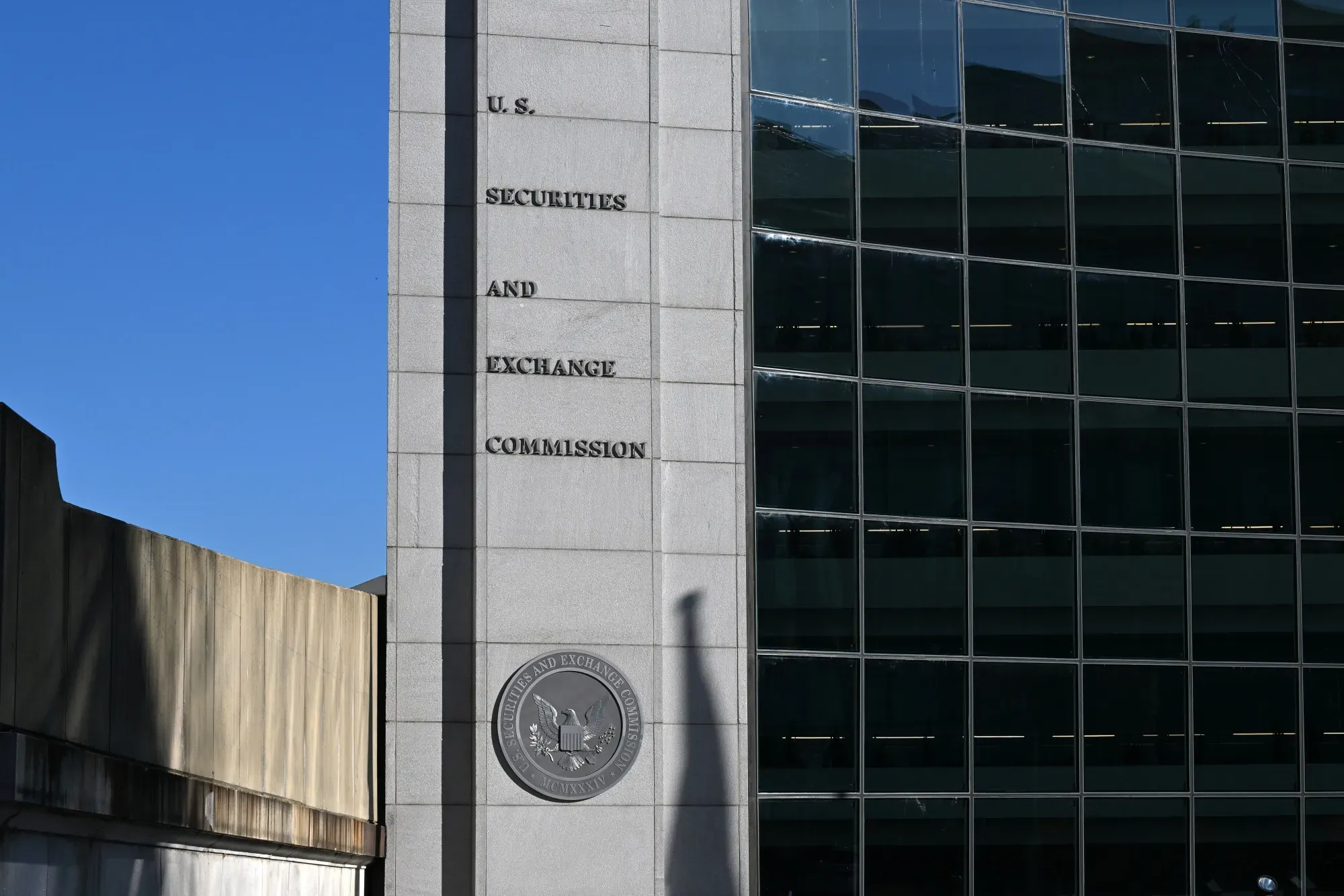
The Securities and Exchange Commission issued a long-awaited “token taxonomy” on Tuesday, a key step forward laying out which types of digital assets it deems to be securities.

The guidance carves out payment stablecoins, digital collectives and digital commodities as non-securities. It also clarifies how federal securities laws apply to protocol mining, staking and crypto airdrops, the SEC said in a memo.

Digital securities, or traditional securities that are tokenized, are subject to SEC rules and regulations, according to the guidance.

“We’re not the securities and everything commission anymore,” Chairman Paul Atkins said at the Digital Chamber’s conference in Washington, in a critique of the Biden administration’s stance that most crypto assets should be treated as securities.

Notably, the SEC explained that a non-security crypto asset may stop being an investment contract under securities laws when an issuer has either fulfilled or failed its representations or promises.

The crypto industry has long sought greater clarity on whether particular assets are considered securities, which typically require more regulatory disclosures than commodities.

The Commodity Futures Trading Commission joined in the interpretation, in the latest sign that Wall Street’s two main regulators are no longer waiting for Congress to finalize legislation to delineate which agency has jurisdiction over which digital assets.

The SEC head also said the agency would soon issue a proposed rule teeing up a safe harbor program for startups to launch crypto companies, crypto investment contracts and security tokens without necessarily having to register with the agency.

The goal would be to allow companies to gain access to capital without being subject to enforcement action, said Atkins, adding the safe harbor could last up to four years.

“Such a safe harbor would provide crypto innovators bespoke pathways to raise capital in the US while providing appropriate investor protections,” Atkins said.

Atkins said the latest efforts would give the agencies a “head start” bringing certainty to the digital asset industry but urged lawmakers to continue their work on market structure legislation.
Source: https://www.bloomberg.com/news/articles/2026-03-17/sec-cftc-move-to-define-which-digital-assets-are-securities

Macro & Micro Compass - Colombia’s Real Threat Is Not Political
Analysis
EconomicsGDPGeopoliticsMacro & Micro Compass

Macro & Micro Compass - Colombia’s Real Threat Is Not Political

Colombia’s unexpectedly competitive three-way presidential race heightens investor anxiety, as a fragmented Congress and wary electorate imperil the deep fiscal tightening needed to avoid a confidence crisis.

PoliticsEconomics & Finance

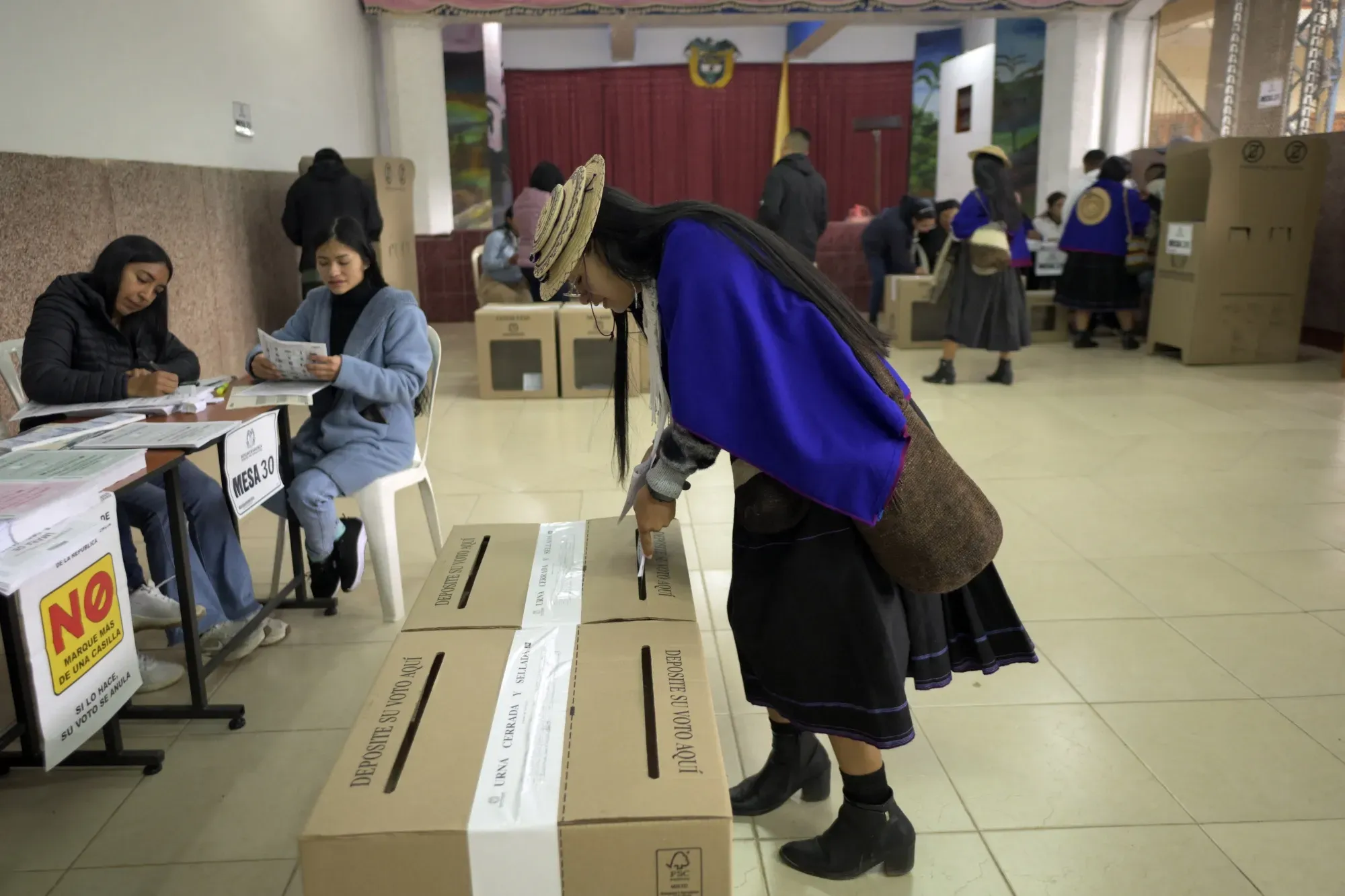
Colombia’s primary elections left political junkies in ecstasy and economists uneasy.

The better-than-expected performance of center-right senator Paloma Valencia has effectively turned the May 31 presidential vote into a three-way race, with leftist Iván Cepeda and hardliner Abelardo de la Espriella also vying for the two spots in an eventual runoff. Valencia’s emergence adds spark to a contest that now looks wide open: the successor to Gustavo Petro could be one of his close ideological allies, a protégé of his nemesis former president Álvaro Uribe or a cartoonish outsider with no experience in office. For any Nordic political scientist fascinated by complex electoral dynamics, this is irresistible; it guarantees a gripping campaign through the likely June 21 second round.

At the same time, Colombia’s fractured politics, reflected in a new congress where no party holds more than a quarter of either chamber, suggest that no matter the ideological leaning of the next government, it will have to build consensus if it hopes to pass legislation and implement reforms. That should worry investors and policymakers, because Colombia faces a looming fiscal crisis that so far no candidate has been willing to address. With meaningful budget cuts largely absent from a campaign focused on insecurity, corruption and health care, the next president won’t arrive in office with a popular mandate to impose the austerity that the Andean nation may soon require.

The numbers are grim: Colombia ended 2025 with a primary deficit of 3.5% of GDP, the largest budget gap in three decades outside periods of crisis. Once interest payments are included, the deficit rises to 6.4% of GDP; it could have surpassed 8% were it not for debt-management maneuvering by the Petro administration. CARF, the country’s fiscal watchdog, has estimated that returning to compliance with Colombia’s debt rule — suspended by Petro last year as he sought to free himself from spending constraints — will require a fiscal adjustment of 4.5% of GDP through 2028. That means the next government will have to spend substantial political capital sustaining a credible budget-tightening of more than one percentage point of GDP per year. The alternative is flirting with an investor confidence crisis.

Already trading at higher sovereign spreads than regional peers such as Chile, Peru, Mexico or even Brazil, Colombia’s five-year credit default swaps hit a 10-month high of 241 basis points on March 6, right before the primary, but eased slightly as investors cheered the election results.

While the finance ministry said last week it aims to reduce the deficit to 5.1% of GDP in 2026 through lower spending and debt service costs, it offered little detail on how it would achieve such an ambitious goal. The notion that the spendthrift Petro might deliver a sharp fiscal contraction during his final five months in office also defies credulity. He appears, instead, to be passing the problem to whoever comes next.
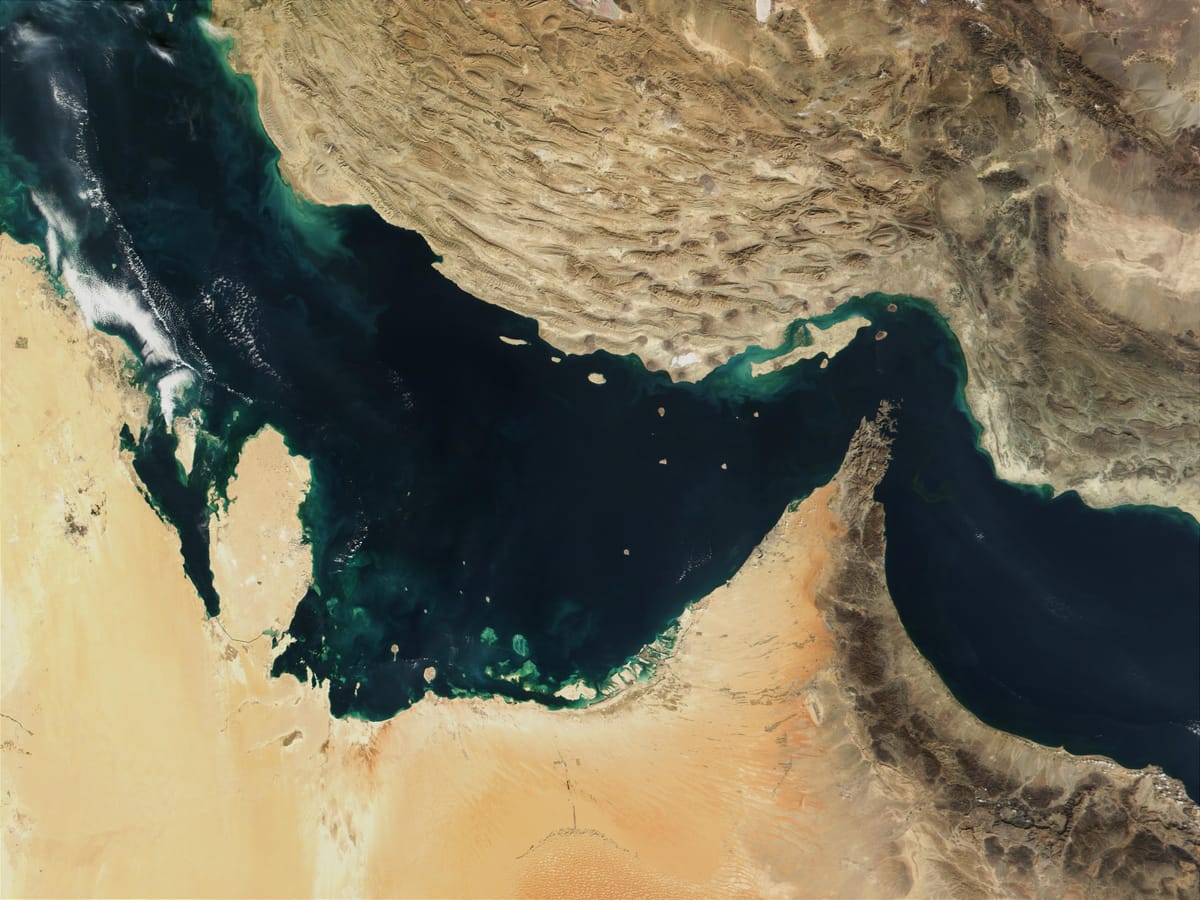
True, Colombia’s fiscal problems didn’t start with its flamboyant and garrulous president. The country has run structurally higher deficits since the pandemic and lost its investment-grade status in 2021 under former president Iván Duque. But Petro has made matters worse, accelerating spending amid persistent inflationary pressures. His administration relied on optimistic revenue projections, underestimated spending pressures and adopted questionable policies, including raising the minimum wage far above inflation and trying to undermine the central bank’s inflation-fighting credibility. The decision in October to cancel the two-year flexible credit line approved by the International Monetary Fund removed an additional financial safeguard.

To be sure, the possibility of a centrist or right-wing victory increases the odds of more orthodox economic policies, helping to explain why investors cheered on the primary’s results. But that shift toward pro-market policy still looks like a leap of faith. According to Polymarket, Cepeda continues to lead the odds of winning the election with 43%. And even if a pro-business government is inaugurated, it’s politically treacherous for any president in Colombia, limited to a single four-year term with no reelection, to devote a large share of the mandate to delivering austerity.

There was a time when Colombia’s fiscal rectitude was a matter of national pride. Unlike most of its neighbors, it has not defaulted on its sovereign debt in nearly a century. Preserving that impressive record will now fall to the next president, who may soon discover that fixing Colombia’s finances is far harder than winning ultra-competitive elections.

Source: https://www.bloomberg.com/opinion/articles/2026-03-16/colombia-s-real-threat-is-not-political