Sharp turnaround for state-backed company central to Beijing’s AI supply chain efforts.
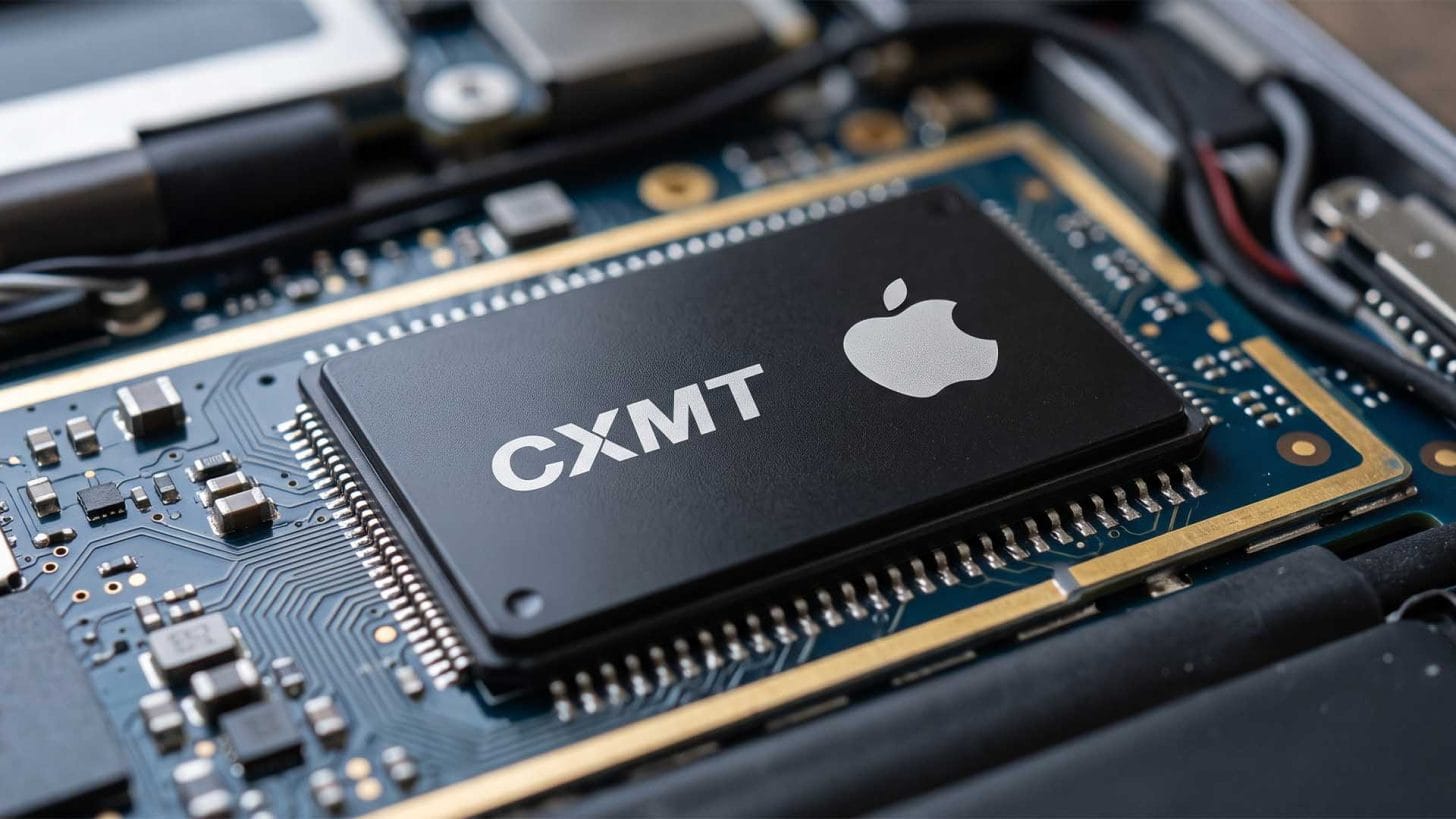
Follow last week's market rumor (see our post), CXMT has been thrust into the global spotlight by the race for memory chips. Apple has begun testing the company’s DRam chips for devices sold in China, according to two people familiar with the matter, as the iPhone maker leads a lobbying effort among US tech companies to get the US government to allow broader use of the company’s products (the Financial Times).
Will Apple use CXMT's chips for devices sold in China?
YesResult
60.00%
NoResult
40.00%
10 Polls
EndedTBD
The interest in CXMT marks a sharp turnaround for a company that spent nearly a decade burning through billions of dollars but has now become central to Beijing’s efforts to build a domestic AI supply chain — and is poised to become one of the most profitable technology companies to be listed on China’s domestic stock market.
The memory shortage has transformed CXMT’s finances. Its net profit soared to Rmb33bn ($4.8bn) in the first quarter of this year, according to its IPO prospectus — a striking reversal from the Rmb37bn ($5.4bn) in losses it has accumulated over the past decade.
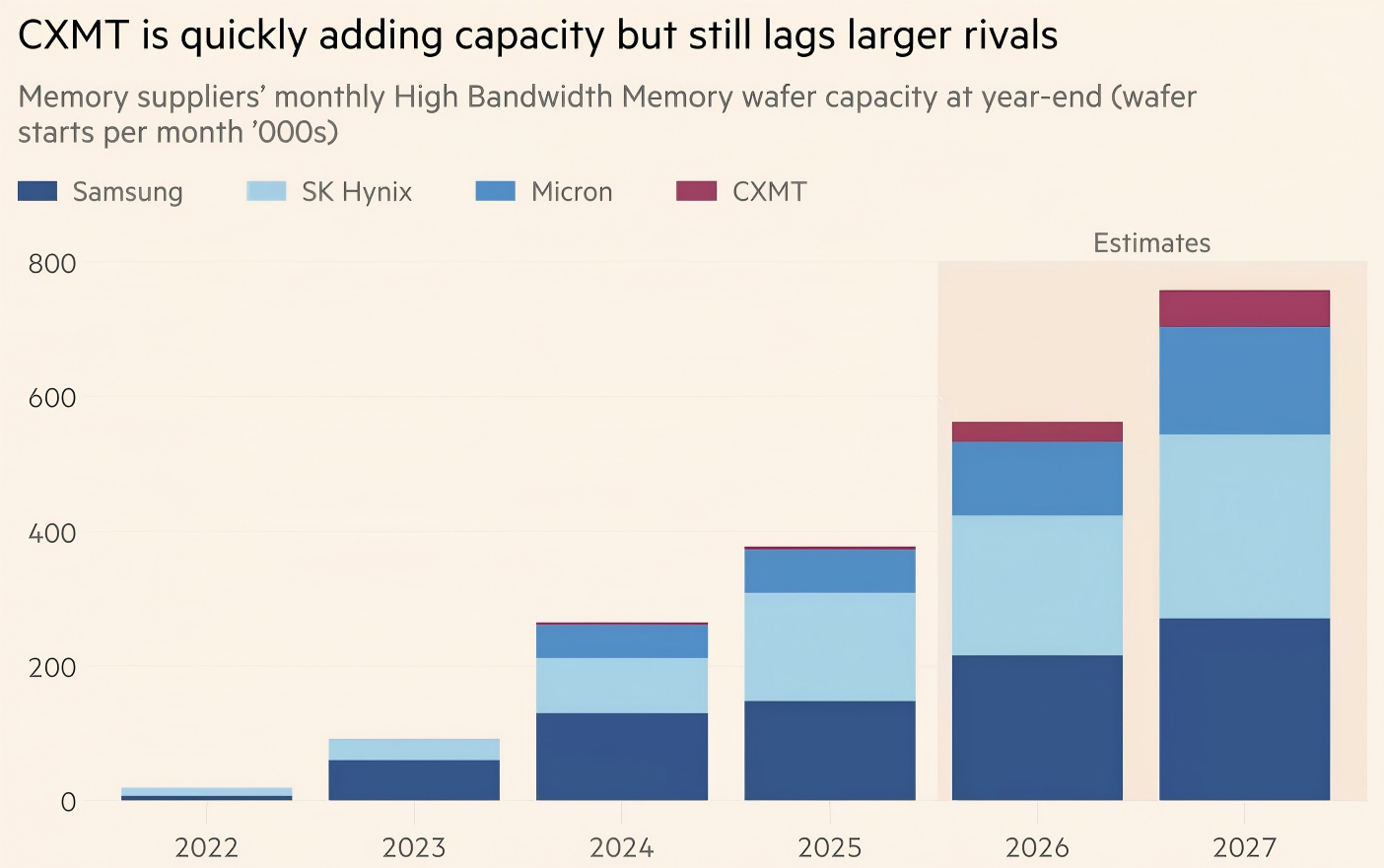
Source: SemiAnalysis Memory Model
CXMT is now the world’s fourth-largest producer of DRam — the chips used in everything from smartphones to servers — behind SK Hynix, Samsung Electronics and Micron.
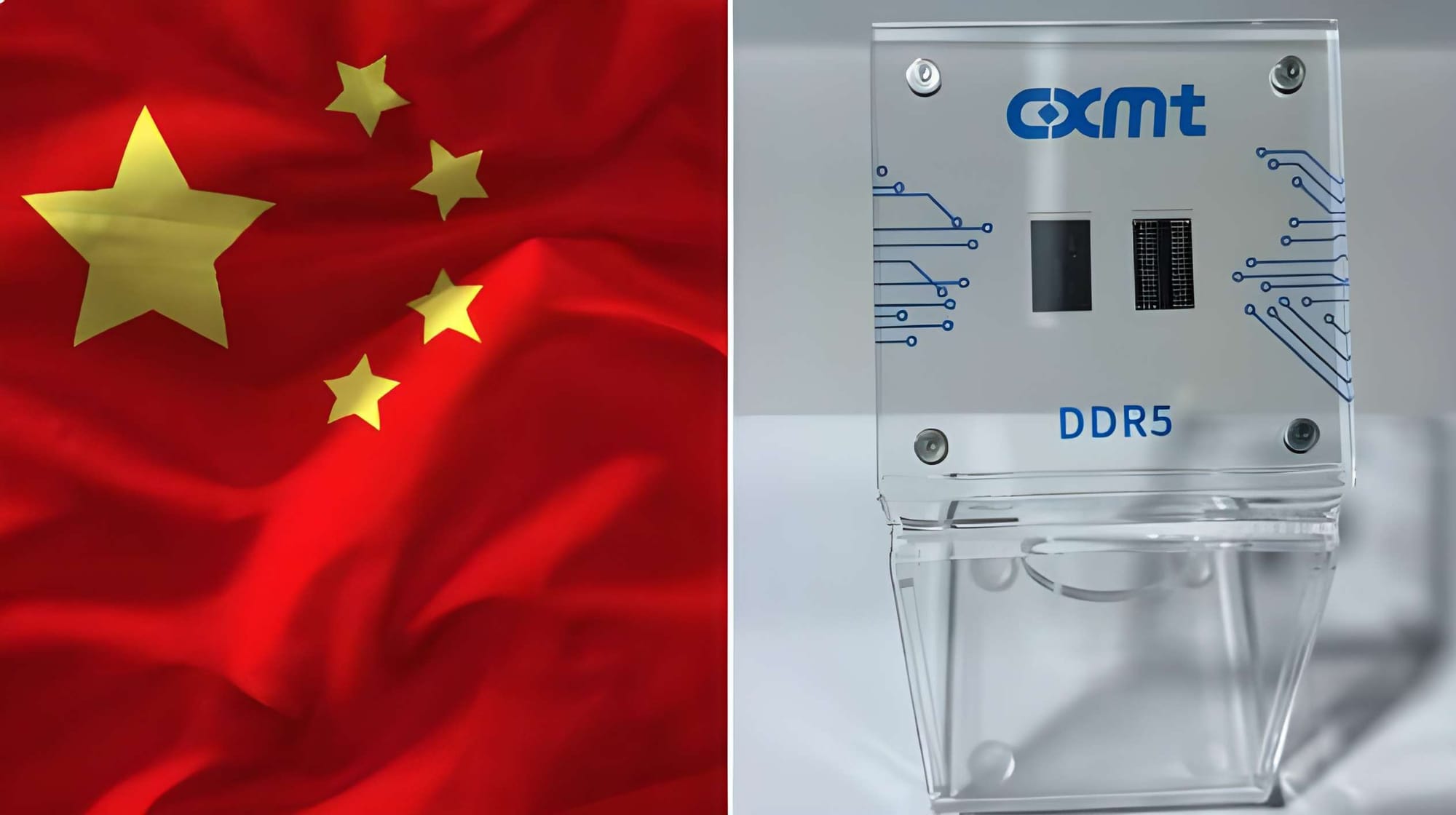
For US tech groups competing over a finite global supply of DRam wafers, the prospect of a fourth global supplier in China is appealing but politically sensitive. Apple has previously faced public pushback from US policymakers when it last explored using Chinese memory suppliers, including then Republican senator Marco Rubio, who flagged security risks in 2022.
Source: wccftech
Despite CXMT’s rapid growth and plans to increase production, analysts say additional Chinese supply is unlikely to ease memory chip prices soon, as virtually all of its output is already committed and demand continues to grow.
“There’s a misconception that Chinese memory is dramatically cheaper and will flood the market,” said Ray Wang, memory analyst at SemiAnalysis. “Capacity is extremely constrained. Even as CXMT expands, it will remain supply constrained for at least the next two years.”
Over the longer term, however, competitors fear a repeat of the pattern seen in Chinese industries from solar panels to electric vehicles: years of state-backed investment followed by rapid capacity expansion and falling prices that squeeze foreign rivals.
Two headlines landed within days of each other and appear to point in opposite directions: Anthropic locking up two decades of dedicated data-center capacity it won't even need until 2027, and Meta suggesting it has AI compute to spare right now. Whether that's a real contradiction or just two companies at different points in the same buildout cycle is genuinely contested — analysts, investors, and the companies themselves haven't settled on one story.
Do you think, will hyperscalers raise CAPEX again in 2026-2027 or not?
Yes - it is way not overResult
100.00%
No - it has peakedResult
0.00%
3 Polls
EndedTBD
Anthropic Locks Up TeraWulf's Data Center Capacity in Kentucky Campus
On July 6, 2026, TeraWulf — a bitcoin miner turned AI landlord — announced a 20-year lease with Anthropic covering its Justified Data campus in Hawesville, Kentucky. The site, built on the grounds of a former aluminum smelter, will scale to roughly 401 megawatts of critical IT load in phases, with initial capacity live in the second half of 2027 and full build-out by early 2028.
TeraWulf expects the lease to generate approximately $19 billion in contracted revenue over its initial term, backed by investment-grade credit — a figure that exceeds TeraWulf's own ~$12 billion market cap. TeraWulf's own capital outlay is modest by comparison: roughly $3-4 billion, less than a fifth of the lease's value. Shares jumped as much as 19% on the news.
In a companion transaction, TeraWulf agreed to sell its 50.1% stake in the Abernathy, Texas joint venture (a 168 MW site developed with Fluidstack) for about $530 million, freeing capital to plow back into wholly-owned AI infrastructure. TeraWulf CEO Paul Prager framed the deal as validation of a strategy built around owning critical infrastructure and locking in direct, long-duration customer relationships — the same "picks and shovels" logic that has pushed bitcoin miners as a group to sell over 15,000 coins and sign more than $70 billion in AI hosting contracts this year alone.
Meta Says It Might Have Compute to Spare
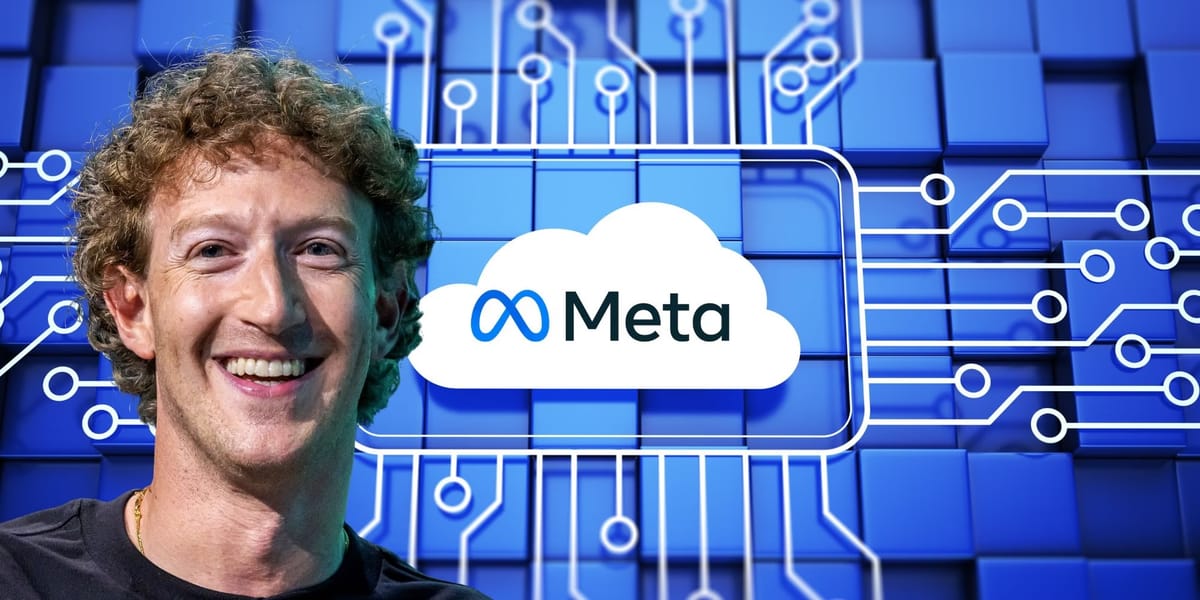
Just days earlier, a very different signal came from the other end of the AI infrastructure chain. At Meta's May shareholder meeting, Mark Zuckerberg said entering the cloud business was "definitely on the table," noting that companies were approaching Meta "almost every week" asking to buy access to its models or spare GPU capacity. By early July, Bloomberg reported Meta was actively developing a "Meta Compute" offering to rent out excess capacity and hosted model access — putting it in direct competition with AWS, Azure, and Google Cloud.
The numbers behind this are enormous: Meta has guided to $125-145 billion in 2026 capex, sits on $182.9 billion in AI infrastructure commitments, and by some estimates could have close to 5 gigawatts of capacity on hand by year-end — including a 2,250-acre Louisiana campus and gigawatt-scale sites in the Midwest. The market's reaction was sharp and split: chip stocks sold off hard (the Philadelphia Semiconductor Index fell over 6% in a session, with Micron, SanDisk, and Intel all down double digits) on fears that a major buyer signaling "excess" implies softer near-term demand, even as Meta shares rose on hopes that idle capex could become a revenue line.
Notably, Meta is not new to leasing capacity to AI labs. It already rents the entire Colossus 1 site in Memphis (300+ MW) to Anthropic for roughly $1.25 billion a month through May 2029, and a separate facility to Google for about $920 million a month — arrangements Bloomberg Intelligence estimates could generate $50 billion-plus by 2028.
Which signal will look more important for the AI infrastructure cycle by the end of 2028?
Both will coexist as a normal parts of the same buildout cycleResult
100.00%
Neither: AI infrastructure demand will weaken materiallyResult
0.00%
1 Polls
EndedTBD
Why the Discrepancy?
Meta could be needing to turn its capex into cash flow. Meta has guided to $125-145 billion in 2026 capex alone and has disclosed roughly $183 billion in cumulative AI infrastructure commitments. That is a lot of depreciation and power spend sitting on the balance sheet with no matching external revenue. Reframing idle or underused capacity as a rentable product — "Meta Compute" — lets Meta tell investors that some of that capex is an income-generating asset rather than a pure cost center. This is at least partly a financial-narrative move, and the market treated it that way: Meta's own shares rose on the announcement even as chip and neocloud stocks (CoreWeave, Nebius) sold off on fears that a top buyer signaling "spare" compute means softer near-term chip demand industry-wide.
A possible gap in model-side demand (the quality of product). If Anthropic's models are pulling in more training and inference demand per dollar of infrastructure than Meta's own Llama/"Watermelon" models are, that alone would produce exactly this pattern — Anthropic scrambling for guaranteed long-term capacity while Meta finds its internal AI workloads aren't absorbing everything it built. This is the hardest of the three to verify directly: Meta has claimed its upcoming Watermelon model matches GPT-5.5-tier performance, so the "quality gap" is contested rather than settled, and neither side's true utilization numbers are public. Worth flagging as a plausible driver, not a confirmed one.
Meta may be freeing up older silicon as it jumps to next-gen chips - a rise of capex, rather than a cut back. Meta is reportedly in talks for a roughly $6.5 billion deal with Samsung Foundry to produce its third-through-fifth generation MTIA accelerators on a 2nm process — a shift away from TSMC, whose leading-edge capacity is said to be booked through 2027. Meta is also targeting a new in-house chip generation roughly every six months as it scales toward 5 gigawatts of capacity by 2030. A hardware refresh cycle that aggressive, layered on top of GPU capacity bought during the initial AI buildout rush, plausibly leaves Meta holding a growing stack of still-functional but no-longer-frontier compute — exactly the kind of capacity that makes sense to lease out rather than idle, while the newest MTIA generations get reserved for Meta's own priority workloads. Separately, Anthropic itself is reportedly exploring Samsung's 2nm node for its own custom silicon, so both companies are pursuing chip diversification in parallel, just from different starting positions (Meta offloading older capacity while upgrading; Anthropic trying to reduce Nvidia dependence for future needs).
Sign up for further professional analysis
To be the premier information portal for prediction markets.
Bloomberg (July 1) - Meta is reportedly developing a cloud infrastructure business that would sell access to AI computing power and models to outside customers. The plan could put Meta into a new competitive lane against cloud leaders such as Amazon Web Services, Microsoft Azure, and Google Cloud. The business would aim to generate revenue from excess AI computing capacity that Meta has built for its own artificial intelligence(AI) ambitions.
Who faces the biggest risk if Meta sells excess AI compute?
Neocloud providers e.g. CoreWeave and NebiusResult
16.67%
Big hyperscalers e.g. AWS, Azure, and Google CloudResult
66.66%
AI chip suppliersResult
0.00%
Meta itselfResult
16.67%
OthersResult
0.00%
6 Polls
EndedTBD
Reuters, citing Bloomberg’s report, added that the planned service could let developers access AI models hosted on Meta’s infrastructure and pay for the computing power needed to run them. Meta is also reportedly considering selling raw AI computing capacity, similar to neocloud providers. Meta declined to comment, and Reuters said it could not independently verify the Bloomberg report.
The bullish interpretation is straightforward: Meta may be trying to turn AI infrastructure from a cost center into a revenue source. If the company has already committed massive capital to data centers, chips and AI systems, then selling unused or excess capacity could help Wall Street better understand the return on that spending.
Reuters reported that Meta is projected to spend as much as $145 billion on AI infrastructure this year, a significant portion of Big Tech’s more than $700 billion outlay on the technology. The scale of that spending explains why investors are watching Meta’s AI strategy so closely.
But the bearish interpretation is also important. If Meta is already looking for ways to sell excess compute, investors may ask whether its internal AI products can absorb all the infrastructure it is building. In other words, the same news can be read in two opposite ways: either Meta has found a monetization path for AI Capex or it is revealing early signs of overcapacity.
Is Meta’s reported AI cloud plan bullish or bearish for the AI trade?
Bullish: it creates a new monetization pathResult
50.00%
Bearish: it signals possible compute overbuildResult
50.00%
Neutral: too early to tellResult
0.00%
Depends on pricing and marginsResult
0.00%
2 Polls
EndedTBD
The impact of competition may also be uneven. Large cloud providers like AWS, Azure, and Google Cloud may be harder to disrupt because they already have broad enterprise ecosystems. The bigger pressure may fall on neocloud companies such as CoreWeave and Nebius, who relay more heavily on AI compute demand and large anchor customers. Reuters quoted D.A. Davidson’s Gil Luria as saying Meta’s added capacity would likely matter more for neoclouds than for the biggest hyperscalers.
Now the key question is not simply whether Meta enters cloud. The real question is : the market prices this as AI monetization or AI overbuild.
If investors believe the cloud pivot proves that AI infrastructure can be resold profitably, Meta’s Capex story becomes easier to defend. If they believe it shows internal AI demand is weaker than expected, the trade could spread pressure across AI infrastructure stocks.
Reuters (July 2)- Meta CEO Mark Zuckerberg told employees at an internal town hall that the company’s AI agent technology has not progressed as quickly as he expected. AI agents are automated systems designed to execute tasks on behalf of users. And they are central to the broader market belief that generative AI will eventually translate into real productivity gains.
Zuckerberg also said Meta’s recent reorganization was not as “clean” as it could have been and that executives miscalculated the timing of the changes. Earlier this year, Meta laid off about 10% of its global workforce and reassigned roughly 7,000 employees to AI focused teams which triggered employee pushback and morale concerns.
Do you think Ai Capex has Peaked?
Yes, it's time to take profitsResult
66.67%
No, Big Tech has enormous potentialResult
33.33%
Let me finish my reading first...Result
0.00%
3 Polls
EndedTBD
Despite the slower progress, Zuckerberg did not signal a give up from AI. Reuters reported that he expects Meta to begin seeing more significant benefits from its AI investments within the next three to six months. Meta is projected to spend as much as $145 billion on AI infrastructure this year.
This is not a story about Meta abandoning AI. It is a story about timing.
The AI market has spent the past two years pricing in a rapid transition from infrastructure investment to application level productivity. Zuckerberg’s comments challenge that timeline. If AI agents are progressing more slowly than expected, the market ought to ask whether AI's payoff is being pushed further into the future.
That matters because Meta is not only spending on models. It is restructuring the company around AI, moving employees into AI workflows, and investing heavily in infrastructure. Reuters reported that Zuckerberg realized the shortcomings in Meta’s AI restructuring, while still emphasizing that the company was not fundamentally changing course on its AI push.
For investors, the tension is simple: AI infrastructure spending is immediate but AI agent revenue and productivity gains are still uncertain. If the benefits arrive within three to six months, as Zuckerberg expects, the current investment cycle may look justified. If progress remains slow, investors may become more skeptical of whether AI agents can deliver enough near-term value to support AI’s rising Capex.
Will Meta’s AI agents show meaningful business impact within the next 3–6 months?
YesResult
0.00%
NoResult
0.00%
Only limited impactResult
100.00%
Too early to judgeResult
0.00%
1 Polls
EndedTBD
This is also why the Reuters report should be read together with the Bloomberg report on Meta’s potential cloud business. If AI agents are slower to mature while Meta is also exploring ways to sell excess compute, the market debate will become sharper: is Meta simply creating more revenue channels for AI infrastructure or is it looking for a backup monetization path because internal AI use cases are not scaling fast enough?
In April 2025, Elon Musk revealed that Optimus production had stalled over a magnet problem: Tesla was waiting on a Chinese export license for the rare-earth magnets that drive one of the robot's arm actuators. It was an unusually specific admission, and it pointed at a dependency the rest of the industry shares but rarely names.
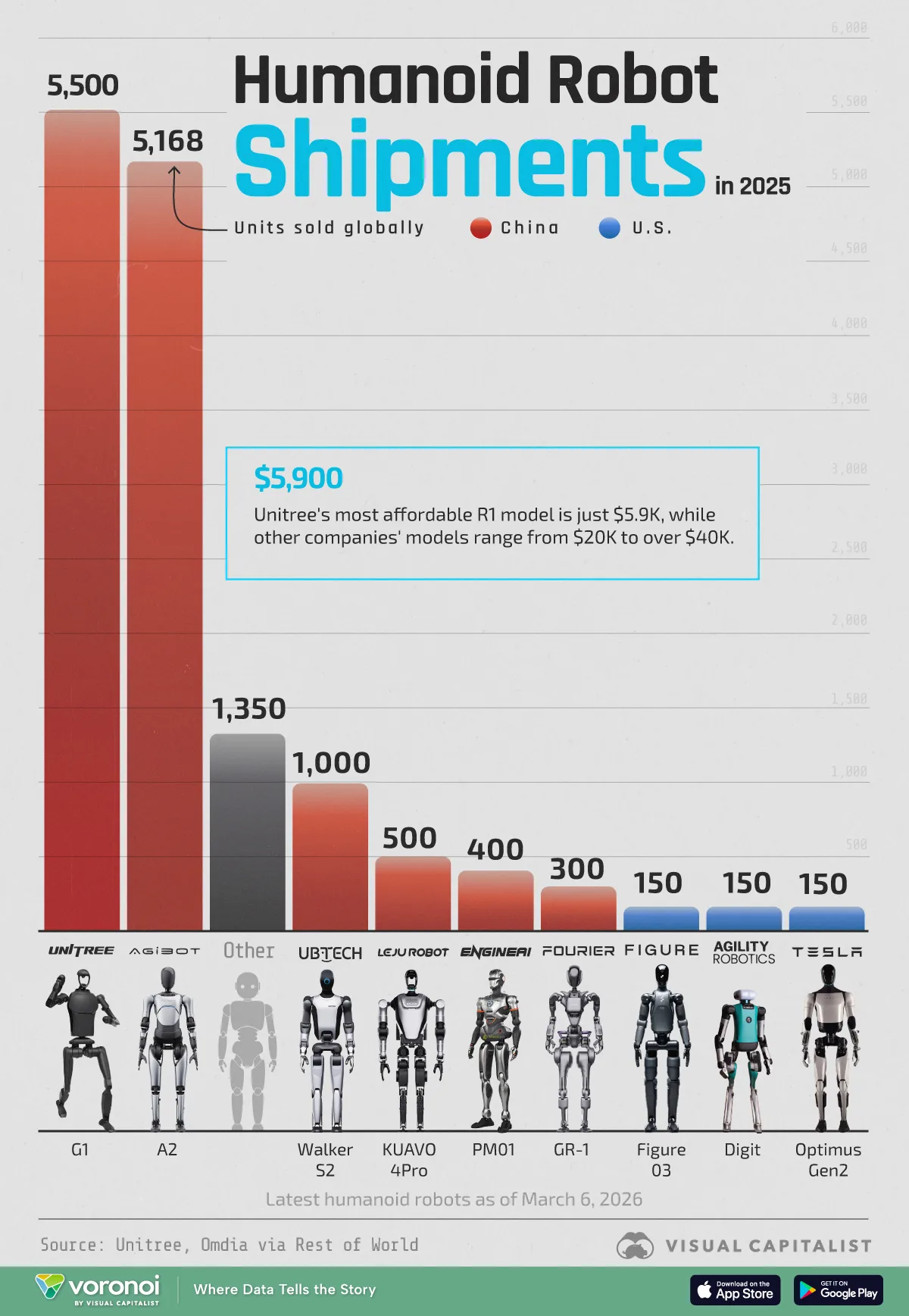
More than a year on, the production reality hasn't moved in the direction Tesla needs. The company had drawn up plans to build at least 5,000 Optimus units for internal use by the end of 2025; external estimates put actual output far lower — market researcher Omdia pegged 2025 humanoid shipments from Tesla, Figure, and Agility at roughly 150 units each. Against that backdrop, the 5,000 target reads less like a miss than a category error.
What Tesla once described as something it was "working through with China" is no longer a quarterly-earnings footnote. It has become a structural problem for an industry still in its infancy — and to see why, you have to look at the magnet itself.
How Soon Will the West Catch Up with China in Humanoid Market Share?
5 yearsResult
75.00%
10 yearsResult
25.00%
4 Polls
EndedTBD
Why the Magnet Is the Chokepoint
Strip a humanoid down and you find dozens of actuators, nearly every one built around a permanent magnet. Morgan Stanley's teardown of Tesla's Optimus Gen 2 counts roughly 40 motors and about 3.5 kg of neodymium-iron-boron (NdFeB) per robot — twice what goes into an electric car. NdFeB dominates because it offers the highest torque and power density of any commercial magnet, and in a humanoid that density is everything: it sets how much the robot lifts, how nimbly it moves, and how long it runs per charge. The magnet-free alternatives are all heavier and weaker for the same output — a poor trade in a machine that carries its own power supply inside a human-scale frame.
The geopolitical wrinkle is heat. Motors crammed into tight joints run hot, and ordinary NdFeB loses its magnetism as temperature climbs, so manufacturers dope it with two heavy rare earths — dysprosium and terbium — to hold it stable under load. Those additives are exactly what China's April 2025 export controls targeted. Neodymium itself was never restricted; the regime instead covered seven medium and heavy elements — including terbium and dysprosium — plus any finished NdFeB magnet containing them. The high-temperature grade a humanoid actuator actually needs sits squarely inside the controlled category.
And there is no quick way around it. Rare earths aren't geologically rare, but separating them is difficult, and China has spent decades building a refining base almost no one else has: it mines well over half the world's supply, processes roughly 90%, and makes close to 90% of all high-performance magnets. New mines and separation plants take years to build. So when Beijing throttles dysprosium and terbium, there is no fast Western substitute — least of all for a humanoid program that needs the heat-resistant grade in volume.
Shoring Up the Reserves
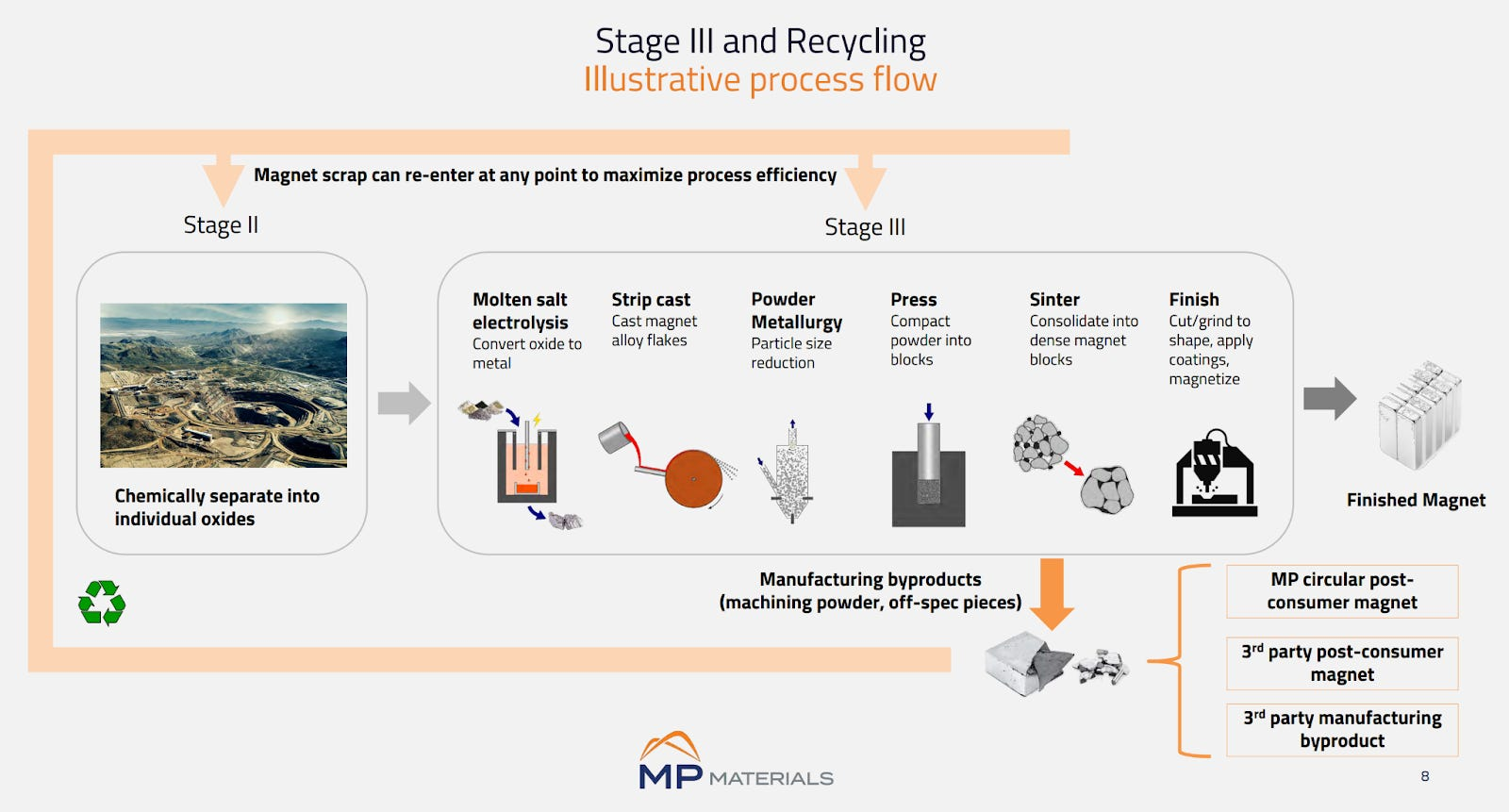
Washington's response has been to try to build the missing supply chain more or less from scratch. In July 2025, the U.S. Department of Defense committed $400 million to MP Materials in convertible preferred stock and warrants — enough to make the Pentagon the company's largest shareholder, with a stake that can reach 15% — alongside a price floor on domestic output and a loan to expand heavy-rare-earth separation. Days later, Apple added a $500 million partnership to produce recycled magnets at MP's Fort Worth plant, using feedstock refined at Mountain Pass in California.
It is a serious pair of commitments, but the timing is the catch. Magnet shipments under the Apple deal aren't expected to begin until 2027, and that initial capacity is earmarked for Apple's own devices — hundreds of millions of them. The Pentagon's motive, meanwhile, is defense-supply resilience, not humanoid robots. For the robotics industry specifically, the practical takeaway is that domestic, robot-grade magnet supply is still years away, while Chinese producers keep scaling with no equivalent constraint. The fix is real; it simply arrives after the gap it was meant to close has had more time to widen.
The Shortage Is Asymmetric — and So Is the Market
The defining feature of this shortage is that it isn't global. If it were, Chinese robot makers would be struggling too — and they aren't. They draw on a domestic supply that isn't subject to China's own export controls, so the constraint that pins down Tesla simply doesn't apply to them. (Even after a late-2025 de-escalation and a general-license mechanism that resumed some shipments, exports of the key heavy rare earths have stayed well below their pre-restriction baseline, and defense uses remain off-limits — the asymmetry has eased at the edges, not closed.)
The market reflects that split. Chinese firms account for around 80% of global humanoid shipments. Unitree alone shipped more than 5,500 units in 2025 and is targeting as many as 20,000 in 2026; Tesla is still straining to reach four figures.
Price is the other axis, and it isn't close. Unitree's G1 starts in the $13,000–$16,000 range, and its R1 launched at under $6,000. Tesla's units aren't for sale to outside buyers at all, and even Musk's long-run target of roughly $20,000–$30,000 sits above what Unitree already charges — with near-term build costs estimated far higher. That isn't a pricing disadvantage so much as a different market.
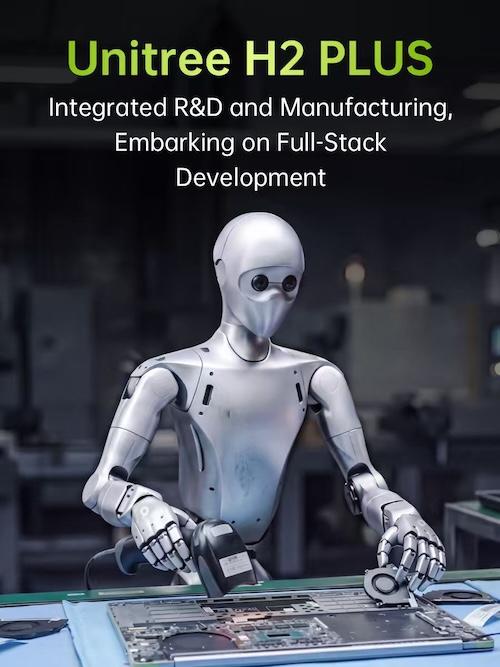
The momentum shows up even where the West is supposed to be strongest. When Nvidia built its first open humanoid reference design on the Isaac GR00T platform, the body it chose was Unitree's H2. An American AI leader is pairing its software stack with a Chinese chassis for the plain reason that the chassis is what ships at scale.
Most coverage treats the magnet shortage as the problem. It's better read as an accelerant: an export squeeze doesn't just deny one side a component, it hands the other a head start — and head starts in manufacturing don't rewind.
Chinese makers have spent two years building at volume, and volume is what drives cost down the learning curve — a descent that doesn't reverse. Tesla won't close the cost gap just because magnets start flowing again; by the time it can mass-produce Optimus, Unitree and its peers will be further down the curve still.
The obvious rejoinder is that the West's edge was never hardware but AI — where the value will ultimately sit. It's the strongest case for optimism, but a shakier one than it looks. Software is maturing on the Chinese side too (Unitree trained its autonomous routines on the same foundation-model tooling now spreading everywhere), and if the reference hardware everyone builds on is Chinese, the "brain" advantage has to be large and durable to outweigh a body that's cheaper, better understood, and already deployed. Betting that software rescues a hardware deficit is a real bet, not a foregone conclusion.
What to Watch
Spot prices for neodymium-praseodymium will get plenty of attention, but on their own they don't diagnose much. The more telling signals are downstream:
Whether MP Materials' output ever reaches robotics customers beyond Apple once shipping begins in 2027.
Whether Optimus can hit its 2026 targets once the magnet constraint eases — or whether the shortfalls persist, revealing that magnets were never the binding limit.
Whether other Western players follow Nvidia's lead and simply build on Chinese hardware.
Resolving the magnet problem is necessary but not sufficient. The real question is whether Western makers can close a two-year scaling gap that Chinese manufacturers have already opened — and scaling gaps, unlike export licenses, don't get resolved with a signature.
June 24 (World Economic Forum) argued that AI data centers should not be treated just as a electricity drains, but also a flexible energy system asset. It may reshape power price, grid investment, battery demand and even AI infrastructure evaluation.
The market debate around AI energy demand is moving from “Can the grid supply enough electricity?” to “Who pays for the grid, storage and flexibility needed to make AI growth possible?” This matters to utilities, battery makers, natural gas producer, clean energy developer and any investor pricing the next phase of AI capital expenditures.
By 2030, what will matter more for AI companies? (select all that apply)
Securing more elecricityResult
46.15%
Lower chips costResult
15.39%
Build better modelsResult
30.77%
Get more value from each unit of computerResult
7.69%
8 Polls
EndedTBD
Robin Zeng, Founder, Chairman and CEO of Contemporary Amperex Technology (CATL) claimed that data center energy demand is not large enough to overwhelm a mature grid, at least in China. In his view, the harder question is not absolute power supply, but how that power is sourced, stored and managed. Also a broader idea has been highlighted: data centers may eventually become flexible grid assets. Buying power when prices are low, using storage to smooth demand and may returning power or flexibility back to the system.
Therefore the AI energy debate is shifting from whether data centers can get enough electricity to whether companies can turn that electricity into measurable productivity, lower operating costs and durable economic value.
Before, the basic logic underlying the demand of AI energy is: more models then more data centers equal more electricity. But the phase next will be around yield. Because if every new megawatt of AI power only produces more experiments, duplicated workflows and higher cloud bills, investors or even the whole marker will query weather the AI CapEx cycle is being mispriced.
Regulation in China dictates that all new data centres must employ 80% renewable energy, a situation that is accelerating research into grid stability and battery technology, with energy storage a key issue.
Thus, AI’s energy cost is no longer just a utility bill. It is becoming part of operating strategy. Robin Zeng said CATL is already using AI systems to buy electricity that generating electricity-bill savings of about 30%.
According to Asia’s Human-led AI Opportunity(June 2026) – 77% of organizations in Asia have adopted advanced AI, but fewer than one-third report achieving widespread and sustained value. Only 20% have reconfigured end-to-end processes around AI, and just 8% have adjusted job roles or decision responsibilities accordingly.
That means Asia is not lacking AI enthusiasm. It is lacking conversion. Many organizations are buying AI capability before they have redesigned workflows, accountability structures and decision rights. In other words, AI adoption is moving faster than the business systems needed to make AI productive.
This is a strong market signal, as it makes the energy debate more financial than it first appears. If AI infrastructure keeps expanding but companies fail to redesign their workflowsIf AI infrastructure keeps expanding but companies fail to redesign their workflows, electricity demand will rise faster than AI returns. That would make data center power a cost center not a productivity engine.
In the past several years, market is pricing the physical AI stack: semiconductor, data center, cooling, storage, grid connection etc. But the next evaluation gap may come from operational stack, which company can redesign work quickly enough to run AI infrastructure into AI operational leverage.
WEF’s separate analysis of AI investment points in the same direction. It argues that many large organizations have not yet seen the returns as they expected from AI spending, not because the technology failed, but because investments often went to the wrong layer. When AI used as a simple productivity assistant may increase efficiency of individual workers but hard to compress the entire workflow. The real value is in redesigning multi-step processes across operations, risk, supply chains and regulated decision-making.
That distinction is crucial for markets. If AI remains a tool layered on top of old processes, companies may face rising energy, software and cloud bills without corresponding productivity gains. If AI is embedded into core workflows, the same electricity cost can support lower cycle times, fewer errors, faster risk review and higher operating margins.
Asia is a particularly important test case because it combines industrial scale, dense digital adoption, large labour markets and very different national AI strategies. WEF notes that China is pushing AI into industrial transformation; Japan is emphasizing reliability and institutional assurance; Singapore is pairing AI investment with governance innovation; India is building momentum through digital public infrastructure and sector-level applications.
Which country will be the first to turn AI adoption into measurable productivity gains successfully?
The United StatesResult
75.00%
ChinaResult
25.00%
SingaporeResult
0.00%
EuropeResult
0.00%
JapanResult
0.00%
OthersResult
0.00%
4 Polls
EndedTBD
That diversity creates a useful market map. China may test whether AI, batteries and industrial systems can be integrated at scale. Japan may test whether trust and reliability become competitive advantages in high-stakes AI deployment. Singapore may test whether governance can accelerate rather than slow adoption. India may test whether public digital infrastructure can help AI scale across services, finance, healthcare and government delivery.
The energy aspect runs through it all. And the victory condition may not depend on who uses the most electricity for AI but who turns AI electricity into the most useful output.
This means battery, flexible demand and storage are part of the AI productivity stack. If AI can forecast power prices, shift workloads, optimize storage and reduce electricity costs, then energy management becomes a source of margin improvement. If not, data-center expansion risks becoming a race to build expensive infrastructure before the business case is fully proven.
Therefore the AI trade should be judged not only by CapEx growth but also by operating conversion. Are companies reducing workflow bottlenecks? Are they changing decision rights? Are they using AI to improve energy procurement? Are they redesigning processes around AI, or merely adding AI tools to unchanged organizations?
Will AI energy management become a major source of enterprises margin improvement?
Yes, especially for data centers and manufacturersResult
0.00%
Yes, but only for very large companiesResult
50.00%
No, power costs will mostly be passed to externalResult
0.00%
Not sureResult
50.00%
2 Polls
EndedTBD
The next phase of the AI market may be less about “how much power does AI need?” and more about “who can produce the most value per watt?”
That is a harder question to price. But it may be the one that separates the real AI winners from the companies simply paying higher electricity bills.
Will OpenAI Actually Handing Stake to Trump Administration / the Gov?
YesResult
25.00%
NoResult
75.00%
4 Polls
EndedTBD
Will Anthropic Follows Suit (after OpenAI) to Hand Stake to the Gov?
YesResult
100.00%
NoResult
0.00%
2 Polls
EndedTBD
According to FT, OpenAI has held discussions regarding the possibility of granting a 5 percent equity stake to the US government. The $852 billion artificial intelligence startup is attempting to clear political hurdles by obtaining financial investment from the Trump administration.
Based on the soruce, two individuals acquainted with the matter, Sam Altman, the chief executive of the ChatGPT creator, has contended that providing the public with a financial interest in the company represents the optimal method for sharing the benefits of AI. He has proposed a stake of this magnitude during preliminary talks with the administration.
The envisioned structure would require other American AI firms to surrender an equivalent percentage, though it remains uncertain whether competing labs would agree to the terms.
Providing the government with an equity position could assist in establishing favorable relations with the administration. This move represents an effort to mitigate political backlash by distributing the wealth created by AI to the general population.
AI developers have encountered a progressively difficult climate in Washington as both American politicians and the public voice growing anxieties regarding extensive data center development, cyber security risks, and the technology's impact on employment.
Both OpenAI and its primary competitor, Anthropic, have recently experienced delays in launching their latest cutting-edge models due to US scrutiny. Furthermore, certain Republicans and advisers to President Donald Trump are advocating for significantly stricter regulations across the industry.
Both rivals are concurrently getting ready for public listings, which would broaden their shareholder bases and produce substantial returns for existing investors, though OpenAI's initial public offering might not occur until next year.
Altman and other OpenAI leadership have proposed that each of the top AI developers in the United States allocate 5 percent of their equity toward an entity modeled after the Alaska Permanent Fund—a sovereign fund that reinvests the state's oil revenues into equities and distributes dividends to residents and the state government.
The targeted firms could encompass Anthropic, alongside Google, Meta, and others, though it is uncertain if any of these entities would consent to OpenAI's plan.
Following public criticism of Intel's chief, Trump shifted his stance to support the US chipmaker after the federal government acquired a 10 percent stake.
The sources noted that these "conceptual" discussions between OpenAI and the government are in their infancy, and implementing any such agreement would likely necessitate an act of Congress. Nonetheless, the negotiations highlight a potential framework for dispersing the financial profits generated by the technology.
Altman has maintained active dialogues concerning public ownership with administration figures, including Trump, Treasury Secretary Scott Bessent, and Commerce Secretary Howard Lutnick, according to several people familiar with the situation.
Additionally, the OpenAI chief executive has conversed with Democratic Senator Bernie Sanders in recent weeks. Sanders has advocated for public ownership closer to 50 percent of each American AI corporation through a sovereign wealth fund.
In past economic policy recommendations, both OpenAI and Anthropic have implied that structures like sovereign or public wealth funds might eventually be necessary to allocate shares to citizens.
In April, OpenAI put forward a proposal for a "public wealth fund" designed to offer every citizen, including individuals who do not participate in financial markets, an equity stake in AI-fueled economic expansion.
In May, the company's non-profit division, the OpenAI Foundation, stated that an AI-driven future would likely require fresh strategies to provide individuals with lasting ownership in the value-generating systems, explicitly highlighting public or sovereign wealth funds.
The foundation noted in a blog post that the objective extends beyond merely supporting citizens through economic transitions after choices are finalized; it aims to provide them with a stake and a voice in directing how that evolution takes place.
OpenAI chose not to comment on the matter, and the White House did not instantly reply to a request for comment.
Where chips become products — and the demand that pulls the whole chain
Will Hyperscalers raise their capex target again in upcoming quarterly results (Jul-Aug 2026)?
YesResult
0.00%
NoResult
0.00%
0 Polls
Ended
Executive summary
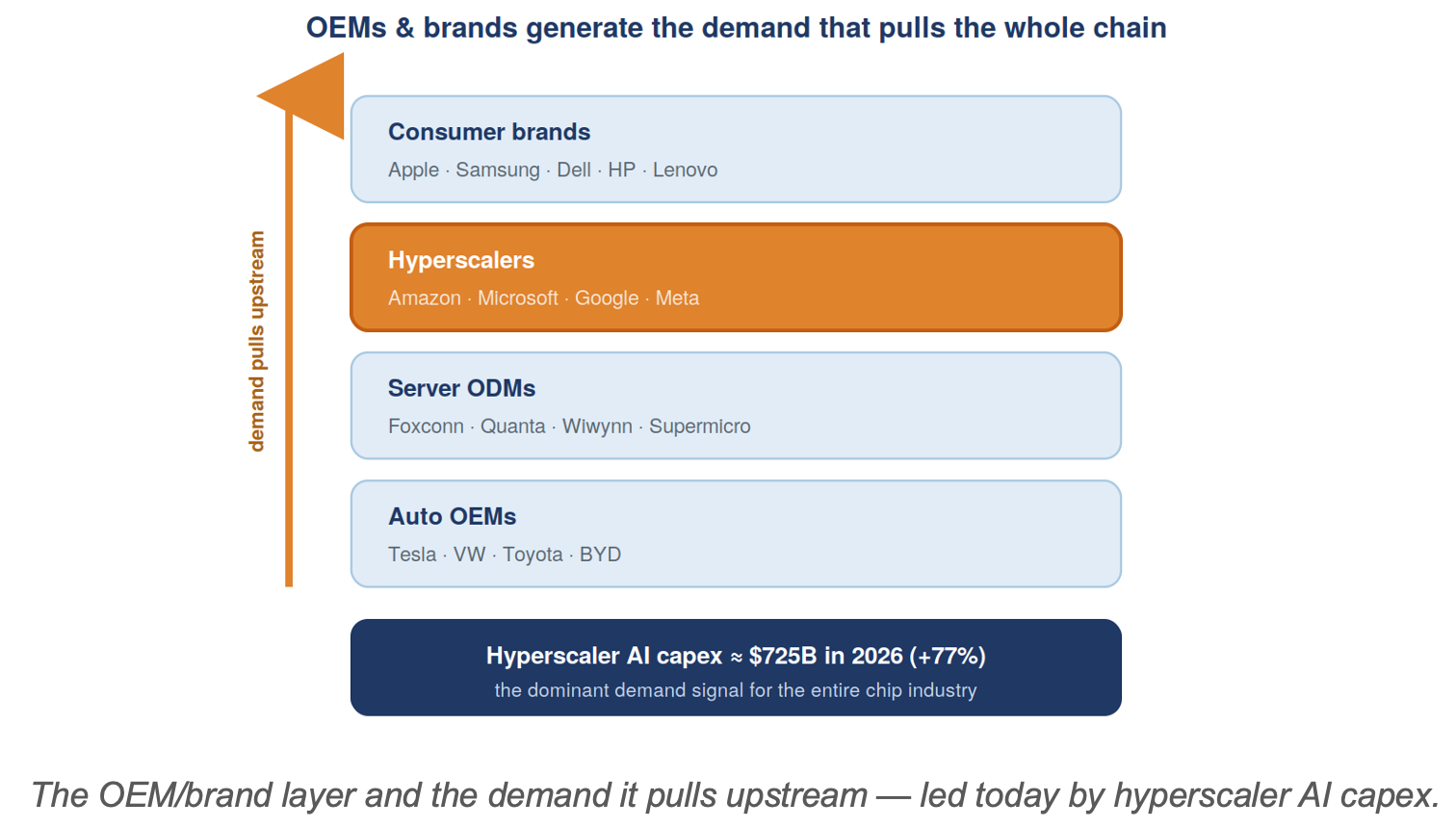
OEMs and brands are where chips become products — the device makers, server builders, and system companies that integrate semiconductors into things people and businesses buy. They are the origin of demand that pulls silicon through the entire value chain. The category spans consumer-device brands (Apple, Samsung, Dell, HP, Lenovo), data-center server ODMs (Foxconn, Quanta, Wiwynn, Supermicro), automakers, and — most importantly today — the hyperscalers whose AI-infrastructure spending now drives the cycle.
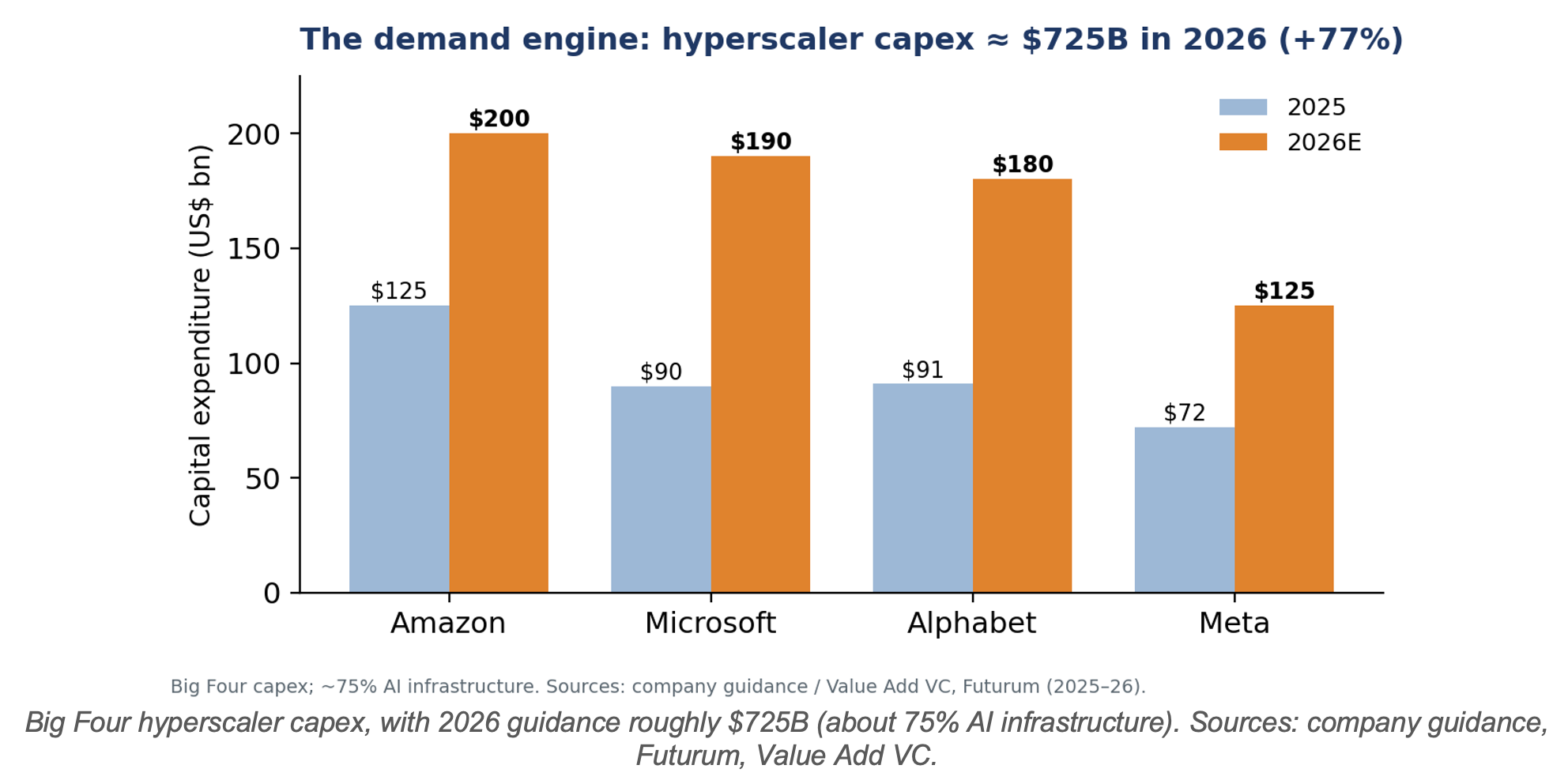
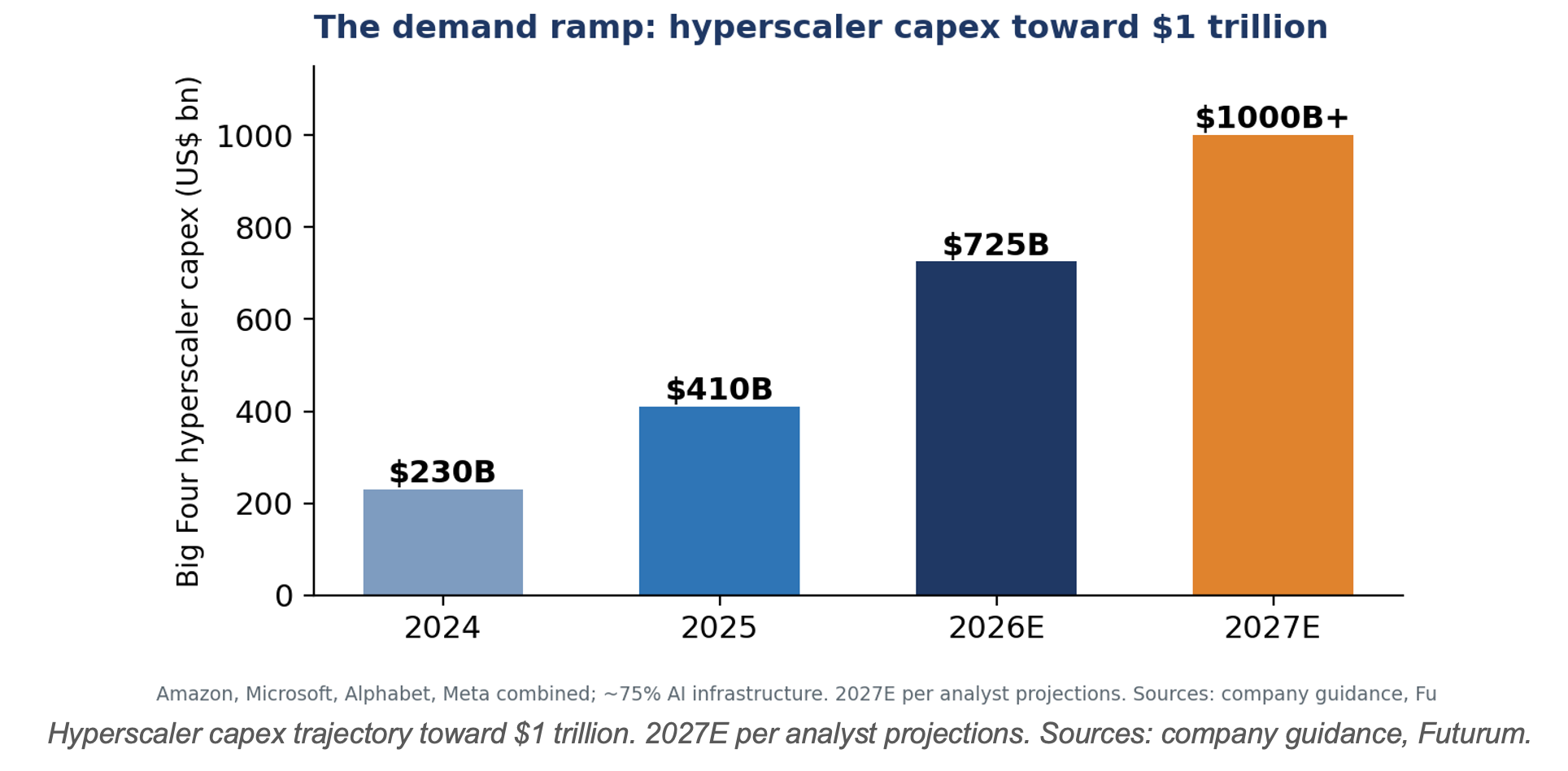
That demand signal is staggering: the four largest US hyperscalers are guiding to roughly $725 billion of capital expenditure in 2026, up about 77% from ~$410 billion in 2025, the overwhelming majority of it AI infrastructure, with analysts projecting big-tech capex above $1 trillion by 2027. This is the engine behind the foundry, fabless, memory, and packaging booms described in the companion primers.
1. Definition and strategic importance
OEMs (original equipment manufacturers) and brands sit at the downstream end of the chain, buying chips, boards, modules, and components and assembling them into finished systems sold under a brand to end markets. They matter because demand starts here — every wafer TSMC makes and every tool ASML sells exists ultimately to satisfy an order that originates with an OEM or a hyperscaler.
2. Position in the value chain
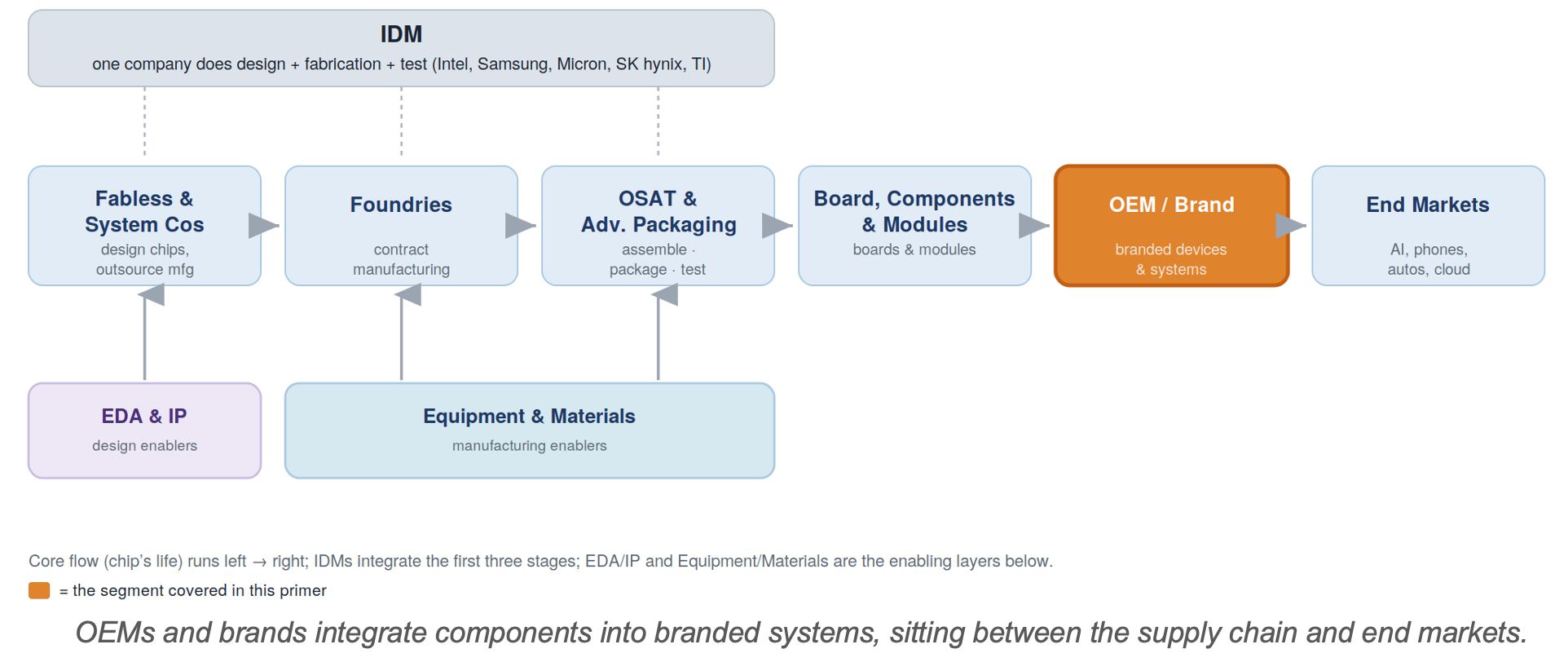
A key nuance: the line between “brand” and “chip designer” is blurring. Apple and the hyperscalers now design their own silicon (covered in the Fabless primer), making them simultaneously the demand origin and an upstream design participant — a vertical integration reshaping the industry’s balance of power.
3. Structure: brands, ODMs, and hyperscalers
Consumer-device brands. Apple, Samsung, Dell, HP, Lenovo, Xiaomi and others design and sell branded phones, PCs, and electronics, capturing brand margin and owning the customer — often outsourcing physical assembly to contract manufacturers (e.g., Foxconn for Apple).
Server and data-center ODMs. The AI build-out is physically assembled by original design manufacturers — Foxconn (Hon Hai), Quanta, Wiwynn, Wistron, and Supermicro — which build the servers and racks that house GPUs and accelerators. These are high-volume, thin-margin businesses booming on AI orders.
Hyperscalers. Amazon, Microsoft, Google, and Meta are both the largest buyers of AI hardware and increasingly the designers of their own chips. Their capital spending is the dominant demand variable for the entire semiconductor industry today.
4. The demand engine: hyperscaler capital spending
The trajectory matters as much as the level: spending has roughly doubled each year and is projected to approach $1 trillion in 2027, with the five largest US hyperscalers reportedly planning to add around $2 trillion of AI-related assets by 2030.
5. Competitive structure and key players
The layer divides by role rather than by a single revenue ranking; margins differ sharply between brand owners and contract builders.
Category
Examples
Role in the
chain
Device brands
Apple, Samsung, Dell, HP,
Lenovo
Design/sell branded devices;
own the end customer; rich margins
Hyperscalers
Amazon, Microsoft, Google, Meta
Largest AI-hardware buyers; also design custom silicon
Server ODMs
Foxconn, Quanta, Wiwynn,
Supermicro
Build AI servers and racks
(thin-margin, high-volume)
Auto OEMs
Tesla, VW, Toyota, BYD
Rising semiconductor content per vehicle
6. Business model and economics
Economics vary enormously by role. Brand owners like Apple capture high margins by owning design, software, and the customer relationship, while contract ODMs (Foxconn, Quanta) run on razor-thin margins despite enormous revenue. Hyperscalers are not selling hardware at all — their chip and server spending is a cost of delivering cloud and AI services, which is why the return on that capex is so closely scrutinized.
7. Demand drivers
• AI infrastructure build-out. Hyperscaler capex (~$725B in 2026) is the single largest pull on advanced logic, memory, and packaging.
• Device refresh cycles. AI PCs and AI smartphones, plus normal replacement of the ~1.2 billion phones and ~250 million PCs shipped each year, provide a large volume base.
• Automotive content. Electrification and ADAS keep raising the dollar value of chips per vehicle.
8. Geopolitics and strategic dimension
OEMs sit atop globally distributed supply chains exposed to tariffs, export controls, and reshoring pressure. Device assembly is shifting (e.g., toward India and Vietnam); AI-server supply chains concentrate in Taiwan-linked ODMs; and the hyperscalers’ build-out is increasingly constrained not by chips but by power and data-center construction — the emerging physical bottleneck of the AI era.
9. A framework for financial analysis
• Follow the capex guidance. Hyperscaler capital-spending guidance is the leading indicator for the whole semiconductor cycle — watch it above almost anything else.
• Separate brand from contract economics. Apple’s margins and a server ODM’s are not comparable despite both being “OEMs.”
• Watch the ROI question. Whether AI revenue justifies the capex is the debate that could move the entire chain.
• Track the physical constraints. Power availability and data-center construction timelines increasingly gate demand.
10. Key debates
• Is the AI capex sustainable? Whether ~$725B+ of annual investment generates adequate returns — the industry’s biggest open question; a pullback would ripple through every upstream segment.
• Vertical integration. How far OEMs and hyperscalers take in-house silicon, eroding the merchant-chip market.
• Demand concentration. Whether reliance on a handful of hyperscalers makes the cycle more fragile.
11. Risk summary
• AI-capex sustainability — the dominant risk; valuations across the chain embed continued spending.
• Demand concentration — a few hyperscalers drive much of leading-edge demand.
• Margin asymmetry — contract ODMs are structurally low-margin and exposed.
• Physical constraints — power and construction bottlenecks; supply-chain and tariff exposure.
Assembly, test, and the packaging revolution reshaping the back end
Executive summary
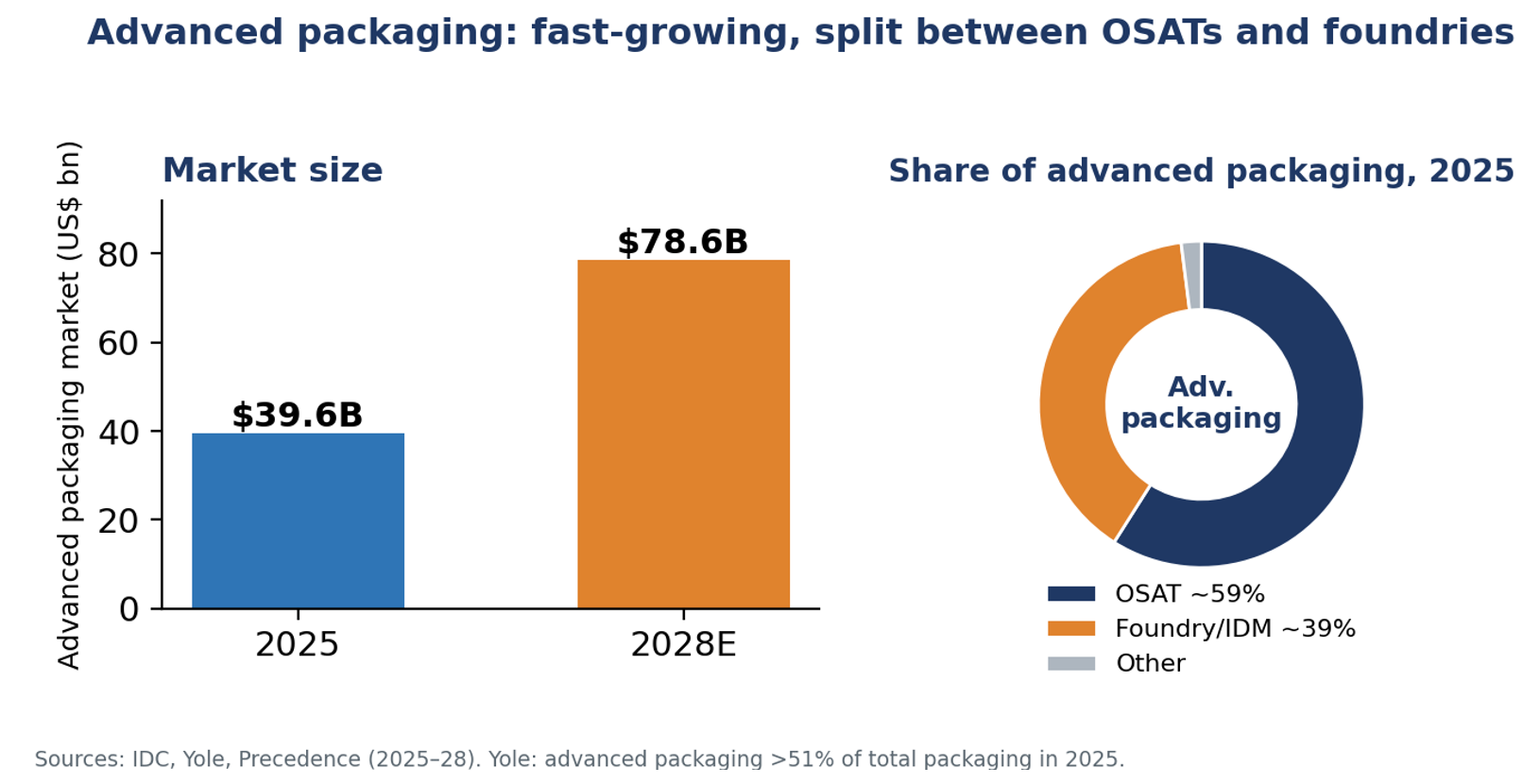
OSAT — outsourced semiconductor assembly and test — firms take finished wafers and turn them into packaged, tested chips. Historically the lowest-margin link in the chain, the back end has been transformed by advanced packaging: chiplets, 2.5D/3D stacking, hybrid bonding, and platforms like TSMC’s CoWoS that are essential to AI chips. The advanced-packaging market is growing from roughly $40 billion in 2025 toward ~$79 billion by 2028.
The competitive twist is that this lucrative new work is contested by three groups: the OSATs (ASE, Amkor, JCET), the foundries (TSMC), and the IDMs (Intel, Samsung). OSATs hold roughly 59% of advanced packaging and the foundry/IDM group about 39% — and the foundries are pushing in hard, because advanced packaging increasingly uses wafer-level, fab-style processes that blur the old front-end/back-end line.
1. Defining the sector and its strategic importance
After a wafer leaves the fab, it must be diced into individual dies, connected and protected within a package, and tested. OSATs provide these back-end services under contract, just as foundries provide front-end manufacturing. Once an afterthought, packaging is now a primary determinant of chip performance — which has turned the back end into a strategic battleground.
2. Position in the value chain
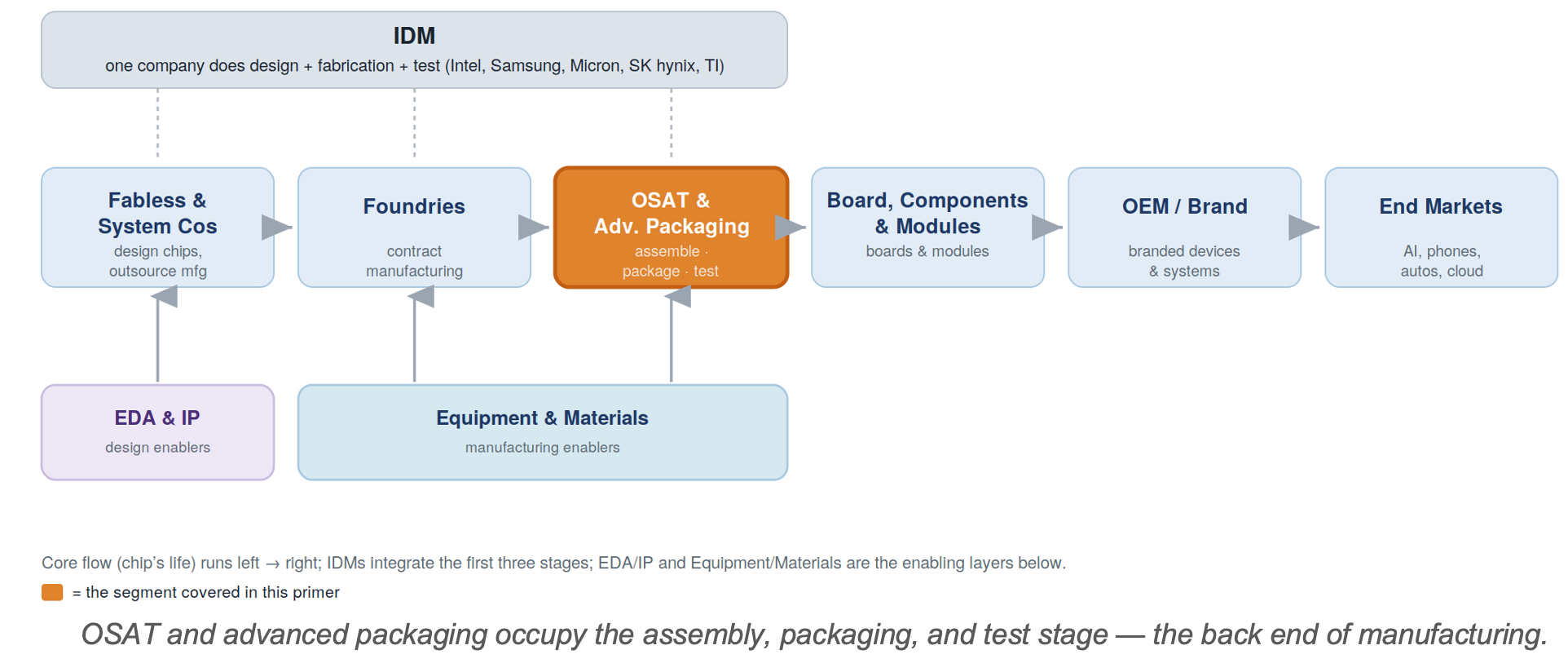
As noted in the Equipment primer, the OSAT service sits here in the chain, while the equipment used to perform it is upstream. Advanced packaging is now drawing front-end tools into the back end — the central structural shift in this segment.
3. Structure: from traditional assembly to advanced packaging
Traditional OSAT. High-volume wire-bond and flip-chip assembly and test for the bulk of the world’s chips — a thin-margin, scale-and-cost business (Amkor’s gross margin runs around 15%, a world away from foundry economics).
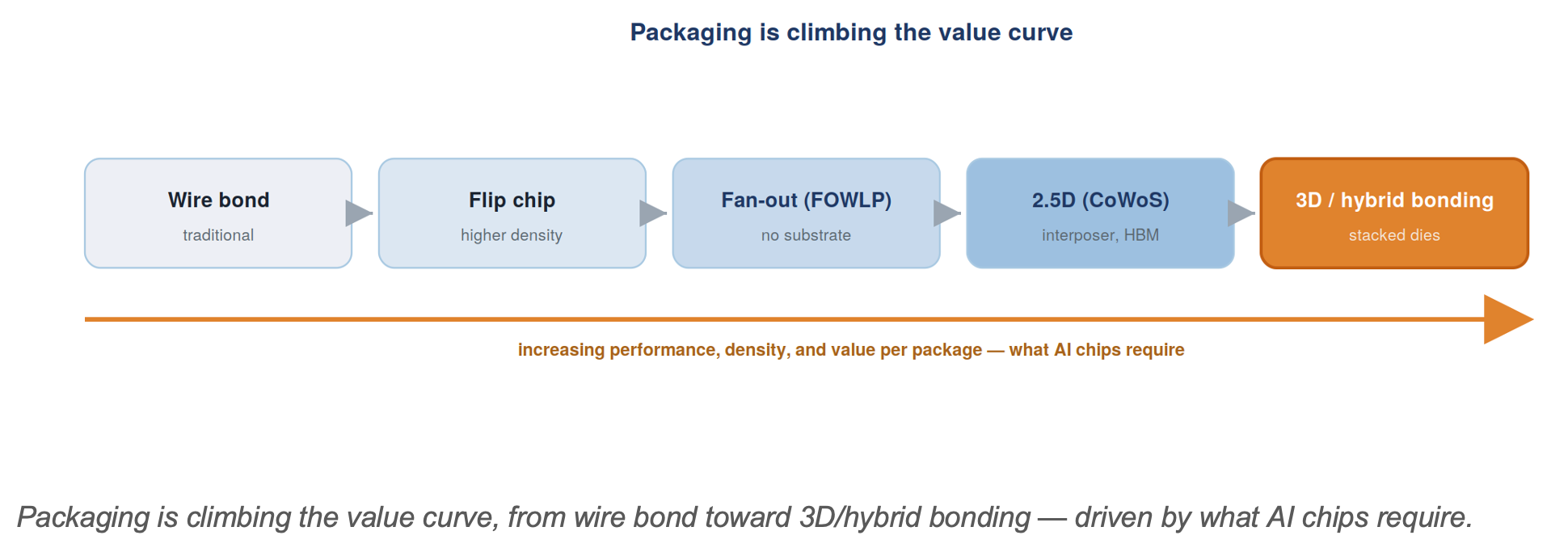
Advanced packaging. The high-value frontier: 2.5D/3D integration, chiplets, fan-out, and hybrid bonding that connect multiple dies and stacked HBM into one high-performance package. This is what AI accelerators require, and by some estimates it surpassed traditional packaging as a majority of total packaging value in 2025.
The players. ASE is the world’s largest OSAT (with a large electronics-manufacturing arm alongside assembly/test); Amkor is second and JCET is China’s leader, followed by Powertech, TFME, and test specialists such as KYEC. But TSMC (CoWoS, SoIC), Samsung (I-Cube, X-Cube), and Intel (Foveros, EMIB) now perform much of the cutting-edge packaging themselves.
4. Market size and segmentation
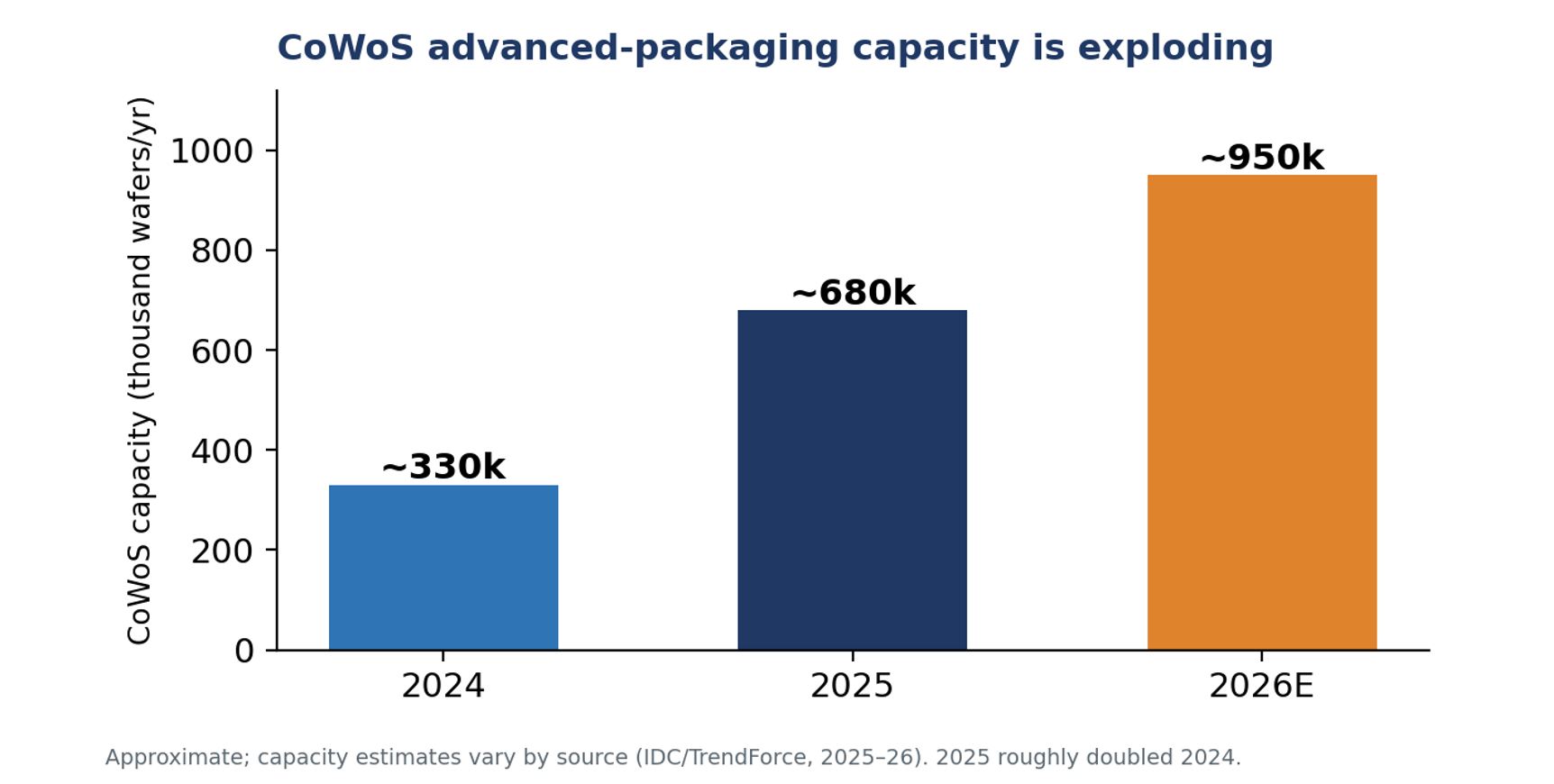
The growth is concentrated in AI-related advanced packaging, and the single most-watched capacity metric is TSMC’s CoWoS, which has roughly doubled year-on-year.
5. Competitive structure and company financials
OSATs are scaled but thin-margin; the foundry/IDM camp is capturing the most advanced (and most profitable) packaging.
Company
Position
Scale
Note
ASE Technology
#1 OSAT
~$20B group revenue
Advanced-packaging sales
~$1B in 2025; includes SPIL and an EMS arm
~680k CoWoS wafers in 2025; allocates to Nvidia, Google, others
6. Business model and economics
Traditional OSAT is a high-volume, low-margin business: gross margins in the mid-teens, competing on cost, scale, and geographic footprint. Advanced packaging offers a path to better economics, but it requires heavy investment in wafer-level, fab-style equipment — which is precisely why the better-capitalized foundries can compete for it. The result is margin pressure from both ends: commodity assembly below, foundry encroachment above.
7. Demand drivers
• AI and HBM. Stacking logic with high-bandwidth memory and integrating chiplets is the core of advanced-packaging demand.
• The end of easy scaling. As transistor shrinks get harder, more performance comes from packaging — structurally favouring this segment.
• CoWoS allocation. TSMC’s packaging capacity gates AI-GPU supply, with 2026 allocations reportedly reserved for Google’s TPU, Meta, OpenAI, and others.
8. Geopolitics and strategic dimension
Packaging has become a reshoring priority: the US CHIPS Act funds back-end capacity (Amkor’s ~$2 billion Arizona plant, with a 10-year TSMC agreement), and Europe is supporting its own. The US-China contest is also reshaping OSAT customer allocation, with Western firms diversifying away from China-based assemblers toward Vietnam, Taiwan, and the US. JCET and other Chinese OSATs, meanwhile, anchor a parallel domestic supply chain.
9. A framework for financial analysis
• Distinguish traditional from advanced. Advanced-packaging mix and growth are the value drivers; traditional assembly is a thin-margin base.
• Watch capex and utilization. A back-end capacity race raises overbuild risk; utilization is the cyclical signal.
• Track foundry encroachment. How much advanced packaging TSMC and Samsung keep in-house caps the OSAT opportunity.
• Mind margins. OSAT returns are structurally lower than foundries’ — advanced packaging is the path up, not a guarantee.
10. Key debates
• Who captures advanced-packaging value? OSATs versus foundries (TSMC) versus IDMs — the segment’s defining contest.
• Overbuild risk. Whether the simultaneous capacity race produces a glut in 2026–27.
• Hybrid bonding leadership. Which players master sub-10-micron hybrid bonding at high yield.
11. Risk summary
• Thin margins — structural, especially in traditional assembly.
• Foundry encroachment — TSMC capturing the most profitable packaging in-house.
The contract chip manufacturers — and TSMC’s extraordinary dominance.
What will TSMC's 3Q2026 operating margin be (guided 56-58%)?
<56%Result
0.00%
56-58%Result
0.00%
>58%Result
100.00%
1 Polls
EndedTBD
Executive summary
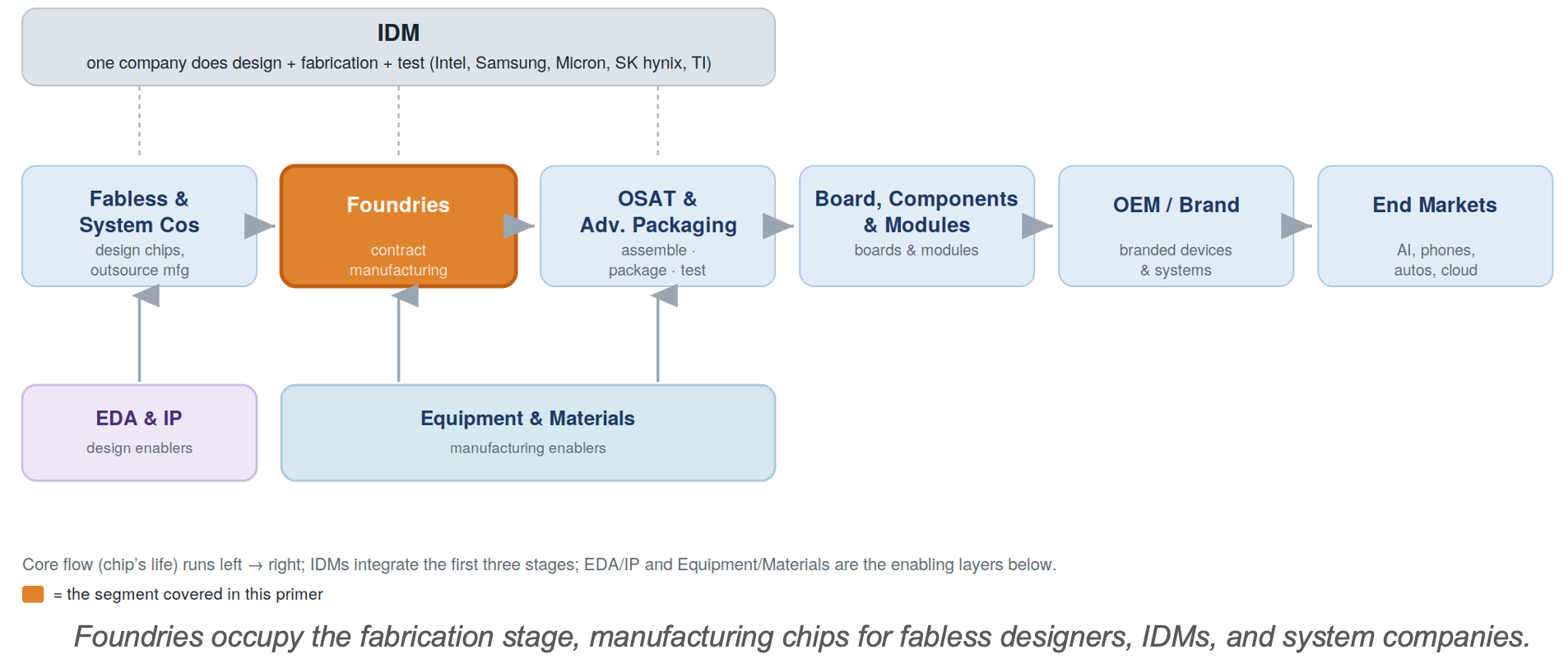
Foundries are pure-play contract chip manufacturers: they fabricate chips designed by others and own no end-product IP. Their existence is what makes the fabless model possible. The segment is defined by one company’s dominance — TSMC, with roughly 70% of global foundry revenue and an even larger share at the leading edge — arguably the single most strategically important company in technology. TSMC’s 2025 revenue reached $122.4 billion (+36%) at a 59.9% gross margin, and it guided 2026 capital spending of $52–56 billion.
Behind TSMC, Samsung Foundry (a distant second, hampered by yield issues), China’s SMIC (growing despite export controls), and the mature-node specialists UMC and GlobalFoundries compete in a far less profitable tier. Intel Foundry is a heavily funded but still nascent challenger. The economics at the leading edge are brutal in capital but, for TSMC, exceptional in pricing power — its 2nm wafers reportedly price around $30,000 each.
1. Defining the sector and its strategic importance
A foundry sells manufacturing capacity and process technology, not products. Customers — fabless firms, IDMs, and system companies — send designs to be fabricated at an agreed price per wafer. Because virtually all advanced chips in the world are made by a handful of foundries (and overwhelmingly by TSMC), the segment is the physical chokepoint of the entire digital economy and the focal point of industrial policy.
2. Position in the value chain
TSMC’s moat is built from process leadership, manufacturing yield, the breadth of its design ecosystem (IP, EDA support, and advanced packaging), and sheer scale — each reinforcing the others. Leading customers co-develop on its newest node, which funds the next node, which attracts the next generation of customers.
Companies that design and manufacture their own chips — memory, analog, power, and Intel.
Executive summary
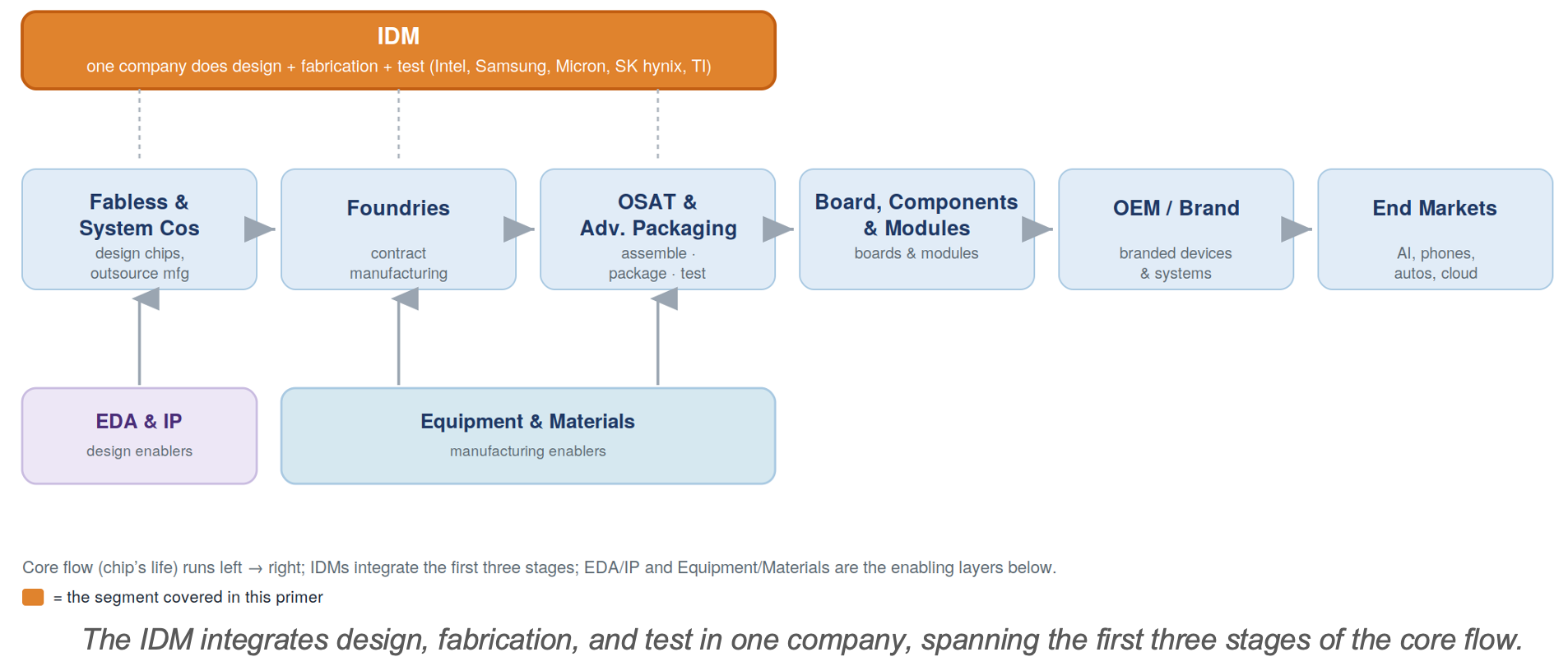
Integrated device manufacturers (IDMs) both design and manufacture their own chips — the original structure of the semiconductor industry, predating the split into fabless designers and contract foundries. IDMs own fabs, control their process technology, and sell finished products under their own brand. They persist because, in their domains, product and process are inseparable. Today they fall into three families: memory (Samsung, SK hynix, Micron), analog/power/embedded (Texas Instruments, Analog Devices, Infineon, ST, NXP, Microchip, Renesas), and logic (Intel, now pivoting toward a foundry model).
The defining dynamic of the current cycle is the AI-driven memory supercycle. High-bandwidth memory (HBM) has transformed DRAM from a boom-bust commodity into a constrained, premium, strategically vital product — so much so that in 2025 SK hynix overtook Samsung in both DRAM revenue and, for the first time ever, operating profit. The analog/power family, by contrast, offers steadier, less cyclical growth tied to automotive and industrial electronics, while Intel’s foundry transition is one of the industry’s biggest open questions.
1. Defining the sector and its strategic importance
An IDM performs the entire chip lifecycle in-house: design, wafer fabrication, and assembly/test. This is the opposite of the disaggregated model, in which a fabless company designs and a foundry manufactures. IDMs remain vertically integrated where manufacturing know-how is itself the competitive advantage — the recipe for a DRAM cell or a precision data converter lives in the process, not in a licensable design file.
Their strategic weight is large: IDMs own the memory that every AI accelerator needs, the analog and power chips in every car and factory, and — through Intel — a substantial share of Western leading-edge manufacturing capacity. They also carry the heaviest financial burden in the industry, funding both R&D and multi-billion-dollar fabs.
2. Position in the value chain
In the value-chain map, an IDM effectively spans the first three stages — design, fabrication, and test — within a single company, rather than handing the chip between specialist firms.
This integration is increasingly the exception rather than the rule. Leading-edge logic largely abandoned it (fabless + foundry), and even some IDMs now outsource their most advanced nodes to TSMC while keeping mature production in-house — a “fab-lite” hybrid. Memory and analog remain the strongholds of full integration.
3. The three families of IDMs
IDMs are not one business but three, with very different economics. (This corrects a framing point: there are three families, not two — memory, analog/power/embedded, and logic.)