Premier info portal for prediction markets. The start point of information market.
Macro & Micro Compass - $1.7 Trillion in Factories, 75,000 Fewer Jobs: What the Market Is Missing on Reshoring
Analysis
Labor MarketEconomicsMacroeconomicsMacro & Micro Compass

Macro & Micro Compass - $1.7 Trillion in Factories, 75,000 Fewer Jobs: What the Market Is Missing on Reshoring

Manufacturing investment is at record highs, but hiring isn't following. A look at the ISM, BLS, and robotics data behind reshoring's real jobs story.

Economics & Finance

The White House shows factory activity at a four-year high, framed as proof that manufacturing is "roaring back" to American soil. Markets have mostly bought the framing: reshoring means jobs, jobs mean wage growth in the industrial belt, and industrial belt strength is bullish for the broad reflation trade.

Since the reshoring wave started showing up in investment announcements, more than $1.7 trillion in U.S. manufacturing capital commitments has coincided with factory payrolls falling by roughly 75,000 from January 2025 to June 2026. Since January 2023, the ISM's manufacturing employment index has now contracted in 41 of the last 42 months. June's headline PMI expanded for a sixth straight month, but the jobs component stayed underwater.

The market is pricing reshoring as an employment story. But the more durable story is an automation story that happens to be wearing a jobs costume.

Is the reshoring boom mainly a jobs story or an automation story?

Jobs, factories mean workers, eventually
66.67%
Automation, the capital is going around labor, not toward it
33.33%
3 Polls

Twenty straight months of expansion is not nothing

The bull case for "reshoring means jobs" isn't naive. With a PMI above 47.5 again in June (which is considered as a threshold for expansion by PR Newswire), overall economy has been in expansion territoriality for 20 months, and new orders have grown for six consecutive months.
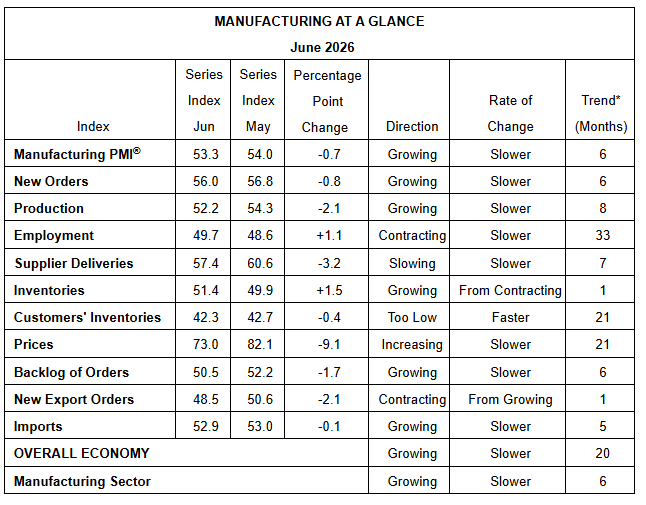
Source: PR Newswire

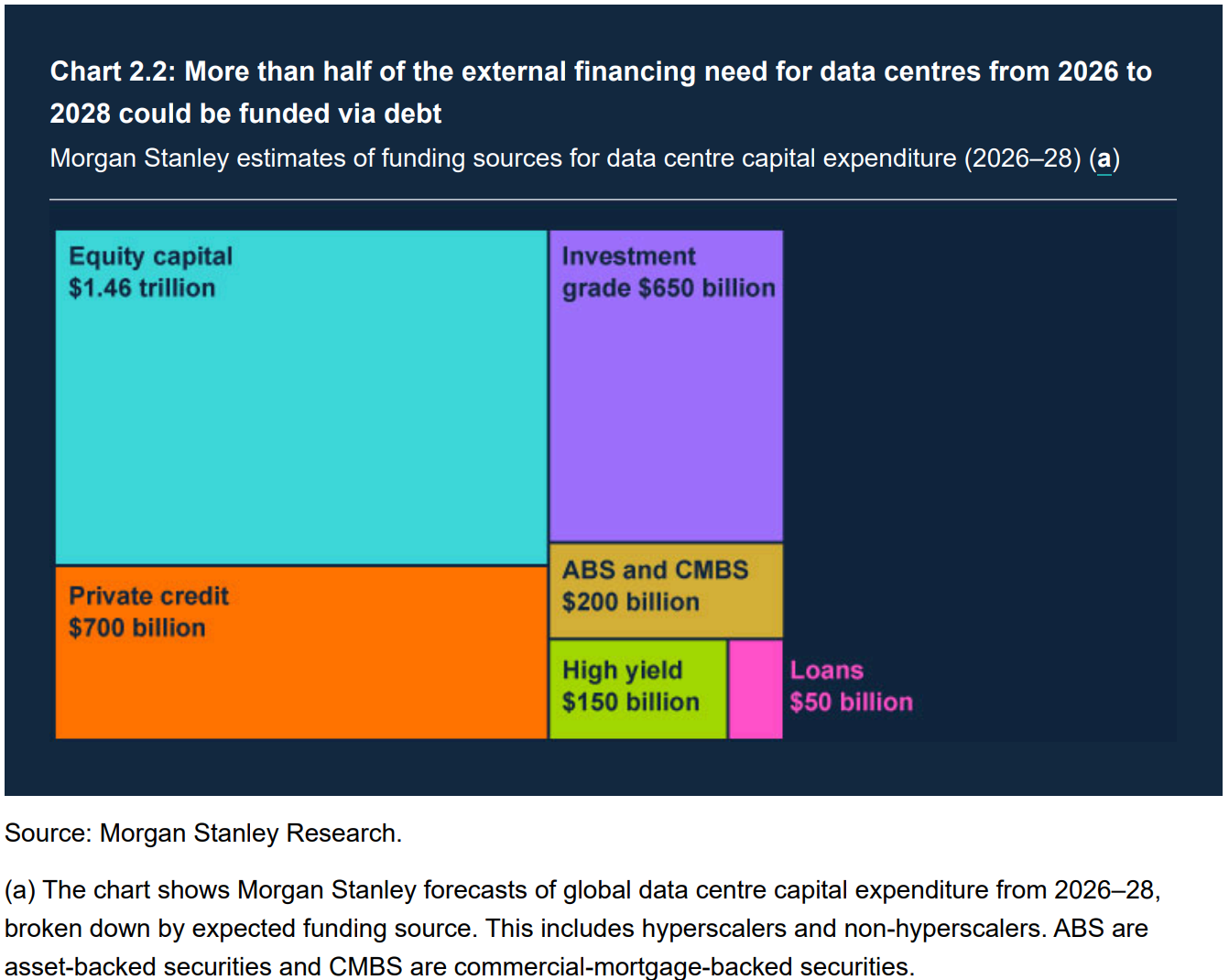
This activity has real capital behind it, as two of just four major industries reporting both rising new orders and rising production in June: semiconductor investment (computer & electronic products) accounting for more than $640 billion of announced commitments and pharmaceutical pledges (chemical products) from major drugmakers have topped $500 billion.

Politically, this is a genuinely popular and genuinely large capital cycle, and capital cycles of this size have historically shown up in payrolls eventually. Traders betting that "more factories" eventually equals "more factory workers" are extrapolating from a century of prior cycles.

The weak assumption: Capital committed is payroll committed

The weak assumption is that investment dollars are a decent proxy for headcount. They aren't anymore, and the split has been visible in the data for over a year now.

The composition of the current investment wave is the tell. According to Reshoring Initiative, 90% of the manufacturing jobs actually announced through reshoring and foreign direct investment in the most recent full year were classified as high-tech or medium-high-tech: semiconductor fabs, advanced materials, EV battery plants, up from 88% the year before.

This split is already visible in the same ISM data behind the bull case above. In June, Computer & Electronic Products, the category that includes semiconductor manufacturing, was one of just four major industries reporting both rising new orders and rising production. It did not make the much shorter list of industries reporting employment growth. The orders are showing up in exactly the industry doing the most reshoring-driven growing. The hiring isn't.

When 81% of businesses say they'd favor automation over hiring people if production returns to the U.S., and when 92% of manufacturers say smart manufacturing (not headcount) will be the main driver of their competitiveness over the next three years, the capital being counted as "reshoring investment" is substantially capital being spent to avoid the labor problem, not solve it with headcount.

Forty-one percent are already prioritizing factory automation hardware investment over the next two years, even though only 29% currently use AI or machine learning at the facility level, so the intent to automate is running well ahead of the infrastructure to do it.

The split is already showing up in four places

1.    Monthly BLS manufacturing payrolls

Manufacturing added just 3,000 jobs in June after shedding 2,000 the previous month. On its own, it may sound positive, but against $1.7 trillion in announced capital and 12.6 million existing manufacturing workers, 3,000 is statistical noise.

If monthly adds start climbing into the tens of thousands and hold there, the job thesis could gain real ground, but otherwise, this flatline is an automation thesis, one release at a time.
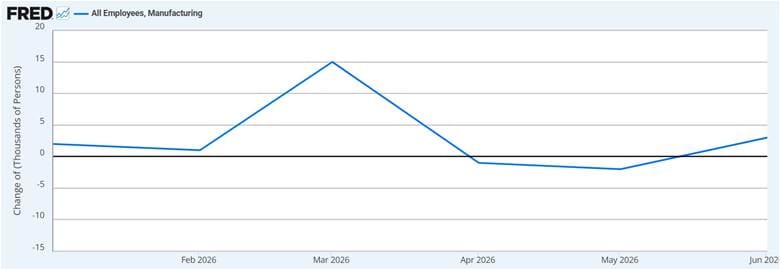
Source: FRED

2.    Average workweek and overtime hours

Average workweek and overtime hours show whether firms are squeezing existing staff instead of hiring. According to BLS, manufacturing's average workweek actually edged down in June while overtime edged up, a pattern more consistent with firms optimizing scheduling and automation around a fixed headcount than one consistent with a hiring wave.

This could be firms buying capacity from machines and shift management rather than the labor market.

3.    Robot order and capex data

North American robot orders rose 6.6% in 2025 to the highest level since 2022, and industry group A3 just reported its most attended trade show ever in June 2026, with collaborative robot orders up more than 50% year-over-year in Q1.

4.    Semiconductor employment intensity

Semiconductors is one of the largest categories of announced reshoring jobs, accounting for about 67% alongside EV batteries and solar, and fabs are among the most capital-intensive, least labor-intensive facilities in manufacturing. As fab construction shifts from building phase (which does employ a lot of construction labor) to operating phase (which doesn't need nearly as many people), watch for regional payroll data in fab-heavy states like Arizona and Texas to show hiring plateaus even as production ramps.

What to watch next

The next BLS Employment Situation report, covering July, lands August 7, and will show whether manufacturing payrolls stay stuck near zero or start closing the gap with the capex headlines. ISM's July manufacturing report follows shortly after, and the number that matters is whether the employment subindex holds above 48 or breaks back toward the low 40s.

The bigger date is August 28, when BLS publishes its preliminary annual benchmark revision to the establishment survey, based on unemployment-insurance tax records rather than the sampled monthly survey.

This revision has a real chance of moving the manufacturing jobs numbers more than any single monthly print this year, in either direction.

Sources:

  1. BLS: Job Openings and Labor Turnover Survey News Release
  2. BLS: The Employment Situation June 2026
  3. Business Wire: A3’s Automate 2026 Breaks Records as Demand for Robotics, AI and Automation Grows
  4. CNBC: Trump tariffs won’t lead supply chains back to U.S., companies will go low-tariff globe-hopping: CNBC survey
  5. Deloitte: 2025 Smart Manufacturing and Operations Survey: Navigating challenges to implementation
  6. FRED: All Employees, Manufacturing (MANEMP)
  7. IndustrialSage: U.S. Manufacturing Investment Tracker
  8. Manufacturing Dive: Manufacturing industry gained 3,000 jobs in June
  9. PRNewswire: Manufacturing PMI® at 53.3%; June 2026 ISM® Manufacturing PMI® Report
  10. Reshoring Initiative: Reshoring Initiative® 2024 Annual Report
  11. Reuters via Yahoo Finance: Factbox-Global drugmakers rush to boost US presence as tariff threat looms
  12. Semiconductor Industry Association: America’s Chip Resurgence: Over $640 Billion in Semiconductor Supply Chain Investments
  13. The Robot Report: North American robot orders rise by 6.6% in 2025, reports A3
  14. White House: Trump Effect: American Manufacturing Is Roaring Back as Factory Activity Hits Four-Year High
Which August data point will move this thesis most?

The Aug 7 jobs report
50.00%
The Aug 28 benchmark revision
0.00%
ISM's employment subindex
50.00%
Automation supplier earnings/orders
0.00%
2 Polls
Silicon Bakery - Apple interest thrusts China’s CXMT into memory chip spotlight
Analysis
SemiconductorConsumer SpendingMust ReadAI InfrastructureMag 7Memory ChipSilicon BakeryIndustry Pulse Semi Analysis

Silicon Bakery - Apple interest thrusts China’s CXMT into memory chip spotlight

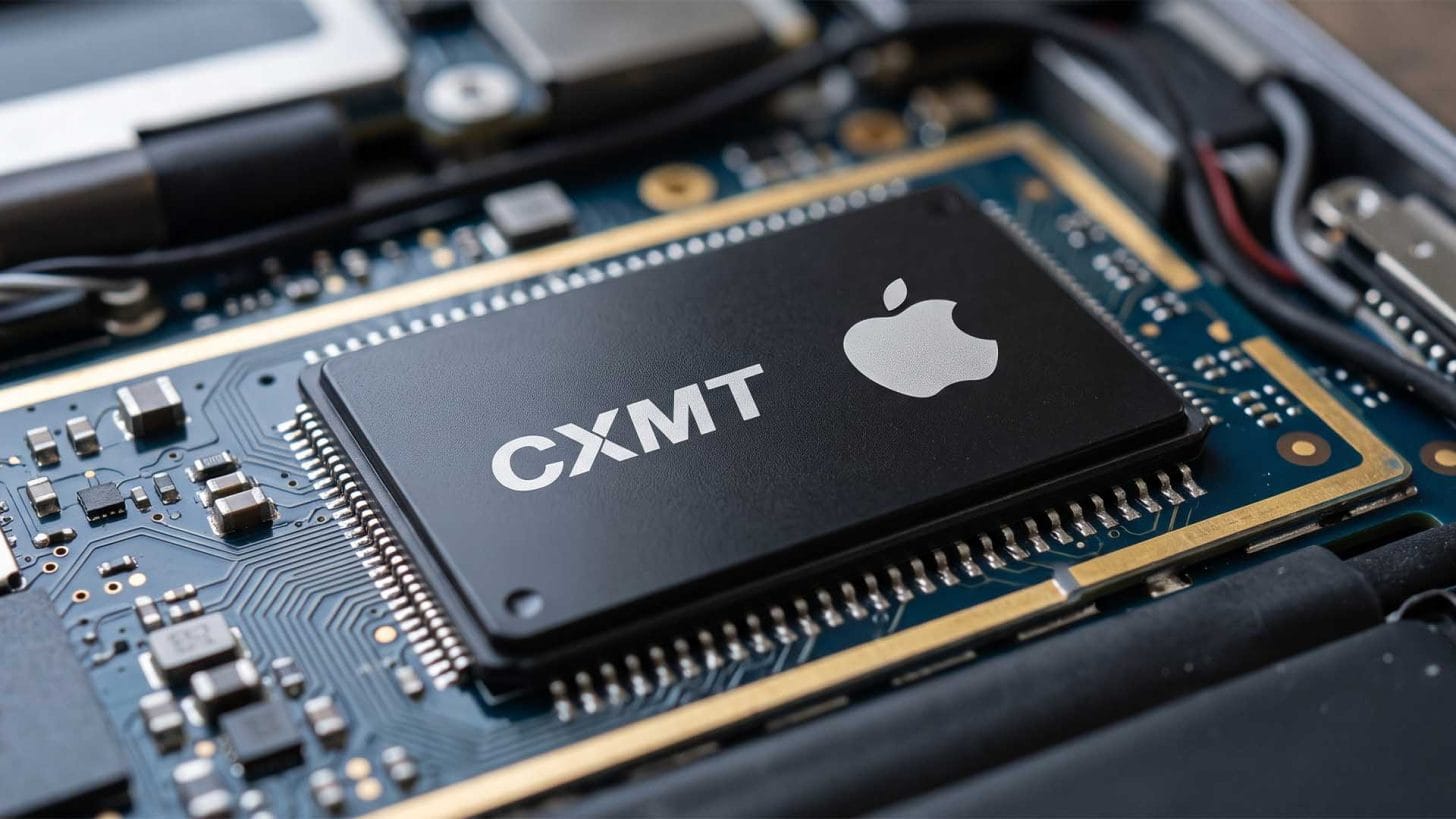
CXMT has been thrust into the global spotlight by the race for memory chips. Apple has begun testing the company’s DRam chips for devices sold in China, according to two people familiar with the matter

Economics & FinanceTech

Sharp turnaround for state-backed company central to Beijing’s AI supply chain efforts.

Follow last week's market rumor (see our post), CXMT has been thrust into the global spotlight by the race for memory chips. Apple has begun testing the company’s DRam chips for devices sold in China, according to two people familiar with the matter, as the iPhone maker leads a lobbying effort among US tech companies to get the US government to allow broader use of the company’s products (the Financial Times).

Will Apple use CXMT's chips for devices sold in China?

Yes
60.00%
No
40.00%
10 Polls

The interest in CXMT marks a sharp turnaround for a company that spent nearly a decade burning through billions of dollars but has now become central to Beijing’s efforts to build a domestic AI supply chain — and is poised to become one of the most profitable technology companies to be listed on China’s domestic stock market.

The memory shortage has transformed CXMT’s finances. Its net profit soared to Rmb33bn ($4.8bn) in the first quarter of this year, according to its IPO prospectus — a striking reversal from the Rmb37bn ($5.4bn) in losses it has accumulated over the past decade.

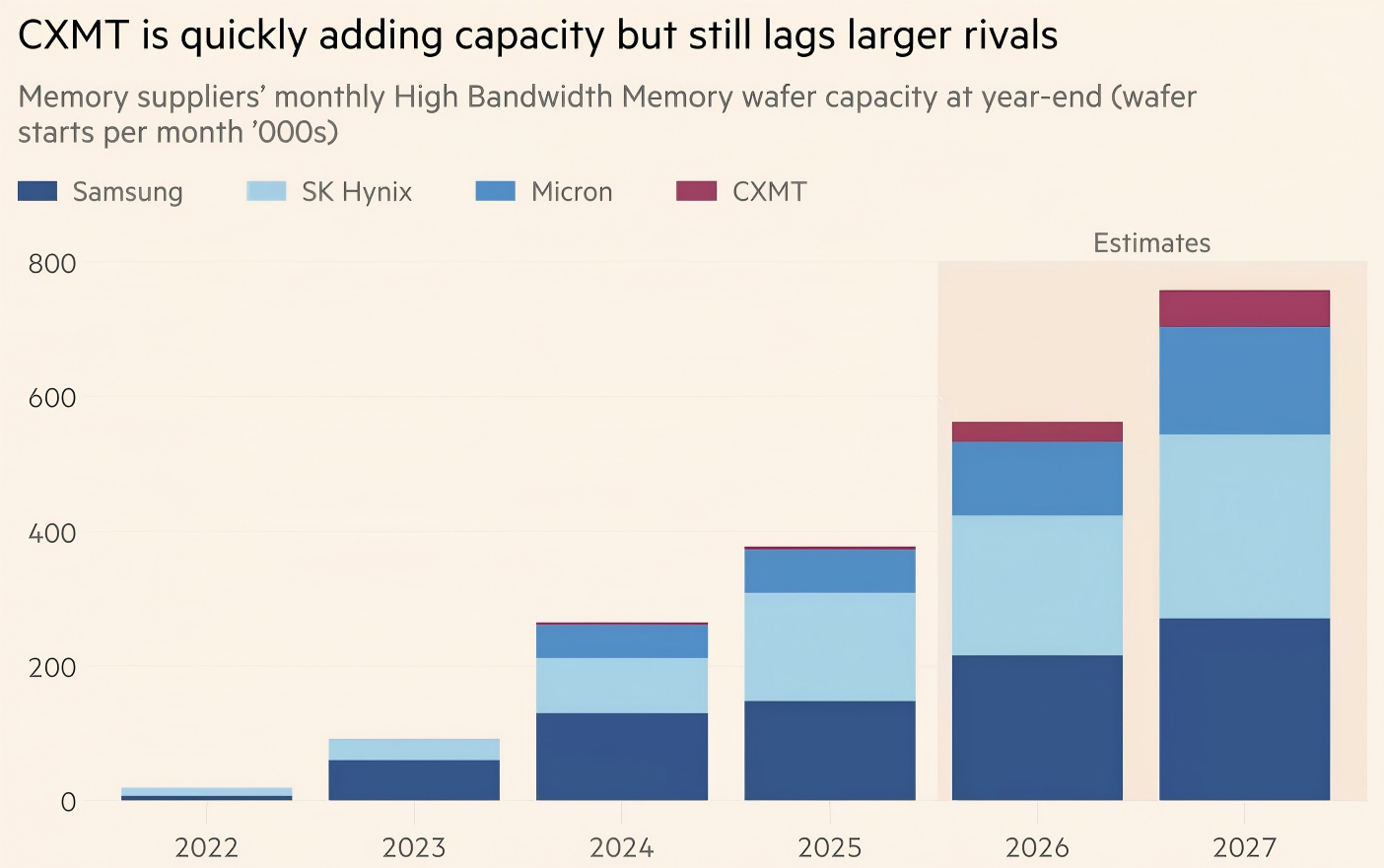
Source: SemiAnalysis Memory Model

CXMT is now the world’s fourth-largest producer of DRam — the chips used in everything from smartphones to servers — behind SK Hynix, Samsung Electronics and Micron.

For US tech groups competing over a finite global supply of DRam wafers, the prospect of a fourth global supplier in China is appealing but politically sensitive. Apple has previously faced public pushback from US policymakers when it last explored using Chinese memory suppliers, including then Republican senator Marco Rubio, who flagged security risks in 2022.

Source: wccftech

Despite CXMT’s rapid growth and plans to increase production, analysts say additional Chinese supply is unlikely to ease memory chip prices soon, as virtually all of its output is already committed and demand continues to grow.

“There’s a misconception that Chinese memory is dramatically cheaper and will flood the market,” said Ray Wang, memory analyst at SemiAnalysis. “Capacity is extremely constrained. Even as CXMT expands, it will remain supply constrained for at least the next two years.”

Over the longer term, however, competitors fear a repeat of the pattern seen in Chinese industries from solar panels to electric vehicles: years of state-backed investment followed by rapid capacity expansion and falling prices that squeeze foreign rivals.

Source: https://wccftech.com/cxmt-developing-high-density-dram-without-euv-might-make-apple-interested/;

https://www.ft.com/content/f4ac5c92-03be-4499-b16a-017a7e9ee228?syn-25a6b1a6=1

Macro & Micro Compass - The BoE Eased Leverage Rules — But Not With the Gilt Exemption Banks Wanted
Analysis
Central BanksCapital MarketsMonetary PolicyMacro & Micro Compass

Macro & Micro Compass - The BoE Eased Leverage Rules — But Not With the Gilt Exemption Banks Wanted

Economics & FinancePolitics

Hours before the Bank of England(BoE) published its July Financial Stability Report, we framed the leverage rule debate around three possible outcomes.

Will the BoE Loosen Bank Leverage Rules to Support the Gilt Market?
The Bank of England(BoE) is going to publish its July Financial Stability Report at 10:30 a.m. (GMT+1) on July 7. There is one issue could have consequences well beyond bank regulation: whether British lenders should be given more room to hold government bonds. The BoE has

The first was a full exemption for gilts from the leverage calculation, which is the most aggressive and market-friendly option. The second was a narrower technical adjustment that would give banks more balance sheet flexibility without dismantling the broader safeguard. The third was no meaningful easing at all.

The Bank has now answered.

The outcome landed closest to option two.

The BoE did move to ease leverage constrains, but not through the full gilt exemption that banks had been discussing before the report. Instead, the Financial Policy Committee and Prudential Regulation Authority plan to consult on a broader redesign of the leverage framework.

What the BoE actually proposed

The package has three main elements.

The Bank plans to remove the Countercyclical Leverage Buffer from leverage requirements; change the calibration of the Additional Leverage Ratio Buffer for systemically important firms; make the framework more releasable during stress. It also proposes reducing the Tier 1 leverage minimum from 3.25% to 3%, while introducing a 25 basis point general leverage buffer. (Page 118 of the report)

Overall, the BoE estimated large UK banks subject to the regime would need to maintain leverage ratios around 20 basis points lower in aggregate, although the impact would vary by bank. Reuters(July 7) noted that the current framework has become binding for three of seven major British banks.

That is easing but it's not the same as removing gilts from the leverage exposure measure.

Before the report, Reuters(July 6) highlighted industry arguments that a gilt exemption could directly expand banks’ capacity to hold UK government debt. Barclays estimated that such a move might enable banks to hold up to £150 billion more in gilts with potentially significant effects on government borrowing costs. Our pre-release News Flash identified that as the most aggressive scenario.

The BoE chose a different route.

Did the BoE go far enough in easing bank leverage rules?

Yes, the 20bp reduction is meaningful
66.67%
No, a gilt exemption was needed
33.33%
It is too early to tell
0.00%
3 Polls

The effect of gilt market is harder to predict now

This is where the subsequent story becomes more interesting than a simple “BoE loosens regulation” headline.

A full gilt exemption will create a relatively direct mechanism: holding more government bonds would no longer expand the relevant leverage exposure measure in the same way, which makes it easier for banks with limited balance sheet capacity to hold more gilts.

But the BoE’s actual plan does not specifically encourage banks to buy more gilts.

The requirement of lower aggregate leverage may still create additional balance sheet capacity. But it does not follow automatically that banks will use that capacity to buy gilts. They could deploy it across lending, market making or other assets instead. That means the large gilt demand estimates discussed before the report should not simply be transferred to the policy package the BoE actually proposed. This is an inference from the difference between the pre gilt exemption scenario and the published reform plan.

In other words, the Bank has loosened the constraint without directly dictating where the newly available capacity goes.

There is also a deeper contradiction inside the report

While easing the leverage pressure on banks, the BoE is also warning of leverage risks in other areas of the financial system.

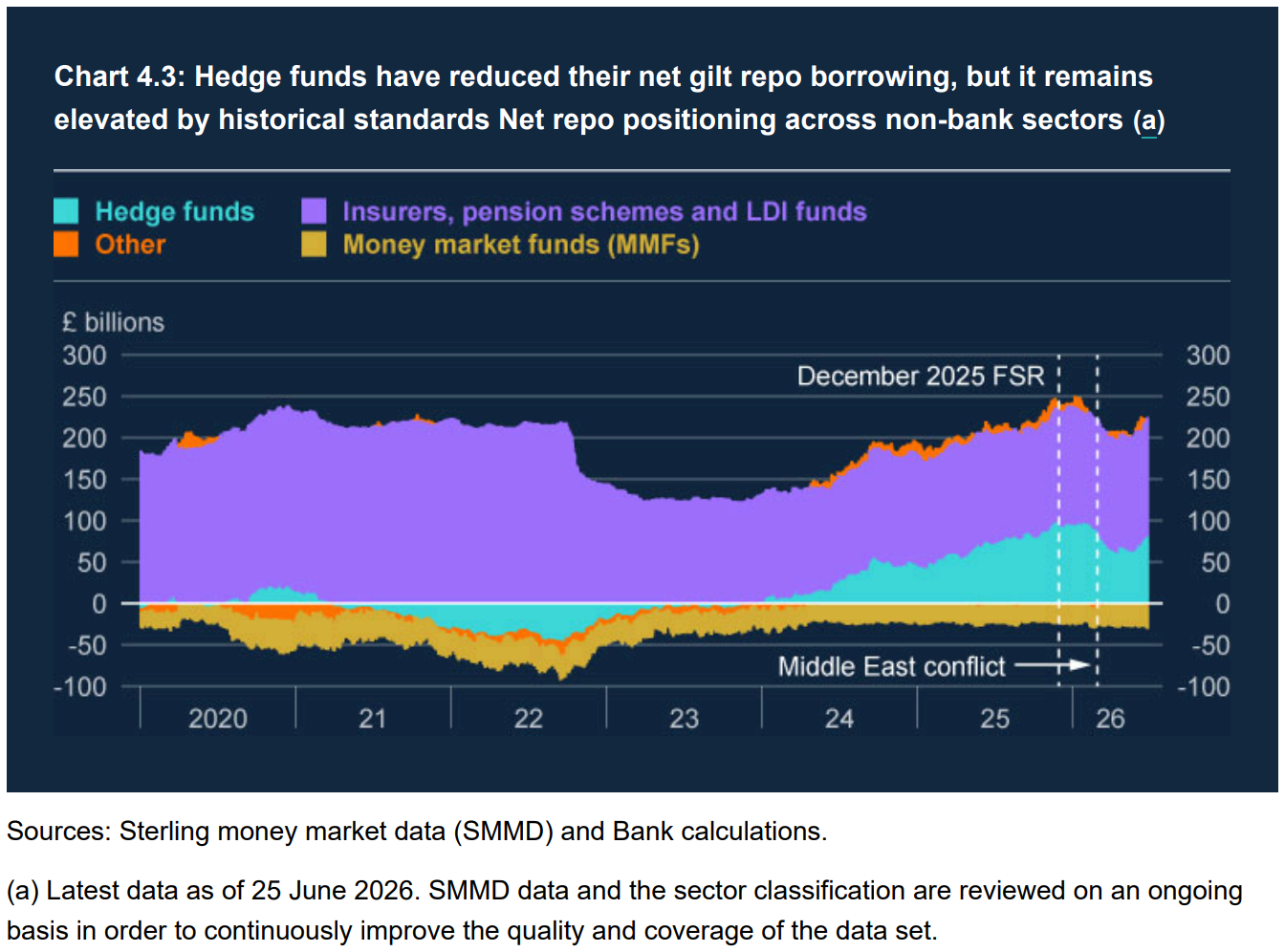
The report says net hedge fund borrowing in the gilt repo market fell roughly 40% from £100 billion by mid-April, but then rose again to around £85 billion from the end of May. The BoE says those positions remain elevated by historical standards and are still heavily associated with leveraged relative value strategies.

That tension did not escape from the notice of policymakers. Reuters(July 7) reported that some FPC members worried the proposed leverage changes could contribute to an unwanted increase in market based leverage, with implications for the resilience of core UK markets.

So the real policy question has changed. Before the report, it was: Will the BoE loosen leverage rules? Now the more important question is: Can the BoE give banks more room to operate without adding to the leverage risks already building in the gilt market?

The Bank itself has not treated that question as settled. It says further analysis will examine whether the proposed reforms create financial stability gaps, including their interaction with gilt repo resilience and market functioning. That work is due to be considered at the FPC’s Q3 meeting, ahead of any potential consultation on this part of the package.

What is the most likely next step in the BoE’s leverage reform?

The current easing policy proceeds largely unchanged
0.00%
Extra safeguards are added after the Q3 review
100.00%
The BoE moves closer to a gilt exemption
0.00%
The reform is delayed or materially weakened
0.00%
1 Polls

The first prediction has now been answered: the BoE was prepared to move.

But it chose the middle path: easing leverage requirements while keeping the broader backstop intact.

The next prediction is harder: whether the BoE’s current plan will remain unchanged once it completes its review of wider gilt market risks.

Source:

  1. Bank of Englan: Financial Stability Report, July, 2026 https://www.bankofengland.co.uk/-/media/boe/files/financial-stability-report/2026/financial-stability-report-july-2026.pdf
  2. Bank of England sets out plan to ease bank leverage rules, July 7, 2026 https://www.reuters.com/business/finance/bank-england-sets-out-plan-ease-bank-leverage-rules-2026-07-07/
AI Speedrun - Anthropic vs Meta: Two Compute Signals, One Confusing Week
Editorial
LLMsMust ReadAI InfrastructureMag 7AI Speed RunIndustry Pulse Semi Analysis

AI Speedrun - Anthropic vs Meta: Two Compute Signals, One Confusing Week

Two headlines landed within days of each other and appear to point in opposite directions: Anthropic locking up two decades of dedicated data-center capacity, while Meta suggesting it has AI compute to spare -- analysts, investors, and the companies themselves haven't settled on one story.

Economics & FinanceTech

Two headlines landed within days of each other and appear to point in opposite directions: Anthropic locking up two decades of dedicated data-center capacity it won't even need until 2027, and Meta suggesting it has AI compute to spare right now. Whether that's a real contradiction or just two companies at different points in the same buildout cycle is genuinely contested — analysts, investors, and the companies themselves haven't settled on one story.

Do you think, will hyperscalers raise CAPEX again in 2026-2027 or not?

Yes - it is way not over
100.00%
No - it has peaked
0.00%
3 Polls

Anthropic Locks Up TeraWulf's Data Center Capacity in Kentucky Campus

On July 6, 2026, TeraWulf — a bitcoin miner turned AI landlord — announced a 20-year lease with Anthropic covering its Justified Data campus in Hawesville, Kentucky. The site, built on the grounds of a former aluminum smelter, will scale to roughly 401 megawatts of critical IT load in phases, with initial capacity live in the second half of 2027 and full build-out by early 2028.

TeraWulf expects the lease to generate approximately $19 billion in contracted revenue over its initial term, backed by investment-grade credit — a figure that exceeds TeraWulf's own ~$12 billion market cap. TeraWulf's own capital outlay is modest by comparison: roughly $3-4 billion, less than a fifth of the lease's value. Shares jumped as much as 19% on the news.

In a companion transaction, TeraWulf agreed to sell its 50.1% stake in the Abernathy, Texas joint venture (a 168 MW site developed with Fluidstack) for about $530 million, freeing capital to plow back into wholly-owned AI infrastructure. TeraWulf CEO Paul Prager framed the deal as validation of a strategy built around owning critical infrastructure and locking in direct, long-duration customer relationships — the same "picks and shovels" logic that has pushed bitcoin miners as a group to sell over 15,000 coins and sign more than $70 billion in AI hosting contracts this year alone.

Meta Says It Might Have Compute to Spare

Just days earlier, a very different signal came from the other end of the AI infrastructure chain. At Meta's May shareholder meeting, Mark Zuckerberg said entering the cloud business was "definitely on the table," noting that companies were approaching Meta "almost every week" asking to buy access to its models or spare GPU capacity. By early July, Bloomberg reported Meta was actively developing a "Meta Compute" offering to rent out excess capacity and hosted model access — putting it in direct competition with AWS, Azure, and Google Cloud.

Meta’s AI Cloud Pivot: Monetization Strategy or Overbuild Signal?
Bloomberg (July 1) - Meta is reportedly developing a cloud infrastructure business that would sell access to AI computing power and models to outside customers. The plan could put Meta into a new competitive lane against cloud leaders such as Amazon Web Services, Microsoft Azure, and Google Cloud. The business would

The numbers behind this are enormous: Meta has guided to $125-145 billion in 2026 capex, sits on $182.9 billion in AI infrastructure commitments, and by some estimates could have close to 5 gigawatts of capacity on hand by year-end — including a 2,250-acre Louisiana campus and gigawatt-scale sites in the Midwest. The market's reaction was sharp and split: chip stocks sold off hard (the Philadelphia Semiconductor Index fell over 6% in a session, with Micron, SanDisk, and Intel all down double digits) on fears that a major buyer signaling "excess" implies softer near-term demand, even as Meta shares rose on hopes that idle capex could become a revenue line.

Notably, Meta is not new to leasing capacity to AI labs. It already rents the entire Colossus 1 site in Memphis (300+ MW) to Anthropic for roughly $1.25 billion a month through May 2029, and a separate facility to Google for about $920 million a month — arrangements Bloomberg Intelligence estimates could generate $50 billion-plus by 2028.

Which signal will look more important for the AI infrastructure cycle by the end of 2028?

Anthropic style: long-term capacity locks up
0.00%
Meta style: monetization of spare compute
0.00%
Both will coexist as a normal parts of the same buildout cycle
100.00%
Neither: AI infrastructure demand will weaken materially
0.00%
1 Polls

Why the Discrepancy?

Meta could be needing to turn its capex into cash flow. Meta has guided to $125-145 billion in 2026 capex alone and has disclosed roughly $183 billion in cumulative AI infrastructure commitments. That is a lot of depreciation and power spend sitting on the balance sheet with no matching external revenue. Reframing idle or underused capacity as a rentable product — "Meta Compute" — lets Meta tell investors that some of that capex is an income-generating asset rather than a pure cost center. This is at least partly a financial-narrative move, and the market treated it that way: Meta's own shares rose on the announcement even as chip and neocloud stocks (CoreWeave, Nebius) sold off on fears that a top buyer signaling "spare" compute means softer near-term chip demand industry-wide.

A possible gap in model-side demand (the quality of product). If Anthropic's models are pulling in more training and inference demand per dollar of infrastructure than Meta's own Llama/"Watermelon" models are, that alone would produce exactly this pattern — Anthropic scrambling for guaranteed long-term capacity while Meta finds its internal AI workloads aren't absorbing everything it built. This is the hardest of the three to verify directly: Meta has claimed its upcoming Watermelon model matches GPT-5.5-tier performance, so the "quality gap" is contested rather than settled, and neither side's true utilization numbers are public. Worth flagging as a plausible driver, not a confirmed one.

Meta may be freeing up older silicon as it jumps to next-gen chips - a rise of capex, rather than a cut back. Meta is reportedly in talks for a roughly $6.5 billion deal with Samsung Foundry to produce its third-through-fifth generation MTIA accelerators on a 2nm process — a shift away from TSMC, whose leading-edge capacity is said to be booked through 2027. Meta is also targeting a new in-house chip generation roughly every six months as it scales toward 5 gigawatts of capacity by 2030. A hardware refresh cycle that aggressive, layered on top of GPU capacity bought during the initial AI buildout rush, plausibly leaves Meta holding a growing stack of still-functional but no-longer-frontier compute — exactly the kind of capacity that makes sense to lease out rather than idle, while the newest MTIA generations get reserved for Meta's own priority workloads. Separately, Anthropic itself is reportedly exploring Samsung's 2nm node for its own custom silicon, so both companies are pursuing chip diversification in parallel, just from different starting positions (Meta offloading older capacity while upgrading; Anthropic trying to reduce Nvidia dependence for future needs).

Sources:

  1. TeraWulf company announcement on July 6, 2026 (https://investors.terawulf.com/news-events/press-releases/detail/142/terawulf-announces-anthropic-lease-at-justified-data-campus-and-sale-of-majority-interest-in-abernathy-joint-venture-to-fluidstack)
  2. CNBC news report on Meta on July 1, 2026 (https://www.cnbc.com/2026/07/01/meta-stock-cloud-ai-compute.html)
  3. MSN news on Meta's potential talk with Samsung July 4, 2026 (https://www.msn.com/en-us/news/insight/meta-eyes-6-5b-samsung-ai-chip-deal-to-fuel-cloud-push/gm-GM294ACBD9?gemSnapshotKey=GM294ACBD9-snapshot-0&uxmode=ruby)
Weekly Casserole - Hedge funds dumped chip stocks for a fourth week as AI shares sold off - Week of July 6, 2026
News Flash
SemiconductorCapital MarketsAI InfrastructureWeekly Casserole Semi News

Weekly Casserole - Hedge funds dumped chip stocks for a fourth week as AI shares sold off - Week of July 6, 2026

U.S. hedge funds sold tech hardware stocks for a fourth week in a row, according ​to a client note from Goldman Sachs. Do you think the rally is over?

Economics & Finance

LONDON, July 6 (Reuters) - U.S. hedge funds sold tech hardware stocks for a fourth week in a row, according ​to a client note from Goldman Sachs on ‌Friday, in line with a recent decline in global chip shares and just before many of these companies will report earnings.Tech shares ​and especially semiconductors have propelled the broader equity market ​higher this year. But tech stocks have been ⁠swinging dramatically on a combination of profit-taking and concern ​about the high levels of spending on AI and when ​the companies behind those outlays might see returns. The SOX index , which tracks the performance of semiconductor stocks, declined 4.2% in the week ​to July 3.

Do you think the Ai/Chip rally is over (poll initiated as of July 7, 2026)?

Yes - it has peaked in June 2026
0.00%
No - it will hit a new high some time in the rest of 2026
100.00%
2 Polls

Here's what the Goldman Sachs note said ​about hedge fund trading in that week:

  • Info tech stocks including semiconductor and ‌hardware ⁠companies was the most net sold U.S. stock sector for the fourth week in a row.
  • Hedge funds had more sold stocks than bought for the third straight week.
  • Last week ​hedge funds mostly ​sold single ⁠U.S. stocks
  • Hedge funds sold other stock sectors including industrial and consumer discretionary shares.
  • These investors bought ​index and ETF products, which often rise alongside ​the ⁠wider market.
  • Hedge funds bought commercial services, consumer staples, real estate and energy stocks.
  • Hedge funds might sell stocks to close bets ⁠based ​on an expectation for those shares ​to rise, or as part of a bet on those shares falling in ​value over time.

Reporting by Nell Mackenzie; Editing by Amanda Cooper.

Source:

Reuters, July 6, 2026: https://www.reuters.com/business/finance/hedge-funds-dumped-chip-stocks-fourth-week-ai-shares-sold-off-2026-07-06/

Will the BoE Loosen Bank Leverage Rules to Support the Gilt Market?
News Flash
Central BanksEconomics

Will the BoE Loosen Bank Leverage Rules to Support the Gilt Market?

Economics & Finance

The Bank of England(BoE) is going to publish its July Financial Stability Report at 10:30 a.m. (GMT+1) on July 7. There is one issue could have consequences well beyond bank regulation: whether British lenders should be given more room to hold government bonds.

The BoE has been reviewing its leverage rules after banks argued that the current framework discourages them from holding gilts. Under the existing regime, banks must hold capital against total exposures, including government bonds, with a leverage requirement of somewhat above 3.25% for affected institutions. Reuters (July 6) - the central bank is expected to update the market on this review in today’s Financial Stability Report. 

The most aggressive proposal would exclude gilts from the leverage calculation. Barclays estimates such a change could allow UK banks to hold as much as £150 billion more in gilts, potentially lowering yields and saving the government around £2.5 billion a year in borrowing costs. 

Will the BoE signal a relaxation of bank leverage rules in today’s Financial Stability Report?

Yes
0.00%
No
0.00%
0 Polls

However, the policy trade-off is extremely obvious.

Supporters argue that relieving the constraint could bring banks back into the gilt market, improve demand for government debt and reduce financing pressure at a time when Britain is increasingly dependent on foreign investors. The US has already relaxed comparable leverage requirements which added competitive pressure on British banks. 

Objectors see a different risk. Former regulators warn that excluding gilts could weaken one of the financial system’s basic safeguards. David Aikman, a former BoE official, told Reuters that the answer was not to “take the batteries out of the fire alarm,” but to investigate whether other risk weights had become too loose.

Therefore, the real question behind today's report is: how far is the BoE prepared to move?

  1. A full gilt exemption would be the clearest market-friendly signal.
  2. A narrower adjustment (e.g. changing the UK specific cyclical component of the leverage ratio) would suggest the Bank wants to support balance sheet capacity without dismantling the broader safeguard.
  3. No meaningful easing would show that financial stability concerns still outweigh the pressure to strengthen gilt demand.

The BoE is also expected to address risks in private credit and the gilt repo market. Previously, it has warned that concentrated: leveraged hedge fund strategies could make government bonds harder to trade during a crisis.

To sum up, the question before the report comes out is: whether the BoE decides that supporting gilt market capacity now justifies accepting more balance sheet risk inside the banking system.

Source:

  1. Bank of England could boost bond demand with leverage rule tweak, banks say, July 6, 2026 https://www.reuters.com/business/finance/bank-england-could-boost-bond-demand-with-leverage-rule-tweak-banks-say-2026-07-06/
Spotify Verifies Streaming Manipulation After Malcolm Todd’s Suspicious Numbers
Editorial
RegulatoryCapital MarketsMusicMust Read

Spotify Verifies Streaming Manipulation After Malcolm Todd’s Suspicious Numbers

A Kalshi-Spotify incident shows how settlement based on the first print can reward temporary manipulation.

Economics & FinancePop Culture

A song called “Earrings” by Malcolm Todd suddenly reached No. 1 on Spotify’s U.S. daily chart on June 30. That would usually be a music story. Maybe the song went viral. Maybe TikTok pushed it. Maybe listeners just found it at the same time.

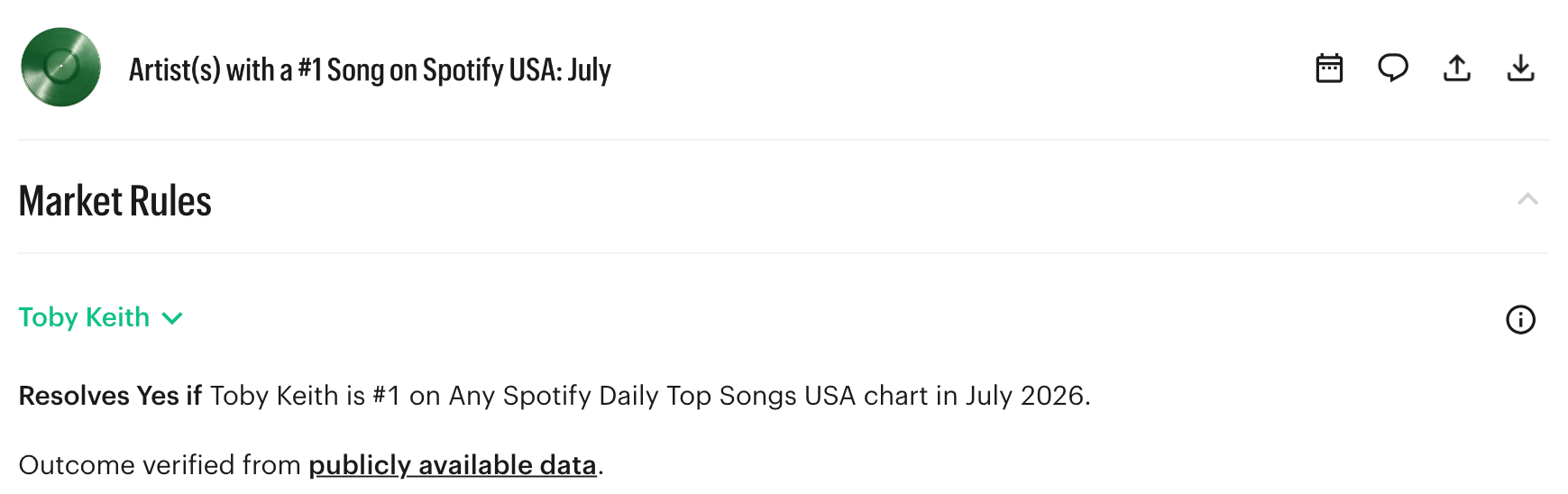
But the song was also tied to a prediction market on Kalshi. The market resolves Yes if the named artist is No. 1 on “Any Spotify Daily Top Songs USA chart in June 2026”, with the outcome verified from Spotify. The market was “Paid out 30 minutes after closing” according to the market page.

Malcolm Todd had been a long shot. Kalshi traders had priced his chance at roughly 2.5% before the dramatic move. Then Kalshi paid out, and Spotify later removed more than 500,000 artificial streams, pushing the track from 1st to 4th after review.

The problem was not simply that Spotify had fake streams. Spotify already has systems for artificial streaming. The problem was that the market paid out before Spotify’s correction arrived.

In other words, the prediction market settled on the first version of the data, not the corrected version.

That turns this from a music-industry story into a market-design story.

The incident

The trader who pushed the issue into public view was Caleb Davies, known as Gaeten Dugas on X (@GaetenD). WIRED described him as a major Kalshi culture-market trader who closely tracks Spotify data, and reported that he contacted Spotify, Kalshi, and Polymarket with concerns about what he believed was bot-driven manipulation.

Davies posted that the “Earrings” move was wildly abnormal. In one X post, he said the Sunday-to-Monday surge was an 11.24 sigma event, or roughly a 1 in 77 octillion chance of happening randomly.

After Kalshi paid out, Davies also wrote on X that he had asked Kalshi not to pay the Spotify market until it investigated. Instead, he said, Kalshi “rushed to pay it out” and Spotify later removed the streams that gave “Earrings” the win. He lost about $4,500 on that.

There are two important caveats. First, Spotify confirmed artificial streaming, but it did not confirm that the motive was prediction-market manipulation. Second, there is no public evidence that Malcolm Todd or his team were involved. Todd might simply have been an innocent bystander.

The race: manipulation, detection, payout

Spotify is not blind to artificial streaming. Its own guidance says artificial streams include streams that do not reflect genuine listening intent, including attempts to manipulate Spotify using bots or scripts. Spotify also says artificial streams do not earn royalties, do not count toward public stream numbers or charts, and do not positively influence recommendation algorithms once detected.

So Spotify has a cleaning process. The problem is timing.

Kalshi’s broader streaming-rank rules state that the underlying is the ranking published by the platform as of a given date, and that revisions made after expiration are not counted in determining the expiration value.

If Spotify catches the fake streams and removes them before the market settles, the manipulation fails. If Spotify catches them after the market settles, the exchange may already have paid the wrong side.

That means the key race is not simply between honest traders and dishonest traders. It is a race between three clocks:

  1. The manipulator’s ability to move the metric before the market deadline
  2. Spotify’s ability to detect and remove artificial streams
  3. Kalshi’s payout clock

In this case, Kalshi’s payout clock appears to have been faster than Spotify’s correction clock.

But the deeper issue is not just that settlement was fast. It is that the contract used a third-party benchmark whose first reading could later be corrected, and then treated that provisional reading as final. The loophole exists when an event contract finalizes before the benchmark source has finished deciding whether the benchmark itself was real.

This is why Spotify’s anti-fraud system does not fully solve the prediction-market problem. Spotify can still clean the chart later, remove fake streams, and withhold royalties. But if the exchange has already paid out, the financial damage inside the prediction market has already happened.

For Spotify, a delayed correction may be acceptable. For a prediction market, it may be too late.

No-side buyers of the Malcolm Todd contract lost roughly $145,000 in total before fees.

BTC 5 mins settlement manipulation

This case also rhymes with the issue in short-duration crypto prediction markets.

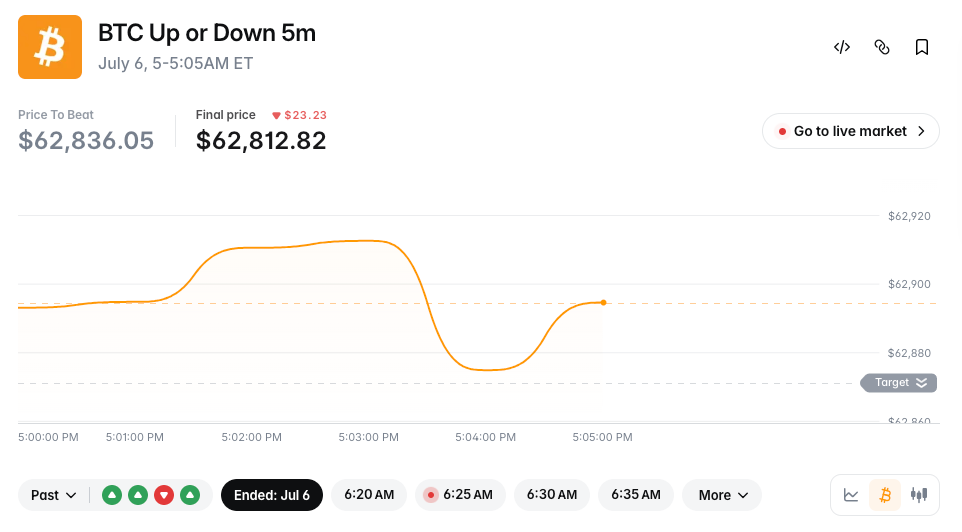
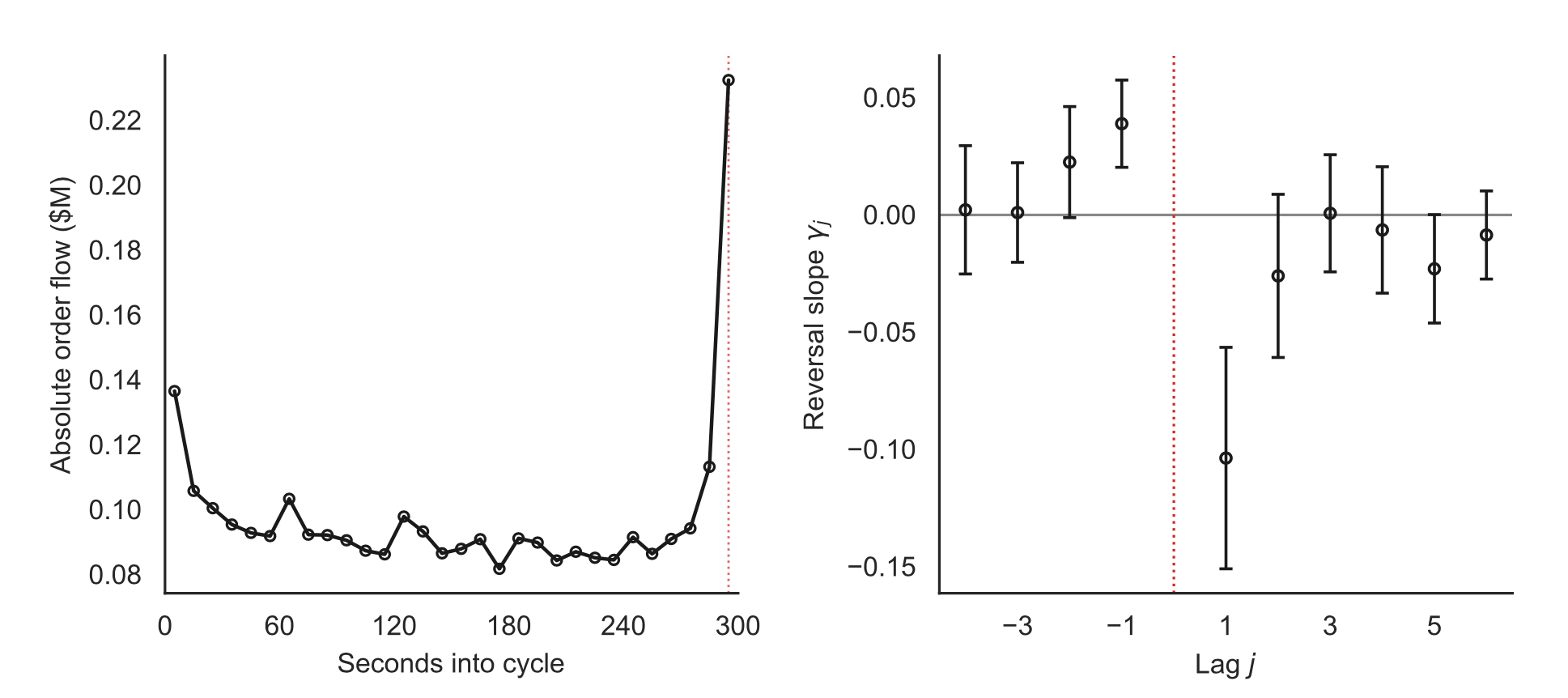
A recent paper on settlement manipulation in prediction markets studied Polymarket’s 5 mins Bitcoin contracts. The authors found that after those contracts launched, order flow spiked on the BTC spot market around when the event contract settles, and prices often reversed after settlement of the event contract.

Their interpretation is that, if a contract pays based on the BTC price at a very specific moment, traders can profit from the event contract by briefly pushing the underlying BTC spot price across the settlement threshold.

In the BTC case, the trader tries to move the price at the settlement moment. In the Spotify case, the trader tries to move the chart before the market deadline and Spotify's correction.

The exact tools are different. One uses trading in the underlying asset. The other may involve artificial streams. But the logic is similar: If a market pays on a temporary value, someone may try to manufacture that temporary value.

There is one important difference, though. A BTC price at a specific timestamp is still a real traded price, even if it was pushed around. It usually will not be “revised away”. Spotify streams are different. Spotify can later correct the stream numbers.

So BTC five-minute markets are mainly about settlement-price manipulation. The Spotify case is about settlement-source contamination.

Order flow in Binance BTC spot markets spikes right before the five-minute prediction market settles (left), and the price impact reverses shortly afterward (right) (from Dai, Jia, & Yu, 2026). This is the same basic logic as the Spotify case. The manipulator does not need to change the long-run truth, only the value used at settlement.

The third-party source problem

Spotify did not design its charts to be financial settlement infrastructure. But once exchanges create markets based on Spotify charts, those charts become settlement benchmarks.

That changes the incentives around the charts.

Before prediction markets, artificial streaming was mainly about royalties, playlist placement, social proof, or artist promotion. With prediction markets, there is a new possibility: someone can profit from the artificial streams without being the artist, the label, or the distributor. They do not need Spotify royalties. They just need the chart to hit the right number before the market pays.

That creates a weird externality. The exchange creates the financial incentives, but Spotify has to deal with the mess. It has to detect the manipulation, clean the data, protect the chart, and answer questions about a market it did not necessarily ask to be part of.

Bloomberg reported that Spotify asked Kalshi and Polymarket to remove its logo and clarify that neither company had a partnership with the streaming service. WIRED also reported that Kalshi removed Spotify’s logo from related markets and changed language that had suggested Spotify verified chart results.

Kalshi has removed Spotify's logo from this related market. However, the link embedded in the text "publicly available data" directs users to Spotify's website.

That reaction makes sense. If your data is being used to settle millions of dollars in contracts, you are no longer just a data publisher. You are being pulled into the role of an unwilling settlement agency.

The fundamental issue is not that prediction markets use outside data. They have to. The issue arises when the exchange relies on a third-party metric that can be influenced before settlement, audited after publication, and revised outside the exchange’s control. In that setting, the market is not simply importing clean information from the real world. It is importing a provisional benchmark whose validity may only be decided after traders have already been paid, subject to the source's discretion.

How should exchanges settle markets based on platform metrics like Spotify charts?

Settle immediately based on the first published result
0.00%
Use the latest result as of the end of a defined window
66.67%
Void the market and return all funds if the source confirms manipulation within a defined window (during which funds are withheld))
0.00%
It depends on the scenario (e.g., how manipulable the metric is)
33.33%
3 Polls

If an exchange settles on the latest result available at the end of a defined review window, how long should that window be after the first result is published?

30 minutes: keep settlement fast
50.00%
24 hours: allow basic source checks
25.00%
48-72 hours: balance speed and correction possibility
25.00%
7 days: prioritize accuracy over payout speed
0.00%
It should depend on the type of underlying metric and its manipulation risk
0.00%
4 Polls
When Evidence Arrives Late: The MicroStrategy Bitcoin Sale
When truth arrives late, prediction markets reveal a deeper problem: are traders betting on events, evidence, or the rulebook?
An Abandoned Football Match and the Fragility of “Final Score”
One abandoned friendly football match became a test of how Polymarket and Kalshi handle messy real-world outcomes.

Disclaimer: The content is for informational purposes only. You should not construe any such information or other material as legal, tax, investment, financial, or other advice. Nothing contained in this article constitutes a solicitation, recommendation, endorsement, or offer by the author(s) or any third party service provider to buy or sell any securities or other financial instruments in your or in any other jurisdiction in which such solicitation or offer would be unlawful under the securities laws of such jurisdiction. The author(s) report(s) no conflict of interest.

Results Deep Dive - Samsung’s Record Profit Wasn’t Enough? Is the AI Memory Boom Nearing Its Peak?
News Flash
SemiconductorSignalsMust ReadEarnings & Operations Semi News

Results Deep Dive - Samsung’s Record Profit Wasn’t Enough? Is the AI Memory Boom Nearing Its Peak?

Economics & Finance

Samsung Electronics has just announced its earnings guidance for the second quarter of 2026. Normally it will push its stock higher.

Instead, investors sold.

Samsung’s second quarter revenue reached approximately KRW 171 trillion, while operating profit hit about KRW 89.4 trillion — its third consecutive record quarter. Profit is approximately 19 times that reported a year ago, which was 4.7 trillion won at that time. And exceeded the KRW 87.3 trillion LSEG SmartEstimate cited by Reuters(July 7).

Will Samsung's operating profit hit another record in Q3 2026?

Yes, Strong AI demand and rising memory prices could drive new highs
33.33%
No, Slower AI investment or falling prices could limit profits
66.67%
3 Polls

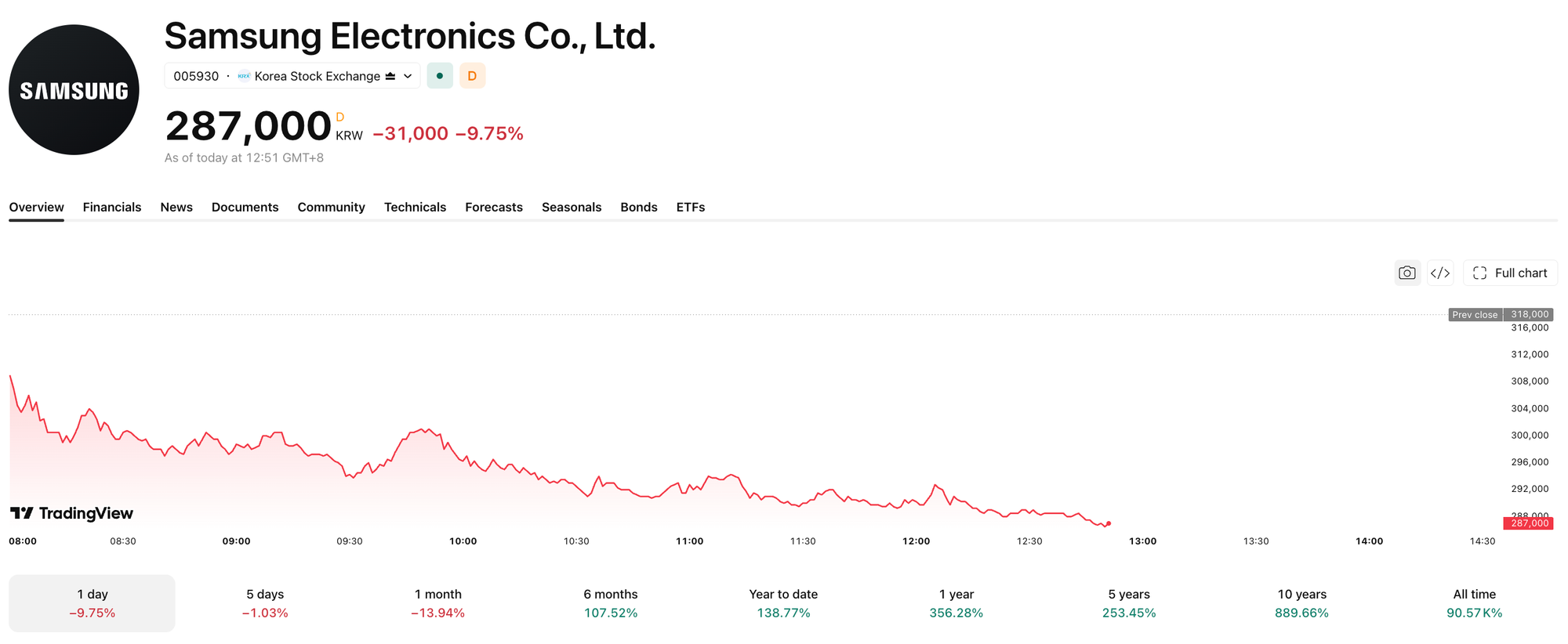
Yet Samsung shares fell as much as 9.75% in the middle-day trading. While SK Hynix dropped 10.58% at the same time. This reaction may be more important than the earnings beat itself.

Update by July 7 12:51 UTC+8 https://www.tradingview.com/symbols/KRX-005930/

The obvious explanation for Samsung’s profit surge is AI. But the more interesting part is that the boom is no longer confined to high bandwidth memory(HBM).

As chipmakers devote more production capacity to AI related products, supply has tightened across conventional memory used in smartphones, PCs and servers. Reuters reported that Citi Research estimated second quarter average selling prices rose 44% quarter-on-quarter for DRAM and 53% for NAND.

Teach-in Series 3 - IDM
Companies that design and manufacture their own chips — memory, analog, power, and Intel.

So why did the stock fall?

Because investors are increasingly asking whether today’s extraordinary profits represent the beginning of a structurally tighter memory market or the peak of another semiconductor cycle.

Reuters reported that concerns are mainly about the durability of AI infrastructure spending. Delays in data centre construction caused by power constraints, labour shortages or local opposition could eventually weaken demand across the hardware supply chain. Investors are also questioning whether major technology companies can keep financing enormous AI capital expenditure when returns remain uncertain.

This is the real market question behind Samsung’s results.

The bullish case is because AI changed the old ecosystem: HBM consumes capacity, conventional DRAM and NAND remain tight, new fabrication plants take years to build, and customers are increasingly seeking longer term supply agreements. The bearish case is that today’s record high prices already assumes an AI buildout that cannot slow materially.

Samsung’ full earnings release planed to announce on July 30. Therefore, it matters more than another confirmation of record profit. Investors will be watching the memory pricing, HBM progress and management commentary. These help them to find evidence that this boom still has room to run.

The headline says Samsung just had an extraordinary quarter.

The stock market is asking whether extraordinary has already become the baseline.

What is the biggest risk to the current AI memory boom?

Memory oversupply
100.00%
Slower hyperscaler AI spending
0.00%
Data centre power constraints
0.00%
Weaker demand for PCs and smartphones
0.00%
Others
0.00%
1 Polls

Source:

  1. Samsung flags 19-fold jump in profit, but shares slump on jitters AI boom may stall, July 7, 2026 https://www.reuters.com/world/asia-pacific/samsung-estimates-19-fold-rise-q2-operating-profit-beating-expectations-2026-07-06/
Macro & Micro Compass - Can Trump Bend the Fed Before the Data Does?
Analysis
EconomicsInterest RateMacroeconomicsMonetary PolicyMacro & Micro CompassAnecdote

Macro & Micro Compass - Can Trump Bend the Fed Before the Data Does?

PoliticsEconomics & Finance

The next fight over the Federal Reserve is no longer just about inflation, jobs, or the timing of the next rate move. It is also becoming a test of how much political pressure markets believe the Fed can absorb.

Will Trump materially reshape the Fed before his current term?

Yes, he is definitely a tough guy
61.54%
No, it's much more difficult than it looks.
30.77%
Only partially
0.00%
Too early too tell
7.69%
13 Polls

Bloomberg(July 3) reported that President Donald Trump’s allies are renewing efforts to reshape the Federal Reserve, including ways to exert more pressure on the institution rather than just fire top officials in Washington. The report lands at a sensitive moment: the June employment report weakened the case for another near-term rate hike, while inflation remains high enough to keep the Fed away from a smoothly rate cutting.

June Jobs Miss: How Will It Affect the Interest Rate Cycle?
The June jobs report gave markets a softer labor signal than the headline unemployment rate suggests.

That makes the political perspective relevant to the market. Thus the rate cycle can be read in two different interpretations.

From economic angle, the Fed should wait for more data. Hiring has slowed sharply, labor-force participation has fallen, and the June payroll miss weakened the argument for another immediate hike. But inflation remains high enough to complicate any rapid turn toward easing.

From political angle, Trump has repeatedly pushed for lower interest rates, while the latest Bloomberg report suggests his allies are continuing to explore ways to reshape the institution. More recently, Trump publicly criticized the Fed board as “a little bit hostile,” underscoring that pressure on monetary policy has not disappeared under the new leadership.

The institutional problem for any president is that the Fed is not designed to be easy to control.

The Board of Governors has seven members nominated by the president and confirmed by the Senate. Governors serve staggered 14-year terms, while the chair and vice chairs serve separate four-year leadership terms. 

Interest rate policy is also broader than the chair alone. The Federal Open Market Committee (FOMC) includes the members of the Board of Governors, the president of the New York Fed, and four other regional Reserve Bank presidents who vote on a rotating basis.

Regional Fed presidents add another layer of insulation. They are not directly appointed by the White House, they are selected through their respective Reserve Banks and require approval from the Board of Governors. 

That means Trump’s influence is real, but constrained. A president can nominate governors when vacancies arise and select the Fed chair from among sitting governors, but the structure of the system makes a rapid takeover difficult. The policy setting process is deliberately distributed across long serving governors and regional institutions.

The Supreme Court has made that boundary even more important.

In one landmark decision, the Court expanded presidential authority to remove leaders of other federal regulatory agencies, strengthening the legal theory of a more powerful “unitary executive.” But the Court also preserved a distinct boundary around the Federal Reserve and separately refused to let Trump remove Governor Lisa Cook while her case proceeds.

So it is to hasty to say Trump controls the Fed. More suitable is that he is testing the boundaries of Fed independence.

 If investors believe monetary policy remains primarily data driven, then payroll momentum, inflation, labor force participation, and upcoming CPI reports should dominate the rate cycle debate.

But if investors begin to believe political pressure can alter the Fed’s reaction function, a different risk enters the market. Traders would no longer be pricing only where inflation and unemployment are heading. They would also have to judge whether the central bank will respond to those indicators in the same way as in the past.

For now, Fed Chair Kevin Warsh is publicly pushing back against concerns over political influence. Speaking at the ECB’s central-banking forum in Sintra, Warsh said the Fed would remain independent and reaffirmed its commitment to price stability and the 2% inflation objective. He also avoided providing clear forward guidance on future rate decisions. 

However, Trump continued to exert pressure in public. After the June jobs report, he described the Fed board as “a little bit hostile” and said Warsh “has to do what he has to do” on interest rates. 

What will matter more for the Fed’s next major rate move?

Economic datas
25.00%
Trump’s political pressure
25.00%
Just Fed's personal decision
25.00%
A combination of these three
25.00%
4 Polls

According to all of these, there are two competing explanations for the next move in rates.

The first is the economic explanation: softer payrolls, falling labor force participation, persistent inflation, and the next CPI report will determine whether the Fed will suspend, hike, or eventually turn toward decrease.

The second is the political explanation: Trump may not need to formally control the Fed to become a market variable. Persistent pressure can affect expectations around future appointments, institutional governance, and how investors perceive the durability of central bank independence.

Is the U.S. rate cycle still being driven mainly by economic fundamentals, or is Trump’s political leverage becoming a market variable in its own right?

Source:

  1. Trump Allies Double Down on Efforts to Reshape Federal Reserve, July 2, 2026 https://www.bloomberg.com/news/articles/2026-07-02/trump-allies-double-down-on-efforts-to-reshape-federal-reserve?srnd=homepage-asia
  2. US job growth slows sharply in June; labor force participation rate at more than 5-year low, July 2, 2026 https://www.reuters.com/world/us/us-job-growth-misses-expectations-june-unemployment-rate-falls-42-2026-07-02/
  3. Supreme Court strengthens Trump's hold on key levers of government power, June 30, 2026 https://www.reuters.com/legal/government/supreme-court-strengthens-trumps-hold-key-levers-government-power-2026-06-30/
  4. Trump blasts ‘hostile’ Fed and says Warsh ‘has to do what he has to do’ on interest rates, July 2, 2026 https://www.marketwatch.com/story/trump-blasts-hostile-fed-and-says-warsh-has-to-do-what-he-has-to-do-on-interest-rates-60b5d16b
  5. Federal Reserve Chair Warsh emphasizes political independence, signals focus on inflation, July 1, 2026 https://apnews.com/article/warsh-federal-reserve-inflation-interest-rate-18c005515444abd2043ad113c9849407
7-Eleven sues Nike over Air Max with Slurpee maker's colors
News
Consumer SpendingLegalFashionConsumer Discretionary

7-Eleven sues Nike over Air Max with Slurpee maker's colors

WASHINGTON, July 2 - 7-Eleven has sued Nike in federal court in Texas, accusing the sportswear giant of copying the convenience store chain's signature orange, green and ​red stripe design on a sneaker that Nike plans to release on July 11, ‌known as "7-Eleven Day."

Economics & FinancePop Culture

7-Eleven vs Nike, Who Will Win over Air Max Lawsuit?

7-Eleven
66.67%
Nike
33.33%
9 Polls

WASHINGTON, July 2 - 7-Eleven has sued Nike in federal court in Texas, accusing the sportswear giant of copying the convenience store chain's signature orange, green and ​red stripe design on a sneaker that Nike plans to release on July 11, ‌known as "7-Eleven Day."

In its lawsuit filed on Wednesday in the federal court in Dallas, 7-Eleven said Nike’s upcoming Air Max 95 shoe features a “confusingly similar imitation” of the company’s tri-color stripe branding, which it says consumers associate with the 7-Eleven ​brand.

Irving, Texas-based 7-Eleven said Nike scheduled the shoe's release for July 11, a date it ​said is widely associated with the retailer's annual "7-Eleven Day" promotion and Free Slurpee Day ⁠at participating stores. Slurpees are frozen, slushy drinks made with flavored syrup.

“Nike has shown a callous ​and malicious disregard for 7-Eleven’s rights,” the lawsuit said.Nike did not immediately respond to a request for ​comment.

In a statement, 7-Eleven said "based on the unauthorized use of our brand along with the impending launch in a matter of days on our birthday, 7-Eleven Day (7/11), we had to act quickly and decisively to protect our brand."

7-Eleven said it ​repeatedly tried to resolve the dispute before filing the lawsuit, but Nike indicated that it would ​continue advertising the shoe and proceed with the planned July 11 launch, according to the lawsuit.

The retailer said it has ‌used ⁠the orange, green and red color combination for decades in store signage, advertising, merchandise, footwear and other products, and owns many trademark registrations for the design.In the lawsuit, 7-Eleven alleges Nike intentionally designed the shoe to evoke the retailer and benefit from its brand recognition. Consumers are likely to mistakenly believe the ​shoe was sponsored or ​endorsed by 7-Eleven, even ⁠though no partnership exists, according to the lawsuit.

The lawsuit points to media reports describing the shoe as inspired by 7-Eleven.

The retailer is seeking a court ​order blocking Nike’s sales of the shoe, and a recall of products already ​distributed. 7-Eleven ⁠also said it wants monetary damages and Nike’s profits from sales of the footwear.

The case is 7-Eleven Inc v. Nike Inc, U.S. District Court for the Northern District of Texas, No. 3:26-cv-02201-X.

Source: Reuters; 7-Eleven sues Nike over Air Max with Slurpee maker's colors, uly 3, 2026: https://www.reuters.com/legal/legalindustry/7-eleven-sues-nike-over-air-max-with-slurpee-makers-colors-2026-07-02/

Nike Bonus Payouts to Fall Short of Target on Lackluster Results
News
Capital MarketsConsumer SpendingConsumer Discretionary

Nike Bonus Payouts to Fall Short of Target on Lackluster Results

Nike Inc. employees were told they would receive less than their target bonus amounts following a year of challenges that has eroded company performance, according to Bloomberg's report.

Economics & Finance

Nike Inc. employees were told they would receive less than their target bonus amounts following a year of challenges that has eroded company performance, according to Bloomberg's report.

Will Nike's Greater China segment revenue increase Year-over-Year (reported basis) in Fiscal 1Q2027?

Yes
60.00%
No
40.00%
5 Polls

Will Nike Brand Digital revenue post a positive Year-over-Year growth rate in Fiscal 1H2027?

Yes
66.67%
No
33.33%
3 Polls

“This year took real work,” Nike Chief Executive Officer Elliott Hill said in a memo reviewed by Bloomberg News. “But the results are not where we need them to be yet.”

In the memo, Hill said that global employees would receive 74% of their target bonus, while the payouts for regional teams varied.

In North America, where Nike has gained ground, employees are set to receive 92% of their bonus, but those in Greater China, which has been a persistent problem area, will only receive 56%.

Hill, who has led Nike for almost two years, has focused his efforts on recapturing growth, but progress has been slow. On Tuesday, the company reported revenue that beat expectations, but the stock still fell as executives said sales will decline over the coming months.

“We’re starting to see signals of our progress in performance product, wholesale, North America, and in how consumers are responding when we lead with sport,” Hill wrote. “We need to turn the progress we have made into consistent performance.”

Separately, Converse workers were told in a memo from the brand’s CEO Aaron Cain that their bonus payouts would no longer be tied to Nike’s results, and instead would only reflect the performance of the Converse brand.

Source: Nike Bonus Payouts to Fall Short of Target on Lackluster Results; July 2, 2026, Bloomberg: https://www.bloomberg.com/news/articles/2026-07-01/nike-bonus-payouts-to-fall-short-of-target-on-lackluster-results?srnd=phx-industries

Volts to Intelligence - Meta’s AI Cloud Pivot: Monetization Strategy or Overbuild Signal?
News
Capital MarketsLLMsHyperscalersAI InfrastructureMag 7Volts to IntelligenceSilicon BakeryAI Speed RunIndustry Pulse Semi News

Volts to Intelligence - Meta’s AI Cloud Pivot: Monetization Strategy or Overbuild Signal?

Economics & FinanceTech

Bloomberg (July 1) - Meta is reportedly developing a cloud infrastructure business that would sell access to AI computing power and models to outside customers. The plan could put Meta into a new competitive lane against cloud leaders such as Amazon Web Services, Microsoft Azure, and Google Cloud. The business would aim to generate revenue from excess AI computing capacity that Meta has built for its own artificial intelligence(AI) ambitions.

Who faces the biggest risk if Meta sells excess AI compute?

Neocloud providers e.g. CoreWeave and Nebius
16.67%
Big hyperscalers e.g. AWS, Azure, and Google Cloud
66.66%
AI chip suppliers
0.00%
Meta itself
16.67%
Others
0.00%
6 Polls

Reuters, citing Bloomberg’s report, added that the planned service could let developers access AI models hosted on Meta’s infrastructure and pay for the computing power needed to run them. Meta is also reportedly considering selling raw AI computing capacity, similar to neocloud providers. Meta declined to comment, and Reuters said it could not independently verify the Bloomberg report.

Meta’s Zuckerberg says AI agent tech progressing slower than expected
Zuckerberg’s AI Agent Reality Check: The Payoff Is Taking Longer

The bullish interpretation is straightforward: Meta may be trying to turn AI infrastructure from a cost center into a revenue source. If the company has already committed massive capital to data centers, chips and AI systems, then selling unused or excess capacity could help Wall Street better understand the return on that spending.

Reuters reported that Meta is projected to spend as much as $145 billion on AI infrastructure this year, a significant portion of Big Tech’s more than $700 billion outlay on the technology. The scale of that spending explains why investors are watching Meta’s AI strategy so closely.

But the bearish interpretation is also important. If Meta is already looking for ways to sell excess compute, investors may ask whether its internal AI products can absorb all the infrastructure it is building. In other words, the same news can be read in two opposite ways: either Meta has found a monetization path for AI Capex or it is revealing early signs of overcapacity.

Is Meta’s reported AI cloud plan bullish or bearish for the AI trade?

Bullish: it creates a new monetization path
50.00%
Bearish: it signals possible compute overbuild
50.00%
Neutral: too early to tell
0.00%
Depends on pricing and margins
0.00%
2 Polls

The impact of competition may also be uneven. Large cloud providers like AWS, Azure, and Google Cloud may be harder to disrupt because they already have broad enterprise ecosystems. The bigger pressure may fall on neocloud companies such as CoreWeave and Nebius, who relay more heavily on AI compute demand and large anchor customers. Reuters quoted D.A. Davidson’s Gil Luria as saying Meta’s added capacity would likely matter more for neoclouds than for the biggest hyperscalers.

Now the key question is not simply whether Meta enters cloud. The real question is : the market prices this as AI monetization or AI overbuild.

If investors believe the cloud pivot proves that AI infrastructure can be resold profitably, Meta’s Capex story becomes easier to defend. If they believe it shows internal AI demand is weaker than expected, the trade could spread pressure across AI infrastructure stocks.

Source:

1.Bloomberg: Meta Is Planning a Cloud Business to Sell AI Computing Power, July 1, 2026 https://www.bloomberg.com/news/articles/2026-07-01/meta-is-building-a-cloud-business-to-sell-excess-ai-compute

2.Reuters: Meta's Zuckerberg says AI agent tech progressing slower than expected, July 2, 2026 https://www.reuters.com/business/zuckerberg-says-ai-agent-development-going-slower-than-expected-2026-07-02/