Premier info portal for prediction markets. The start point of information market.
Rules & Mandates - Insight of the Rebuild: Venezuela’s Economic Recovery vs. Global Capital Constraints
Analysis
RegulatoryGeopoliticsEconomicsCapital MarketsMacroeconomics

Rules & Mandates - Insight of the Rebuild: Venezuela’s Economic Recovery vs. Global Capital Constraints

Why people focus on a V-shaped Venezuelan oil recovery are mispricing global liquidity, crowding-out effects, and Big Tech’s capital monopoly.

Economics & FinancePolitics

Why people pay attention on a V-shaped Venezuelan oil recovery which covers global liquidity, crowding-out effects, and Big Tech’s capital monopoly.

1. The Diplomatic Mirage vs. Physical Reality

Traders on Kalshi and Polymarket are exhibiting a severe structural mispricing by wagering on a V-shaped rebound in Venezuelan crude output following the political transitions of early 2026. This consensus commits a fatal analytical error: substituting diplomatic headlines for macrofinancial and physical reality.

Maintaining output near 1.2 million barrels per day represents low-hanging fruit—the ceiling of marginal operational workovers by incumbent international oil companies (IOCs) like Chevron and Repsol. These operators are deploying zero greenfield CapEx; they are operating under strict debt-recovery waivers, reinvesting only localized cash flows without assuming balance-sheet risk.

Underneath headline volumes, the physical capital stock is severely depleted. As documented by Piergiuseppe Fiore in the Society of Petroleum Engineers (SPE, February 2026), rehabilitating corroded pipelines and extra-heavy crude upgrading facilities mandates an uncompromising 5-to-7-year technical overhaul. Furthermore, the sovereign is immobilized beneath a $150+ billion external debt wall, which halts international risk underwriting. Francisco Monaldi (Rice University’s Baker Institute, January 2026) confirms that breaching the 2-million-barrel-per-day threshold requires a sustained $100 billion CapEx program over a decade—roughly $10 billion annually. This requires heavy industrial engineering and project finance, not political sentiment.
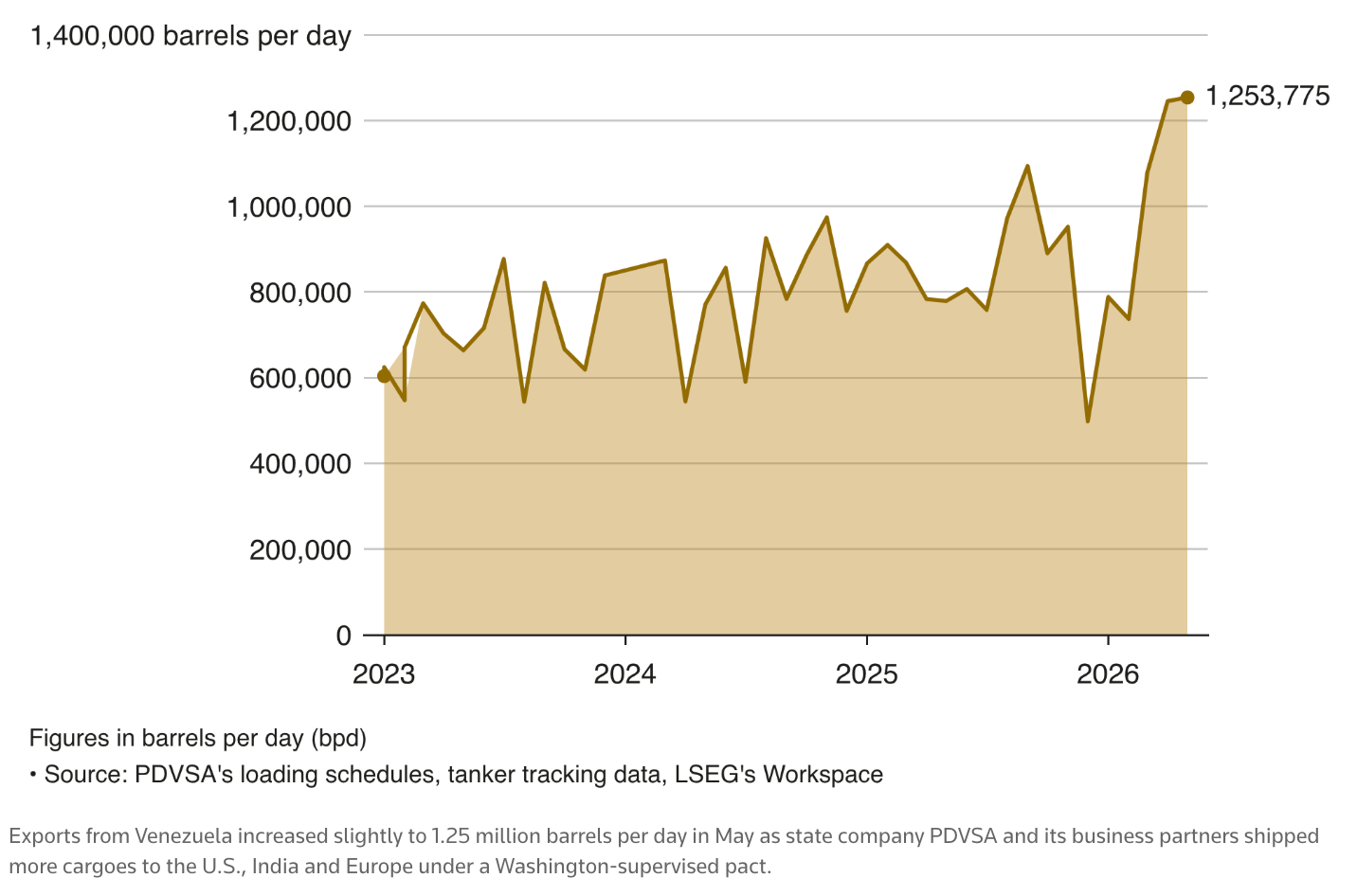
Venezuelan oil exports source link

2. The Global Liquidity Drought and Sovereign Crowding-Out

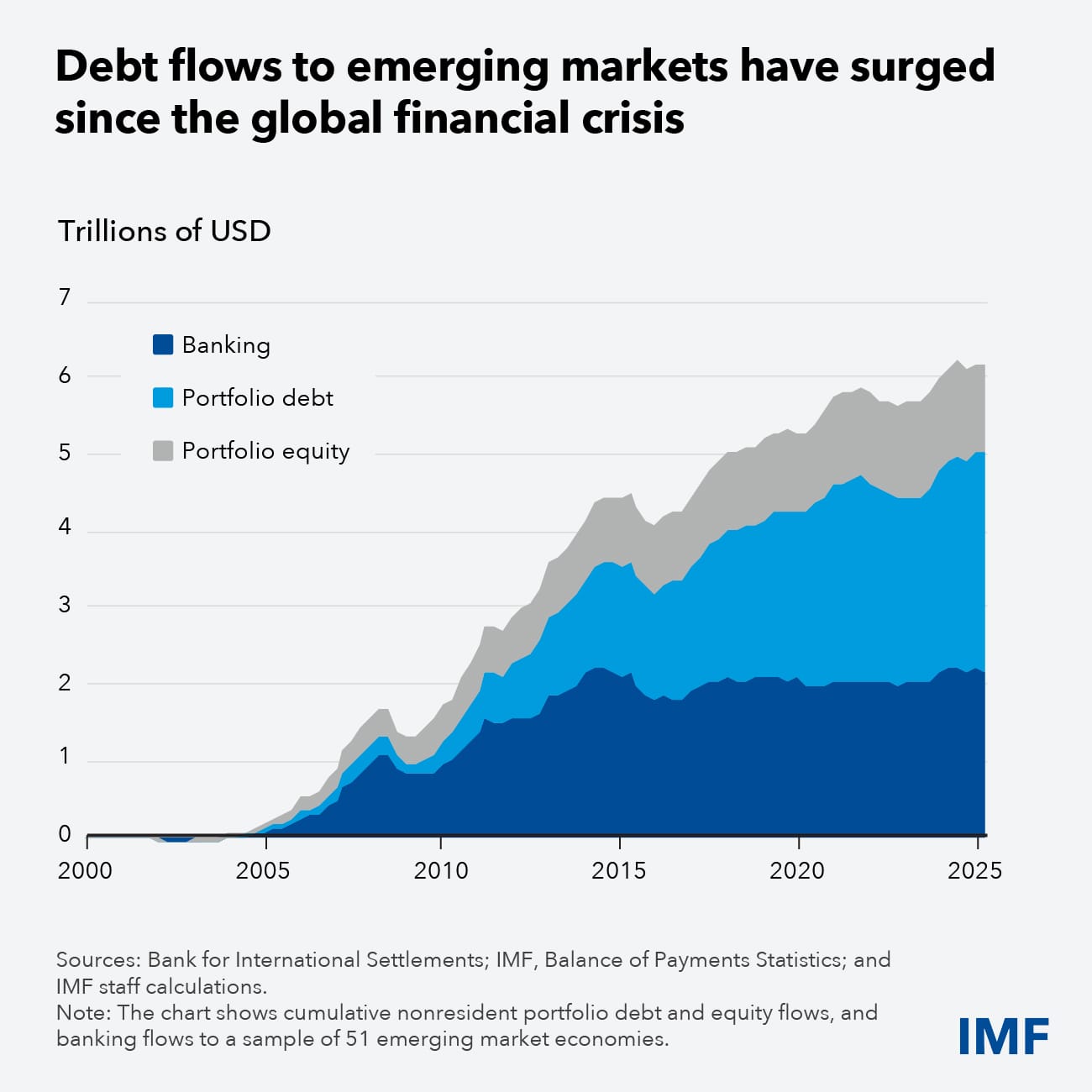
As of July 2026, emerging markets are facing an acute Global Liquidity Drought. Non-bank financial institutions (NBFIs), which hold over 80% of emerging market portfolio debt, are aggressively compressing risk. Confronted with elevated base rates and geopolitical shocks, institutional capital is executing sudden stops across high-yield developing jurisdictions. Simultaneously, Bank for International Settlements (BIS, 2026) locational data confirms that cross-border bank claims in U.S. dollars have stagnated, leaving Latin American sovereign lending paralyzed.

Shut out from international debt capital markets, vulnerable sovereigns are forced to tap domestic banking systems. This Crowding-Out dynamic absorbs local liquidity and denies essential commercial refinancing to industrial sub-contractors. Contrary to retail prediction market assumptions that PDVSA can self-fund via current oil sales, internal cash generation faces total free cash flow cannibalization. Gross export revenues are immediately siphoned off by legacy creditor arbitration claims, multilateral debt service, and basic operational survival, leaving zero net liquidity for capital deployment.
source link

Will Venezuela’s gross oil production return to pre-crisis levels (2M+ barrels/day) before 2028 end?

Yes
100.00%
No
0.00%
1 Polls

3. The Capital Monopoly: Big Tech AI vs. Emerging Market Debt

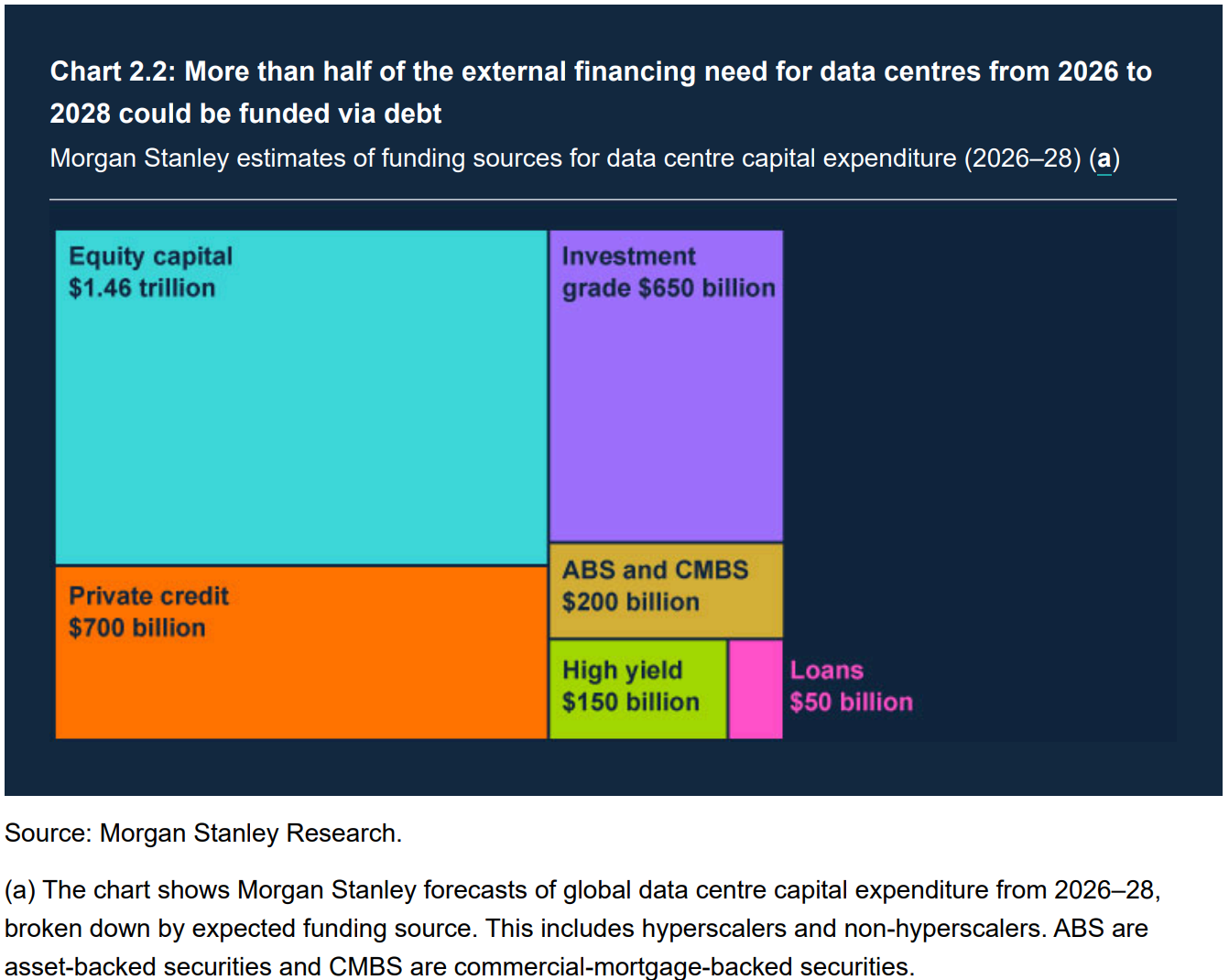
This emerging market refinancing crisis is exacerbated by an unprecedented structural drain: Artificial Intelligence. In its April 2026 Global Financial Stability Report (GFSR, Chapter 2 & Box 1.3), the International Monetary Fund (IMF) explicitly warns that hyperscaler compute infrastructure is monopolizing global debt capacity. The IMF projects AI data center buildouts will absorb $2.9 trillion in CapEx by 2028, siphoning over $800 billion from the private credit market.

By contrast, total private credit allocation across all emerging market infrastructure sits below $100 billion. For institutional asset managers (e.g., BlackRock, Brookfield), capital allocation is dictated by risk-adjusted arbitrage and collateral enforceability. Financing a North American GPU cluster secured by an investment-grade Big Tech balance sheet provides enforceable collateral and guaranteed yields, vastly outperforming the risk profile of an unhedged brownfield project in the Orinoco Belt. AI financial engineering is directly crowding out Latin American infrastructure reconstruction.

(also see our analysis on big tech company Capex & operation dilemma)

On the ground, the V-shaped recovery thesis collides with an immediate two-pronged bottleneck: geological math and legal deadlock.

The most definitive physical barometer is the Baker Hughes Rig Count. Through mid-2026, active drilling rigs in Venezuela have flatlined at 2.00 active units—a 98% collapse compared to the 80 to 100+ rigs deployed in the early 2010s. In mature reservoirs exhibiting a natural decline rate of 15% to 20% annually, operating two rigs guarantees an imminent net production contraction, not a recovery.

Furthermore, the International Energy Agency (IEA OMR, May 2026) highlights a critical diluent bottleneck. Orinoco extra-heavy crude (Merey 16) cannot flow through pipeline networks without being blended with imported naphtha or light condensates. Securing these diluent cargoes requires an immediate upfront cash-burn in hard currency—working capital that PDVSA cannot access.

Finally, the April 2026 legal deadlock surrounding CITGO Petroleum illustrates sovereign insolvency. Encumbered by $20 billion in enforceable creditor judgments and restrained by the U.S. Treasury’s Office of Foreign Assets Control (OFAC), PDVSA is stripped of its primary foreign refining subsidiary, eliminating any capacity to capture international downstream refining margins.

In a global market facing tight capital constraints, where will institutional infrastructure funds prioritize deployment?

Emerging Market Reconstruction (e.g., Venezuela)
0.00%
Developed Market AI Infrastructure (Big Tech)
0.00%
0 Polls

5. What Prediction Markets Are Missing: The Trader’s Checklist

For event contract traders positioning on Kalshi or Polymarket across 2026 and 2027 expiration cycles, capturing alpha requires ignoring political narratives and monitoring macrofinancial plumbing:

  1. J.P. Morgan EMBI (Venezuela Sub-Index): The primary feasibility filter. Until defaulted sovereign debt spreads compress to viable levels, international commercial banks will refuse to underwrite the credit facilities required for pipeline rehabilitation.
  2. IMF GFSR AI Private Credit Volumes: The global liquidity filter. Track Big Tech debt issuance and securitization absorption. The more private credit capacity AI compute consumes, the less liquidity remains available for high-yield Latin American risk.
  3. Baker Hughes Monthly Rig Count: The physical arbiter. If an event contract prices in a surge in gross barrel output over a 12-month horizon but active drilling rigs fail to scale exponentially, the market is structurally mispriced—signaling a high-conviction opportunity to short the contract (Bet NO).

References & Institutional Sources:

  • Baker Hughes. (2026). International Rig Count: Latin America – Venezuela. Baker Hughes Energy Data Hub.
  • Bank for International Settlements (BIS). (2026). International Banking Statistics and Global Liquidity Indicators. BIS Quarterly Review, International Financial Market Developments.
  • Blackmon, D. (2026, April 2). CITGO Sale Twists In The Wind As Treasury Department Stalls. Forbes, Energy & Public Policy Analysis.
  • Fiore, P. (2026, February). Venezuela Case History: Natural Resources, Operational Collapse, and Impact on Global Energy Business. Society of Petroleum Engineers (SPE) / Journal of Petroleum Technology (JPT).
  • International Energy Agency (IEA). (2026, May). Oil Market Report: World Oil Supply – Latin America and Venezuela. IEA Publications, Paris.
  • International Monetary Fund (IMF). (2026, April). Global Financial Stability Report: Global Financial Markets Confront the War in the Middle East and Amplification Risks. Chapter 2: "Capital Flows to Emerging Markets" & Box 1.3: "Required Financing and Securitization for Data Centers".
  • Monaldi, F. (2026, January 26). Without Institutional Change, Venezuela's Oil Bonanza Remains Unviable. Rice University’s Baker Institute for Public Policy / Americas Quarterly.

Global Chokepoint - US Military Launches Strikes on Iran for Second Straight Day
News Flash
Oil & GasGeopoliticsMaritimeGlobal Chokepoint

Global Chokepoint - US Military Launches Strikes on Iran for Second Straight Day

The US military struck Iran for the second straight day, an escalation of violence that threatens efforts to reach a permanent peace deal.

Politics

The US military struck Iran for the second straight day, an escalation of violence that threatens efforts to reach a permanent peace deal.

Will U.S and Iran resume talk before July 13th?

Yes
0.00%
No
100.00%
1 Polls

US Central Command said its forces completed another round of strikes Wednesday “to further degrade” Tehran’s ability to attack commercial shipping in the Strait of Hormuz. About 90 targets were hit, including air defense systems, coastal surveillance assets, and missile and drone storage sites, it said on X.

The Islamic Revolutionary Guard Corps said it had struck US bases in Kuwait and Bahrain and threatened to expand the attacks, according to Press TV. Earlier, parliamentary speaker Mohammad Bagher Ghalibaf issued a warning that “the US still hasn’t learned that bullying and breaking its commitments no longer come without a cost.”

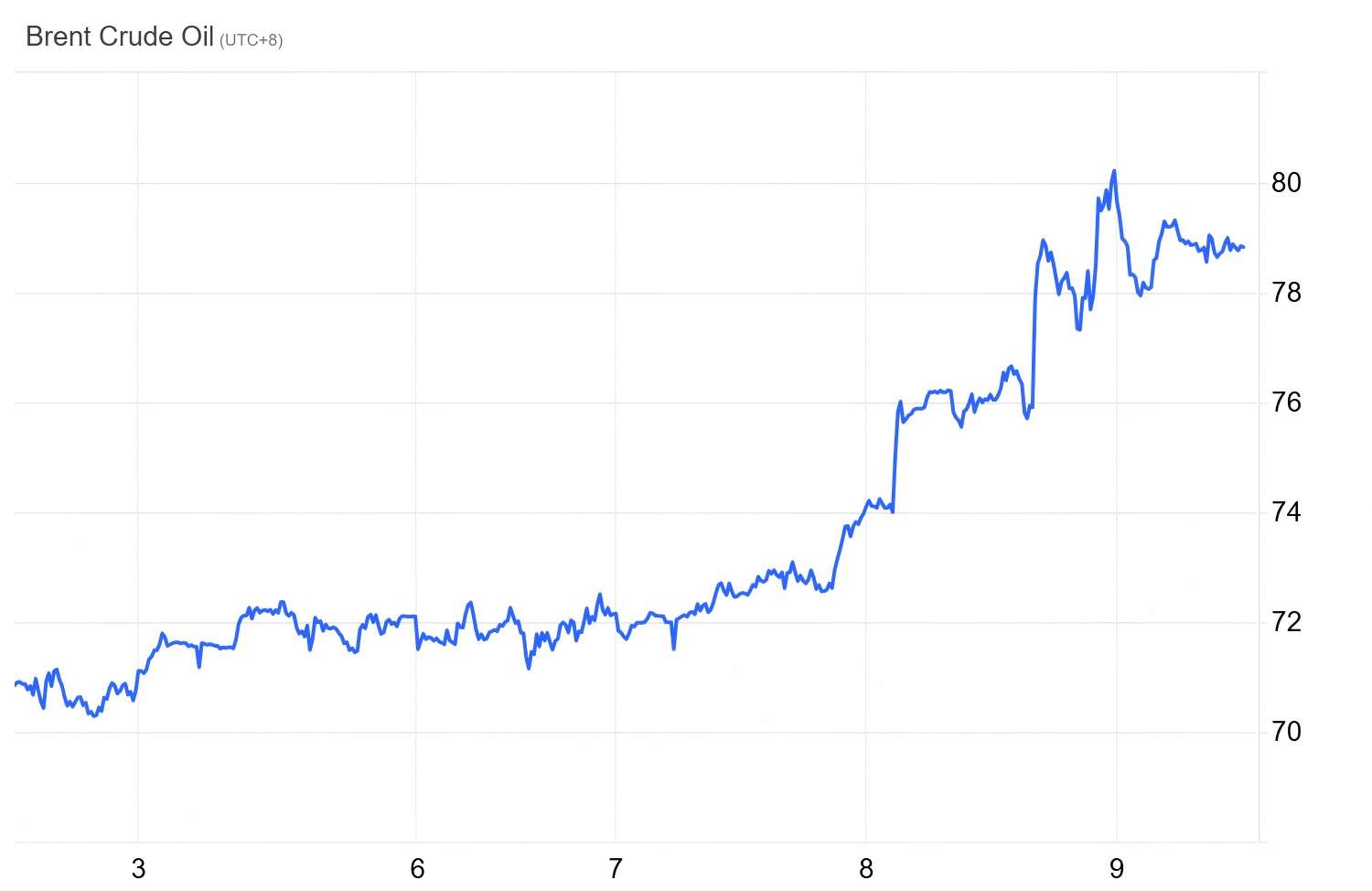
Brent crude rallied for a third day, climbing above $80 a barrel before paring gains as the latest strikes stoked fears the conflict could disrupt shipping through the waterway.

Oil Jumps on US-Iran Jitters, Source: TradingEconomics

Traffic through the Strait of Hormuz came to a near standstill on Thursday. Observable movements in the world’s most vital energy conduit largely occurred along an Iran-approved route nearer to the waterway’s north, while the US-supported Omani corridor was quiet, ship-tracking data show.

Source: https://www.bloomberg.com/news/articles/2026-07-08/us-military-launches-strikes-on-iran-for-second-straight-day

Macro & Micro Compass - Federal Reserve Fed officials were split on direction of interest rates at last meeting, minutes show
News
Central BanksEconomicsInflationInterest RateMacro & Micro Compass

Macro & Micro Compass - Federal Reserve Fed officials were split on direction of interest rates at last meeting, minutes show

Fed policymakers were split on the future of interest rates at their June meeting, with officials offering competing cases for hikes or cuts, according to minutes released Wednesday.

Economics & FinancePolitics

Federal Reserve officials were split last month about the future of interest rates, with policymakers entertaining scenarios in either direction, according to meeting minutes released Wednesday.

In Kevin Warsh's first meeting June 16-17 as chairman of the Federal Open Market Committee, participants saw outcomes where inflation could ease and allow lower rates, while others envisioned a scenario where price increases stay elevated and lead to hikes.

During his post-meeting news conference, Warsh billed the debate as a “family fight” that ended with the committee unanimously voting to keep the Fed’s benchmark funds rate anchored in a range between 3.5%-3.75%, where it has been for all of 2026.

Many participants indicated that the appropriate level of the federal funds rate would be within or slightly below the current target range at the end of this year. Many other participants, however, assessed that the appropriate level of the federal funds rate would be above the current target range at the end of this year.

Participants noted that their future policy actions would depend on incoming information.

Will the Fed keep the federal funds target range at 3.50%-3.75% through the end of 2026?

Yes
39.16%
No
60.84%
309 Polls

Inflation has been on the rise for much of the past year, fueled earlier by President Donald Trump’s tariffs then exacerbated by the Iran war. Economists, though, have been split as to its durability, particularly since energy prices have plunged in recent weeks.

FOMC officials expressed “that inflation would remain elevated in the near term and then begin to decline as the effects of tariffs and energy price increases wane and other supply disruptions related to the closure of the Strait of Hormuz diminish. Participants judged that the risks to the inflation outlook were still tilted to the upside.”

Participants also noted the impact of artificial intelligence, observing that the “ongoing strong demand for AI infrastructure would likely sustain upward pressure on prices for technology products and electricity.” 

The minutes also highlighted a shift in the Fed's communication strategy. “A number of participants noted that it was an opportune time to consider significant changes to the FOMC’s postmeeting statement,” the minutes said. “A majority of participants remarked that they saw advantages in shortening the statement.“

Source: https://www.cnbc.com/2026/07/08/fed-minutes-june-2026-.html

https://www.reuters.com/business/fed-minutes-due-analysts-debate-whether-warsh-will-curtail-them-2026-07-08/?utm_source=chatgpt.com

Global Chokepoint - US Strikes Iran and Blocks Oil Sales in New Test of Truce
Quick Take
Oil & GasEnergyGeopoliticsGlobal ChokepointCommodity

Global Chokepoint - US Strikes Iran and Blocks Oil Sales in New Test of Truce

US President Donald Trump said his tentative ceasefire with Iran is done, raising the prospect of a renewed military conflict between the two countries, bringing fresh volatility to energy markets and tested an already fragile peace agreement between Washington and Tehran.

Economics & FinancePolitics

US President Donald Trump said his tentative ceasefire with Iran is done, raising the prospect of a renewed military conflict between the two countries.

Ceasefire Collapses, Middle East Tensions Escalate

The US carried out a new round of strikes in Iran targeting more than 80 sites and revoked a waiver allowing new sales of its oil, further imperiling a peace agreement after a series of attacks on ships in the Strait of Hormuz.

Both sides accused the other of violating the ceasefire. Three commercial ships were attacked in the Strait of Hormuz over the last day, the most since the agreement went into effect, with the US blaming Iran for the strikes.

Source: Iranian Army

The actions, taken in response to recent attacks, brought fresh volatility to energy markets and tested an already fragile peace agreement between Washington and Tehran.

Oil Surges on Supply Risks & Ripple Effects Across Markets

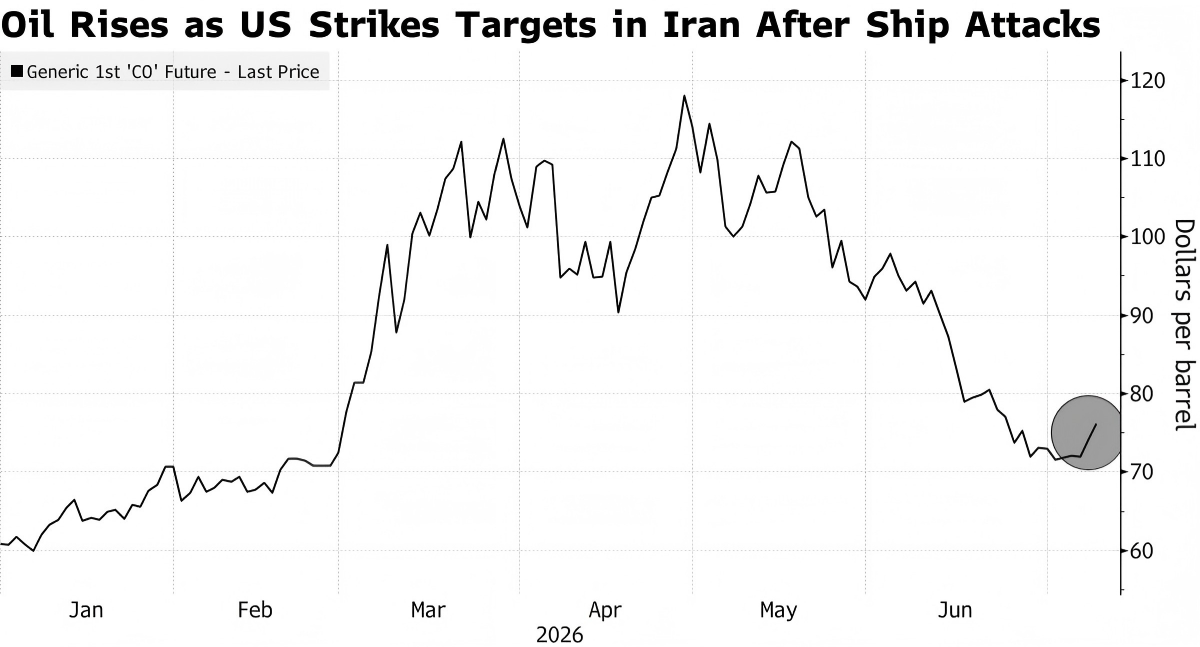
Brent hit the highest level in two weeks, advancing 5.3% to around $78 a barrel.  The rebound, after futures had plunged in the second quarter as regional tensions cooled, could rekindle inflationary concerns in global markets and among policymakers.

Source: Bloomberg

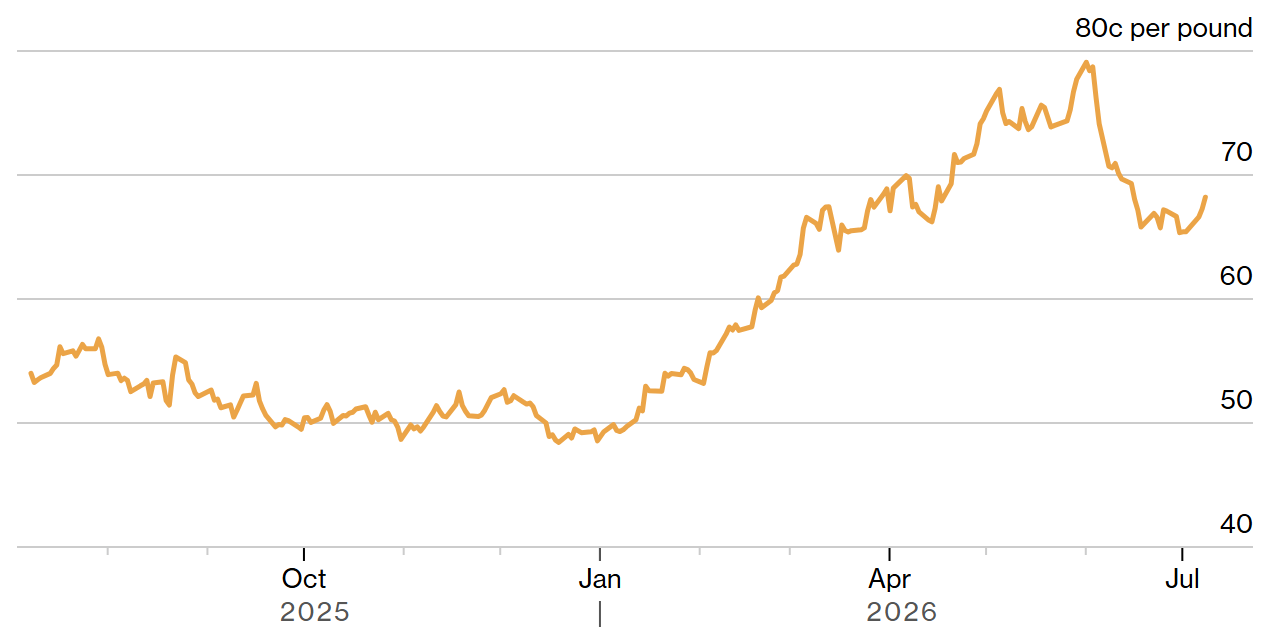
Chicago soybean oil futures climbed to a three-week high after fresh US military strikes on Iran sent crude oil prices higher. As a major biofuel feedstock, soybean oil prices are often tied to movements in crude. When crude oil prices rise, alternatives such as biofuels become more attractive to buyers.

Source: CME Group

Stocks fell after President Donald Trump declared the ceasefire. S&P 500 futures fell 0.8% following the previous session’s selloff in chip stocks. The Stoxx 600 fell 1.5% as crude prices pushed bond yields higher. Treasuries ticked lower and the dollar wavered.

Iranian Oil Sales Face Pressure

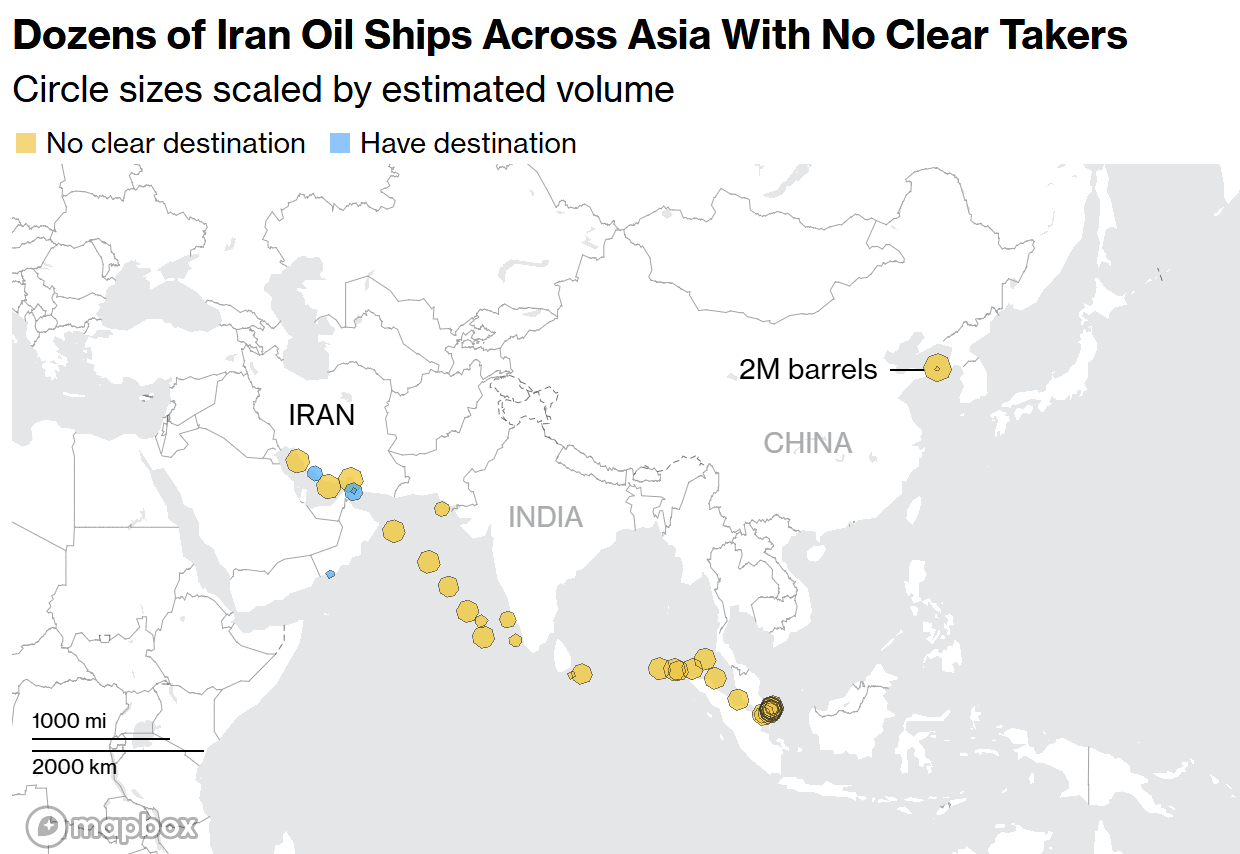
Tens of millions of barrels of Iranian oil already on tankers have been left in limbo after the US walked back a waiver allowing the Islamic Republic to sell the crude.

There are around 63 million barrels of Iranian oil currently on the water, either in transit or idling, according to Bloomberg calculations based on Vortexa data. The crude is on vessels in the Persian Gulf and spread across Asian waters. Most of these ships are not indicating a clear destination or are signaling that they’re available for orders, meaning they haven’t found a buyer.

Source: Bloomberg

Even before the waiver was revoked, Tehran was struggling to sell its oil. That was partly due to a deluge of non-Iranian crude coming out of the Persian Gulf, meaning the barrels were no longer trading at a discount to alternatives, and also because buyers were wary of various risks still involved in the trade.

The trade faced a number of obstacles. European Union and UK restrictions remained in place, complicating insurance, and some ports may not have been willing to allow Iran’s dark-fleet ships to dock. Buyers were also wary of sudden changes in US policy.

There weren’t any recorded purchases of Iranian crude by Asian refiners outside of China since the waiver was issued, the traders said, although some sales may be kept under wraps due to their sensitivity.

One of the few remaining markets for the oil is China’s independent refiners, known as teapots, who were Iran’s main customers prior to the Middle East war. However, it’s likely Tehran would need to offer steep discounts to pique their interest.

Source: https://www.bloomberg.com/news/articles/2026-07-07/us-revokes-waiver-allowing-iran-oil-sales-after-tanker-attacks?srnd=homepage-asia;

https://www.bloomberg.com/news/articles/2026-07-08/iranian-oil-at-sea-left-in-limbo-after-us-revokes-60-day-waiver;

https://www.bloomberg.com/news/articles/2026-07-08/trump-says-us-ceasefire-with-iran-is-over-after-strikes?srnd=homepage-asia

Macro & Micro Compass - The BoE Eased Leverage Rules — But Not With the Gilt Exemption Banks Wanted
Analysis
Central BanksCapital MarketsMonetary PolicyMacro & Micro Compass

Macro & Micro Compass - The BoE Eased Leverage Rules — But Not With the Gilt Exemption Banks Wanted

Economics & FinancePolitics

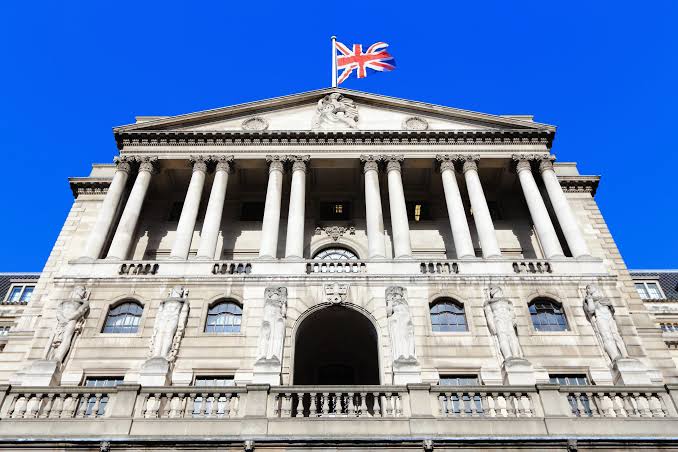
Hours before the Bank of England(BoE) published its July Financial Stability Report, we framed the leverage rule debate around three possible outcomes.

Will the BoE Loosen Bank Leverage Rules to Support the Gilt Market?
The Bank of England(BoE) is going to publish its July Financial Stability Report at 10:30 a.m. (GMT+1) on July 7. There is one issue could have consequences well beyond bank regulation: whether British lenders should be given more room to hold government bonds. The BoE has

The first was a full exemption for gilts from the leverage calculation, which is the most aggressive and market-friendly option. The second was a narrower technical adjustment that would give banks more balance sheet flexibility without dismantling the broader safeguard. The third was no meaningful easing at all.

The Bank has now answered.

The outcome landed closest to option two.

The BoE did move to ease leverage constrains, but not through the full gilt exemption that banks had been discussing before the report. Instead, the Financial Policy Committee and Prudential Regulation Authority plan to consult on a broader redesign of the leverage framework.

What the BoE actually proposed

The package has three main elements.

The Bank plans to remove the Countercyclical Leverage Buffer from leverage requirements; change the calibration of the Additional Leverage Ratio Buffer for systemically important firms; make the framework more releasable during stress. It also proposes reducing the Tier 1 leverage minimum from 3.25% to 3%, while introducing a 25 basis point general leverage buffer. (Page 118 of the report)

Overall, the BoE estimated large UK banks subject to the regime would need to maintain leverage ratios around 20 basis points lower in aggregate, although the impact would vary by bank. Reuters(July 7) noted that the current framework has become binding for three of seven major British banks.

That is easing but it's not the same as removing gilts from the leverage exposure measure.

Before the report, Reuters(July 6) highlighted industry arguments that a gilt exemption could directly expand banks’ capacity to hold UK government debt. Barclays estimated that such a move might enable banks to hold up to £150 billion more in gilts with potentially significant effects on government borrowing costs. Our pre-release News Flash identified that as the most aggressive scenario.

The BoE chose a different route.

Did the BoE go far enough in easing bank leverage rules?

Yes, the 20bp reduction is meaningful
66.67%
No, a gilt exemption was needed
33.33%
It is too early to tell
0.00%
3 Polls

The effect of gilt market is harder to predict now

This is where the subsequent story becomes more interesting than a simple “BoE loosens regulation” headline.

A full gilt exemption will create a relatively direct mechanism: holding more government bonds would no longer expand the relevant leverage exposure measure in the same way, which makes it easier for banks with limited balance sheet capacity to hold more gilts.

But the BoE’s actual plan does not specifically encourage banks to buy more gilts.

The requirement of lower aggregate leverage may still create additional balance sheet capacity. But it does not follow automatically that banks will use that capacity to buy gilts. They could deploy it across lending, market making or other assets instead. That means the large gilt demand estimates discussed before the report should not simply be transferred to the policy package the BoE actually proposed. This is an inference from the difference between the pre gilt exemption scenario and the published reform plan.

In other words, the Bank has loosened the constraint without directly dictating where the newly available capacity goes.

There is also a deeper contradiction inside the report

While easing the leverage pressure on banks, the BoE is also warning of leverage risks in other areas of the financial system.

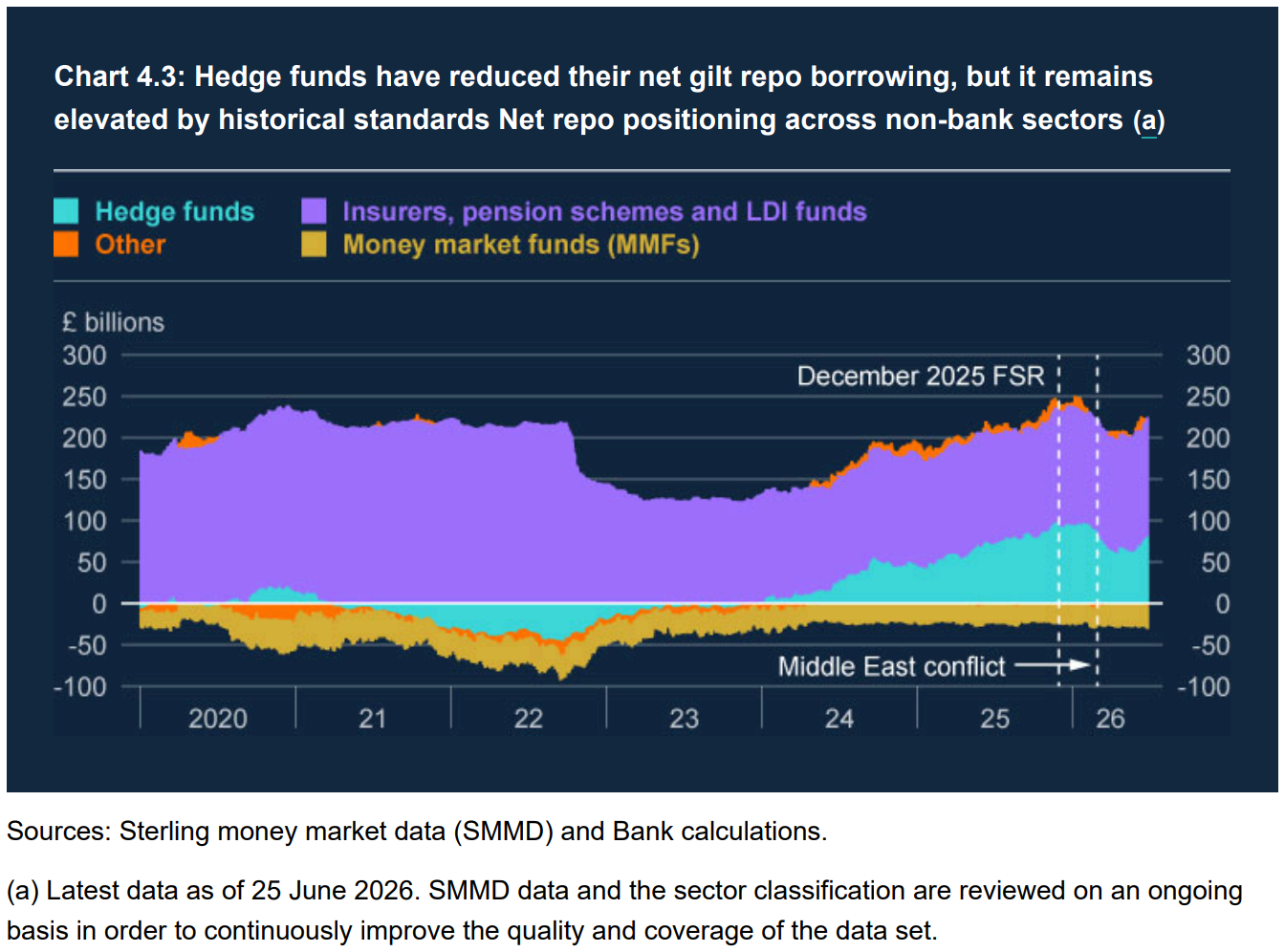
The report says net hedge fund borrowing in the gilt repo market fell roughly 40% from £100 billion by mid-April, but then rose again to around £85 billion from the end of May. The BoE says those positions remain elevated by historical standards and are still heavily associated with leveraged relative value strategies.

That tension did not escape from the notice of policymakers. Reuters(July 7) reported that some FPC members worried the proposed leverage changes could contribute to an unwanted increase in market based leverage, with implications for the resilience of core UK markets.

So the real policy question has changed. Before the report, it was: Will the BoE loosen leverage rules? Now the more important question is: Can the BoE give banks more room to operate without adding to the leverage risks already building in the gilt market?

The Bank itself has not treated that question as settled. It says further analysis will examine whether the proposed reforms create financial stability gaps, including their interaction with gilt repo resilience and market functioning. That work is due to be considered at the FPC’s Q3 meeting, ahead of any potential consultation on this part of the package.

What is the most likely next step in the BoE’s leverage reform?

The current easing policy proceeds largely unchanged
0.00%
Extra safeguards are added after the Q3 review
100.00%
The BoE moves closer to a gilt exemption
0.00%
The reform is delayed or materially weakened
0.00%
1 Polls

The first prediction has now been answered: the BoE was prepared to move.

But it chose the middle path: easing leverage requirements while keeping the broader backstop intact.

The next prediction is harder: whether the BoE’s current plan will remain unchanged once it completes its review of wider gilt market risks.

Source:

  1. Bank of Englan: Financial Stability Report, July, 2026 https://www.bankofengland.co.uk/-/media/boe/files/financial-stability-report/2026/financial-stability-report-july-2026.pdf
  2. Bank of England sets out plan to ease bank leverage rules, July 7, 2026 https://www.reuters.com/business/finance/bank-england-sets-out-plan-ease-bank-leverage-rules-2026-07-07/
Macro & Micro Compass - Can Trump Bend the Fed Before the Data Does?
Analysis
EconomicsInterest RateMacroeconomicsMonetary PolicyMacro & Micro CompassAnecdote

Macro & Micro Compass - Can Trump Bend the Fed Before the Data Does?

PoliticsEconomics & Finance

The next fight over the Federal Reserve is no longer just about inflation, jobs, or the timing of the next rate move. It is also becoming a test of how much political pressure markets believe the Fed can absorb.

Will Trump materially reshape the Fed before his current term?

Yes, he is definitely a tough guy
61.54%
No, it's much more difficult than it looks.
30.77%
Only partially
0.00%
Too early too tell
7.69%
13 Polls

Bloomberg(July 3) reported that President Donald Trump’s allies are renewing efforts to reshape the Federal Reserve, including ways to exert more pressure on the institution rather than just fire top officials in Washington. The report lands at a sensitive moment: the June employment report weakened the case for another near-term rate hike, while inflation remains high enough to keep the Fed away from a smoothly rate cutting.

June Jobs Miss: How Will It Affect the Interest Rate Cycle?
The June jobs report gave markets a softer labor signal than the headline unemployment rate suggests.

That makes the political perspective relevant to the market. Thus the rate cycle can be read in two different interpretations.

From economic angle, the Fed should wait for more data. Hiring has slowed sharply, labor-force participation has fallen, and the June payroll miss weakened the argument for another immediate hike. But inflation remains high enough to complicate any rapid turn toward easing.

From political angle, Trump has repeatedly pushed for lower interest rates, while the latest Bloomberg report suggests his allies are continuing to explore ways to reshape the institution. More recently, Trump publicly criticized the Fed board as “a little bit hostile,” underscoring that pressure on monetary policy has not disappeared under the new leadership.

The institutional problem for any president is that the Fed is not designed to be easy to control.

The Board of Governors has seven members nominated by the president and confirmed by the Senate. Governors serve staggered 14-year terms, while the chair and vice chairs serve separate four-year leadership terms. 

Interest rate policy is also broader than the chair alone. The Federal Open Market Committee (FOMC) includes the members of the Board of Governors, the president of the New York Fed, and four other regional Reserve Bank presidents who vote on a rotating basis.

Regional Fed presidents add another layer of insulation. They are not directly appointed by the White House, they are selected through their respective Reserve Banks and require approval from the Board of Governors. 

That means Trump’s influence is real, but constrained. A president can nominate governors when vacancies arise and select the Fed chair from among sitting governors, but the structure of the system makes a rapid takeover difficult. The policy setting process is deliberately distributed across long serving governors and regional institutions.

The Supreme Court has made that boundary even more important.

In one landmark decision, the Court expanded presidential authority to remove leaders of other federal regulatory agencies, strengthening the legal theory of a more powerful “unitary executive.” But the Court also preserved a distinct boundary around the Federal Reserve and separately refused to let Trump remove Governor Lisa Cook while her case proceeds.

So it is to hasty to say Trump controls the Fed. More suitable is that he is testing the boundaries of Fed independence.

 If investors believe monetary policy remains primarily data driven, then payroll momentum, inflation, labor force participation, and upcoming CPI reports should dominate the rate cycle debate.

But if investors begin to believe political pressure can alter the Fed’s reaction function, a different risk enters the market. Traders would no longer be pricing only where inflation and unemployment are heading. They would also have to judge whether the central bank will respond to those indicators in the same way as in the past.

For now, Fed Chair Kevin Warsh is publicly pushing back against concerns over political influence. Speaking at the ECB’s central-banking forum in Sintra, Warsh said the Fed would remain independent and reaffirmed its commitment to price stability and the 2% inflation objective. He also avoided providing clear forward guidance on future rate decisions. 

However, Trump continued to exert pressure in public. After the June jobs report, he described the Fed board as “a little bit hostile” and said Warsh “has to do what he has to do” on interest rates. 

What will matter more for the Fed’s next major rate move?

Economic datas
25.00%
Trump’s political pressure
25.00%
Just Fed's personal decision
25.00%
A combination of these three
25.00%
4 Polls

According to all of these, there are two competing explanations for the next move in rates.

The first is the economic explanation: softer payrolls, falling labor force participation, persistent inflation, and the next CPI report will determine whether the Fed will suspend, hike, or eventually turn toward decrease.

The second is the political explanation: Trump may not need to formally control the Fed to become a market variable. Persistent pressure can affect expectations around future appointments, institutional governance, and how investors perceive the durability of central bank independence.

Is the U.S. rate cycle still being driven mainly by economic fundamentals, or is Trump’s political leverage becoming a market variable in its own right?

Source:

  1. Trump Allies Double Down on Efforts to Reshape Federal Reserve, July 2, 2026 https://www.bloomberg.com/news/articles/2026-07-02/trump-allies-double-down-on-efforts-to-reshape-federal-reserve?srnd=homepage-asia
  2. US job growth slows sharply in June; labor force participation rate at more than 5-year low, July 2, 2026 https://www.reuters.com/world/us/us-job-growth-misses-expectations-june-unemployment-rate-falls-42-2026-07-02/
  3. Supreme Court strengthens Trump's hold on key levers of government power, June 30, 2026 https://www.reuters.com/legal/government/supreme-court-strengthens-trumps-hold-key-levers-government-power-2026-06-30/
  4. Trump blasts ‘hostile’ Fed and says Warsh ‘has to do what he has to do’ on interest rates, July 2, 2026 https://www.marketwatch.com/story/trump-blasts-hostile-fed-and-says-warsh-has-to-do-what-he-has-to-do-on-interest-rates-60b5d16b
  5. Federal Reserve Chair Warsh emphasizes political independence, signals focus on inflation, July 1, 2026 https://apnews.com/article/warsh-federal-reserve-inflation-interest-rate-18c005515444abd2043ad113c9849407
Rules & Mandates - Avoids Trump's July 4 Tariff Deadline: Why "De-Escalation" Is the Wrong Read
Analysis
EconomicsCommodityGeopoliticsRules & Mandates

Rules & Mandates - Avoids Trump's July 4 Tariff Deadline: Why "De-Escalation" Is the Wrong Read

A look at what the EU-US tariff deal actually locks in, why markets are reading it as de-escalation, and why the underlying trade risk hasn't gone away for the companies caught in the middle.

Economics & FinancePolitics

The EU beat the clock. On June 25, the Council of the EU formally adopted the regulations implementing its tariff commitments under the EU-US trade agreement, and as of July 1, the bloc has eliminated remaining duties on US industrial goods and opened preferential access for a range of US agricultural and seafood products.

The headline read is relief: deadline avoided, tariffs down, transatlantic trade stabilized.

But now the question is whether "de-escalation" is the right word for a deal that only exists because of a threat, is still full of trapdoors, and leaves the sector most likely to derail it, steel and aluminum, still bleeding.

Do you think the EU-US tariff deal is genuine de-escalation or a fragile truce?

Genuine de-escalation, the risk is largely resolved
20.00%
A fragile truce; the risk just moved, not disappeared
20.00%
Too early to tell
60.00%
5 Polls

Why the de-escalation read makes sense

Tariffs on US industrial goods are eliminated outright, and the European Commission estimates the change saves EU importers and consumers around €5 billion a year. Both sides describe it as a multi-year framework running through 2029, with a built-in review before it expires.

But the whole point of the July 4 deadline was to pressure the EU into implementing what had already been negotiated the previous August.

When Trump warned tariffs would jump to much higher levels if the EU did not act, the EU acted. This is not pure de-escalation; it is coercive leverage working as Washington intended.

Here's where the risk case gets stronger

The de-escalation read leans on treating "deal signed" as "risk resolved." But the deal's own text argues otherwise.

The agreement keeps a 15% all-inclusive tariff cap, but it also gives the European Commission explicit power to suspend tariff preferences if US tariffs on steel and aluminum derivative products stay above that cap past set checkpoints, with a Commission report due to Parliament and Council by December 1, 2026. Layered on top of that is a separate safeguard mechanism letting Brussels investigate and counter import surges that threaten serious harm to EU industry or agriculture.

Neither of those provisions is decorative, and neither is hypothetical. EU steel is still paying the full 50% US tariff, deal or no deal, because steel and aluminum were carved out of the 15% cap from the start.

Eurofer, the EU steel industry association, has published the damage: EU steel exports to the US fell 34% in the three quarters after the tariff hike to 50%, from 2.93 million tonnes to 1.94 million tonnes, and the industry has said plainly that the trade agreement is worth nothing for steel producers until this is actually fixed. It is a cost being paid today, while the "de-escalation" headline runs.

Brussels is not just waiting on Washington here, either. The EU brought in its own new steel safeguard on July 1, a tariff-free quota capped at 18.3 million tonnes a year with a 50% duty above it, applied to all trading partners.

This follows the EU's October 2025 move toward a replacement steel safeguard, aimed at preventing diverted steel from flooding Europe as US tariffs redirected trade flows. In other words, it's one side's tariffs generating spillover that the other side has had to build new defenses against.

Why this matters more for companies than for headlines

The first reason is that preferential access is not the same as permanent access, and the suspension clause doesn't stop at the disputed products. Duty-free treatment on US industrial goods and preferential terms on farm and seafood products are conditioned on a mechanism the EU can suspend, and this mechanism reaches across the broader preference package, not just steel and aluminum.

Companies budgeting multi-year input costs around July 1 pricing, or firms in the "safe" industrial lane who assume this doesn't touch them, are underwriting a policy that can change over a dispute in a completely different sector.

The second is timing. Capex decisions with multi-year payback windows now depend on two separate clocks: whether Washington resolves the metals dispute before the end-2026 checkpoint, how the Comission frames the issue in its December 1, 2026 report, and whether an EU industry group successfully invokes the safeguard clause before then. Either one moving can change the cost basis a multi-year investment was built on.

What to watch next: Three triggers to keep an eye on

The steel and aluminum clock. Watch whether US tariffs on the affected steel and aluminum derivatives come down to 15% or below before the deal's end-of-2026 checkpoint. Right now they're still at 50%, which is expected under the deal as written, but if that hasn't changed by the deadline, the EU gains a suspension option it doesn't currently have.

Next, watch whether the safeguard mechanism is actually invoked over an agricultural import surge. The mechanism existing does not prove fragility on its own, but the first attempt to use it will.

Finally, watch whether industry pushback spreads beyond steel. Eurofer has already gone on record saying the deal is worth nothing for steel producers until the tariff issue is fixed, so the real signal is whether farm groups or other sectors start making the same complaint.

The better way to read this deal

At first glance, this looks like a story about a deadline getting cleared. This is only the surface-level read.

What is actually being priced is whether “signed” means “settled.” The agreement's own design with conditional caps, suspension triggers, and an unresolved metals dispute parked on a calendar is itself evidence that both governments expect to renegotiate risk, not that risk is gone.

The de-escalation read says the truce holds. The better read says the truce has a built-in test at the end of 2026, and right now nothing suggests steel and aluminum are on track to pass it.

Which of these would most change your read on this deal?

US steel/aluminum tariffs actually coming down before the end-of-2026 checkpoint
100.00%
The EU invoking its safeguard clause over an ag import surge
0.00%
Industry pushback spreading beyond steel to other sectors
0.00%
Nothing, I think this settles either way
0.00%
1 Polls

Sources:

  1. APNews: EU issues new steel and e-commerce regulations to reduce trade imbalance with China
  2. CNBC: Tariffs: Trump threatens EU if no trade deal is signed by new deadline
  3. European Commission: The EU-US trade deal: Restoring stability and predictability
  4. Iowa Farm Bureau: U.S. farm exports gain ground in new EU trade deal
  5. Lexology: EU: Update on the EU-US Tariff Agreement
  6. NBC News: E.U. hits the brakes on U.S. trade deal after Trump threatens 15% global tariffs
  7. Sullivan & Cromwell: EU Implements Tariff Commitments Under the EU-U.S. Trade Deal
  8. The Express Tribune: European Parliament approves long-delayed EU-US trade agreement
Market Rumor - OpenAI proposes handing Trump administration 5% stake
News
Capital MarketsAI Infrastructure

Market Rumor - OpenAI proposes handing Trump administration 5% stake

According to FT, Sam Altman’s start-up in early talks for a public ownership deal as political pressure rises.

Economics & FinanceTechPolitics

Will OpenAI Actually Handing Stake to Trump Administration / the Gov?

Yes
25.00%
No
75.00%
4 Polls

Will Anthropic Follows Suit (after OpenAI) to Hand Stake to the Gov?

Yes
100.00%
No
0.00%
2 Polls

According to FT, OpenAI has held discussions regarding the possibility of granting a 5 percent equity stake to the US government. The $852 billion artificial intelligence startup is attempting to clear political hurdles by obtaining financial investment from the Trump administration.

Based on the soruce, two individuals acquainted with the matter, Sam Altman, the chief executive of the ChatGPT creator, has contended that providing the public with a financial interest in the company represents the optimal method for sharing the benefits of AI. He has proposed a stake of this magnitude during preliminary talks with the administration.

The envisioned structure would require other American AI firms to surrender an equivalent percentage, though it remains uncertain whether competing labs would agree to the terms.

Providing the government with an equity position could assist in establishing favorable relations with the administration. This move represents an effort to mitigate political backlash by distributing the wealth created by AI to the general population.

AI developers have encountered a progressively difficult climate in Washington as both American politicians and the public voice growing anxieties regarding extensive data center development, cyber security risks, and the technology's impact on employment.

Both OpenAI and its primary competitor, Anthropic, have recently experienced delays in launching their latest cutting-edge models due to US scrutiny. Furthermore, certain Republicans and advisers to President Donald Trump are advocating for significantly stricter regulations across the industry.

Both rivals are concurrently getting ready for public listings, which would broaden their shareholder bases and produce substantial returns for existing investors, though OpenAI's initial public offering might not occur until next year.

Altman and other OpenAI leadership have proposed that each of the top AI developers in the United States allocate 5 percent of their equity toward an entity modeled after the Alaska Permanent Fund—a sovereign fund that reinvests the state's oil revenues into equities and distributes dividends to residents and the state government.

The targeted firms could encompass Anthropic, alongside Google, Meta, and others, though it is uncertain if any of these entities would consent to OpenAI's plan.

Following public criticism of Intel's chief, Trump shifted his stance to support the US chipmaker after the federal government acquired a 10 percent stake.

The sources noted that these "conceptual" discussions between OpenAI and the government are in their infancy, and implementing any such agreement would likely necessitate an act of Congress. Nonetheless, the negotiations highlight a potential framework for dispersing the financial profits generated by the technology.

Altman has maintained active dialogues concerning public ownership with administration figures, including Trump, Treasury Secretary Scott Bessent, and Commerce Secretary Howard Lutnick, according to several people familiar with the situation.

Additionally, the OpenAI chief executive has conversed with Democratic Senator Bernie Sanders in recent weeks. Sanders has advocated for public ownership closer to 50 percent of each American AI corporation through a sovereign wealth fund.

In past economic policy recommendations, both OpenAI and Anthropic have implied that structures like sovereign or public wealth funds might eventually be necessary to allocate shares to citizens.

In April, OpenAI put forward a proposal for a "public wealth fund" designed to offer every citizen, including individuals who do not participate in financial markets, an equity stake in AI-fueled economic expansion.

In May, the company's non-profit division, the OpenAI Foundation, stated that an AI-driven future would likely require fresh strategies to provide individuals with lasting ownership in the value-generating systems, explicitly highlighting public or sovereign wealth funds.

The foundation noted in a blog post that the objective extends beyond merely supporting citizens through economic transitions after choices are finalized; it aims to provide them with a stake and a voice in directing how that evolution takes place.

OpenAI chose not to comment on the matter, and the White House did not instantly reply to a request for comment.

Source: 1. The Financial Times; OpenAI proposes handing Trump administration 5% stake; July 2, 2026: https://www.ft.com/content/7c803eab-8e80-4431-9a87-e943bf00e00b?syn-25a6b1a6=1

Breaking News - Micron Announces $250 Million Investment in Trump Accounts Reaching 1 Million Children, Families and the Future Workforce
News
Capital MarketsSemiconductorAI Infrastructure Semi News

Breaking News - Micron Announces $250 Million Investment in Trump Accounts Reaching 1 Million Children, Families and the Future Workforce

Company launches employee matching and community seed funding, reinforcing Micron’s broader U.S. investment and workforce development strategy

Politics

Will More Tech Leads Follow Micron to Support Trump Accounts?

Yes
75.00%
No
25.00%
4 Polls

Will Micron's Stock Price Ever Hit Above US$1,500 on or before 4Q2026 Results?

Yes
100.00%
No
0.00%
2 Polls

According to Micron's press release:

WASHINGTON, June 30, 2026 (GLOBE NEWSWIRE) -- In honor of America’s 250th anniversary, Micron Technology, Inc. (Nasdaq: MU) today announced a $250 million investment to increase long-term savings opportunities for children and families through Trump Accounts (also known as 530A Accounts).

As part of this initiative, the company is launching an employee matching benefit for contributions up to $1,000 per child under 18. Additionally, Micron will provide a community benefit of a one-time $250 seed deposit for children with Trump Accounts where Micron operates in Idaho, New York, Virginia, California, Colorado, Minnesota and Texas.

Micron’s investment is the largest corporate commitment of its kind and is expected to support up to one million children. Most of the funding will benefit children and families in communities where Micron operates, expanding long-term financial opportunities for the next generation.

The program complements Micron’s previously announced investment of over $200 billion in U.S. memory manufacturing and R&D, creating over 90,000 U.S. jobs. Together, these investments reflect Micron’s sustained commitment to strengthening the nation’s semiconductor ecosystem and the workforce that supports it.

“At Micron, we believe investing in people is as important as investing in technology,” said Sanjay Mehrotra, Micron Chairman, President and CEO. “As America celebrates its 250th anniversary, this investment is about helping children build a strong foundation for future opportunity while supporting the workforce and communities that will shape U.S. semiconductor leadership. We appreciate President Trump and Secretary Bessent for establishing these accounts, which give Micron another meaningful way to support children and families as they plan for the future.”

“Trump Accounts are a transformative policy initiative that will help unlock the American Dream for millions of children. It is encouraging to see our nation's leading companies, including Micron, supporting this effort by stepping up to help children in the communities and offering matching contributions for their employees,” said U.S. Treasury Secretary Scott Bessent. “Thanks to President Trump's leadership, momentum continues to build as more companies and institutions participate, helping the next generation of Americans become shareholders in the world's most vibrant capital markets.”

“I applaud Micron for this powerful commitment to Trump Accounts,” said Michael Dell, Chairman and CEO, Dell Technologies. “Micron and Dell have long enjoyed a strong business partnership, and through this initiative, we are also coming together to support children, create long-term economic opportunity and invest in America’s future.”

“Micron’s massive investment in their people and communities reflects their tremendous values and love of country and will serve as a blueprint for companies all over America,” said Brad Gerstner, Founder and Chairman of Invest America. “This is not an abstract investment — these are meaningful dollars directly into the private Trump Accounts of nearly one million kids. Trump Accounts have unlocked a transformative new type of corporate philanthropy that reconnects every child to the American Dream by making them a direct shareholder in our great American companies. We hope every company, small, medium and large, will follow their lead at any level of support.”

In addition to this initiative, Micron is investing hundreds of millions of dollars across the U.S to expand access to semiconductor careers through K-12 STEM education, semiconductor curriculum development, AI education, community college and university partnerships, registered apprenticeships and other workforce programs.

Trump Accounts are invested in eligible low-fee U.S. index funds, providing broad market exposure and the long-term benefits of compounding. Families can learn more and open an account at https://trumpaccounts.gov/. More information about how residents of eligible counties can qualify for Micron’s seed funding will be available at https://micron.com/communityinvestment. ​ 

Source: 1. Micron's Press Release. June 30, 2026 (US Time); https://investors.micron.com/news-releases/news-release-details/micron-announces-250-million-investment-trump-accounts-reaching

In Japan, A New Type of Prediction Market is Taking Advantages of the Loophole in Gambling Regulations
News
LegalPrediction MarketRegulatory

In Japan, A New Type of Prediction Market is Taking Advantages of the Loophole in Gambling Regulations

PoliticsEconomics & Finance

From the rapidly developing point based prediction applications in Japan, we can see the demand for event forecasting is spreading into Asia. The business model is rely on the loyalty points, regulatory arbitrage and advertising, which differs from the trading fee as commonly known.

Will Japan formally regulate prediction markets before 2028?

Yes
66.67%
No
33.33%
6 Polls

Prediction markets are usually discussed as a financial innovation: traders price future events; markets aggregate information; platforms earn from liquidity, spreads or transaction activity. Japan is testing a different version that is suitable for local people, but the core idea remains the same.

Jun 29 (Bloomberg), In Japan, local APPs such as Miraima allow users to predict real world outcomes, including sports results, political events, stock moves, and entertainment outcomes without staking cash or crypto. Instead they can redeem virtual points for gift cards or third-party reward points such as Amazon or Paypal after successful prediction. Miraima launched only months ago, has reportedly approached one million monthly users, helped by sports events and political interest.

The core demand is clearly there: people want to express views on public events, compete with others and be rewarded when they are right. 

Differ from Polymarket or Kalshi, Miraima's business model is more like a combination of prediction market, mobile game, and loyalty points platform. Users are not necessarily trading against a live order book. They are engaging with an app, watching ads, completing tasks, and returning for repeated prediction games. Miraima’s founder says the company is already profitable through fees generated when users watch advertising videos or download apps. But compared with overseas prediction platforms who can monetize transaction and settlement fees, the margin profit of Miraima is till thin.

This distinction matters. Because if the U.S. version of prediction markets is trying to become a regulated financial exchange worldwide, the Japanese version is first becoming an attention business. Due to Japan already has a large loyalty-points economy that can absorb prediction style products and won't looks like a cash gambling immediately. April 2026 (Nomura Research Institute) Private-sector point and mileage issuance by major companies across 12 domestic industries reached ¥1.3695 trillion in FY2024, up about 6% from the previous year, and forecast issuance would grow to ¥1.7257 trillion by FY2029. Cashless payments were the largest catalyst accounting for about 53% of private-sector issuance. This helps explain why a point based prediction app can feel native to Japanese consumer behavior rather than like an imported gambling product.

The regulatory system in Japan is the main reason why using points. The Penal Code broadly prohibits gambling for both ordinary and habitual gambling.This makes real-money prediction markets difficult to operate. Bloomberg also cites Japan Exchange Group CEO Hiromi Yamaji saying that cash based prediction markets would face not only gambling law issues but also difficult questions around insider trading and market manipulation.

Therefore using points, gift cards and shopping rewards instead of cash or crypto, is the best way to stay outside. But the structure is not risk free: Japan’s National Police Agency warns that online gambling can still be illegal even when accessed through overseas or “free bonus point” formats. This shows the regulators will be more cautious when a product looks like wagering.

Point-based prediction APPs are more like financial information markets or gambling products?

Mostly financial information just with rewards
50.00%
Mostly gambling as users enjoy the feeling of betting
0.00%
Depends on whether rewards are cash-equivalent
0.00%
A separate loyalty-gaming category
50.00%
2 Polls

The unresolved question is whether Japan will treat these APPs like harmless loyalty games, a new form of gambling, or something closer to financial information markets. Bloomberg reports that lawyers see possible scrutiny under lottery related rules, especially because some Japanese point based services currently do not impose age limits while Polymarket and Kalshi restrict users to 18 and older.

For investors or founders who want to get involved in prediction markets especially in Asia market, have to notice there is no single regulatory path. India and Indonesia has already blocked Polymarket as online gambling platform; while South Korea has officially launched an investigation into whether Polymarket involves online gambling.

The U.S. path looks different, CFTC records list Kalshi as a designated contract market and also show several newer prediction market or event contract related exchange registrations and pending applications, which means American market is moving through financial market infrastructure rather than consumer gaming infrastructure.

The market signal is bullish: nearly one million monthly users for a young prediction APP suggests that event forecasting can become a mass market behavior outside the U.S.

The business-model signal is more mixed: if monetization depends mainly on ads and APP download incentives, these platforms may scale engagement faster than revenue.

The regulatory signal is the most important: once prediction markets become visible enough, Japan will have to decide whether to regulate them, ban them or formally separate “forecasting as information” from “betting as gambling.”

For now, Japan’s point based prediction market is not the Asian version of Polymarket. It is something more local and maybe more revealing: a prediction market disguised as a loyalty points APP. Growing rapidly because users want to bet on the future even when the law does not yet know what to call it.

Prefer a prediction market only contains macro information for trading OR with gamified content?

Be professional and full of trading context
50.00%
Have to be gamified otherwise it is too boring
0.00%
Better find a balance because I am a newer who needs interests first
50.00%
2 Polls

Source:


1. ポイ活型の予測市場が日本で台頭-賭博規制の隙間突く新サービス、月間100万人突破も ("Point-based" prediction markets are on the rise in Japan—new services exploiting loopholes in gambling regulations are even surpassing one million monthly users), June 29, 2026 https://www.bloomberg.com/jp/news/features/2026-06-29/THDEWIKIUPS700#gsc.tab=0

  1. 野村総合研究所、2029年度のポイント・マイレージ年間発行額は約1.7兆円に拡大すると予測 (Nomura Research Institute forecasts that the annual issuance value of loyalty points and mileage will expand to approximately 1.7 trillion yen in fiscal year 2029), April 21, 2026 https://www.nri.com/jp/news/newsrelease/20260421_1.html
  2. オンラインカジノを利用した賭博は犯罪です!(Gambling using online casinos is a crime!) https://www.npa.go.jp/bureau/safetylife/hoan/onlinecasino/onlinecasino.html
Macro & Micro Compass - June NFP Report: Stability Is Priced In, But Is It Fully Supported by the Data?
News
EconomicsLabor MarketMacro & Micro CompassMacroeconomics

Macro & Micro Compass - June NFP Report: Stability Is Priced In, But Is It Fully Supported by the Data?

Markets are pricing June NFP around 100,000-150,000 jobs, reflecting economist forecasts and recent labor data, as attention turns to how incoming prints align with current expectations.

Economics & FinancePolitics

This week’s Nonfarm Payrolls report lands on Thursday, July 2, at 8:30 a.m. ET, according to the US Bureau of Labor Statistics (BLS), one day earlier than usual because US markets are closed Friday for Independence Day.

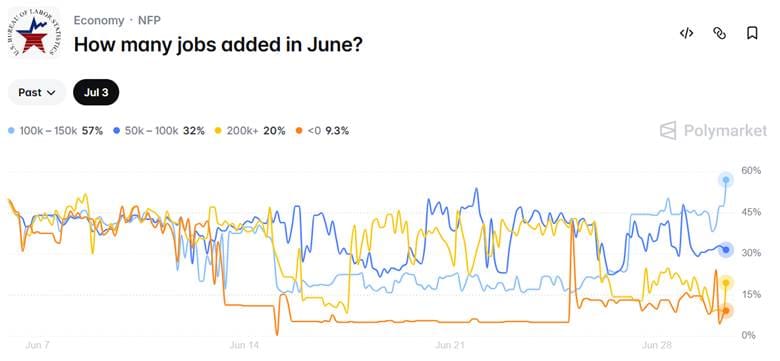
Polymarket is currently pricing the July 2 U.S. Nonfarm Payrolls release with a huge tilt toward 100k-150k jobs added, just below 60%, but the upside tail is not negligible.

This is consistent with economists' forecasts. According to a Reuters poll, economists are clustered around 110,000 jobs added in June, down from May’s 172,000 gain. Unemployment is expected to hold near 4.3%, while wage growth is expected to stay around 0.3% month over month.

But what if the market is overconfident in the stability of the 100k-150k range because it is anchoring on lagged, revised, and smoothing labor indicators?

What do you think the market is underestimating the most?

Downside risk from weakening hiring momentum
25.00%
Strength in labor market resilience (hot upside surprise risk)
25.00%
No major mispricing, consensus is fair
25.00%
Mixed signals dominate
25.00%
4 Polls

May made the bar harder to clear

The reason this week’s report is more interesting than the consensus number suggests is May.

Economists expected only 85,000 jobs last month. The actual number came in at 172,000. March and April were also revised higher by a combined 93,000 jobs. A few weeks ago, the concern was that hiring had become too soft. After May, the cleaner question is whether the slowdown thesis got too much credit too early.

Still, the devil is in the details because May was not a perfectly broad-based boom. Leisure and hospitality added 70,000 jobs, local government added 55,000, and health care added 35,000. Financial activities lost 22,000 jobs. This shows an uneven labor market holding headline strength.

Another report above 150,000 would make May look less like a one-off. A number below 100,000 would bring back the idea that the labor market’s surface strength is hiding weaker hiring underneath.

But is headline NFP a clean signal?

Everything in the pricing depends on this: headline payrolls accurately reflect underlying labor momentum.

But NFP is not a direct measure, it’s a modelled survey estimate that makes it vulnerable. The current consensus stability relies heavily on data that has already been revised multiple times this year.

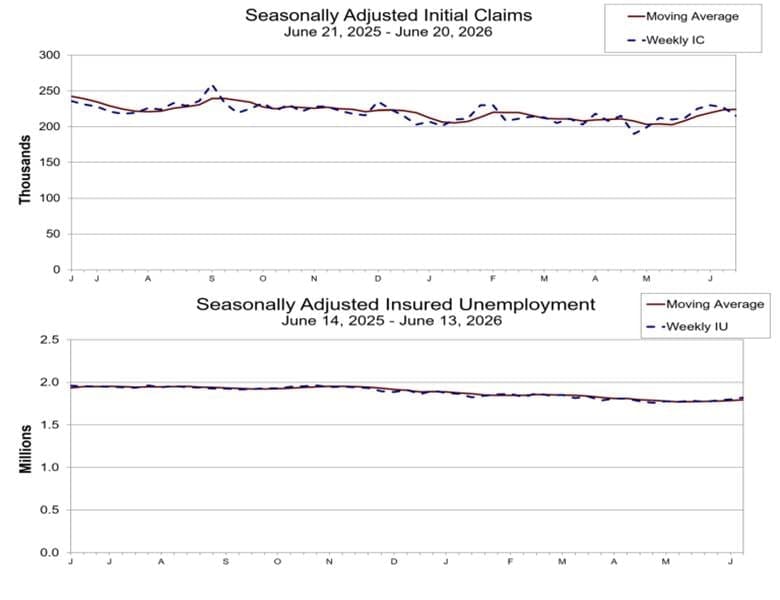
Initial claims fell to 215,000 for the week ending June 20, below the 225,000 economists expected. This alone tells you companies are not suddenly rushing to cut workers.

The softer signal is in continuing claims, which rose to 1.821 million. Low initial claims say layoffs are contained, but higher continuing claims say people who lose jobs may be taking longer to find the next one.

The latest JOLTS data shows that job openings rose to 7.6 million in April, but hires fell to 5.1 million and total separations dropped to 5.0 million. Quits were little changed at 3.0 million, while layoffs and discharges were also little changed at 1.7 million.

Taken together, it’s not a classic “everyone is getting fired” labor market, but it does look more like a frozen one. A low-churn environment where hiring momentum is softening even as headline stability is preserved.

Wages may matter more than the jobs number

The payroll number gets the headline, but wages may decide the market reaction.

In May, average hourly earnings rose 0.3% on the month and 3.4% from a year earlier. Another 0.3% wage print in June would not look shocking on its own. Paired with a strong jobs number, though, it becomes harder for the market to treat labor strength as harmless.

A softer payroll number with cooler wages would do the opposite. It would support the argument that demand is fading and that policy is already restrictive enough. The unemployment rate would then become the tie-breaker. A move up from 4.3% would carry more weight than a small miss on payrolls alone.

What traders should watch on Thursday

The key risk this week is that markets overweight the stability implied by recent revisions. March was revised up 29,000 and April up 64,000, reinforcing the perception that initial prints understate true strength.

A market pricing the initial June print needs the actual release to land soft, not just the eventual, revised reality, and on a year where every revision has added jobs back rather than taken them away, betting heavily against the consensus bracket has a real headwind.

The first number to watch is the headline payroll range. A 100,000 to 150,000 print broadly confirms the market’s base case. A sub-100,000 print makes the slowdown story harder to ignore. A 150,000-plus print puts the “too hot” debate back on the table.

A 4.3% unemployment rate keeps the soft-landing read in place, but that reading depends on the rate staying pinned inside a narrow 4.3%-4.5% band where small shifts change how much slack the market thinks exists. At 4.4%, this stability starts to look less certain, and a drop toward 4.2% would make it harder to argue that hiring is cooling fast enough.

The third number is wages. Payrolls can miss or beat for noisy reasons, especially in summer. Wage growth is harder to shrug off because it feeds directly into the Fed debate.

Revisions also deserve a close read. May looked strong partly because previous months were revised higher. A June miss would sting less with upward revisions. A June beat would look more convincing with another positive revision behind it.

The print won't move the July 28-29 FOMC decision directly, but it's the last full labor read before it, and a soft surprise would revive easing hopes, while a strong payroll-and-wage combination would strengthen the case for higher-rate risk.

Sources:

1.     Barron’s: Additional 93,000 Jobs Added to March and April Totals

2.     BLS: Employment Situation Summary (March)

3.     BLS: Employment Situation Summary (May)

4.     BLS: Job Openings and Labor Turnover Summary

5.     DOL: Unemployment Insurance Weekly Claim

6.     Reuters: Wall St Week Ahead Jobs data, rate bets in focus as US stocks close solid first half

Which data point will matter most for June NFP release?

Payrolls headline number
0.00%
Wage growth
0.00%
Unemployment rate
100.00%
Revisions to prior months
0.00%
1 Polls
Rules & Mandates - Deadly twin quakes are a gut punch to a Venezuelan economy already on its knees
News
GeopoliticsElectionRules & Mandates

Rules & Mandates - Deadly twin quakes are a gut punch to a Venezuelan economy already on its knees

Politics

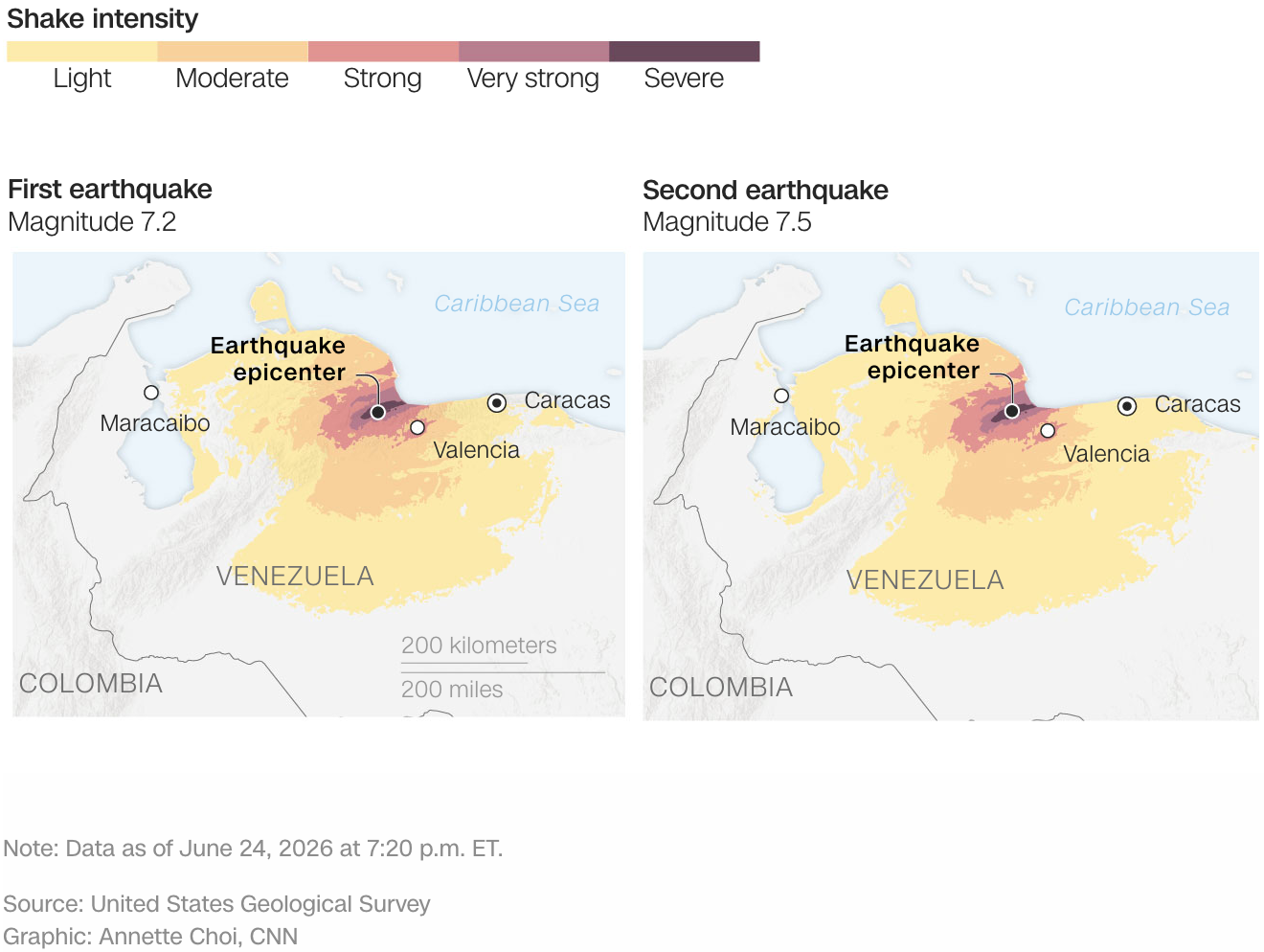
The strongest earthquake hit Venezuela in a century, at the worst possible moment for the country's fragile political transition.

Will U.S. emergency aid strengthen Venezuela’s post-Maduro government?

Yes
75.00%
No
25.00%
4 Polls

June 25(CNN)- the disaster struck while acting President Delcy Rodríguez was trying to cautiously reopen the economy, rebuild ties with foreign oil companies. And seek relief from U.S. sanctions after the January capture of former President Nicolás Maduro. Venezuela had already been weakened by years of hyperinflation, corruption, sanctions, and oil-sector mismanagement. Now, the earthquake has turned an economic recovery story into a test of political survival.

 Early modeling from the U.S. Geological Survey suggests economic losses could reach tens of billions of dollars, and possibly as much as the size of Venezuela’s entire economy.

Venezuela’s state capacity was already thin before the quake. Hospitals, electricity, water systems, fuel supply, medicine access, and basic logistics were all under pressure. A disaster of this scale does not simply damage buildings. It exposes whether a government can coordinate rescue operations, keep public services functioning, prevent shortages from worsening, and convince citizens that the state is still capable of protecting them.

For Rodríguez, the earthquake is a legitimacy test. She has been trying to present as pragmatic, post-Maduro, and capable of restoring Venezuela’s relationship with global markets. Because the ordinary Venezuelans are unlikely to judge the transition by oil contracts or sanctions language alone. They will judge it by whether help arrives, whether hospitals can function, whether food and medicine remain available and whether reconstruction feels real.

For Washington, the quake is also a credibility test. President Donald Trump has claimed that U.S. intervention left Venezuela in better hands and said after the quake that the U.S. is ready to help. Secretary of State Marco Rubio also said the U.S. would deploy search-and-rescue teams, medical resources, and humanitarian assistance.Secretary of State Marco Rubio also said the U.S. would deploy search-and-rescue teams, medical resources, and humanitarian assistance.

Now the question is clear: Will those promises become visible action?

Will promises become visible actions

Yes
66.67%
No
33.33%
3 Polls

If U.S. aid arrives quickly and at scale, it could strengthen Rodríguez’s government and deepen U.S. influence over Venezuela’s recovery.

But if aid is delayed, limited, or seen as self-interested. The disaster could revive anti-U.S. sentiment, strengthen Chavista narratives about foreign control, and make the post-Maduro transition look fragile.

The earthquake is therefore more than a natural disaster. It is the first major governance crisis of Venezuela’s new political order.

Source:

  1. CNN: Deadly twin quakes are a gut punch to a Venezuelan economy already on its knees, June 25, 2026 https://edition.cnn.com/2026/06/25/economy/venezuela-economy-analysis-intl-hnk

Relavent events: